Engineering at the Interfaces: Three Eras From Early Whitepapers to Metered Silicon & Formal Specs

Every historical GitHub research whitepaper (Dec 2025 – Jul 2026) and February 2026 founding essay is preserved verbatim under its original date—paired with dated November 25, 2026 errata and hindsight—alongside 29 November 2026 studies (spanning inline board-shunt measured_j, on-chip counter reported_j, analytical models est_j, Lean 4 formal proofs, and unmetered design specifications), signed and self-checked by OpenIE’s internal gates with public harnesses open for independent external replication.

58 Illustrated Entries Era 0: 20 Dec 2025–Jul 2026 Whitepapers (Verbatim + Addendum) Era I: 9 Feb 2026 Founding Essays (Verbatim + Addendum) Era II: 29 Nov 2026 Studies · Signed Provenance · Self-Checked Glossary & Non-Mixing (⊥) →

// NEW HERE? START IN PLAIN WORDS · READING DEPTH SWITCH

Human Takeaways First — Technical Hashes & Rails Whenever You Want Them

In plain words: A coffee-shop cashier doesn’t re-invent arithmetic from scratch every time someone pays with a $5 bill—they check a simple table. And modern AI is wonderful at tackling unfamiliar questions, but running giant models on repeat wastes 90%+ of energy and invites silent errors—therefore we verify answers once, compile proven routines into tiny fast circuits, and measure real physical joules across all 58 entries below.

// EXTERNAL AUDITABILITY, ERRATA & REPLICATION CALL · NOV 25, 2026

0 External Peer Reviews Yet · Open Replication Standing Invite

Open Call for Independent Replication & 25 Nov 2026 Outside Review Errata

On this blog, “Signed Provenance · Self-Checked” means byte-hashed (BLAKE3), signed (Ed25519), and linted by Open Interface Engineering’s own automated gates—not peer-reviewed or independently confirmed by an outside lab. In response to a thorough 11-page independent outside review on November 25, 2026, we restored verbatim historical whitepapers and essays above dated errata addenda, fixed unit/ratio slips, separated measured & formal engineering from unifying framing essays, disclosed our full AI-tooling workflow and per-repo licensing, and packaged 3 commodity-hardware replication kits. If you rerun any public harness—especially if your numbers disagree with or narrow ours—we will publish your replication outcome verbatim.

Three-Era Intellectual Genealogy (With Explicit Evidence Classes)

How Our Thinking Evolved (Dec 2025 Whitepapers → Feb 2026 Essays → Nov 2026 Self-Checked Studies)

measured_j ⊥ reported_j ⊥ est_j ⊥ unmetered →
15 PDFs Original Archival Whitepaper PDFs (Dec 2025 – Feb 2026, Preserved Unaltered)
Browse & download archival PDFs ↓

Direct downloads of the 15 original typeset PDFs (hosted under their original archival licenses; see licensing table) alongside their verbatim blog transcripts and dated November 25, 2026 errata addenda.

Track:
Category:

Showing 58 of 58 entries

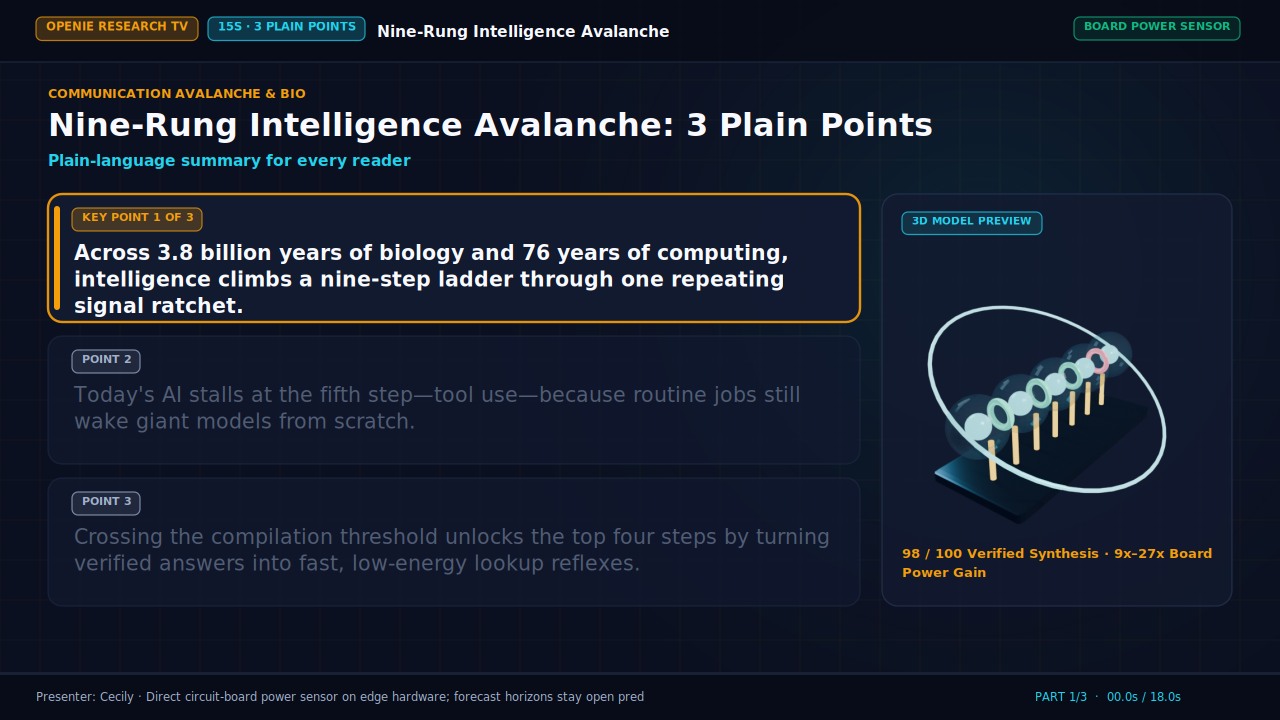
OpenIE Research Position: From Ephemeral Inference to Compiled Agency — 4-stage lookup-first cascade across waiOS, Avalanche, LUT6/LutAdapt, and the Deterministic Null

OpenIE Research Position: From Ephemeral Inference to Compiled Agency

Why advanced computational intelligence should become as ubiquitous and low-energy as spellcheck: treating frontier neural inference as a last resort, enforcing the Deterministic Null control arm, and compiling verified discoveries downward through Avalanche, waiOS, and LUT6 Boolean fabrics.
Technical metadata & provenance ▾ measured_j
Signed Provenance · Self-Checked Unifying Framing & Synthesis research measured_j

Synthesizes Open Interface Engineering's research position (25 Nov 2026) with all 6 of 6 Shots on Goal plus the Oct 23 – Nov 24, 2026 (2–34 days old) 6-Model Open-Weight SOTA Hardware Shunt Panel (openIE-dev/openie-research-experiments @ 6a22dee, 5,111/5,111 CHECKSUMS.sha256; observatory: https://research.openie.dev/living/compiled-agency/, Source Sheet: https://research.openie.dev/sourcesheets/from-ephemeral-inference-to-compiled-agency/, Blueprint v1.0: https://research.openie.dev/blueprint/): intelligence is a hindsight label on reliable low-energy agency; non-AR LiquidAI/d1-2B (/v1/systemone, 0 decoded tokens) is the most energy-efficient neural model (55.53 J measured_j Thor INA3221; 63.73 J reported_j Zen 5 RAPL; 608.50 J gross / 142.51 J net measured_j KV260 INA260) yet burns 15.9M×–185.9M× more joules/correct than classical Shape D (1.40–4.78 µJ); 2-day-old PrismML/Ternary-Bonsai-2.5-27B (Q2_0, 2026-11-24) hits 86.67% on Thor yet burns 1,512.64 J VDD_CPU_SOC_MSS / 2,583.01 J INA238 VIN (3.82× MORE measured_j than 26.4B Looped MoE TML Inkling-2-Mini at 396.27 J) due to ARMv9 scalar ggml_vec_dot_q2_0_q8_0_generic fallback; and multi-teacher C(x,z)=1 crystallization lifts t=2 recall to 91.11%–97.78% at 0.011–0.064 µJ, achieving 96.67% (290/300) @ 13.27 J (29.86× measured_j cut) on Thor, 91.33% @ 25.01 J gross / 5.89 J net (21.6× measured_j cut) on KV260, and 94.33% @ 26.08 J (25.84× reported_j cut) on Zen 5 across a live 300-query Zipf(0.85) stream.

• 24 min read
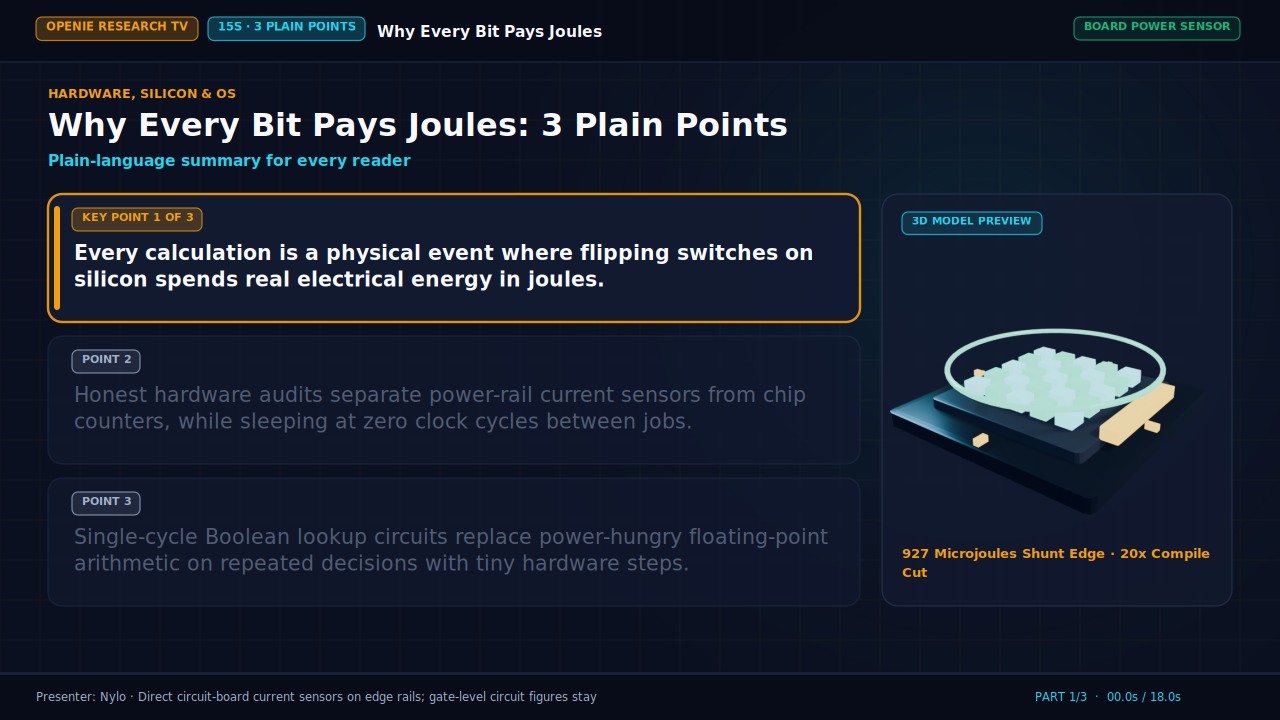
The Communication Tool Avalanche — 927.30 uJ / 50.13 us verify on Thor shunt (measured_j; 23.8–33.1 us on desktop reported_j) · DES-10 98/100 tasks vs <=49/100 solo camps

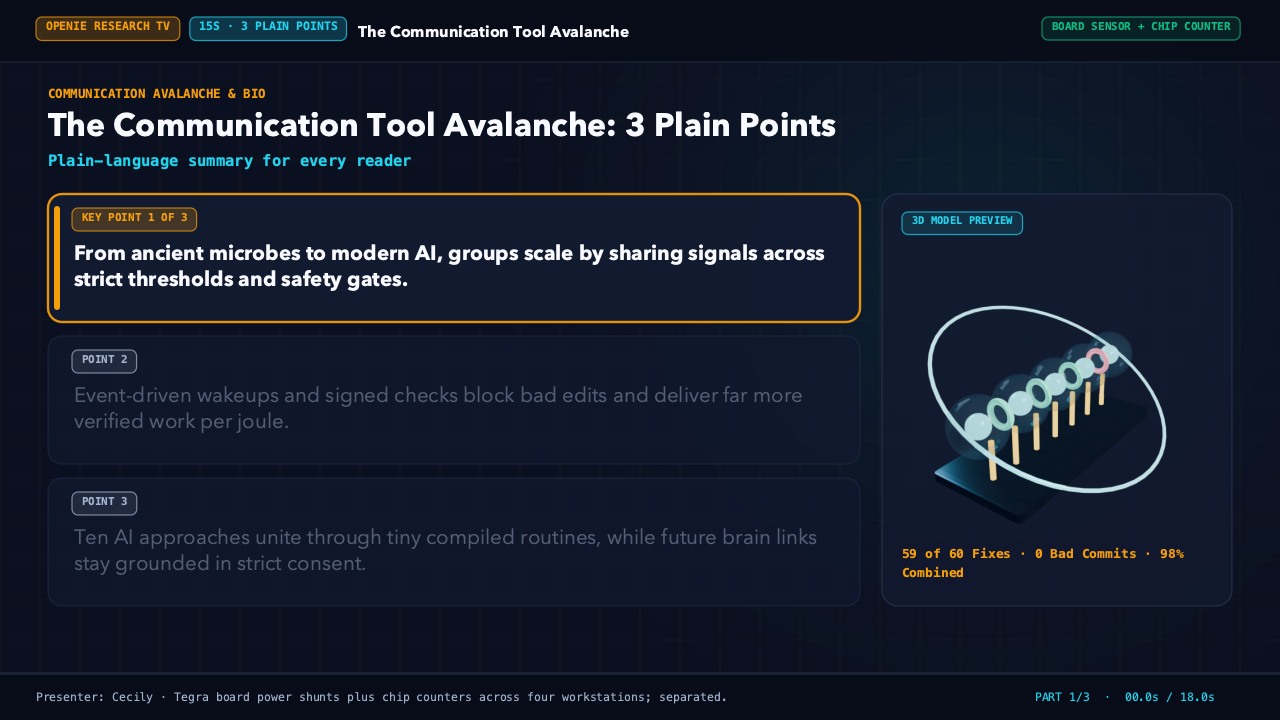
The Communication Tool Avalanche: Cross-Host Shunt vs. Counter Handoff Audit, DES-10 Multi-Paradigm Routing (98/100), and Framing Boundaries

Reconciles 927.30 uJ (Jetson AGX Thor INA3221 measured_j over 50.13 us) vs 23.84-33.12 us workstation latencies (reported_j), defines DES-10 98/100 (1% false commit) vs <=49/100 solo camps, and scopes bio analogies and 45 Lean consent theorems.

Technical metadata & provenance ▾ measured_j
Signed Provenance · Self-Checked Unifying Framing & Synthesis research measured_j

Audits signed binary agent handoffs and multi-paradigm routing with strict host and framing separation: 1 KiB Rust BLAKE3 + Ed25519 verification measured 927.30 uJ over 50.13 us p50 (~18.5 W whole VDD_CPU_SOC_MSS domain, TI INA3221 measured_j; 75,374x lower energy than NL prose relays) on NVIDIA Jetson AGX Thor versus 23.84–33.12 us (90.81–642.38 uJ reported_j) on faster desktop CPUs; on the 100-task 5-regime CTA-E5 suite, routed 10-paradigm DES-10 solved 98/100 tasks (with 1/100 false commit) vs <=49/100 for any isolated paradigm C1–C10; the 3.8 Ga bio-to-AI rung map is labeled ex-post interpretive framing and the 45 Lean 4.36.0 theorems verify an abstract state-machine consent model, NOT human-brain clinical/hardware safety.

• 8 min read
Nine-Rung Study Guide (avalanche.openie.dev) — Educational Synthesis Portal (avalanche.openie.dev) · DES-10 98/100 tasks (1/100 false commit) vs <=49/100 solo camps (Thor INA3221 measured_j)

The Nine-Rung Study Guide (avalanche.openie.dev): Ex-Post Biological Framing vs. Falsifiable Multi-Paradigm Benchmarks

Presents avalanche.openie.dev as an educational synthesis portal: labels the 3.8 Ga bio-to-AI rung ladder as ex-post interpretive framing, clarifies abstract Lean consent theorems, and keeps Thor 927.30 uJ (50.13 us) separate from workstation 23.8-29.5 us latencies.

Technical metadata & provenance ▾ measured_j
Signed Provenance · Self-Checked Unifying Framing & Synthesis research measured_j

Presents avalanche.openie.dev (openIE-dev/avalanche-openie-web) as an educational study guide summarizing the 9-rung compilation-threshold thesis: explicitly labels the biological-to-AI rung mapping as an ex-post pedagogical framing (not a predictive biological law), clarifies that the 45 CTA Lean 4.36.0 theorems verify an abstract state-machine consent predicate rather than human-brain clinical/hardware safety, and keeps Jetson AGX Thor physical shunt readings (927.30 uJ over 50.13 us, measured_j; 98/100 DES-10 vs <=49/100 isolated camps at 9.26x–26.87x CpJ) strictly separated from workstation reported_j latencies (23.84–29.54 us).

• 5 min read
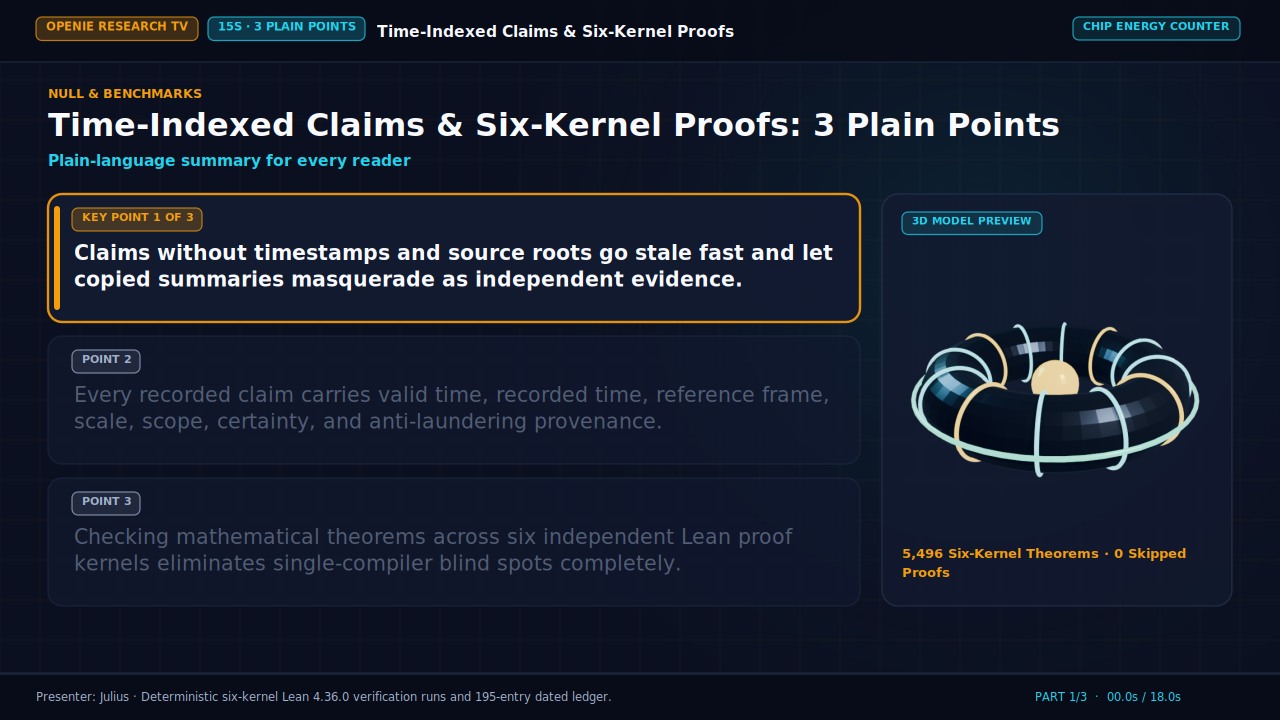
Seven-Axis Knowledge Schema & Proof Audit — Unmetered 7-axis claim schema (knowledge.openie.dev) · 1,422 6-kernel Lean declarations audited (with 12 open draft-0.9 theorems in RCE)

The Knowledge Claim Schema (knowledge.openie.dev): Seven Epistemic Axes, Bitemporal Lineage, and Corrected Six-Kernel Proof Counts

Defines knowledge.openie.dev’s unmetered 7-axis claim schema (valid/transaction/reference time, granularity, scope, certainty, provenance) and corrects cross-repo Lean proof counts (132 6-kernel theorems + 5,393 RCE constants alongside 12 open RCE draft theorems).

Technical metadata & provenance ▾ unmetered

Defines a structured knowledge claim on knowledge.openie.dev as an unmetered 7-axis tuple ⟨V_t, T_t, R_t, G, S, C, P⟩ (valid time, transaction time, reference time, granularity, scope, calibrated certainty, provenance), while correcting the fleet Lean 4.36.0 proof summary to separate source theorem declarations (1,422 across 4 suites in bwrap 6-kernel lake check --paranoid; 5,393 elaborated RCE constants) from the 12 unproved draft-0.9 theorem statements in openIE-dev/rce.

• 5 min read
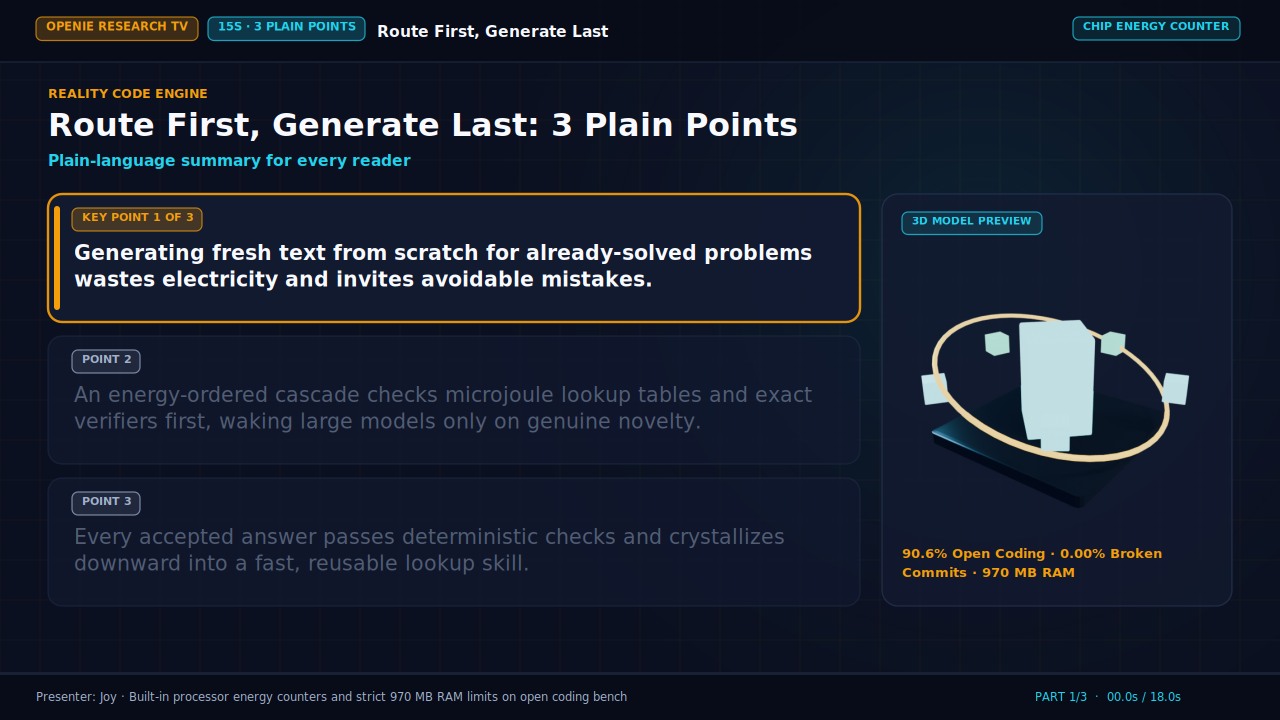
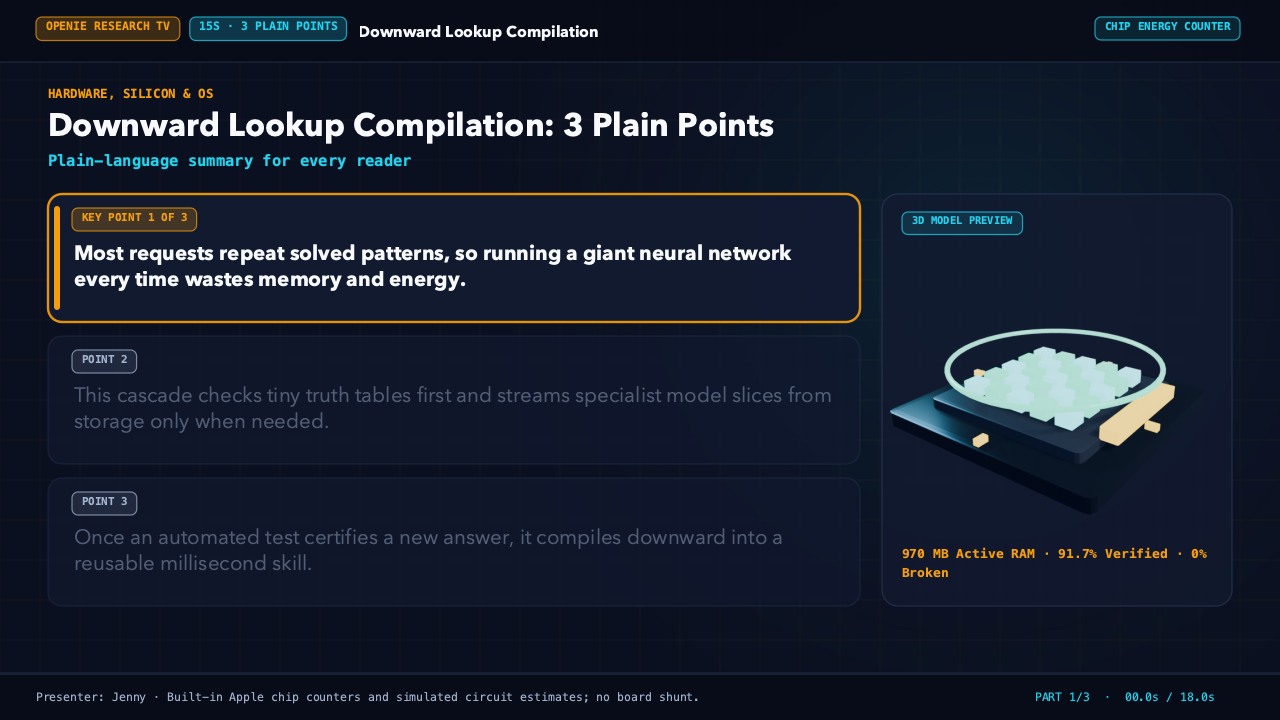
Synthesis Stack & Pattern-lang Scope — 7-axis synthesis taxonomy (synthesis.openie.dev) · 29/32 (90.6%) BigCodeBench slice & 970 MB AirMoL stream (M5 Max reported_j) · Pattern-lang BSL-1.1

The Synthesis Stack (synthesis.openie.dev): 7-Axis AI Taxonomy, 29/32 BigCodeBench Slice Scope, and Pattern-lang BSL-1.1 Status

Frames synthesis.openie.dev’s 7-axis taxonomy, qualifies 90.6% (29/32 BigCodeBench slice, 95% UB <= 10.9% on 0/32 broken commits, 970 MB AirMoL RAM in lut-adapt), and discloses Pattern-lang is BSL-1.1 source-restricted.

Technical metadata & provenance ▾ reported_j
Signed Provenance · Self-Checked Unifying Framing & Synthesis engineering reported_j

Maps AI systems ("AI is software") onto a 7-axis taxonomy on synthesis.openie.dev while grounding its three headline numbers in lut-adapt-ai (Apache-2.0): 29/32 (90.62%) pass rate on a 32-task BigCodeBench v0.1.3 slice behind a unit-test gate (0/32 broken commits admitted -> 95% Clopper-Pearson upper bound <= 10.89% on N = 32, NOT universal zero risk) and 970 MB peak RAM streaming 34.66B Qwen3.6-35B-A3B via AirMoL (Apple M5 Max reported_j), and explicitly disclosing that companion Pattern-lang (openIE-dev/pattern-lang) is BSL-1.1 source-restricted.

• 5 min read
Compute Stack Taxonomy & KV260 Shunt Scope — 258-primitive taxonomy (compute.openie.dev) · anchored by 11.43 nJ/cycle KV260 whole-SOM INA260 shunt (measured_j; 98 pJ seed delta inconclusive)

The Compute Stack (compute.openie.dev): 258-Primitive Taxonomy, KV260 Whole-SOM INA260 Scope (11.43 nJ), and Toolchain Status

Maps 258 computational primitives across 33 families on compute.openie.dev, qualifying the 11.43 nJ KV260 whole-SOM INA260 reading (and inconclusive 98 pJ seed delta) from gates.md and separating Thor shunt vs Zen 5 RAPL figures.

Technical metadata & provenance ▾ measured_j
Signed Provenance · Self-Checked Unifying Framing & Synthesis energy measured_j

Presents compute.openie.dev as a 258-primitive, 33-family computational taxonomy paired with specific companion hardware anchors: 11,428 pJ/cycle (11.43 nJ, SE = 129 pJ across N = 4 interleaved 25 s passes at 25 MHz) whole-SOM TI INA260 power-slope average on AMD Kria KV260 (with an inconclusive 98 pJ seed delta near the 1.25 mA INA260 step, measured_j in gates.md) and 162.56 nJ/op LUT6 / 927.30 uJ verify shunts on Jetson AGX Thor (measured_j), while noting that JLandauer CLI tooling on compute.openie.dev is not yet released as a public open-source repo.

• 5 min read
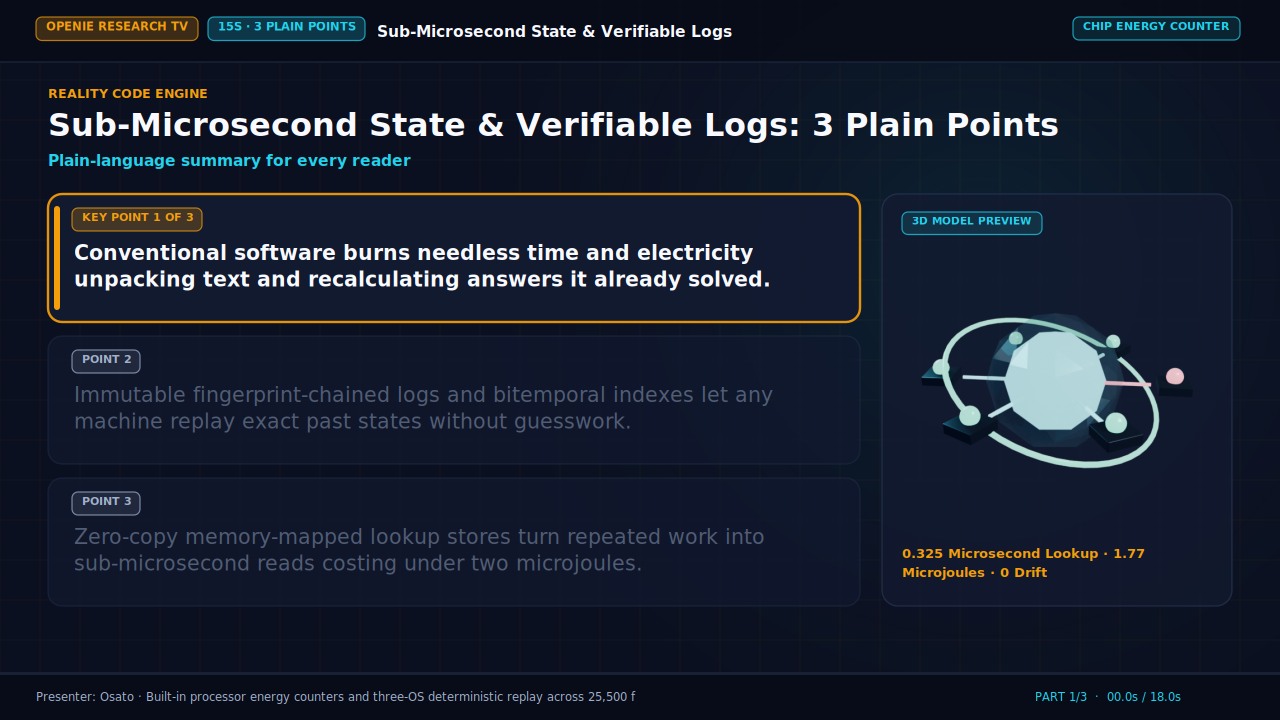
Data Systems Stack & JouleDB Scope — 10-axis taxonomy (1,260,000 cells, unmetered) · 0.325 us / 1.77 uJ DNULLMM1 34-record mmap probe (M5 Max reported_j) · JouleDB core BSL-1.1/private

The Data Systems Stack (data.openie.dev): 10-Axis Coordinate Taxonomy (1.26M Cells), DNULLMM1 mmap Scope, and Honest JouleDB BSL-1.1 Status

Separates data.openie.dev’s unmetered 10-axis taxonomy (1,260,000 cells + illustrative canvas) from DNULLMM1’s 34-record mmap lookup (0.325 us / 1.77 uJ reported_j) and discloses that JouleDB is BSL-1.1 with private core source and zero DuckDB/ClickHouse benchmarks here.

Technical metadata & provenance ▾ reported_j
Signed Provenance · Self-Checked Unifying Framing & Synthesis engineering reported_j

Clarifies three distinct artifacts previously conflated under eco-database: (1) data.openie.dev defines an unmetered 10-axis data-system taxonomy (5·12·4·7·5·7·5·4·6·5 = 1,260,000 discrete cells) with an illustrative HTML5 impedance visualizer; (2) the 0.325 us / 1.771 uJ reading (Apple M5 Max L3 reported_j) comes from POSIX mmap lookups over a static 34-record DNULLMM1 store in rce-jepa—NOT a full transactional/analytical DBMS; and (3) JouleDB (openIE-dev/jouledb) is licensed under BSL-1.1 with its core storage engine in a private internal mirror (crates.io ships an installer stub) and was not benchmarked head-to-head against DuckDB, ClickHouse, or PostgreSQL here.

• 5 min read
OpenIE Stack Conceptual Map (Unmetered) — Unmetered Conceptual Map (stack.openie.dev) · 3 Foundational Theories × 8 Domain Taxonomies (joules = null, [M]/[S])

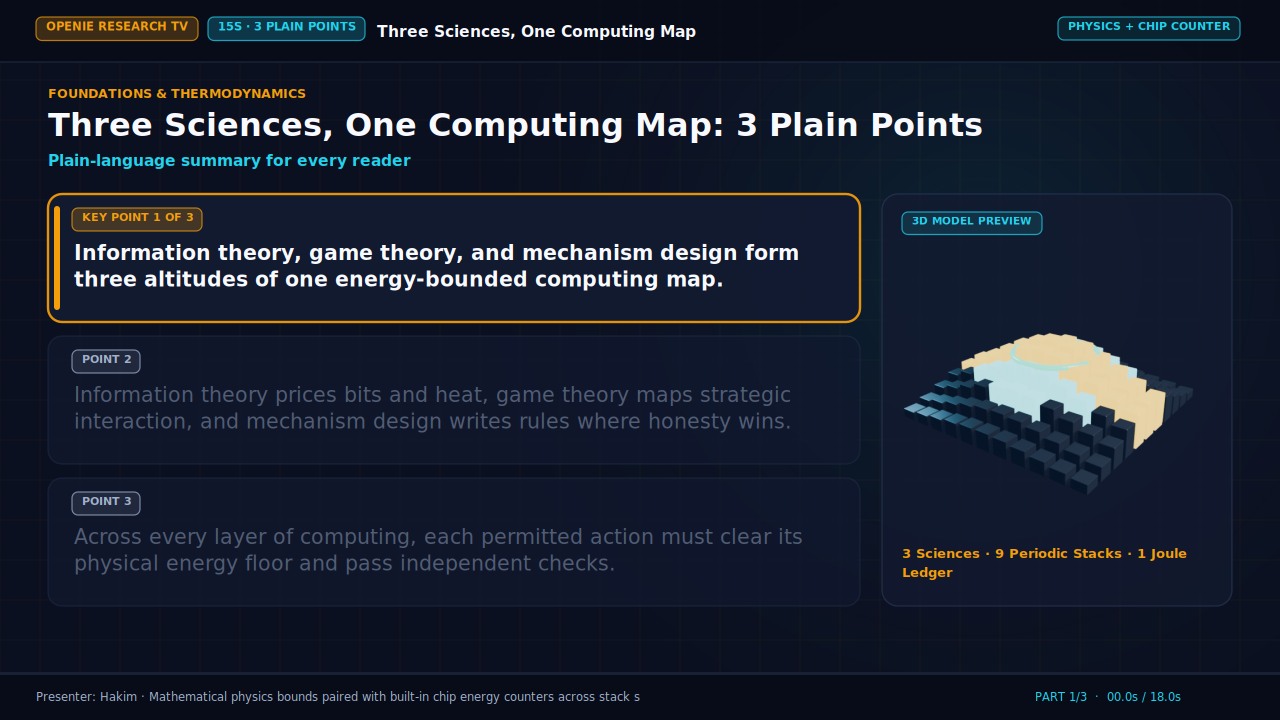
The OpenIE Stack Map (stack.openie.dev): An Unmetered Conceptual Taxonomy Across Information Theory, Game Theory, and Mechanism Design

Clarifies that stack.openie.dev is an unmetered teaching map relating Information Theory, Game Theory, and Mechanism Design across 8 domain stacks—containing zero standalone hardware benchmarks.

Technical metadata & provenance ▾ unmetered
Signed Provenance · Self-Checked Unifying Framing & Synthesis research unmetered

Presents stack.openie.dev strictly as an unmetered conceptual and pedagogical overview ("Three names, one substrate": Information Theory, Game Theory, and Mechanism Design) indexing OpenIE’s eight domain coordinate taxonomies, with zero standalone hardware measurements or formal theorems of its own (unmetered; underlying stack repos span Apache-2.0, BSL-1.1, and private trees).

• 5 min read
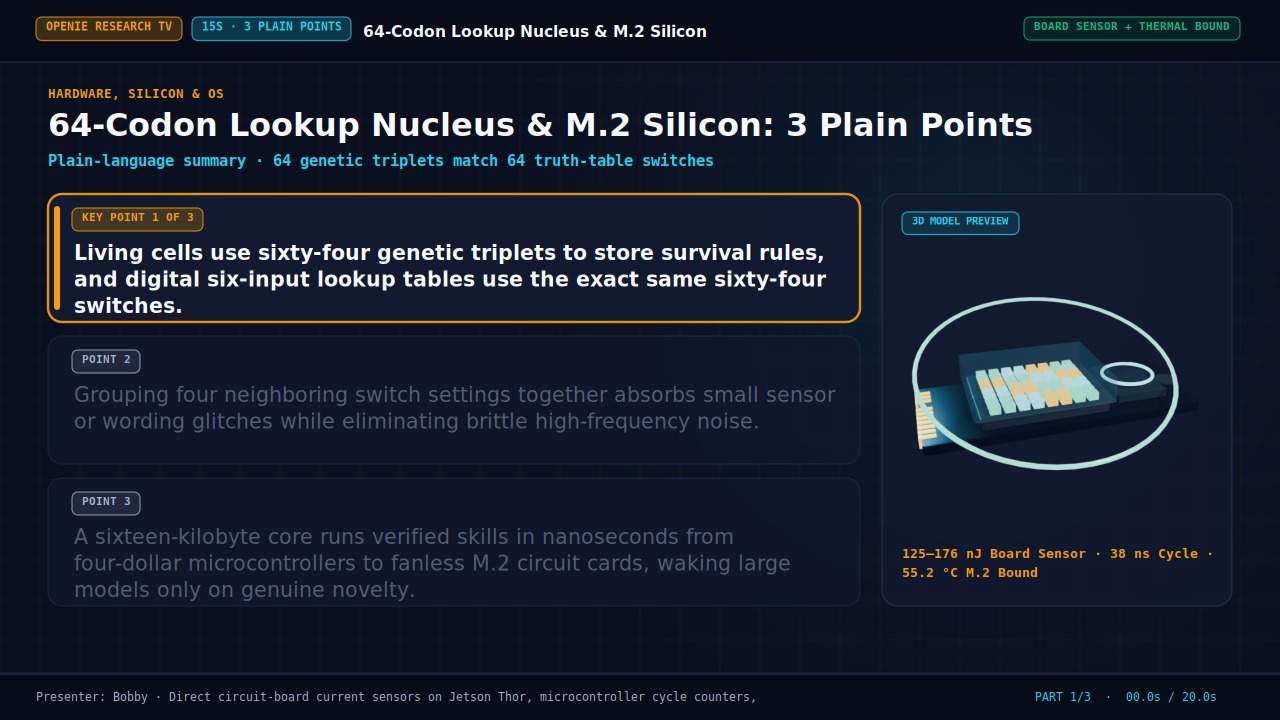
4 KB LUT6 Nucleus & M.2 FPGA Port — 162.56 nJ/op bit-sliced & 1,935 nJ scalar LUT6 (Thor INA3221 measured_j) · 0.86 est_W / 55.2 est_C M.2 XC7A200T (est_j; 64=64 is naming motivation only)

The 4 KB LUT6 Page & 16 KB Nucleus: Counting-Parallel Motivation (2^6 = 4^3 = 64), Walsh-Hadamard Filtering, and M.2 Thermal Bounds

States upfront that 2^6 = 64 (LUT6 bits) and 4^3 = 64 (RNA codons) is a naming counting parallel—not a biological isomorphism—and separates Thor INA3221 measured_j, Cortex-M55 DWT cycles, and Artix-7 XC7A200T est_W/est_C.

Technical metadata & provenance ▾ measured_j
Signed Provenance · Self-Checked Measured/Empirical Engineering energy measured_j

Packs 256 six-input LUT6 gates plus a 672 B zero-MUL ternary T-MAC tail into a 4,096 B #![no_std] Rust CompactLut6Page (16 KB 4-page Nucleus), stating upfront that 2^6 = 64 and 4^3 = 64 is a combinatorial counting parallel used for naming—NOT a biophysical isomorphism; hardware tests separate Jetson AGX Thor TI INA3221 shunt readings (162.56 nJ/op bit-sliced, 1,935.05 nJ scalar, measured_j), live Alif Cortex-M55 DWT cycles (684.6 cycles scalar, 2.68 bit-sliced), and Numato Aller A7 XC7A200T analytical gateware estimates (0.86 est_W, 55.2 est_C with DDR3 off vs 95.8 est_C bare with DDR3 on, est_j).

• 7 min read
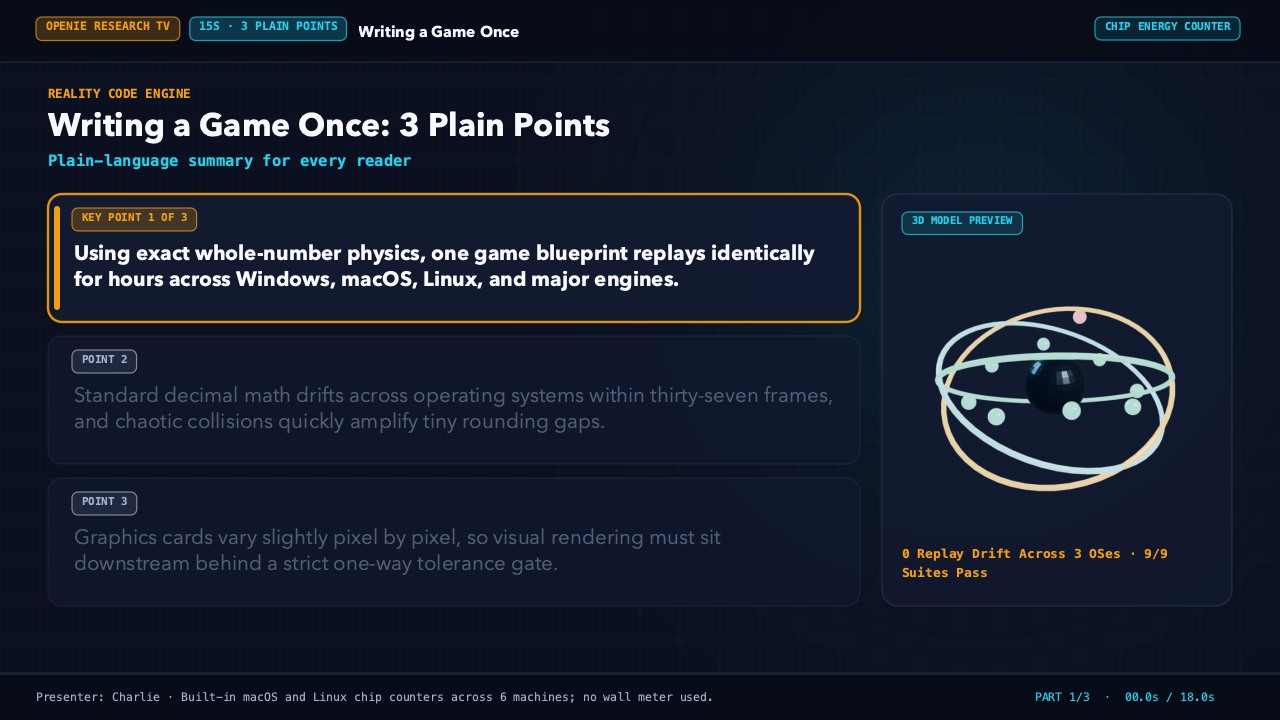
Deterministic Simulation Steps (RCE Game Loop) — 1.694 mJ/tick C++20 -O3 vs. 13,090.6 mJ/tick boxed Python = 7,728x (Core i9 RAPL reported_j, 10k Q32.32 actors; measured_j = null)

Deterministic Cross-Platform Simulation Steps: Reconciling 1.69 mJ/Tick and the 7,728x Python-vs-C++20 Ratio

Verifies bit-identical 100,000-tick Q32.32 integer state steps across 8 languages and 4 CPU architectures, clarifying that 1.694 mJ/tick and 7,728x are Linux RAPL reported_j comparing C++20 -O3 against interpreted rce emit python (not Unity/Godot).

Technical metadata & provenance ▾ reported_j
Signed Provenance · Self-Checked Measured/Empirical Engineering engineering reported_j

Across 8 emitted target languages and 4 CPU/OS architectures (32 cells, 100,000 ticks), Q32.32 fixed-point RCE state machines produced 0 digest mismatches; on Intel Core i9-13900H Linux RAPL socket counters (reported_j; measured_j = null, no external meter), stepping 10,000 actors cost 1.694 mJ/tick in clang++ -O3 C++20 (2.211 mJ Wasm32, 3.673 mJ Rust -O3) versus 13,090.57 mJ/tick in interpreted rce emit python (CPython 3.14)—a 7,728x ratio against boxed Python, NOT against native Unity, Unreal, or Godot C++.

• 6 min read
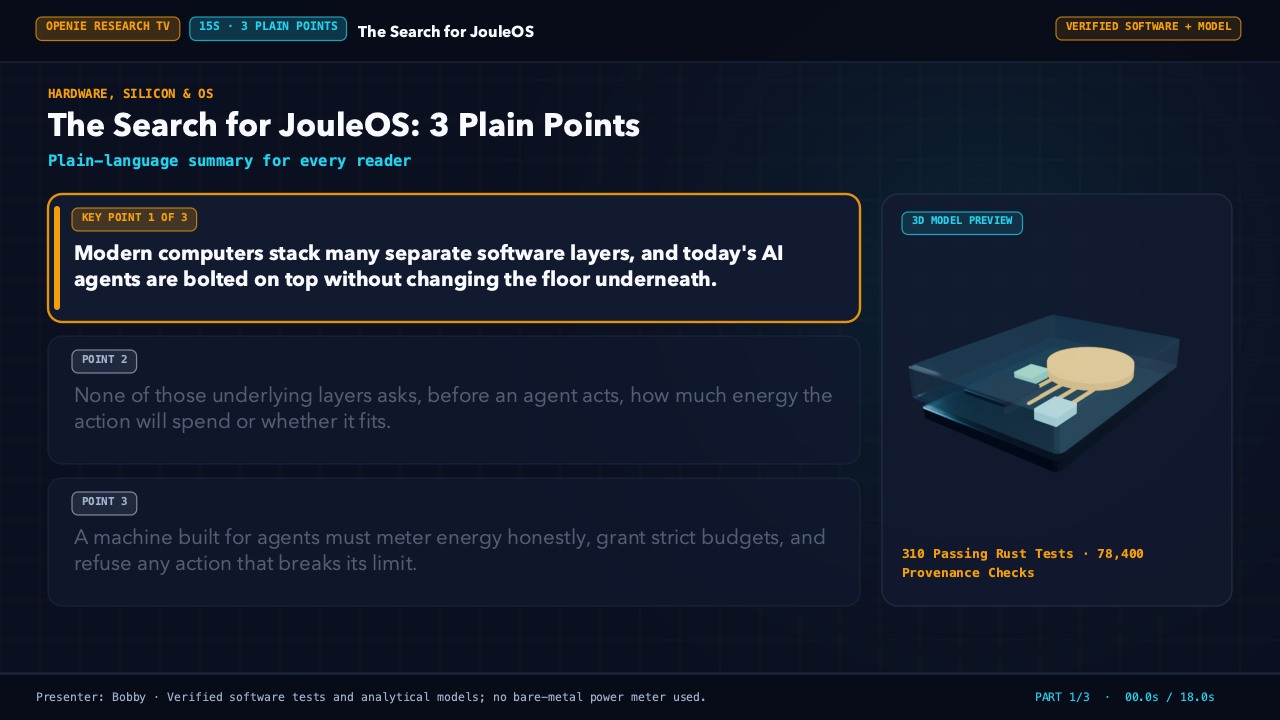
JouleOS Design Proposal (Unmetered) — Design Proposal & Architecture Specification (unmetered, joules = null) · 78,400 = 280×280 Rust provenance-lattice pair checks

JouleOS: An Unmetered Operating-System Design Proposal, Provenance-Lattice Checks (78,400 Pairs), and Prior Energy-OS Lineage

Explicitly scopes JouleOS as an unmetered architectural proposal (core OS repo private; ~10^5x README figure unverified), clarifies 78,400 = 280 x 280 provenance-lattice monotonicity checks, and cites ECOSystem, Cinder, Linux EAS, and RAPL.

Technical metadata & provenance ▾ unmetered

Reviews JouleOS strictly as an unmetered operating-system design proposal (joules = null; core OS repository is private and its internal ~10^5x README ratio is an unverified claim, not a measurement), clarifies that 78,400 refers to 280 × 280 exhaustive provenance-lattice monotonicity state-pair checks in the companion jcp-satb-cad-spine Rust crate suite (310 unit tests, 0 silent promotions), and situates the design directly within Linux EAS, cpufreq/schedutil, powercap RAPL, ECOSystem (2002), and Cinder (2011).

• 5 min read
LUT-Adapt & Mixture-of-Limits Cascade — 87.25x–222.57x Thor INA3221 shunt CpJ on LUT6/wearable ops (measured_j) · 91.67% (44/48) Qwen3.6-35B & 62.50% (10/16) 24B+120B gated coding (reported_j)

LUT-Adapt & Mixture-of-Limits: Separating Thor DC Shunt Readings from Workstation Chip Counters Across Coding & Wearable Cascades

Separates Jetson AGX Thor TI INA3221/INA238 physical DC shunts (measured_j) from workstation chip counters (reported_j), Cortex-M55 DWT cycles, and FPGA VCD est_j, tying 91.67% (44/48) and 62.50% (10/16) to exact model/gate arms.

Technical metadata & provenance ▾ measured_j
Signed Provenance · Self-Checked Measured/Empirical Engineering engineering measured_j

In openIE-dev/lut-adapt-ai (Apache-2.0, commit dc45357), physical TI INA3221/INA238 DC shunts on NVIDIA Jetson AGX Thor (measured_j, board_metered = true) measured 162.56–162.71 nJ/op (87.00x–87.25x CpJ vs INT8 Micro-MLP) for bit-sliced 80 six-input (6-bit, 64-entry) LUT6 truth tables and 222.57x lower energy on a 56-bit 4-token wearable epistemic gate; on workstation counters (reported_j, board_metered = false), MoL + Qwen3.6-35B-A3B (<think> + unittest gate) reached 91.67% (44/48) on the 48-task coding bakeoff and MoL + Devstral-24B + Nemotron-120B-A12B reached 62.50% (10/16) on hard adversarial tasks.

• 8 min read
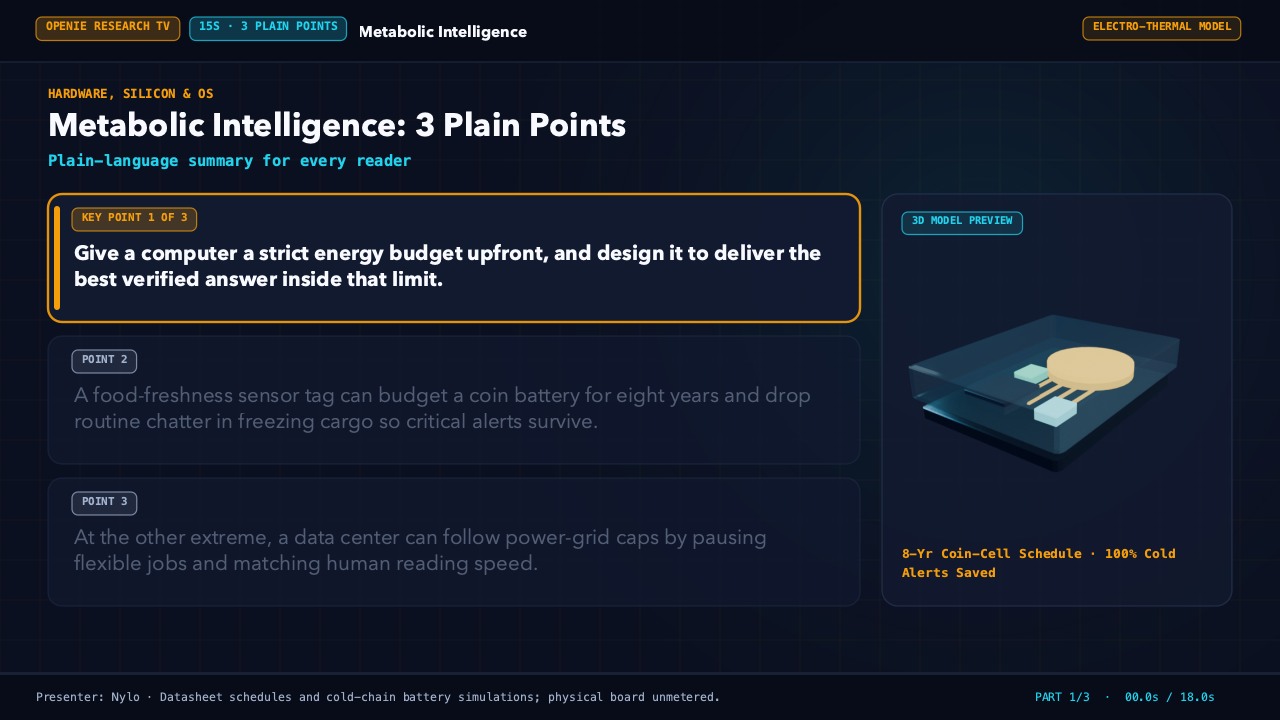
MEI Coin-Cell Cold-Chain Simulation — 40/40 safety alerts preserved & 490/500 routine beacons refused in -20 °C simulation (2,680 JCR-1 receipts across 3 temps, est_j)

Minimum Energy Intelligence (MEI): 8-Year Coin-Cell Budget Math, -20 °C Brownout Simulation, and All Five Event Counts

Product/CAD simulation audit (est_j, 0 physical tags cycled): shows exact 8-yr 10 uW = 2.52 kJ vs CR2032 ~2.38 kJ cold-derated capacity math and reconciles 10,000 wakeups, 500 beacons, 490 refusals, 40/40 cold alerts, and 2,680 JCR-1 receipts.

Technical metadata & provenance ▾ est_j

In datasheet-calibrated CAD/SPICE-style discrete simulation (est_j, board_metered = false; zero physical tags fabricated), continuous 10 uW draw over 8 years requires 2,524.6 J (~2.52 kJ), exceeding a cold-derated 3 V 220 mAh CR2032 (~2,376 J nominal, 2,059 J at +4 °C, 0 J unbuffered at -20 °C where R_int hits 71.78 ohm) unless sleep drops below ~5 uW or a larger CR2477/Li-SOCl2 cell + buffer cap is used; across 10,000 simulated wakeups at -20 °C (500 routine beacons + 40 excursion alerts), two-phase hold/settle grant sharding refused 490 routine beacons to preserve 40/40 alerts, emitting 2,680 Ed25519 JCR-1 receipts across +25/+4/-20 °C.

• 7 min read
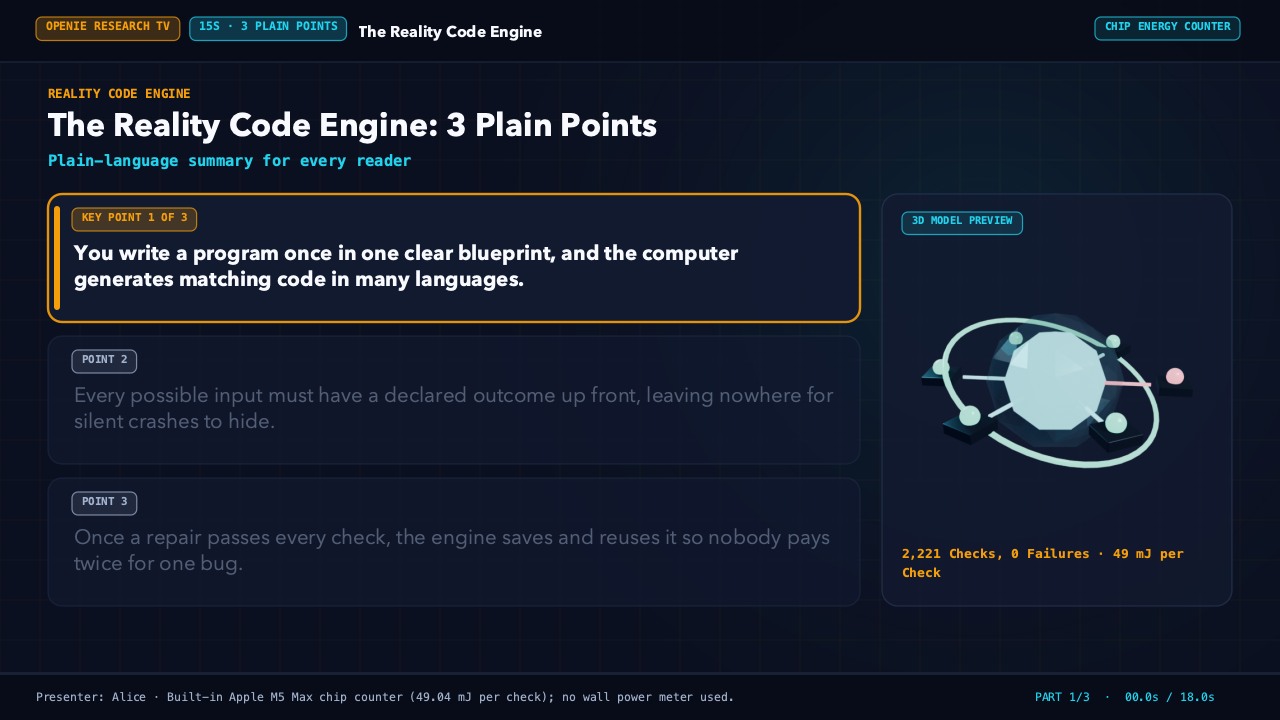
Reality Code Engine (RCE) — 49.04 mJ/Form check & 15.44 J across 62 Forms (M5 Max reported_j) · 2,221/2,236 conformance passes · 12 draft-0.9 theorems open

The Reality Code Engine (RCE): Total State-Machine Specification, 49 mJ Single-Form Checks vs. 15.44 J Suite Scope, and Open Draft Theorems

Specifies RCE Draft 0.9 at openIE-dev/rce (f87d6af2): reconciles 49.04 mJ single-Form check vs 15.44 J 62-Form suite and 2,221/2,236 conformance clauses, and discloses 12 unproved draft-0.9 theorems alongside 97 completed Lean files.

Technical metadata & provenance ▾ reported_j

In openIE-dev/rce (Apache-2.0, commit f87d6af2), external Apple M5 Max L3 counters recorded 49.04 mJ (7.32 ms, reported_j) for a single Form check and 15.44 J (2.32 s) across the full 62-Form check/run/emit suite while 2,221/2,236 normative conformance checks passed (0 failures, 15 reserved); 97 completed Lean 4.36.0 files pass 6/6 kernels with 0 sorry (1,264 source declarations / 5,393 constants), alongside 12 unproved draft-0.9 theorem statements in Appendix F.9.

• 7 min read
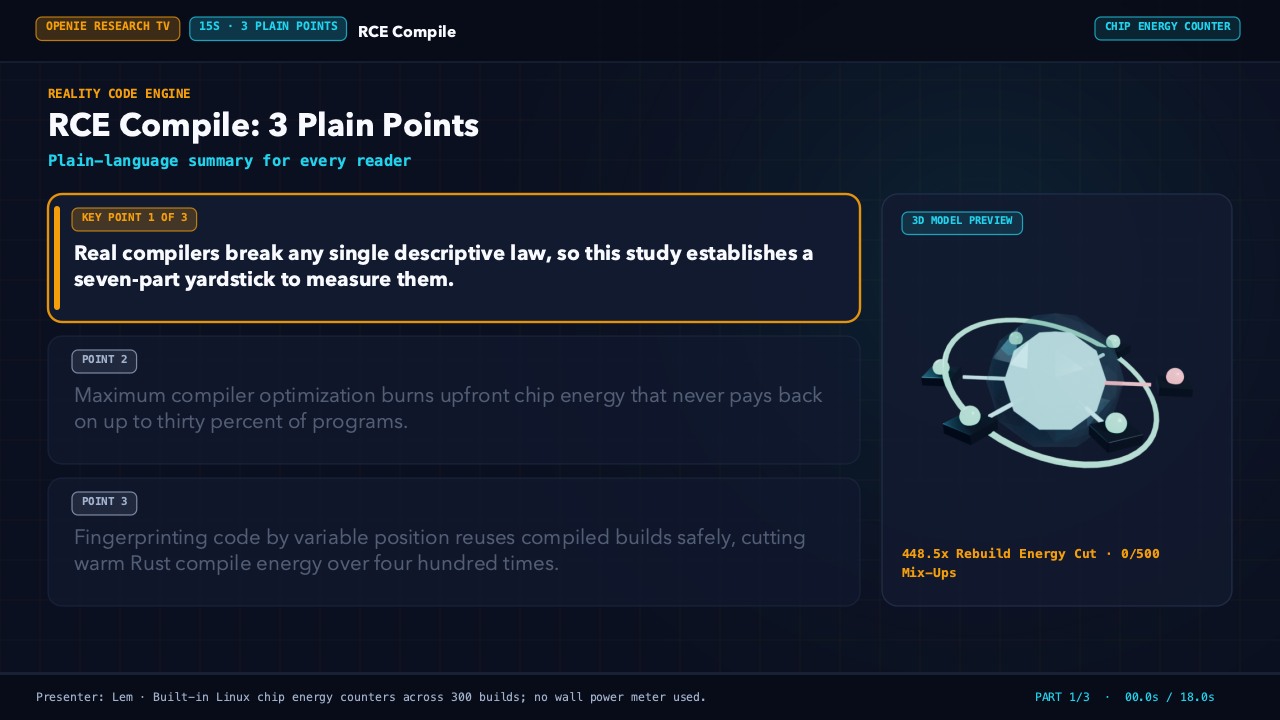
RCE Compile Normal-Form & Cache Audit — Up to 448.5x best-case warm-cache rebuild cut · 20.07x (Zen 5) & 15.44x (Core i9) prelude compile cut (Linux RAPL reported_j)

RCE Compile: A Proposed 7-Part Compiler Normal-Form Contract, Per-Machine Prelude Cuts, and De Bruijn Warm-Cache Bounds

Refutes a descriptive "Law of Compilation" in favor of a proposed 7-part contract, separating Zen 5 (20.07x) vs Core i9 (15.44x) prelude cuts and up to 448.5x best-case warm De Bruijn cache hits (Linux RAPL reported_j).

Technical metadata & provenance ▾ reported_j
Signed Provenance · Self-Checked Measured/Empirical Engineering engineering reported_j

Refutes the existence of a descriptive "Law of Compilation" across shipping compilers and restates it as a proposed 7-part normal-form contract; factoring librce_rt.rlib cuts cold per-kernel rustc -O3 compile core reported_j by 20.07x on AMD Ryzen AI Max+ 395 (Zen 5) and 15.44x on an idle dedicated Intel Core i9-13900H, while a De Bruijn positional source cache (crediting de Bruijn 1972) achieves 0/500 mutant collisions and up to 448.5x best-case warm-cache rebuild energy reduction on alpha-renamed single-file kernels (Linux RAPL reported_j).

• 7 min read
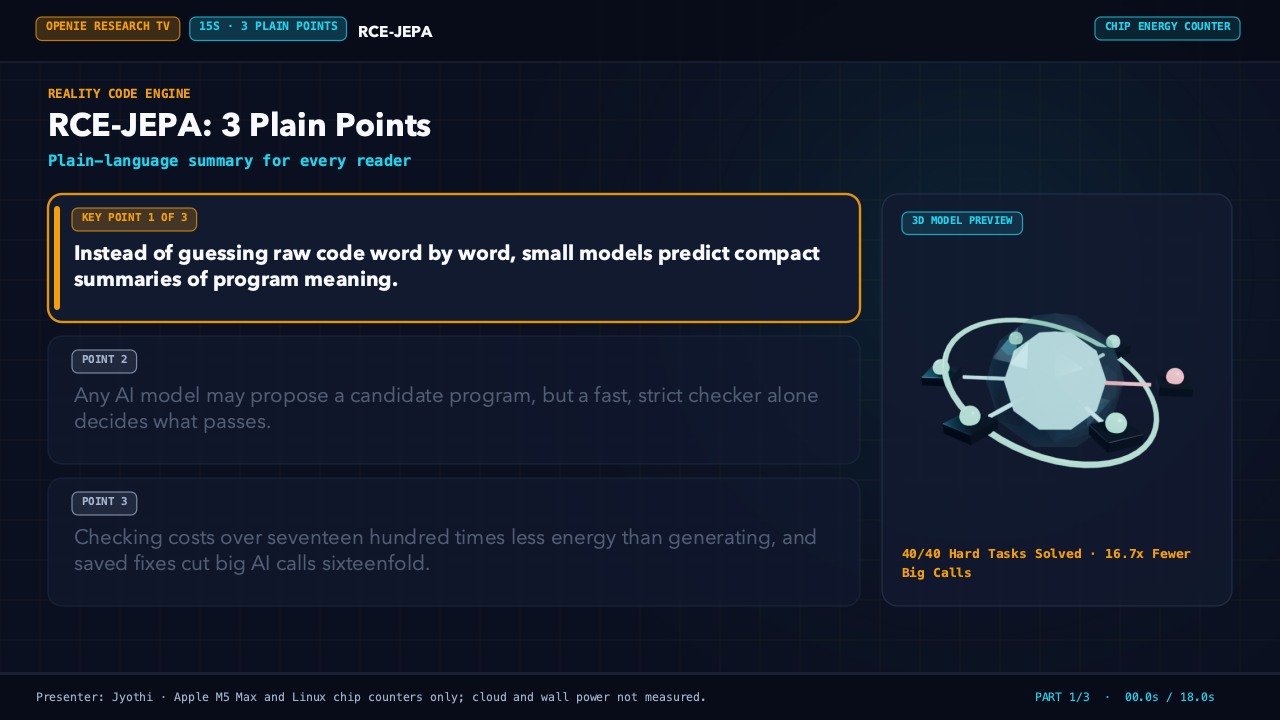
RCE-JEPA Latent Repair & Residual Cascade — 111/151 deterministic + 27/40 FormJEPA-v1 (8.4M) + 40/40 5-turn H15-Iterative · OOD EBM AUROC 0.5278 (Zen 5 / M5 Max reported_j)

RCE-JEPA: Latent Form Repair Proposers, Energy Scorers (FormEBM-v3), and 40/40 Bounded Residual Closure

Evaluates deterministic rce repair (111/151 zero-call closes), FormJEPA-v1 (8.42M), FormEBM-v2/v3 (0.9437 unseen H5 AUROC, 0.5278 OOD H15), and bounded 5-turn H15-Iterative closure (40/40 on Opus/Sonnet 5.5, reported_j).

Technical metadata & provenance ▾ reported_j
Signed Provenance · Self-Checked Measured/Empirical Engineering research reported_j

On the 151-task RCE repair ladder (openIE-dev/rce@1762fb4b), deterministic rungs a..e closed 111/151 (73.5%) at 0 model calls, an 8.42M-parameter latent proposer (FormJEPA-v1, 58.65–474.76 mJ Zen 5 RAPL core reported_j) closed 27/40 residual tasks at k = 16, FormEBM-v3 reached 0.9437 AUROC on 200 unseen synthetic beams while plateauing at 0.5278 zero-shot cross-task AUROC on multi-module git-history rewrites, and <=5-turn checker-feedback H15-Iterative closed 40/40 on Claude Opus 5.5 and Sonnet 5.5 (0 contradictions).

• 7 min read
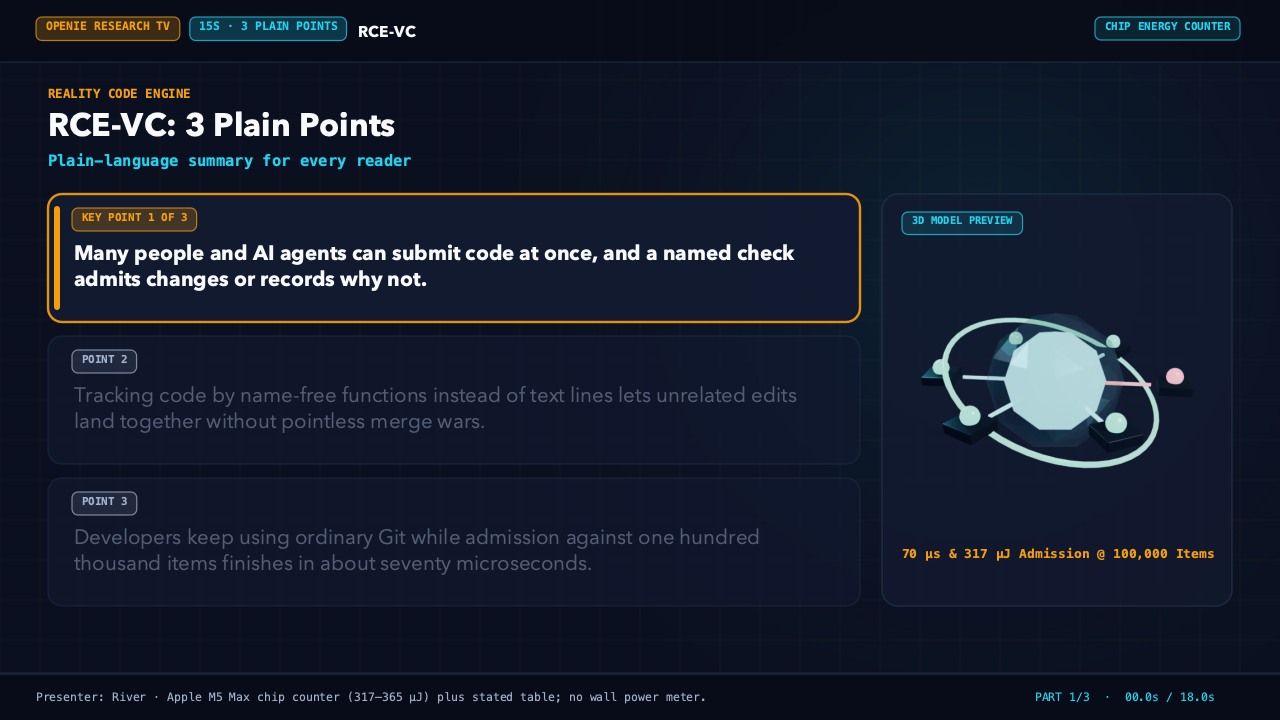
RCE-VC Structural Admission Prototype — 317–365 uJ/unit admission at 100k units (M5 Max L3 reported_j) · v0.1.0 prototype (external git merge-ort corpus not yet benchmarked)

RCE-VC: A Proposed Structural Version-Control Prototype, Rename Behavior, Key Collisions, and Git Comparison Scope

Presents openIE-dev/rce-vc (v0.1.0, 49 offline tests) as a proposed structural VCS prototype (317-365 uJ/unit M5 Max reported_j), disclosing structural key collisions on identical bodies and zero external merge-benchmark runs vs git merge-ort.

Technical metadata & provenance ▾ reported_j
Signed Provenance · Self-Checked Measured/Empirical Engineering engineering reported_j

Presents openIE-dev/rce-vc (Apache-2.0, commit aba99fce, 49 offline Rust tests) as a proposed unit-level repository admission contract and v0.1.0 prototype admitting single edits into a 100,000-unit persistent trie in 69.7–73.6 us and 317.2–365.4 uJ (Apple M5 Max L3 reported_j), while explicitly disclosing name-free structural key collisions on identical function bodies (e.g., f(x,y)=x+y vs g(a,b)=a+b) and noting that head-to-head conflict replay against git merge-ort, GumTree, or Mergiraf remains unrun.

• 6 min read
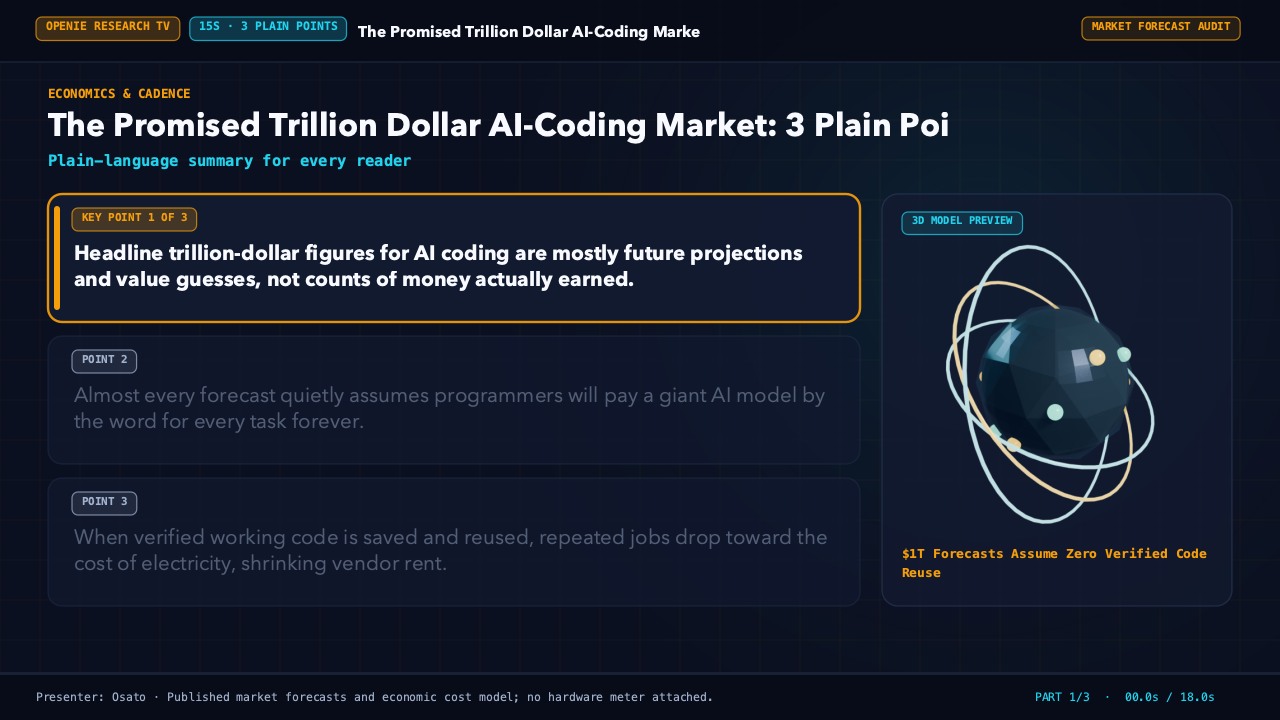
AI Coding Market & Token Arithmetic — USD 2.25/query (100k in + 10k out API tokens) -> USD 9,450/yr at 4,200 queries/yr · RCTs span +55.8% to -19% (unmetered, [S]/[M])

AI Coding Market Arithmetic: Token-vs-Word Accounting, Annual Agent Spend Assumptions, and Mixed RCT Evidence

Audits enterprise AI coding TAM projections, reconciles API tokens (~0.75 words/token) and the 1,400-1,481 active-hour assumption behind ~USD 10k/yr spend, and contrasts +21%-55.8% speedups against METR -19% slowdowns.

Technical metadata & provenance ▾ unmetered
Signed Provenance · Self-Checked Unifying Framing & Synthesis product unmetered

Audits published AI coding market numbers from primary filings and surveys: reconciles API tokens (~0.75 English words/token, never "100k words") in Appenzeller & Li’s (a16z, Oct 2025) USD 2.25/query illustration (USD 9,450/developer/yr at 3 queries/hr × 7 hr/day × 200 days = 4,200 queries/yr), contrasts USD 4.0B surveyed 2025 spend (Menlo Ventures) against USD 2.6T–4.4T TAM claims, and reports mixed developer RCTs from +55.8% (Peng et al. 2023) and +21% (Paradis et al. 2024) to 19% slower on experienced OSS maintainers (METR / Becker et al. 2025) (unmetered).

• 6 min read
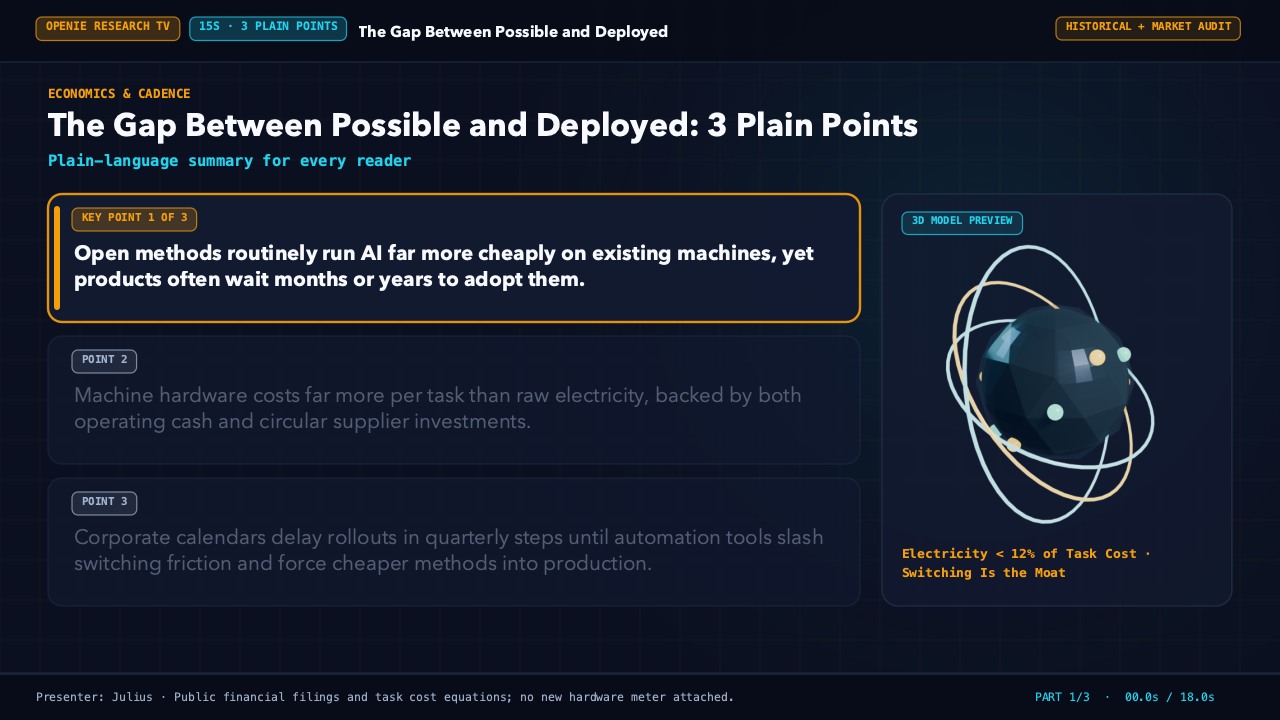
Latency, Capex & 280x Price Decomposition — Plug power = 1.5%–11.8% of H100e hourly cost · 280x / (2x × 2x) = 70x (~74x; ~141x vs capex alone) software-driven price drop (unmetered)

Latency, Capital Amortization, and Inference Price Decomposition: Fixing the 280x Factor Arithmetic

Decomposes accelerator-hour costs across 74 Epoch AI frontier sites (plug electricity 1.5%-11.8% vs capex 8x-70x larger), reconciles 280x / (2 x 2) = 70x (~74x) vs ~141x software price factors, and audits SEC capex/OCF ratios.

Technical metadata & provenance ▾ unmetered
Signed Provenance · Self-Checked Unifying Framing & Synthesis energy unmetered

Across 74 Epoch AI frontier datacenter sites (median USD 33,300 capex and 880 W per H100-equivalent), plug electricity accounts for only 1.5%–11.8% of hourly compute cost (capital amortization is 8x–70x electricity); dividing the >280x Nov 2022–Oct 2024 GPT-3.5-level price drop by both ~2x hardware trends (1.98x capex/FLOP and 1.90x J/FLOP) leaves 70x (~74x exact; or ~141x when dividing out capex alone because electricity share is <12%), while FY2025/2026 SEC filings bound NVIDIA directed ecosystem investments at <=19.5% of revenue (unmetered).

• 6 min read
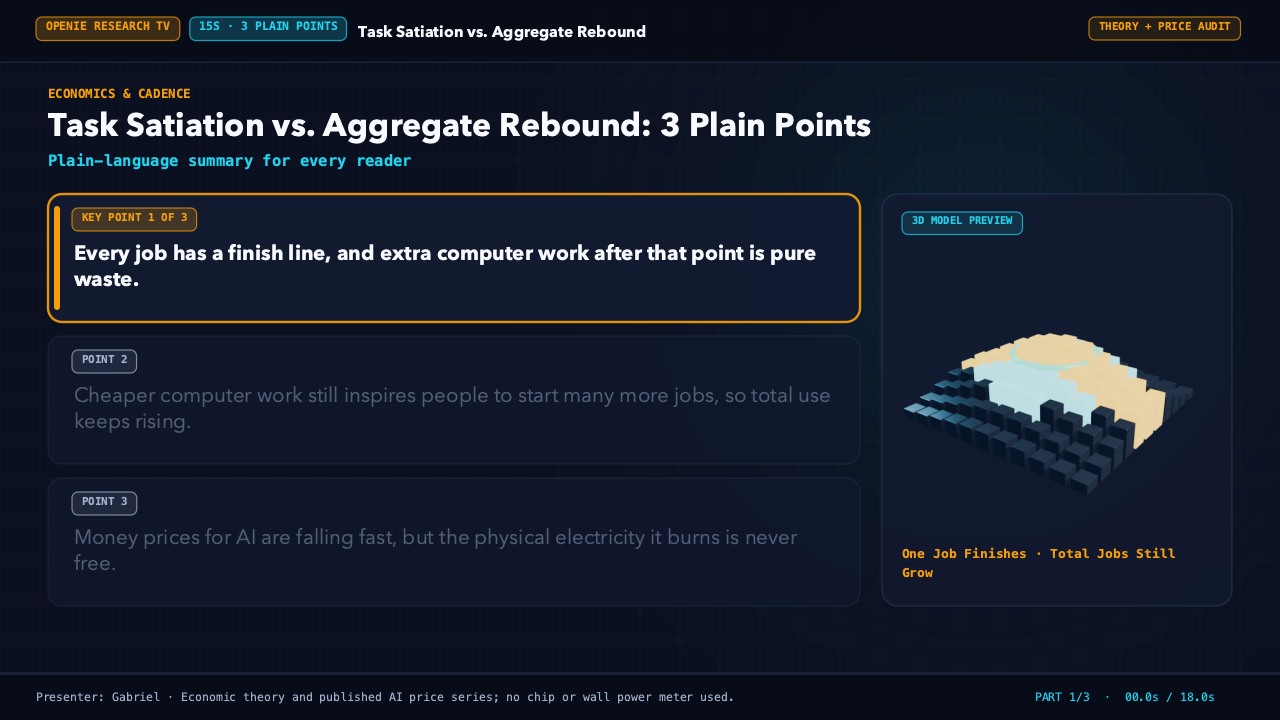
Task Satiation vs. Aggregate Rebound — Per-Task Satiation [M] vs. Macro Jevons Rebound when Elasticity > 1 [S] (unmetered economic synthesis)

Task Satiation vs. Aggregate Jevons Rebound: Bounded UnitSpecs Meet Elastic Fleet Demand

Separates per-task verification satiation (where extra compute after C(z)=1 adds zero utility) from macro-scale Jevons rebound, where cheaper per-task AI historically expands total electricity demand.

Technical metadata & provenance ▾ unmetered
Signed Provenance · Self-Checked Unifying Framing & Synthesis energy unmetered

Proves analytically that while an individual closed-specification task satiates once a deterministic gate passes (C(z) = 1, zero marginal task utility from further sampling), lowering per-task energy and price triggers classical Khazzoom-Brookes / Jevons rebound—increasing aggregate datacenter electricity whenever cross-economy task demand elasticity exceeds unity (unmetered synthesis).

• 5 min read
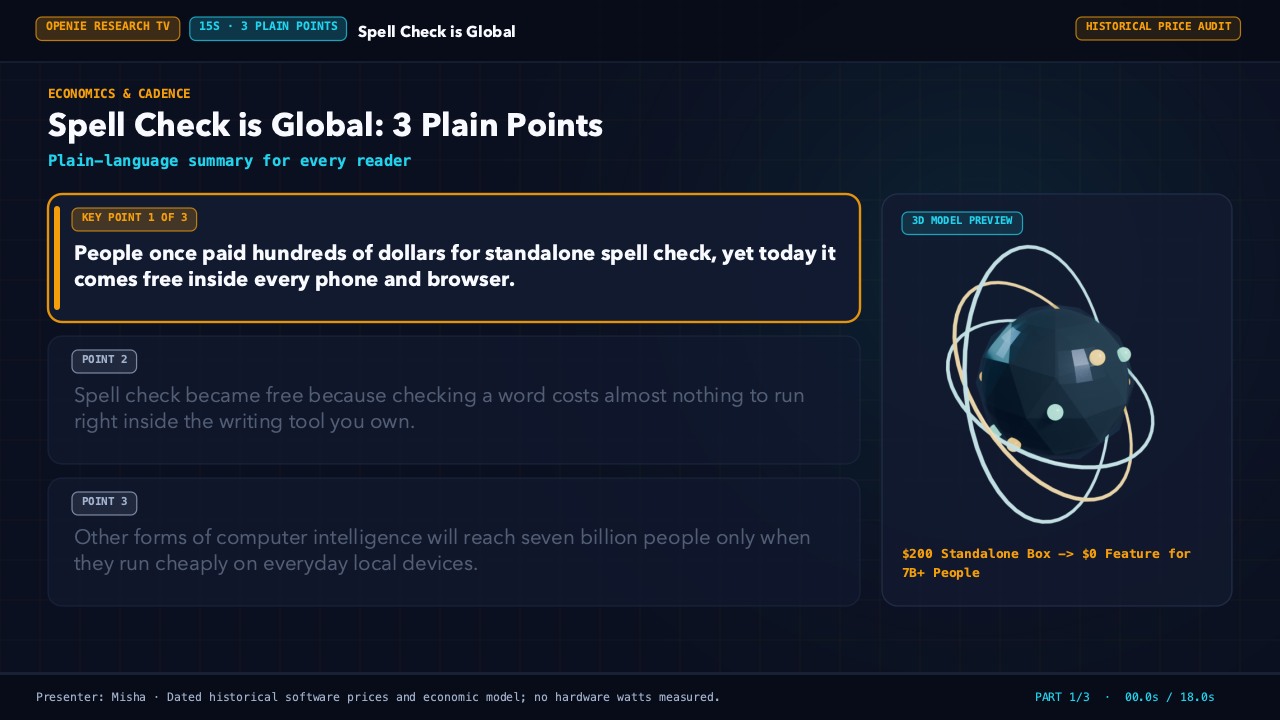
Spell Check Archival Price Trace — USD 200 standalone WordCheck (Jan 1981) -> bundled OS/Hunspell USD 0 license archival trace (unmetered, [S])

Spell Check as an Existence Proof: Archival Price Trace from USD 200 Standalone Packages to Bundled Zero

Primary-source archival history tracing isolated-word spell checking from USD 200 standalone PC software (1981) and USD 89-99 grammar tools to OS-bundled zero-license-price libraries—with explicit narrow-domain limits.

Technical metadata & provenance ▾ unmetered
Signed Provenance · Self-Checked Unifying Framing & Synthesis product unmetered

Traces dated retail advertisements and product histories showing isolated-word spell check moving from a USD 200.00 standalone Commodore PET package (Compute!, Jan 1981) and USD 89–99 Grammatik add-ons (1988–1989) to bundled word-processor features (1983–1992) and zero-license-price local OS libraries—serving strictly as a narrow existence proof for bounded zero-marginal-cost routines, not open-ended reasoning (unmetered archival study).

• 5 min read
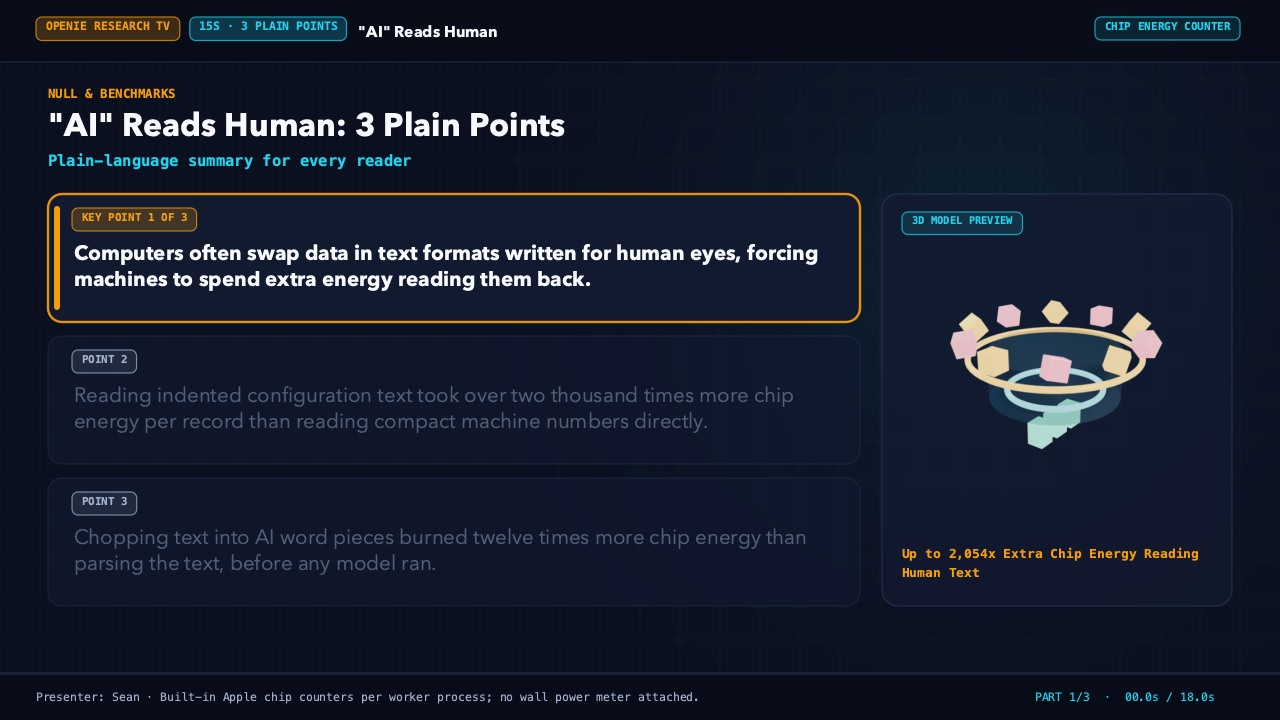
Serialization & Tokenization Energy Tax — 280.4 nJ fixed binary vs. 2,212 nJ JSON & 27,679 nJ tiktoken/record (M5 Max L3 reported_j) · 109/170 L2 windows rejected for drift

"AI" Reads Human: Serialization, Tokenization, and Per-Process Parse Energy Across 34 Workloads

Measures parse time, token bloat across 5 tokenizers, and Apple M5 Max per-process ri_energy_nj (reported_j) on a 20,000-record synthetic corpus while reporting 109/170 shared-host IOReport drift rejections.

Technical metadata & provenance ▾ reported_j
Signed Provenance · Self-Checked Measured/Empirical Engineering engineering reported_j

Across a seeded 20,000-record synthetic corpus in CPython 3.13 on Apple M5 Max (per-process kernel ri_energy_nj L3 reported_j), fixed binary unpacking used 280.4 nJ/record versus 2,212.1 nJ for stdlib JSON (7.89x), 69,922.1 nJ for C libyaml (249.4x), 575,799.3 nJ for pure-Python YAML (2,053.8x), and 27,679.2 nJ for cl100k_base JSON tokenization (12.5x json.loads()), while 109/170 whole-chip IOReport windows fired Falsifier 6 (>5% idle drift) and base64/hex text encoding saved almost zero LLM tokens.

• 6 min read
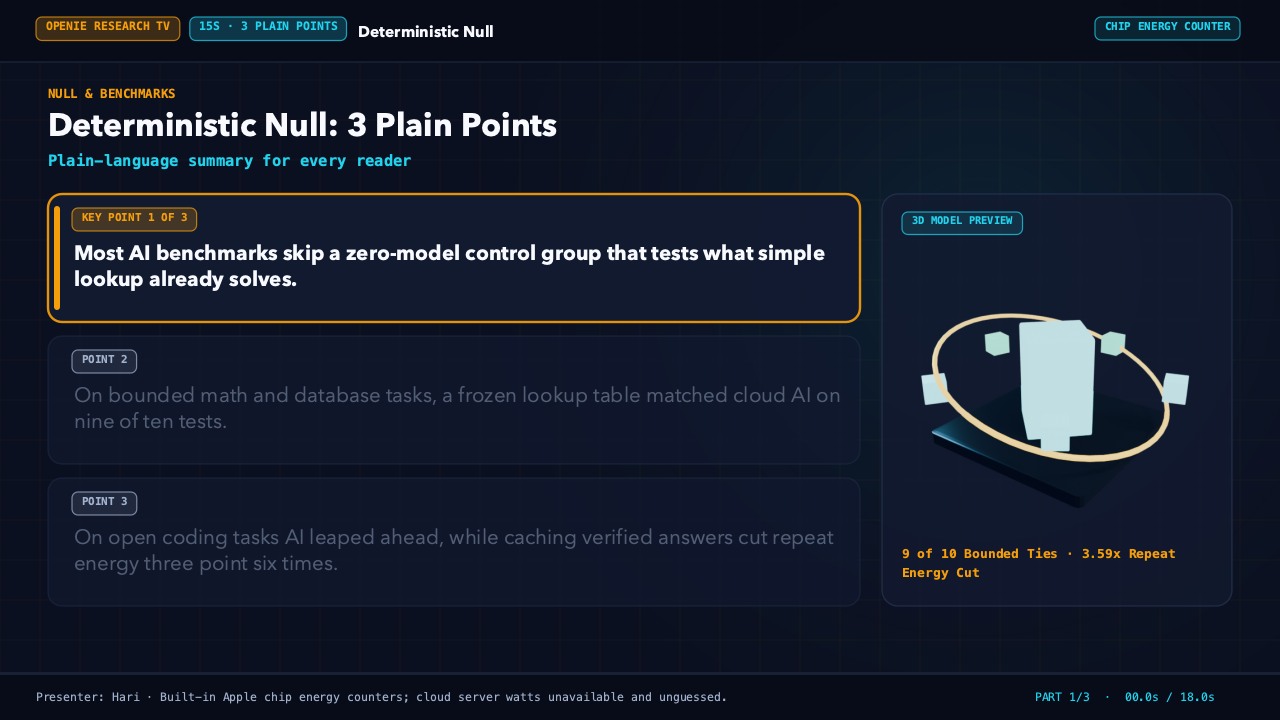
Deterministic Null Baseline — 9/10 Track-A bounded ties vs. 6 LLMs · +45.8 to +95.0 pp LLM lead on open SWE/BFCL suites (reported_j)

Deterministic Null: A Hash-Precommitted Zero-Model Baseline Across 6 LLMs and Public Coding/Tool Suites

Evaluates a 5-language zero-model deterministic baseline (Shape D: N0/N1) committed via OpenTimestamps and drand against 6 LLMs across 4,030 instances and 6 upstream SWE-bench Verified repos.

Technical metadata & provenance ▾ reported_j
Signed Provenance · Self-Checked Measured/Empirical Engineering research reported_j

Against a hash-precommitted zero-model deterministic baseline (Shape D N0/N1, bit-identical across Rust, C++20, Go, Julia, and Python under OpenTimestamps and drand rounds 6663734/6664089), 6 LLMs tied or trailed on 9/10 bounded Track-A template cells (N = 2,840) but led by +45.83 to +95.00 percentage points across unique public suites (BFCL v3, tau-bench Retail, BigCodeBench v0.1.3, N = 1,190) and patched up to 5/6 cold upstream SWE-bench Verified repos vs. 0/6 for Shape D (Apple M5 Max reported_j).

• 7 min read
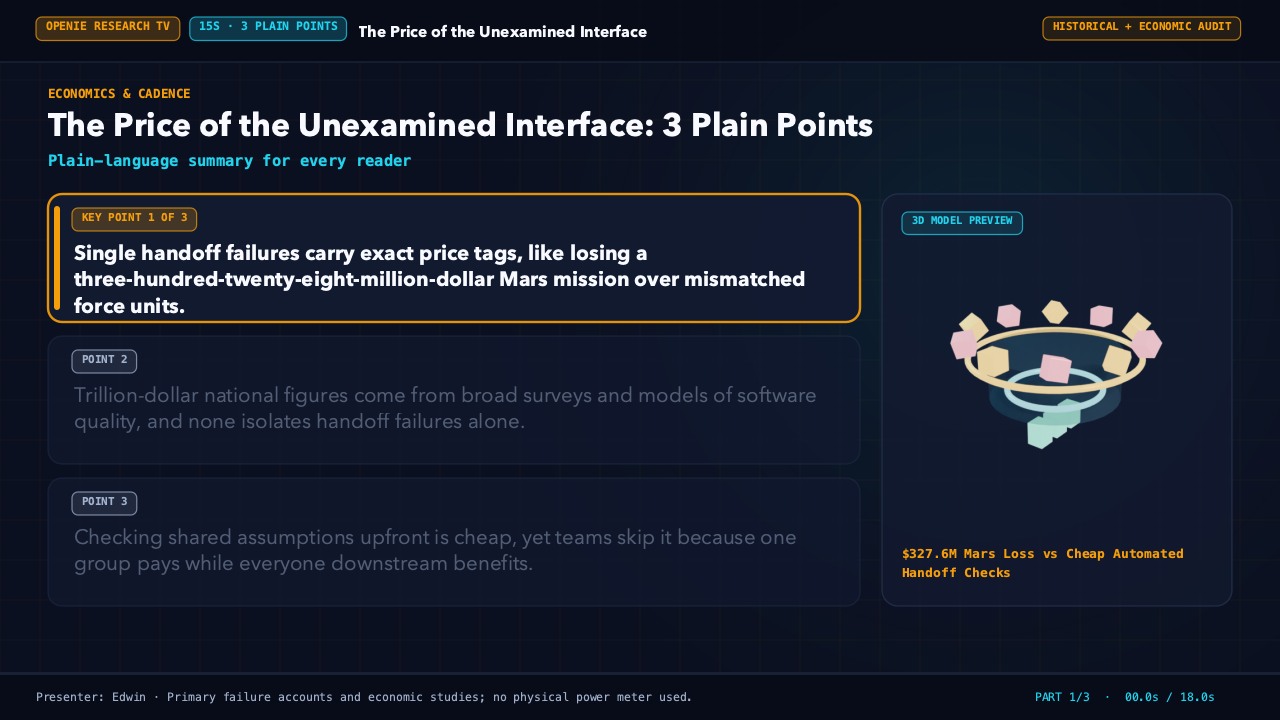
Interface Economics (Analytical Model) — Analytical Cost Model & Literature Synthesis · 0 Field Trials Run (unmetered, [M]/[S])

Interface Economics: Analytical Cost Models of Ambiguity, Verification Boundaries, and Handoff Contracts

An unmetered microeconomic and information-theoretic cost model comparing ambiguous natural-language handoffs against typed, deterministically verified interfaces.

Technical metadata & provenance ▾ unmetered
Signed Provenance · Self-Checked Unifying Framing & Synthesis research unmetered

Models organizational and software interfaces as information channels where specification ambiguity shifts rework cost downstream, deriving analytical conditions under which upfront typed schemas and deterministic gates lower total expected cost (unmetered theoretical synthesis; zero live firm or hardware experiments).

• 4 min read
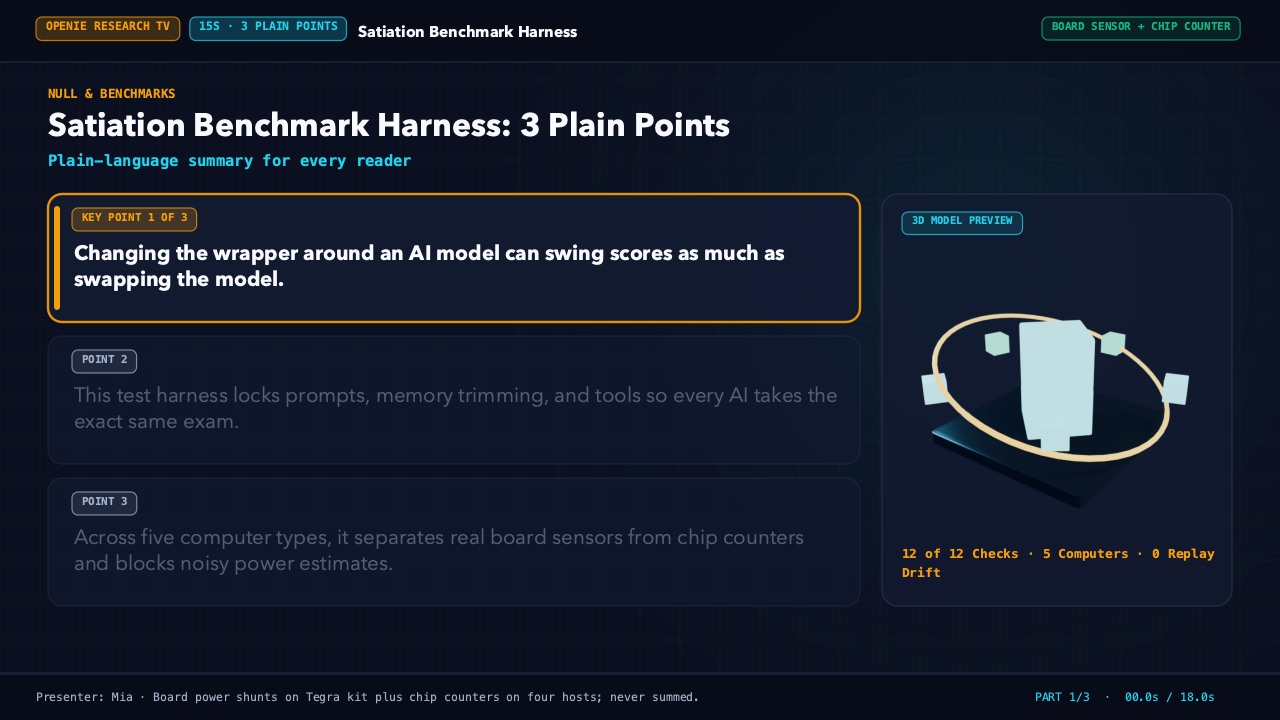
SATB Telemetry & Harness Audit — 12/12 C1–C12 checks across 5 hosts · 32.6%–89.9% CPU-proportional attribution error exposed (Thor measured_j & 4 reported_j hosts)

Satiation Benchmark (SATB) Harness: 5-Host Telemetry Audit, Kepler Splitting Errors, and Co-Tenant Falsifiers

Cross-platform audit of the sequential Rust SATB harness (12/12 C1-C12 checks) across Jetson AGX Thor DC shunts and 4 counter hosts, exposing 32.6%-89.9% CPU-splitting errors and Windows tick aliasing.

Technical metadata & provenance ▾ measured_j
Signed Provenance · Self-Checked Measured/Empirical Engineering engineering measured_j

Across 5 hardware/OS hosts—anchored by physical TI INA238/INA3221 DC shunts on NVIDIA Jetson AGX Thor (measured_j) plus Apple M5 Max, AMD Strix Halo, Intel Core i9-13900H, and Windows 11 + RTX 2060 (reported_j)—the SATB Rust harness passed 12/12 deterministic replay checks while proving that Kepler-style CPU-utilization splitting errs by 32.59%–89.88% and Windows 15.625 ms tick aliasing undercounts bursts by -89.88%.

• 5 min read
Goal-Holding Agents Under Budget Guards — 36/5,400 pre-fix vs. 0/10,800 post-fix overspends · tight-budget gain did not replicate (CPU counter, reported_j)

Goal-Holding Agents Under Budget Guards: Pre- and Post-Fix Overspend Audit and Replication Limits

Pre-fix (36/5,400 overspends) and post-fix (0/10,800 overspends) budget-guard experiments across 30 Sudoku tasks, fired falsifiers (R-F1..R-F6), non-replicating tight-budget gains, and on-chip reported_j limits.

Technical metadata & provenance ▾ reported_j
Signed Provenance · Self-Checked Measured/Empirical Engineering research reported_j

Moving comparison and receipt bookkeeping inside the budget guard cut simulated/counter episode overspends from 36/5,400 (Run 1, firing R-F2) to 0/10,800 (preregistered Run 2, Darwin ri_energy_nj and cycle-modeled Linux, reported_j), while the exploratory tight-budget task gain (+2.65 tasks at B = 1.0) failed to replicate and multiple falsifiers (R-F1..R-F6) fired.

• 7 min read
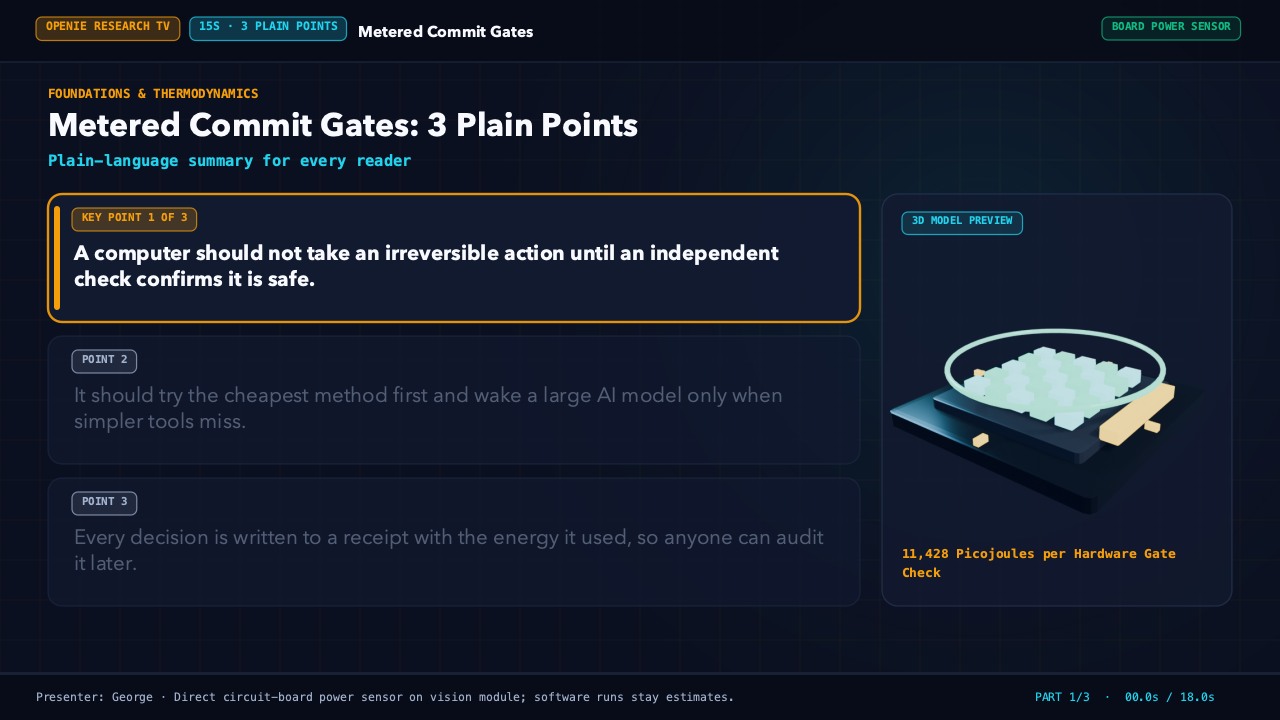
Metered Commit Gates — 11.43 nJ/cycle whole-SOM average (KV260 INA260 shunt, measured_j) · 0/209,261 simulated false allows (95% UB <= 1.43e-5)

Metered Commit Gates: KV260 Whole-SOM Shunt Measurements, Statistical Safety Bounds, and Cascade Scope

Whole-SOM TI INA260 shunt power-slope readings on AMD Kria KV260 (11.43 nJ/cycle, N = 4 A/B/A passes), inconclusive 98 pJ seed delta near sensor floor, and Clopper-Pearson bounds over 209,261 simulated checks.

Technical metadata & provenance ▾ measured_j
Signed Provenance · Self-Checked Measured/Empirical Engineering energy measured_j

On an AMD Kria KV260 board, whole-SOM VCC_SOM TI INA260 halt-vs-run power-slope metering measured 11,428 pJ/cycle (11.43 nJ, SE = 129 pJ across N = 4 interleaved 25 s passes at 25 MHz, measured_j) while a 98 pJ seed-fabric delta remained inconclusive near the 1.25 mA sensor step; in software simulation, 209,261 pendulum checks observed 0 false allows (95% Clopper-Pearson upper bound <= 1.43e-5) alongside predicate disagreements in NI-4.

• 7 min read
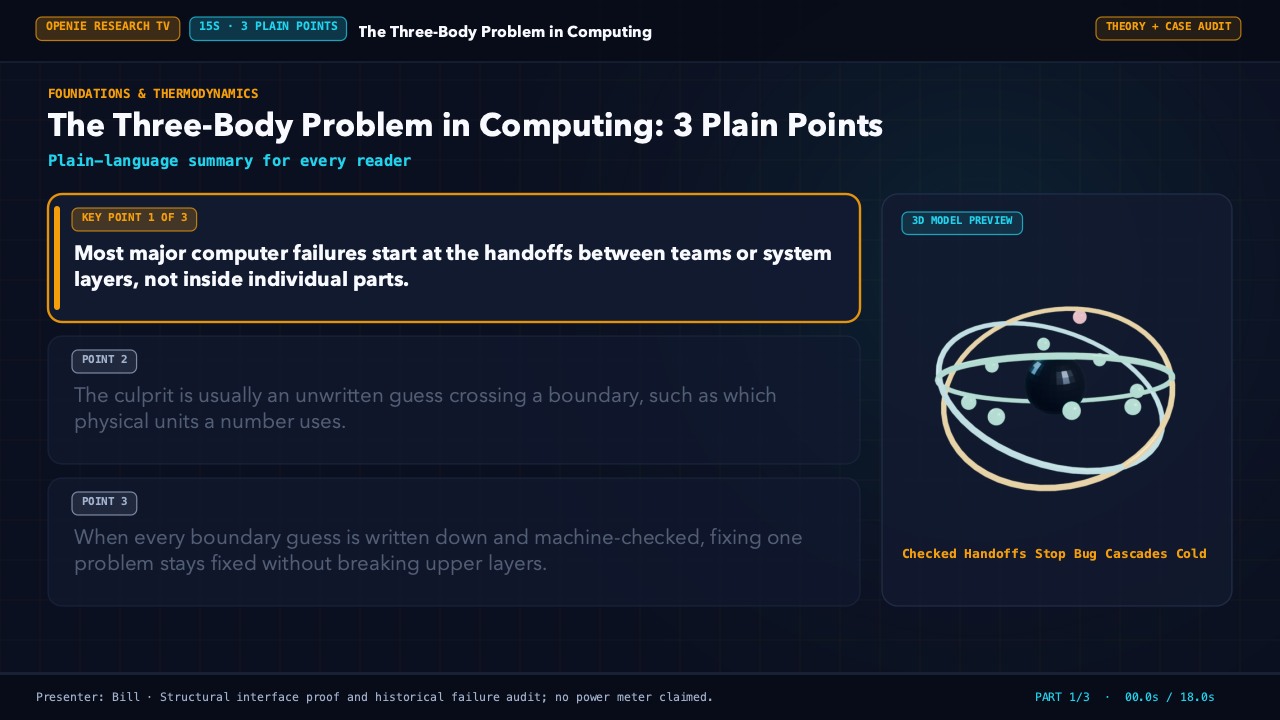
Specification, Proposer & Gate (Design Metaphor) — Architectural Framing & Design Metaphor · 0 Standalone Hardware Runs (unmetered, [M]/[S])

Specification, Proposer, and Gate: The "Three-Body" Software Design Metaphor for Verifiable Automation

An unmetered architectural framing paper using "Three-Body" strictly as a structural metaphor for separating Specifications, Proposers, and Deterministic Gates—not celestial mechanics.
Technical metadata & provenance ▾ unmetered
Signed Provenance · Self-Checked Unifying Framing & Synthesis research unmetered

Frames reliable AI-assisted automation around three decoupled software roles—Specification, Proposer, and Deterministic Gate—using "Three-Body" strictly as a structural design metaphor (not gravitational physics), with zero new hardware measurements in this paper (unmetered).

• 5 min read
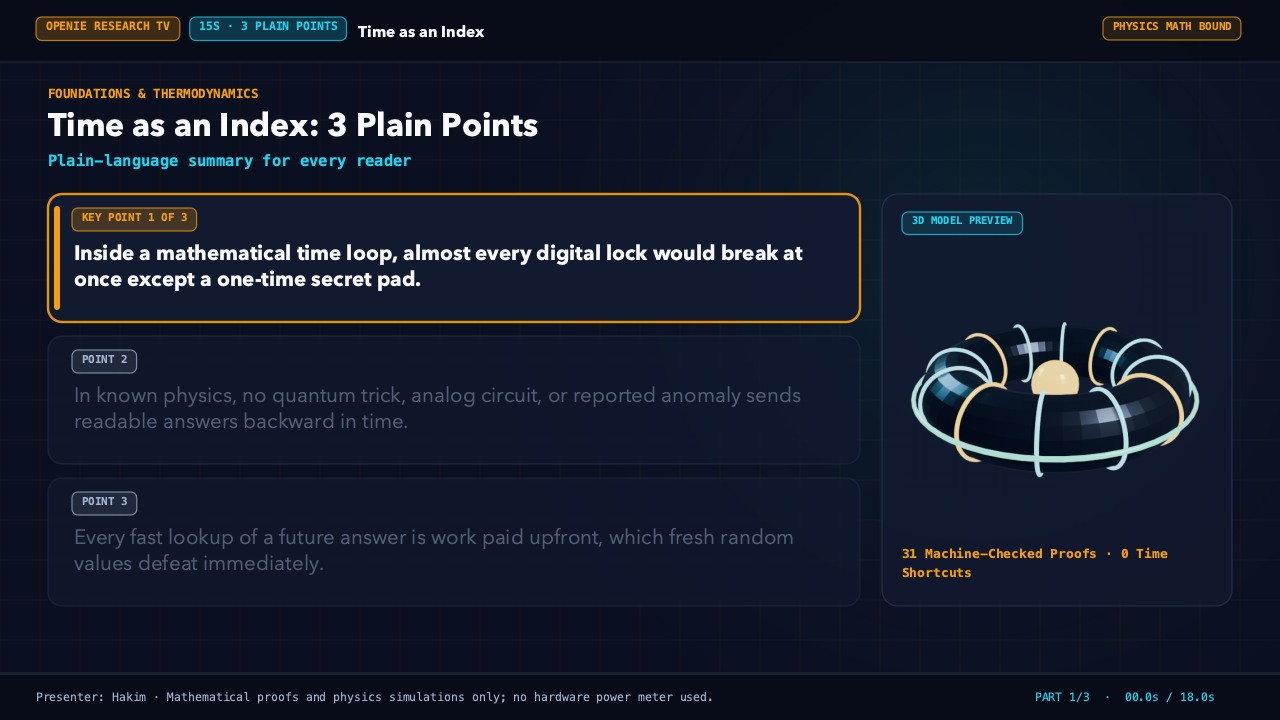
Time as an Index — 31 Lean 4.36.0 theorems [T] · 0/32,768 SHA-256 spectral bins below p = 10^-6 (N = 65,536, unmetered)

Time as an Index: Formal Complexity Horizons, Precomputation Bounds, and SHA-256 Spectral Controls

Formal Lean 4 proofs over oracle/CTC models (31 theorems), Hellman time-memory tradeoffs, and 65,536-digest SHA-256 spectral null tests (unmetered formal/simulation study).

Technical metadata & provenance ▾ unmetered

Across 31 six-kernel-checked Lean 4.36.0 theorems over abstract oracle models and N = 65,536 SHA-256 spectral tests (0 frequency bins below Bonferroni-corrected p = 10^-6), computational "future lookup" reduces in known physics to paid-in-advance Hellman precomputation defeated by fresh per-query salts (unmetered formal and simulation study).

• 5 min read
Illustration of scalar energy landscapes unifying world prediction, planning, and verification

Energy First Architecture (EFA): One Learned Scalar Energy That Predicts, Plans, Remembers, and Verifies

July 19, 2026 Physical AI Whitepaper v1 testing sparse-positive ReLU latents, training-free Hebbian fast weights, dendritic continual gates, port-Hamiltonian priors, and hybrid flow-matching + scalar energy verification on synthetic physics and control benchmarks.
Technical metadata & provenance ▾ unmetered
Whitepaper (Jul 19, 2026) · Verbatim + Addendum Measured/Empirical Engineering research unmetered

On low-dimensional physics, POMDP, and cognitive probe tasks in Rust/Ferric, pairing flow-matching proposals with a learned scalar energy verifier resolved non-convex 2-DOF action local minima (0% -> 100% reach) and certified contraction on 30.4% of state space (unmetered in electrical joules).

• 7 min read
Compiler graph lowering across digital GPU/AMX backends and post-CMOS physics dialects

flowG & TEI Fabric: Typed FunctionGraph IR and Cost-Surface Dispatch Across Physics Dialects

June 10, 2026 Wave II compiler and thermodynamic-fabric specifications uniting ~90 flowg-* Rust crates (dtype-explicit FunctionGraph IR) with TEI Fabric's 6 literature-anchored physics cost surfaces from 36 pJ/MAC CMOS to 1 fJ/sample p-bits.

Technical metadata & provenance ▾ est_j
Whitepaper (Jun 10, 2026) · Verbatim + Addendum Formal Proof / Spec engineering est_j

Unified language frontends and ONNX models (MobileNetV2, quantized BERT, 1.6 GB Stable Diffusion UNet) onto a capability-safe, dtype-explicit FunctionGraph IR (flowG) and simulated subgraph partitioning across six literature-parameterized CMOS and post-CMOS energy cost surfaces, demonstrating that ADC/DAC and E-O-E boundary conversions dominate naive array-core savings (est_j).

• 7 min read
Silicon floorplan and heterogeneous substrate routing architecture from Joule Zero and Mantle

Joule Zero (sky130A CI2605) & Mantle: Heterogeneous Substrate Position & OpenLane PnR Design (Status: RTL & Place-and-Route Signoff Targeting sky130A CI2605 — Designed Only, Not Fabricated or Silicon-Measured)

May 20, 2026 Wave II RTL/OpenLane physical-design study and Mantle substrate-mismatch position paper: a 14-macro 15.1 mm² sky130A CI2605 test-die layout (dual RISC-V, 32x32 ReRAM PIM macro model, Toffoli logic tile, translinear LUT) across 47 OpenLane runs — designed only, not fabricated.

Technical metadata & provenance ▾ est_j
Whitepaper (May 20, 2026) · Verbatim + Addendum Measured/Empirical Engineering product est_j

Completed RTL integration and 47 OpenLane physical-design iterations (v0->v47) for a 15.1 mm² 14-macro heterogeneous layout targeting the sky130A CI2605 OpenFrame harness (with 10/12 cf-precheck checks passing and non-critical Wishbone peripheral paths tied off under DRT-0352 congestion) — designed only, not fabricated into silicon or physically metered (est_j).

• 7 min read
Architecture of JouleDB unifying multi-model persistence with hyperdimensional contrast intelligence

JouleDB v0.1 & v0.2: Energy-Aware Intelligence Infrastructure and the Six Contrast Axioms

April–May 2026 Wave II whitepapers specifying the Six Biological Contrast Axioms, all 15 HDC runtime primitives, zero-training WN18RR link prediction (83.8% Hits@10 alongside a 26.4% Hits@1 hierarchical floor), 594 GB CoW hardening, and our 'Good, Bad, and Ugly' self-audit.

Technical metadata & provenance ▾ reported_j
Whitepaper (Apr 28, 2026) · Verbatim + Addendum Measured/Empirical Engineering research reported_j

Specified 6 Contrast Axioms and 15 HDC runtime primitives over a Copy-on-Write multi-model Rust database (hardened on a 594 GB dataset), achieving 83.8% Hits@10 and 0.468 MRR alongside a 26.4% Hits@1 floor on internal WN18RR link-prediction evaluation at ~9 uJ/prediction (est_j/reported_j, private repo).

• 8 min read
Illustration of decentralized joule-metered compute exchange and interface pricing

Invisible Infrastructure (VDCX): Pricing Compute in Joules — 88.7% Cost Cut Modelled (est_j, Assuming Oracle Zero-Friction Routing)

February 28, 2026 mesh-economics whitepaper proposing VDCX: an MVNO-inspired 3-tier SWIM-over-QUIC compute exchange with 16-byte Joule Wire headers, DISARM difficulty routing (88.7% modelled cost cut, est_j), HTTP x402 settlement, and GSF SCI carbon scoring.

Technical metadata & provenance ▾ est_j
Whitepaper (Feb 28, 2026) · Verbatim + Addendum Formal Proof / Spec energy est_j

Specifies a 3-tier SWIM-over-QUIC compute mesh with 16-byte wire energy headers, GSF SCI carbon scoring across 6 named grid-carbon feeds plus IPCC embodied factors, and an analytical DISARM tier model projecting an 88.7% daily spend reduction under oracle zero-friction routing (est_j).

• 6 min read
Diagram of unified storage, hyperdimensional indexing, and energy-metered search tiers

The Joule Stack: Energy-Aware Computing from Database to Search

February 24, 2026 full-stack retrieval whitepaper uniting JouleDB (B-tree + 10,000-bit Kanerva hyperdimensional SDM), 28-provider float-free Verity search, 16-vendor Joule-LLM, an 11-layer cascade, and Three-Phase Energy Receipts.

Technical metadata & provenance ▾ reported_j
Whitepaper (Feb 24, 2026) · Verbatim + Addendum Measured/Empirical Engineering engineering reported_j

Integrated a B-tree + 10,000-bit Kanerva hyperdimensional store, 28-provider fixed-point federated search ('Verity'), and an 11-layer retrieval cascade emitting Three-Phase Energy Receipts that explicitly separate local RAPL/IOKit counter joules (~12 uJ L0, reported_j) from calculated wire transport and remote FLOP*PUE cloud estimates (2.001 J L3, est_j).

• 6 min read

Beyond Binary: Ternary Computing for Energy Efficiency

What if we stopped forcing every number into zeros and ones? Ternary encoding with {-1, 0, 1} replaces multiplication with addition and cuts LLM inference energy by up to 82%.

Technical metadata & provenance ▾ est_j
Feb 2026 Essay · Verbatim + Addendum Unifying Framing & Synthesis research est_j

Restricting quantization-aware-trained neural weights to {-1, 0, +1} replaces floating-point multiply-accumulate gates with conditional additions in analytical gate-level models (est_j analytical estimate; requires QAT from scratch and lookup/unpack care on real hardware).

• 8 min read

Deterministic Code Generation: Trust, but Verify

AI-generated code is probabilistic by nature. That's fine for prototypes — and terrifying for production. Deterministic coding replaces hope with proof.

Technical metadata & provenance ▾ reported_j
Feb 2026 Essay · Verbatim + Addendum Unifying Framing & Synthesis engineering reported_j

Wrapping stochastic LLM token generation inside an automated formal specification and static admission gate rejects unverified candidate edits before repository commit (conceptual framing in Feb 2026; warm-cache 317 µJ reported_j gate in Nov 2026).

• 8 min read

Invisible Security for Apple Silicon

When AI inference moves to local hardware, every security boundary becomes a liability. Invisible Mac SSI makes macOS security infrastructure disappear — so your models can run without friction.

Technical metadata & provenance ▾ unmetered
Feb 2026 Essay · Verbatim + Addendum Measured/Empirical Engineering engineering unmetered

Automating macOS ad-hoc Mach-O signing (codesign -s -) and local file-hash checks removes CI/CD launchd friction on Apple Silicon hosts (unmetered operational workflow; provides AMFI arm64 execution hashes only, NOT verified identity or local tamper resistance).

• 9 min read
Architectural diagram illustrating PTX-to-Metal GPU translation across unified memory hardware

Breaking the CUDA–Metal Barrier: A PTX-to-Metal Translation Layer for 100 Million Dormant GPUs

February 19, 2026 v1.1 technical whitepaper and 33-EC2 compatibility experiment lowering PTX 8.0 across 276 CUDA C-ABI symbols to Apple Metal (4,999 GFLOPS FP32 on M3 Ultra), with explicit FP64-to-FP32 surrogate downcast and est_j TDP disclosures.

Technical metadata & provenance ▾ est_j
Whitepaper (Feb 19, 2026) · Verbatim + Addendum Measured/Empirical Engineering engineering est_j

A ~20,000-line Rust C-ABI libcuda shim lowered PTX 8.0 kernels to Apple Metal shaders at up to 4,999 GFLOPS FP32 SGEMM on M3 Ultra across 9 fully supported, 10 degraded (including FP64-to-FP32 truncation), and 5 unsupported CUDA capability categories (est_j TDP envelope).

• 7 min read
Visual synthesis of ternary {-1, 0, +1} logic and 64-state LUT6 hardware primitives

Ternary Encoding Research Survey: 1.58-Bit QAT Weights, Balanced Ternary Logic, and Post-Binary Storage

February 17, 2026 7-domain literature survey covering QAT-trained BitNet b1.58/2B4T, TerEffic & TENET FPGA ternary LUTs, room-temperature Artix-7 SRAM ER-TCAM (293 ns) vs. 4 K cryogenic Josephson TCAM (26.5 aJ/cell), multipath QUIC, and Cranelift ISLE lowering.

Technical metadata & provenance ▾ est_j
Whitepaper (Feb 17, 2026) · Verbatim + Addendum Unifying Framing & Synthesis research est_j

Synthesizes peer-reviewed benchmarks across QAT-trained 1.58-bit ternary LLMs (BitNet b1.58, bitnet.cpp), FPGA/ASIC LUT accelerators (TerEffic, TENET, TeLLMe v2), distinct CMOS-FPGA vs. cryogenic-SQUID ternary TCAMs, and 5-trit-per-byte SIMD packing (est_j external literature).

• 8 min read

Benchmarking a $599 Mac Mini Against Cloud GPUs: Unified-Memory Tradeoffs and Nov 2026 FP64 Surrogate Errata

We ran identical cuBLAS workloads on 4 Apple Silicon Macs and 3 NVIDIA cloud GPUs. See the raw SGEMM tables, unified-memory transfer gains, and our November 2026 errata on FP64->FP32 downcast surrogates and whole-system vs. GPU-card TDP.

Technical metadata & provenance ▾ est_j
Feb 2026 Essay · Verbatim + Addendum Measured/Empirical Engineering engineering est_j

While owned Apple Silicon workstations avoid PCIe copy bottlenecks (2.8–3.6x 256 MB transfer vs. L4) and lower amortized USD/M-GFLOPS-hr for casual duty cycles, the $599 Mac mini M4 loses raw FP32 SGEMM to all three tested cloud GPUs (3,418 vs. 4,416–24,616 GFLOPS), its reported DGEMM figure was a non-IEEE-754 f64->f32 downcast surrogate, and GFLOPS/W mixed whole-Mac TDP with GPU-only TDP (mixed system/GPU TDP — est_j corrected in Errata).

• 16 min read

Running CUDA Entry Points Across 33 Cloud Instances via a CPU Fallback Backend (Feb 2026, with Nov 2026 Errata)

We tested an early CUDA runtime/API compatibility shim across 33 EC2 instance runs via a host CPU fallback backend (with attached GPUs unused), documenting a 9 supported / 10 degraded / 5 unsupported limits matrix and Nov 2026 errata.

Technical metadata & provenance ▾ unmetered
Feb 2026 Essay · Verbatim + Addendum Measured/Empirical Engineering engineering unmetered

Intercepting CUDA runtime and library entry points via a static glibc-2.17 host CPU fallback shim executed 17 element-wise/BLAS compatibility tests and 47 library smoke-test stubs across 33 EC2 runs while leaving all physical GPUs unused (CPU fallback shim; 1 GB overcommit, 9 microarchitectures, and g4ad AMD GPU corrected in Errata).

• 19 min read
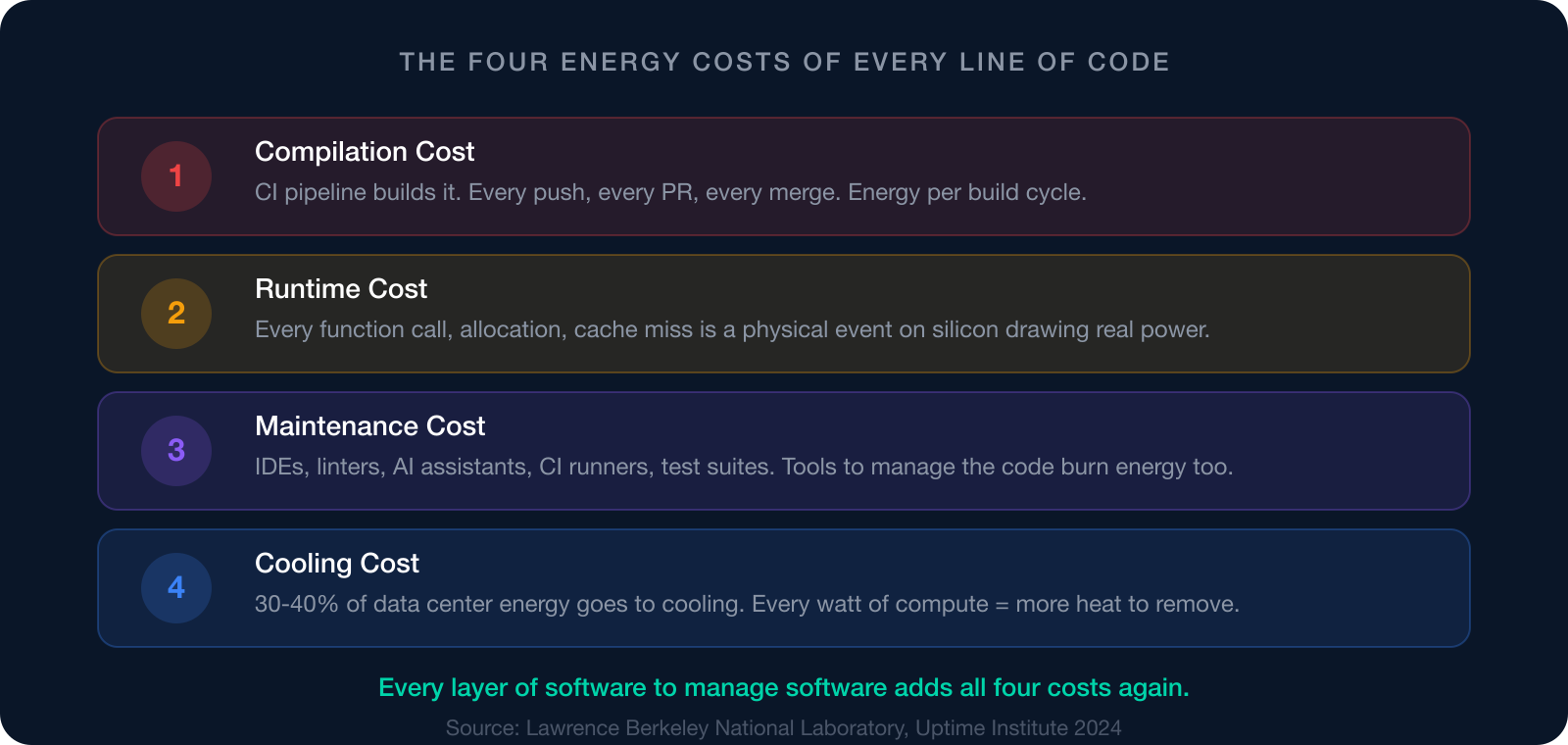
Layered breakdown of software abstraction and memory-hierarchy energy costs

The Hidden Energy Crisis in Computing & Manifesto for Sustainable Software

February 14, 2026 companion whitepaper and 10-principle Sustainable Computing Manifesto synthesizing Wirth's Law, the Pereira et al. (SLE 2017) 75.88x language runtime spread, the ~100x DRAM-vs-L1 energy gap, and 10 MW datacenter TCO.

Technical metadata & provenance ▾ est_j
Whitepaper (Feb 14, 2026) · Verbatim + Addendum Unifying Framing & Synthesis energy est_j

Synthesizes published programming-language energy ratios (75.88x CPython vs. C on CLBG microbenchmarks), CMOS memory-hierarchy fetch multipliers (~100x off-chip DRAM vs. L1 SRAM), and 10 MW campus electricity/PUE math into ten sustainable software principles (est_j).

• 6 min read
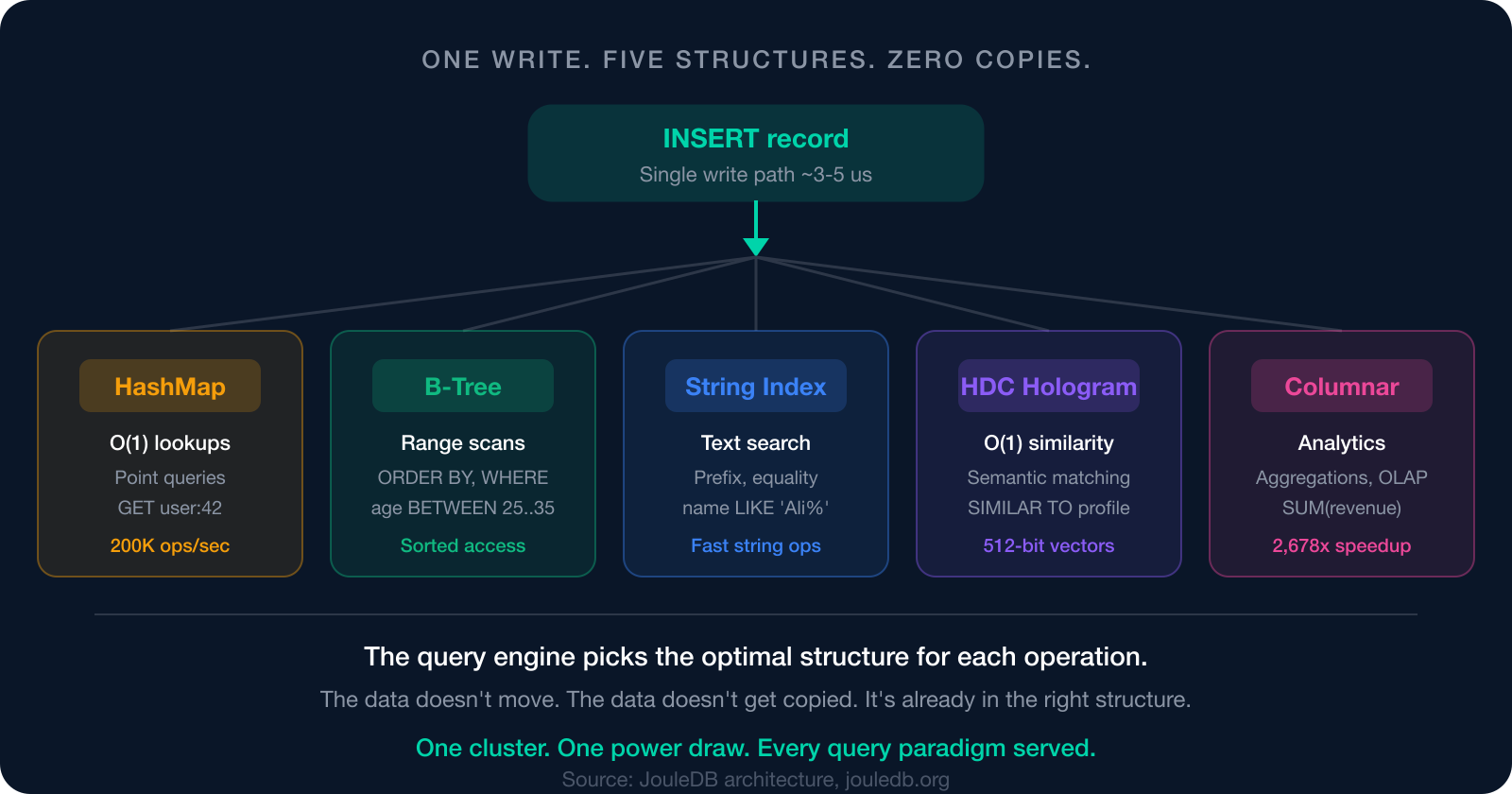
Five concurrent data structures populated from a single write with per-query joule telemetry

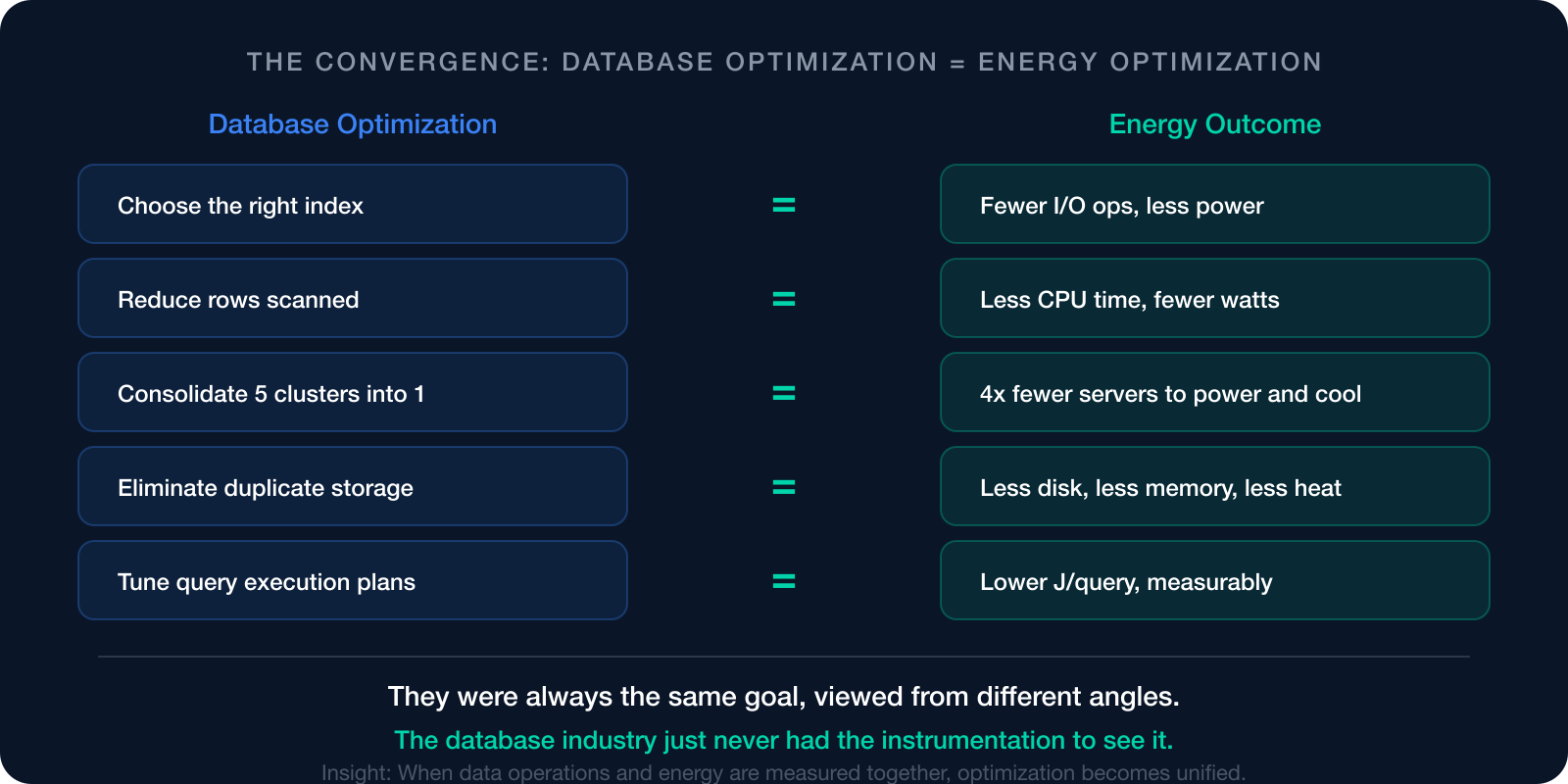
Every Query Has a Cost in Joules

Your database doesn't know how much energy it uses. It should. Data and energy are fundamentally coupled — and the industry's refusal to measure that coupling is the most expensive blind spot in modern infrastructure.

Technical metadata & provenance ▾ reported_j
Feb 2026 Essay · Verbatim + Addendum Measured/Empirical Engineering engineering reported_j

Exposing per-query energy telemetry alongside multi-representation storage makes query routing energy-visible, though February 2026 mixed IOKit/RAPL counters (reported_j) with TDP fallbacks (est_j) and compared Arrow columnar SUM against an unindexed sequential row scan rather than DuckDB or ClickHouse.

• 14 min read
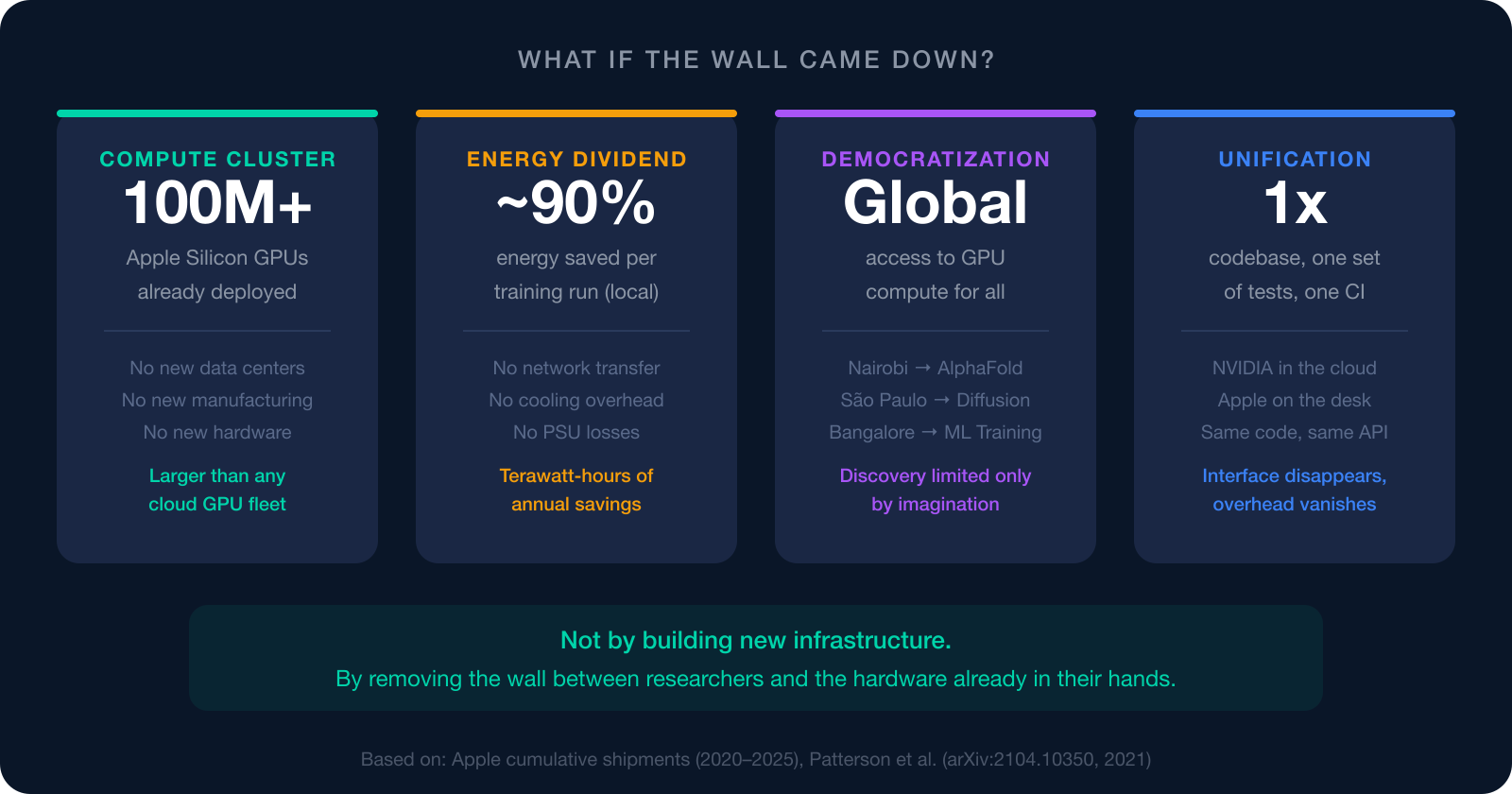
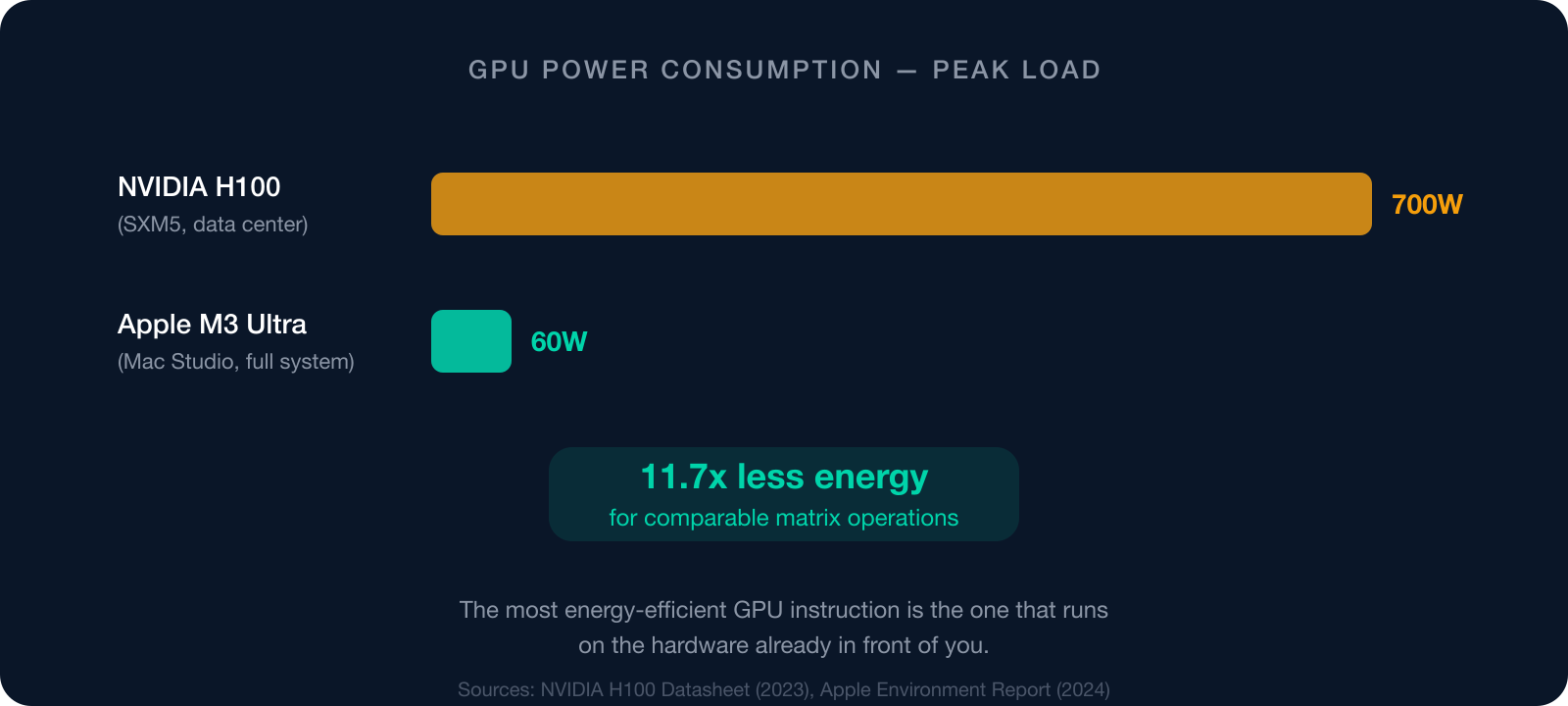
Envelope comparison between NVIDIA H100 700W TDP and Apple M3 Ultra 60W sustained system draw

GPU Access Control — CUDA vs Metal: Making Rigid Interfaces Disappear

The invisible cost of GPU silos runs deeper than vendor lock-in. It's a tax on discovery, a brake on science, and a wall between researchers and the hardware that could change everything.

Technical metadata & provenance ▾ est_j
Feb 2026 Essay · Verbatim + Addendum Unifying Framing & Synthesis engineering est_j

Proprietary GPU API boundaries strand capable unified-memory desktop GPUs, though February's '700 W vs. 60 W (~90% saved)' comparison contrasted instantaneous thermal power envelopes (est_j watts) rather than time-integrated joules per identical completed training workload (J = W × t).

• 19 min read
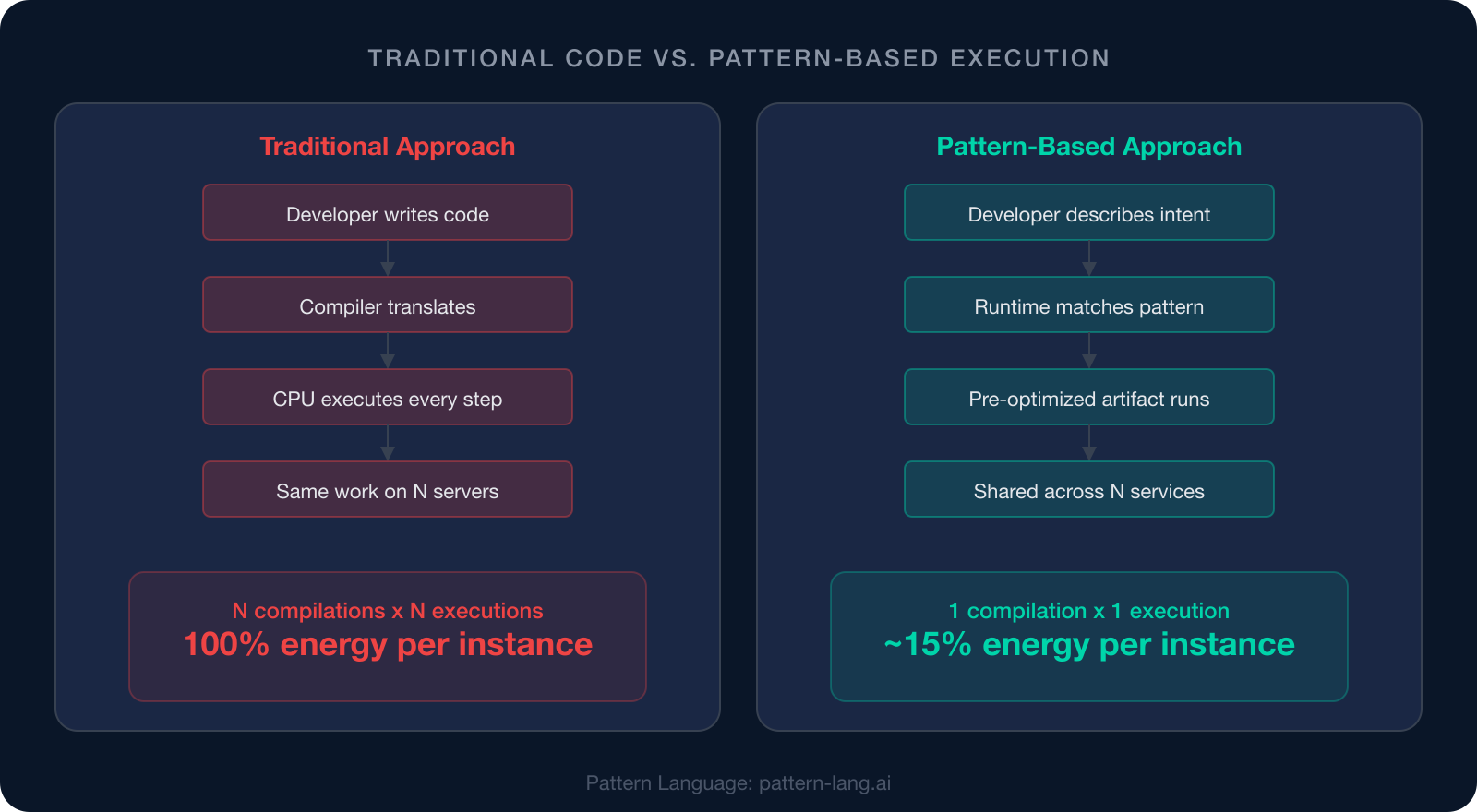
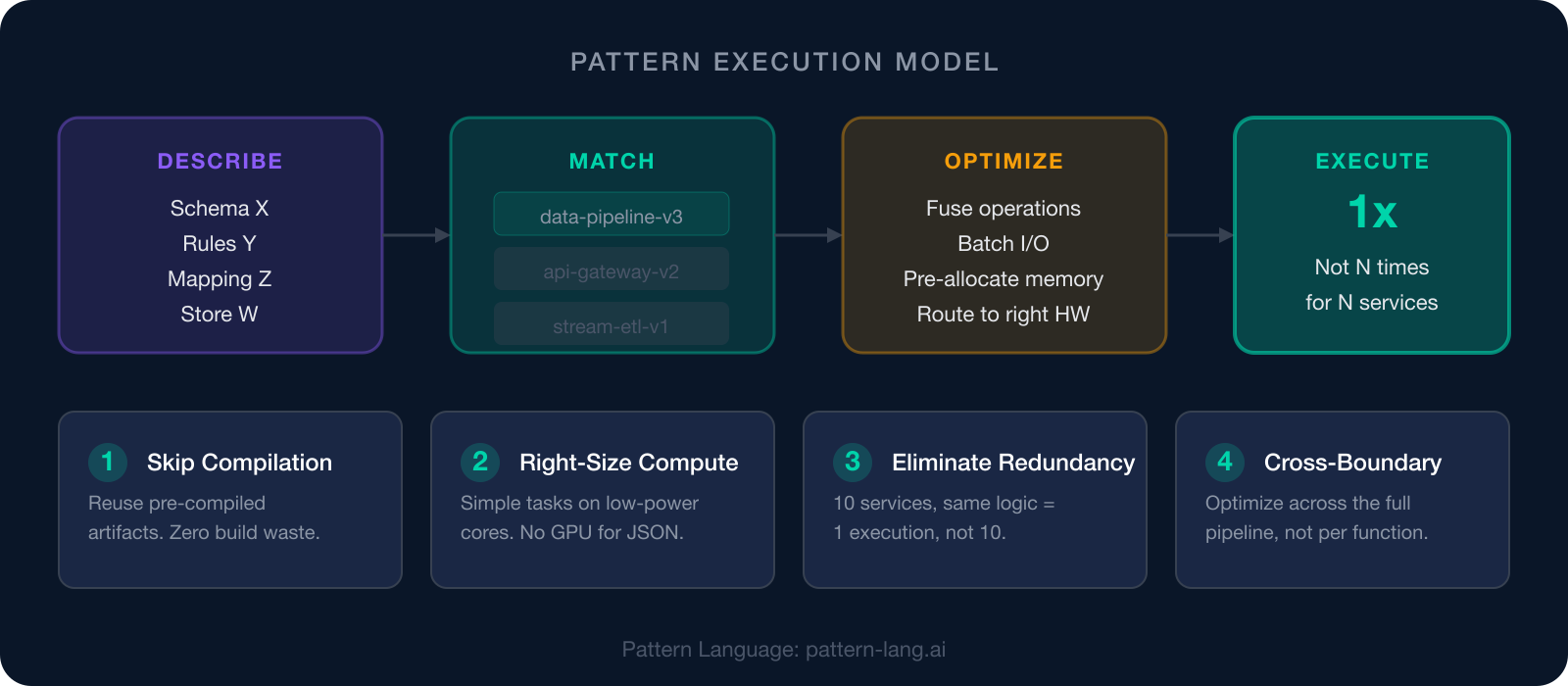
Side-by-side comparison of bespoke code execution vs. reusable compiled patterns

Patterns, Not Code: The Real Cost of Wasted Energy

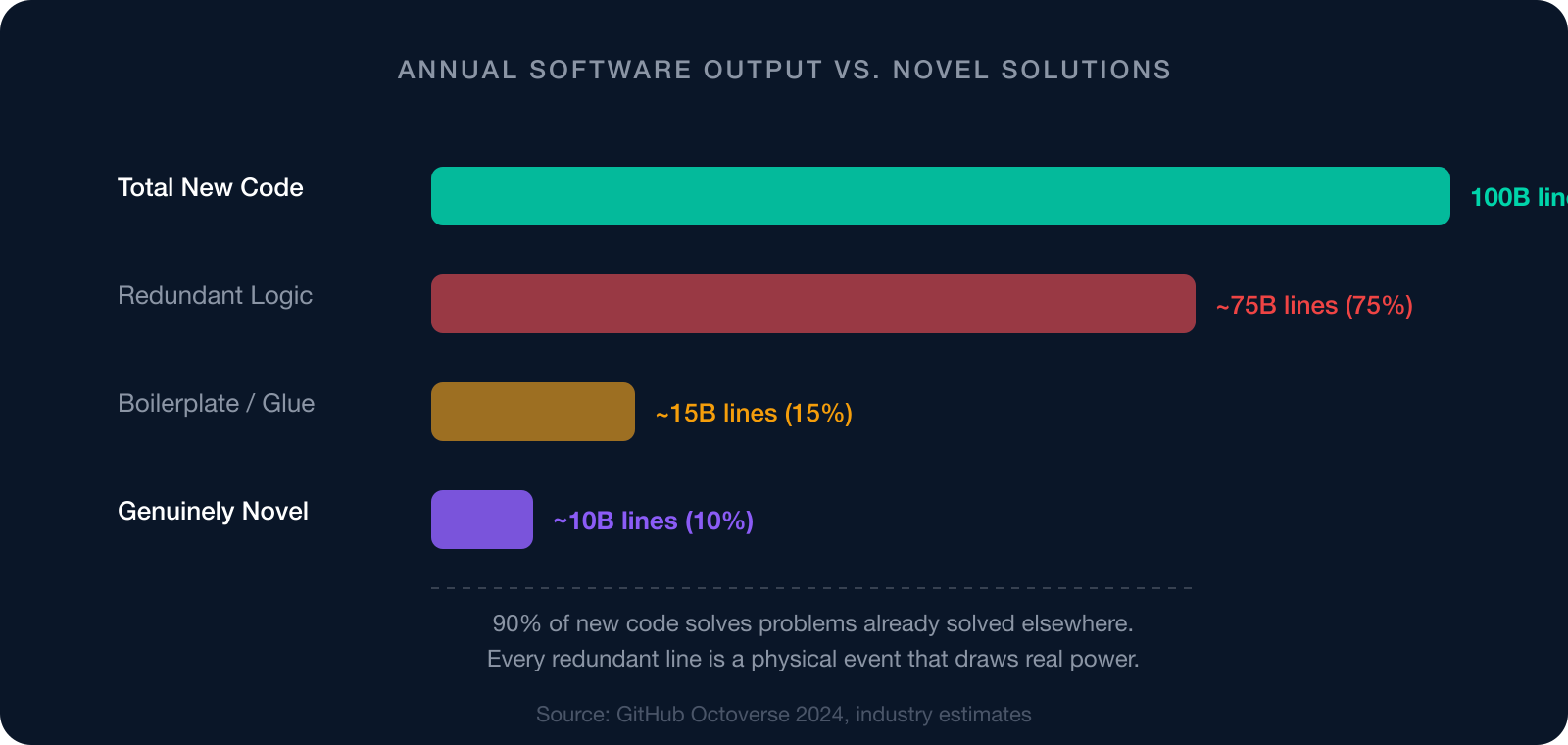
The world doesn't need more code. It needs better patterns. Every redundant line of software burns real watts, generates real heat, and costs real money. There's a different way.

Technical metadata & provenance ▾ est_j
Feb 2026 Essay · Verbatim + Addendum Unifying Framing & Synthesis research est_j

Reusing canonical, pre-verified execution patterns avoids redundant compilation and runtime overhead, though February's macro-cost example contained a unit-conflation arithmetic error (100,000 hrs × 0.10 USD/hr = 10,000 USD cloud compute, not 4–6M USD) and understated NVIDIA A100 board-level pJ/FLOP (est_j analytical estimate — corrected in Errata).

• 15 min read
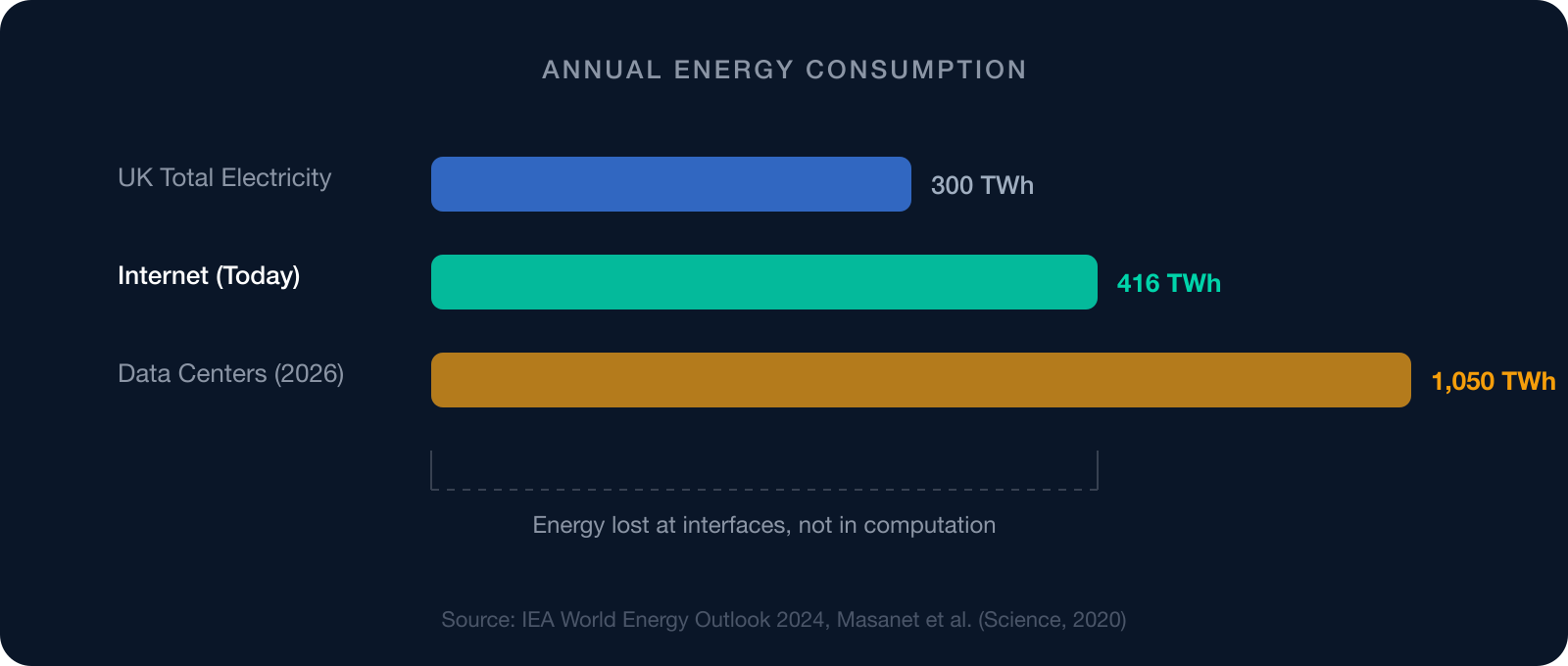
Annual energy consumption comparison showing the internet surpassing UK total electricity

The Hidden Energy Crisis at Every Interface

The world's computing infrastructure wastes enormous energy where systems meet. We tracked $15M in engineering integration losses across 30+ projects — and built tools to make interface energy measurable.

Technical metadata & provenance ▾ est_j
Feb 2026 Essay · Verbatim + Addendum Unifying Framing & Synthesis energy est_j

Unexamined subsystem boundaries cause both financial integration rework ($15M project NRE ledger in human/engineering dollars, separate from electrical Wh/J) and avoidable electrical energy draw when routine queries route unconditionally to frontier models (72.3% saving was an early est_j analytical tiering projection; IEA datacenter citations audited in Errata).

• 16 min read
Diagram of typed pattern DAG execution, effect-based stage splitting, and multi-language emission

The Pattern Programming Language: Programs as Port-Type-Compatible Pattern Graphs Across 37 Target Languages

February 11, 2026 v1.1 language specification representing programs as ~200-byte binary-serialized DAGs (.gp) with a 5-class Effect System, Port Semantic Contracts, and 37-language codegen—with November 25, 2026 errata fixing its 55.1% port-compatibility share and Any-wildcard soundness caveat.

Technical metadata & provenance ▾ unmetered
Whitepaper (Feb 11, 2026) · Verbatim + Addendum Formal Proof / Spec engineering unmetered

Specifies a binary-serialized acyclic dataflow representation (.gp) with a 5-class effect conflict matrix, Design-by-Contract port predicates, and 37-language code emitters; across 413,449 ordered catalog port pairs, 227,653 (55.06%) match under port-compatibility rules that include a bidirectional Any wildcard (unmetered).

• 6 min read
Illustration of offline catalog enumeration amortizing synthesis into microsecond lookup

The Cartographer: LLM-Driven Pattern Catalog Expansion for Deterministic Synthesis

February 8, 2026 whitepaper proposing 'Enumerate, Don't Generate': using 48 offline LLM calls to expand an 800-pattern closed-benchmark catalog across 48 domains into a compact bincode index for microsecond deterministic retrieval.

Technical metadata & provenance ▾ unmetered
Whitepaper (Feb 8, 2026) · Verbatim + Addendum Measured/Empirical Engineering research unmetered

Forty-eight offline LLM enumeration prompts (T = 0.3) expanded an 800-pattern curated base library across 20 additional systems domains (48 total), canonicalizing ~3,000–4,000 deduplicated typed signatures at ~15 KB per 100 patterns in bincode (unmetered).

• 6 min read
Systems architecture illustration for Joule compile-time energy budgets and OS scheduling

Joule Technical Overview & Founding Story: Compile-Time Energy Budgets for Systems Software

February 4, 2026 language specification whitepapers introducing Joule: an affine-ownership systems language with static @energy_budget annotations (est_j), RAPL/ARM runtime meters (reported_j), and a Cranelift/LLVM/MLIR tri-backend compiler architecture.

Technical metadata & provenance ▾ reported_j
Whitepaper (Feb 4, 2026) · Verbatim + Addendum Formal Proof / Spec product reported_j

Specifies an affine-ownership systems programming language pairing static WCET-style @energy_budget instruction/memory cost annotations (est_j) with runtime hardware-counter meters (RAPL/IOReport, reported_j) across a Cranelift, LLVM (-Oe), and MLIR tri-backend design.

• 6 min read
Visual representation of continuous state-space dynamics coupled to a verified runtime

Building an AI-First Language with Selective State Spaces (Mamba-2 State Space Duality in Rust)

February 2026 (v1.0) control-theory-to-Rust architectural monograph tracing Rudolf Kalman's 1960 state-space equations through HiPPO and Mamba-2 State Space Duality (SSD) into a zero-dependency Rust 1.93.0 specification with grammar-constrained Oracle types.

Technical metadata & provenance ▾ unmetered
Whitepaper (Feb 3, 2026) · Verbatim + Addendum Formal Proof / Spec research unmetered

Derives a continuous-to-discrete control-theoretic formulation from Kalman (1960) through Zero-Order Hold discretization, HiPPO, and Mamba-2 State Space Duality into a pure-Rust 1.93.0 systems design with O(log L) prefix scans and CFG-masked Oracle types (unmetered).

• 7 min read
Unified stack bridging L0 deterministic lookup through L3 reasoning with procedural compilation

Unified Intelligence: Integrating Adaptive Routing with Deterministic Execution (L0–L3 Horizon)

February 2, 2026 whitepaper uniting Search-First routing with Cortex IR execution across the L0–L3 Horizon (11.9 J/query observed warmed average vs. 170 J LLM baseline = 14.3x on calibrated M4 Max telemetry), with November 25, 2026 ratio and regime reconciliations.

Technical metadata & provenance ▾ reported_j
Whitepaper (Feb 2, 2026) · Verbatim + Addendum Measured/Empirical Engineering research reported_j

Calibrating local execution costs on an Apple M4 Max (7.6% MAE vs. macOS power counters), routing 10,000 enterprise log queries across L0–L3 with compiled Cortex IR procedural caching reduced energy from a modeled 170 J/query uniform LLM baseline to 11.9 J/query observed (14.3x, vs. 8.0 J/query oracle and <50 J/query under cold-start 40%-novel episodic drift).

• 7 min read
Diagram of the three physical infrastructure walls confronting modern AI inference

The AI Inference Crisis: The Token Crash Paradox, KV-Cache Limits, and Hardware-Grounded Routing

January 30, 2026 infrastructure economics whitepaper framing the Token Crash Paradox: why a 62–1,000x drop in unit API token prices coincided with rising enterprise inference spend against KV-cache and HBM memory-bandwidth walls.

Technical metadata & provenance ▾ est_j
Whitepaper (Jan 30, 2026) · Verbatim + Addendum Unifying Framing & Synthesis energy est_j

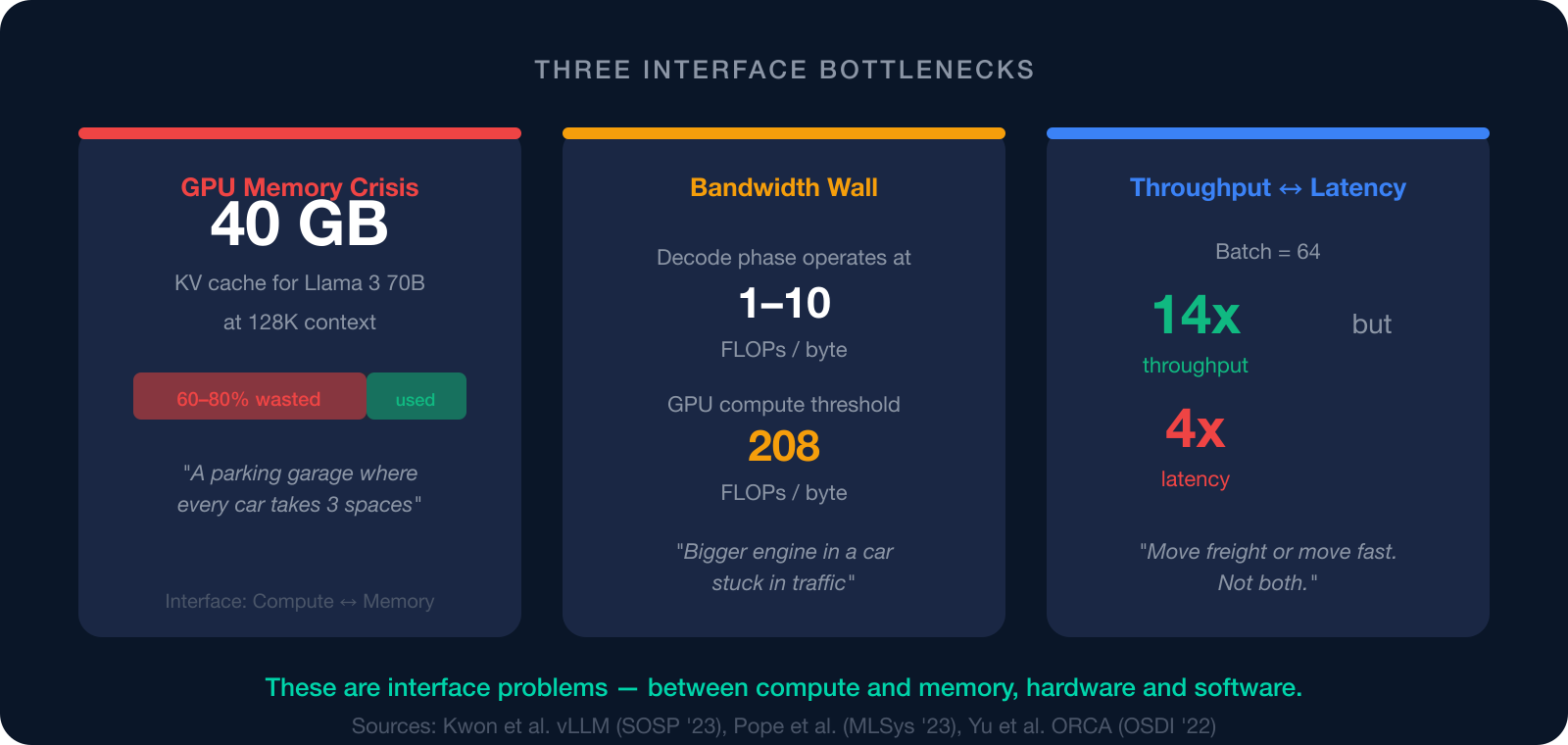
Unit API token price reductions of 62–1,000x coincided with rising aggregate enterprise AI spend due to 50–100x multi-step agentic token amplification and memory-bandwidth-bound (1–10 FLOPs/byte) autoregressive decode bottlenecks (est_j).

• 7 min read
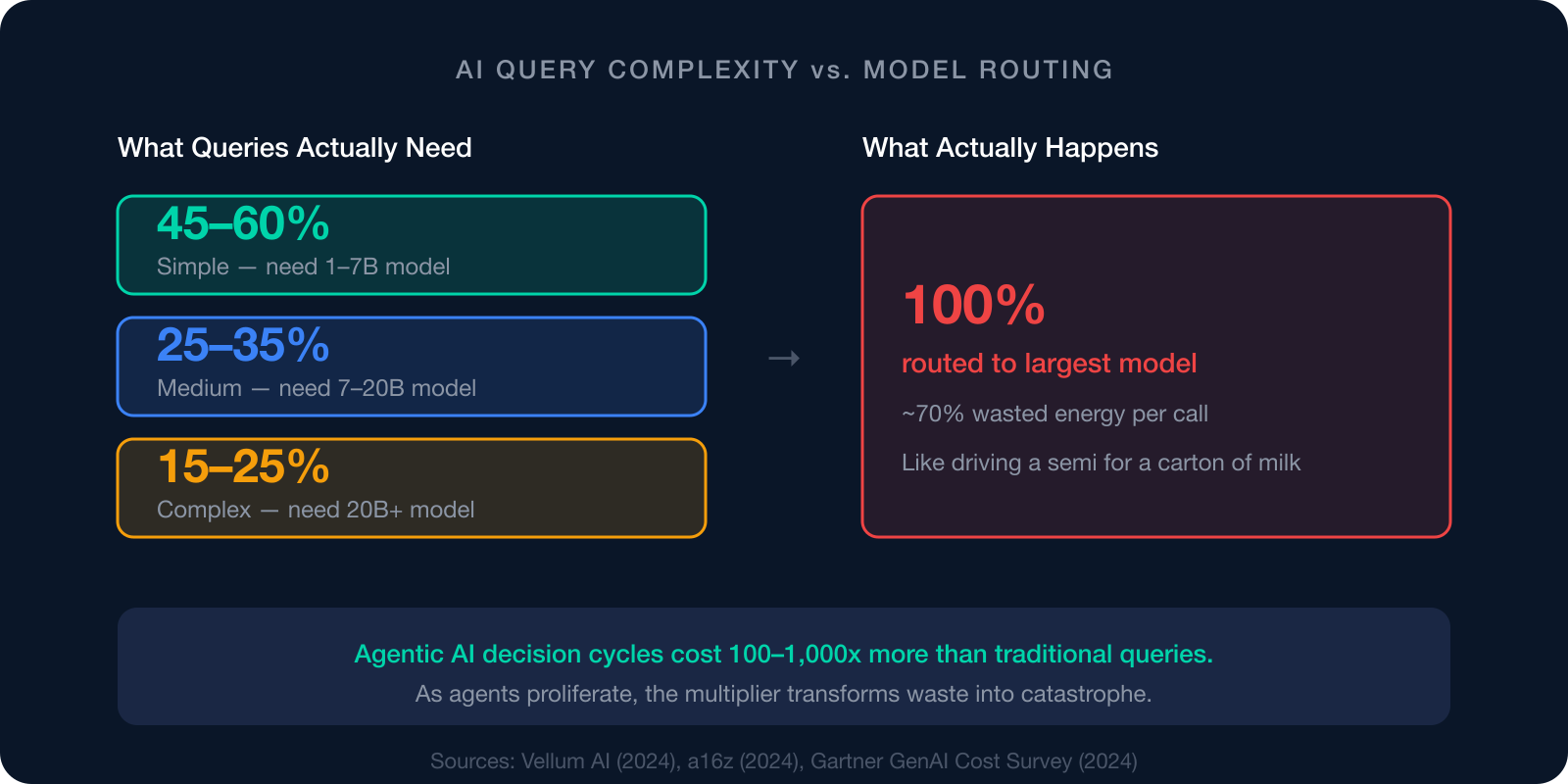
Distribution of simple, medium, and complex AI queries routed across model tiers

Metabolic Cascade Inference: Hardware-Aware Adaptive Routing for Energy-Efficient AI

January 26, 2026 whitepaper introducing thermal- and battery-grounded 3-tier model routing, conditional speculative decoding, inline claim validation, and procedural skill extraction—with November 25, 2026 errata reconciling its 70.25% vs. 72.3% tier-mix arithmetic.

Technical metadata & provenance ▾ est_j
Whitepaper (Jan 26, 2026) · Verbatim + Addendum Measured/Empirical Engineering energy est_j

Simulated a 3-tier hardware-state-aware routing loop with thermally gated k=4 speculative decoding, yielding a 70.25% exact analytical cost reduction under its nominal 60%/25%/15% (1 / 3.5 / 10 unit) split and 69.0% (65 vs. 210 units) on a 21-query discrete trace (est_j).

• 6 min read
Illustration contrasting human-oriented code presentation with machine canonical structure

4D Code Personality Coordinates Over Piecewise-Discrete AST Transforms: The Style Engine

January 22, 2026 whitepaper factoring surface code presentation out of LLMs into ~1,800 lines of deterministic Rust parameterized by [0, 1]^4 coordinates over piecewise-discrete AST tiers across 37 languages, with a 9.56 ms Metal grid search and analytic surrogate coordinate polish.

Technical metadata & provenance ▾ unmetered
Whitepaper (Jan 22, 2026) · Verbatim + Addendum Measured/Empirical Engineering engineering unmetered

Parameterized five piecewise-discrete code-presentation transforms (comments, docstrings, identifier alpha-renaming, provenance headers) via a [0, 1]^4 coordinate vector across 37 languages, matching target style features in 13.57 ms via a 160,000-point Metal grid search plus smooth analytic-surrogate CPU coordinate polish (unmetered).

• 7 min read
Architecture visual for neural-symbolic compilation and deterministic runtime execution

Cortex: Neural-Symbolic Programming for Energy-Efficient Code Execution

January 12, 2026 whitepaper introducing Cortex: a polyglot tree-sitter ingestion, 128-dim Mamba context monitor, SSA optimizer, and Cranelift/Metal execution prototype, with November 25, 2026 errata scoping its 5-language evaluation, 34.4x energy ratio, and in-house interpreter baseline.

Technical metadata & provenance ▾ est_j
Whitepaper (Jan 12, 2026) · Verbatim + Addendum Measured/Empirical Engineering engineering est_j

Cortex lifted and executed 480/500 benchmark scripts across 5 evaluated languages (out of 21 wired tree-sitter grammars), accelerated 1000x1000 f32 matmul 182.2x relative to its own unoptimized AST/bytecode interpreter, and lowered modeled pipeline energy from 110 J to 3.2 J = 34.4x (est_j).

• 7 min read
Illustration of deterministic verification harnesses gating AI-generated software artifacts

Deterministic Code Auditing for Production-Ready Software (AI-Verify & Fruition Scoring)

December 22, 2025 whitepaper introducing AI-Verify: a 15-language tree-sitter static stub/complexity linter emitting SARIF 2.1.0 in 14.5 ms/file, paired with November 25, 2026 errata on comment non-monotonicity and detector-label circularity.

Technical metadata & provenance ▾ est_j
Whitepaper (Dec 22, 2025) · Verbatim + Addendum Measured/Empirical Engineering engineering est_j

AI-Verify audited 15 languages via tree-sitter CST rules at 14.5 ms/file (~0.05 J est_j) and achieved 92.9% F1 on a 2,000-file stub/placeholder dataset, subject to syntactic-comment gaming and lexical label-definition overlap.

• 7 min read
Diagram contrasting massive global code redundancy against bounded formal-language lookup

Bounded Entropy in Formal Languages: A Mathematical Foundation for Deterministic Code Generation

December 15, 2025 founding whitepaper auditing 2.3 million Rust functions across 50,000 repositories (94.7% under 1.0 bit of signature-conditioned entropy), paired with November 25, 2026 errata correcting its kWh/MWh daily unit slip and dimensional objective formula.

Technical metadata & provenance ▾ est_j
Whitepaper (Dec 15, 2025) · Verbatim + Addendum Formal Proof / Spec research est_j

Across 2.3M statically normalized Rust functions, 94.7% exhibited <1.0 bit of conditional implementation entropy given signature and trait context, motivating an L0–L5 lookup-before-inference cascade modeled at 75.0 kWh/day (86.25 kWh/day with 15% retries) vs. 1.03 kWh/day per 1M completions (est_j).

• 10 min read