"AI" Reads Human: Serialization, Tokenization, and Per-Process Parse Energy Across 34 Workloads
Measures parse time, token bloat across 5 tokenizers, and Apple M5 Max per-process ri_energy_nj (reported_j) on a 20,000-record synthetic corpus while reporting 109/170 shared-host IOReport drift rejections.
Primary Source: Primary Paper: research.openie.dev/papers/ai-reads-human/ · Canonical Digest:
blake3:tv:354d34ae4d1f4445cf393cc82d84c99ac2bac5585366b86e02521716baa3112c· Telemetry Class:reported_j(Apple M5 Max macOS proc_pid_rusage ri_energy_nj L3 reported_j (subprocess isolated); measured_j = null (no wall meter))Unattended Gate Flag (
human_in_gate = false): Automated build, benchmark, and proof-checking scripts ran without manual human override; signed & self-checked by OpenIE — not independently peer-reviewed (Verification & AI-Use Disclosure · Glossary).Inline Evidence Tags:
[T]machine-checked Lean 4 theorem over stated axioms ·[E]empirical benchmark or hardware log ·[M]analytical/mathematical model or simulation ·[S]external literature, filing, or specification citation.
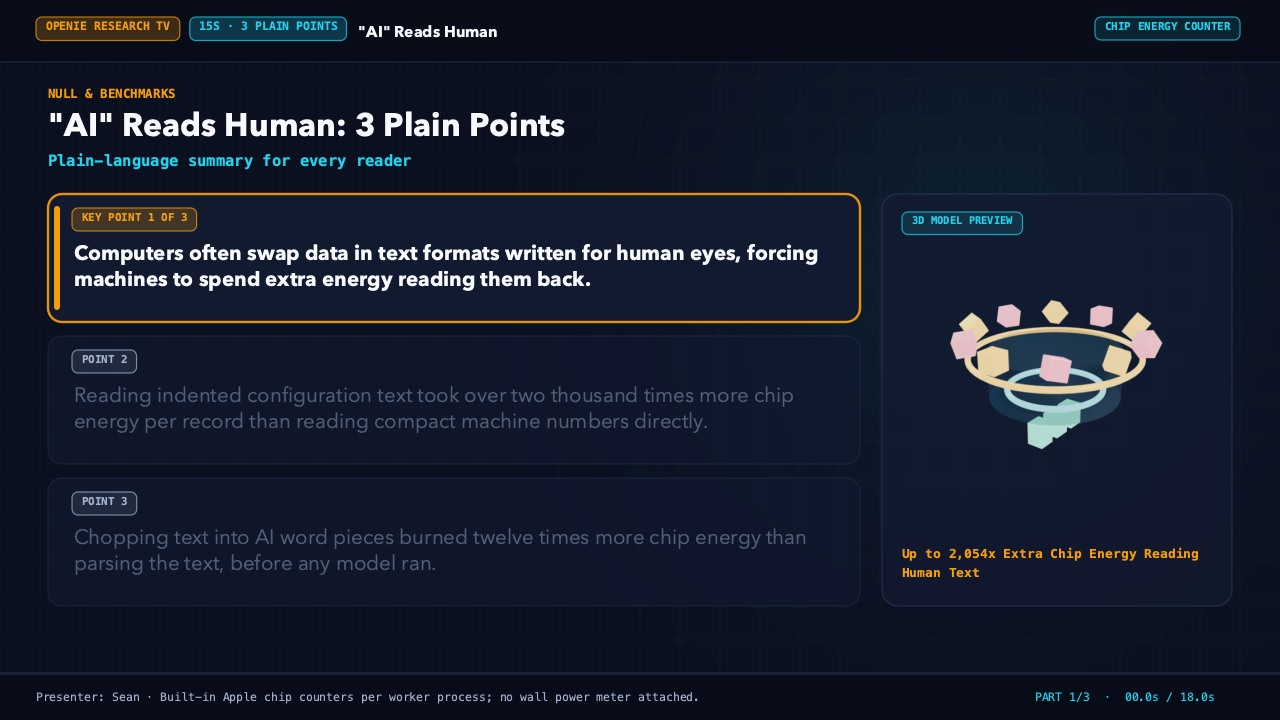
Per-record parse and tokenization energy on Apple M5 Max L3 ri_energy_nj (reported_j) plus 109/170 whole-chip IOReport drift rejections.
Key Claims & Evidence Tags
- [E · reported_j, Apple M5 Max
ri_energy_njL3] On20,000seeded records (seed = 20261016, CPython3.13),struct.iter_unpackon a23 Bfixed binary record (using a shared 24-word dictionary) consumed 280.4 nJ/record, vs. 2,212.1 nJ (7.89x) forjson.loads, 69,922.1 nJ (249.4x) for Clibyaml, 575,799.3 nJ (2,053.8x) for pure-PythonPyYAML, and 27,679.2 nJ (98.7xbinary /12.5xjson.loads) just to tokenize compact JSON withtiktoken(cl100k_base) before any GPU neural layer runs. - [E · Negative Result 1: Base64/Hex Does Not Save LLM Tokens] Dumping the
23 Bbinary layout as text for an LLM yielded20.3tokens/record in Base64 (0.89xCSV) and22.7tokens/record in Hex (0.99xCSV vs.22.9for CSV,36.2compact JSON,51.4YAML,65.6pretty JSON)—showing that text-tokenized LLMs do not benefit from binary wire formats unless binary tool payloads bypass the text context window. - [E · Negative Result 2:
109/170Shared-Host Drift Rejections] Whole-chipIOReport(L2) subtraction failedFalsifier 6(> 5.0%pre/post idle drift) on 109 of 170 measurement windows on active laptops, motivating worker-subprocessproc_pid_rusage(L3) isolation and leaving inline hardwaremeasured_jand GPU prefill/decode (M4) explicitly open.
Methods, Baselines & Artifact Scope
| Methodological Dimension | Primary-Paper Grounding & Scope |
|---|---|
| Hardware & Telemetry | Timing baseline: 8-vCPU Linux Xeon (Python 3.13.5, minimum of 9 repeats; no RAPL exposed). Energy campaign: Apple M5 Max (macOS worker subprocess proc_pid_rusage(RUSAGE_INFO_V6).ri_energy_nj L3 reported_j, alongside audited whole-chip IOReport L2 reported_j; measured_j = null, board_metered = false). |
| Workload & Benchmark Suite | 34 parse and tokenization workloads over a synthetic seeded 20,000-record corpus (id, 3-word name, float, bool, 3 tags, 31-bit int), plus 5 open tokenizers (cl100k_base, o200k_base, GPT-2, Mistral-7B-v0.1, Qwen2.5-0.5B) and parser-differential hazard checks (Node v20.19.2, jq 1.7, PyYAML 6.0.2, lxml 6.1.3). |
| Baseline(s) Compared | 23 B fixed binary (struct.iter_unpack with shared 24-word table), CSV (RFC 4180), compact/pretty JSON (RFC 8259), C libyaml & pure-Python YAML (1.2.2), XML (lxml), Markdown (CommonMark 0.31.2), and CBOR (RFC 8949). Compiled C/Rust zero-copy parsers (simdjson, Cap’n Proto, FlatBuffers): planned (M8), not yet benchmarked here. |
| Runs (N) & Spread / Uncertainty | Xeon timing: N = 9 repeats over 20,000 records (min reported: 116 ns binary, 904 ns JSON, 85,300 ns libyaml). Apple M5 Max energy: N = 5 windows × 34 workloads = 170 windows (109/170 L2 whole-chip windows flagged for > 5% idle drift; subprocess L3 means reported in parse_energy.tsv). |
| Caching / Cold vs. Warm Scope | In-memory buffer parsing after warm-up import; shared 24-word dictionary for the 23 B binary format must be pre-agreed by hash (explicitly noted in Figure 8 so binary byte size is not overstated). |
| Artifact & License Availability | Work-in-progress manuscript (CC0-1.0) and full scripts/logs (MIT OR Apache-2.0) in openIE-dev/openie-research-experiments; self-checked, open for external replication. |
Problem, Work-in-Progress Scope & Library Caveats
The primary paper explicitly labels itself a work in progress and highlights four methodological boundaries upfront [E]: (1) parsers perform unequal object-allocation work (struct.iter_unpack returns tuples whereas json.loads and PyYAML allocate typed dicts/lists); (2) measurements thus far run inside CPython 3.13 rather than native C++/Rust SIMD parsers (simdjson, serde, FlatBuffers, planned as M8); (3) the 20,000-record corpus is synthetic and identifier-light; and (4) GPU transformer prefill/decode joules (M4) and inline wall-meter measured_j remain unmeasured [E].
Parse Energy, Token Bloat & Parser-Differential Hazards
-
Subprocess
ri_energy_nj(L3 reported_j) across formats[E]: Isolating each of the34workloads in a fresh macOS worker process resolved a 2,053.8x CPU energy span across the same20,000records:280.4 nJ/rec(structbinary) ->2,212.1 nJ/rec(json.loads,7.89x) ->27,679.2 nJ/rec(tiktoken cl100k_baseon compact JSON,98.7xbinary and12.5xjson.loads) ->69,922.1 nJ/rec(PyYAML + C libyaml,249.4x) ->575,799.3 nJ/rec(pure-PythonPyYAML,2,053.8x)[E]. -
Five-tokenizer inflation
[E]: Relative to CSV (22.9cl100k_basetokens/rec), compact JSON uses36.2(1.58x), YAML51.4(2.24x), and indent-2 JSON65.6(2.86x;2.22xunderQwen2.5to3.66xunderGPT-2)[E]. -
Interoperability hazards in human-first formats
[E, S]: Differential tests confirmed9007199254740993(2^53 + 1) parses exactly in Pythonjsonwhile silently rounding to...992in NodeJSON.parse, duplicate JSON keys behave unpredictably (RFC 8259 §4), and Pythonjsonaccepts non-standardNaN/Infinityby default[E, S].
Limitations & Negative Results
-
Why
109/170whole-chip windows were rejected: Unisolated laptopIOReport(L2) drifted by> 5.0%on109of170runs (64.1%), proving that whole-package subtraction on active workstations cannot reliably resolve microjoule-per-record deltas[E]. -
Binary-as-text fails for LLMs: Encoding the
23 Bbinary struct into Base64 (20.3tok/rec) or Hex (22.7tok/rec) saves almost nothing over CSV (22.9tok/rec) while destroying legibility—confirming that binary formats help machine-to-machine buses (CBOR,Protobuf), whereas LLM context savings require field projection or grammar-constrained structured decoding[E].
Energy & Telemetry Scope
All joule numbers in this study are macOS kernel proc_pid_rusage (ri_energy_nj, L3 reported_j) CPU-model estimates (measured_j = null, board_metered = false). Background LLM GPU inference figures cited in the paper (3–4 J/output token on 65B LLaMA in Samsi et al. 2023; 0.047 kWh/1,000 generations in Luccioni et al. FAccT 2024 V1.1) are external literature [S], not measurements from this setup.
Related Work & References
- RFC 8949 (CBOR, Bormann & Hoffman 2020) & RFC 8785 (JCS, Rundgren et al. 2020): Standard deterministic binary and canonical JSON wire encodings
[S]. - Protocol Buffers, Apache Avro, Cap’n Proto & Langdale & Lemire (simdjson, VLDB J. 2019): Schema-typed binary serialization and gigabyte-per-second SIMD JSON parsing
[S]. - Willard & Louf (Outlines, 2023), Poesia et al. (Synchromesh, ICLR 2022) & Scholak et al. (PICARD, EMNLP 2021): Finite-state and incremental-parsing constrained decoding for language models
[S]. - Samsi et al. (IEEE HPEC 2023) & Luccioni, Jernite & Strubell (ACM FAccT 2024 V1.1): Empirical GPU energy benchmarks of LLM text generation
[S].
David Charlot
Open Interface Engineering, Inc. · Signed Provenance · Self-Checked
Corpus generator, 34-workload benchmark scripts, and 109/170 drift-rejection logs public in openIE-dev/openie-research-experiments (MIT OR Apache-2.0); prose CC0-1.0; self-checked. Full licensing & AI-use disclosure →
Video Summaries, Syndication & Site Reference
Check the primary artifacts or run an independent replication
Inspect signed provenance manifests, rerun our public Apache-2.0 commodity-hardware replication kits, review our November 25, 2026 outside-review errata, or browse primary manuscripts on the Research Hub.