Task Satiation vs. Aggregate Jevons Rebound: Bounded UnitSpecs Meet Elastic Fleet Demand
Separates per-task verification satiation (where extra compute after C(z)=1 adds zero utility) from macro-scale Jevons rebound, where cheaper per-task AI historically expands total electricity demand.
Primary Source: Primary Paper: research.openie.dev/papers/satiation/ · Canonical Digest:
blake3:tv:3ea9cd43444f33d5bae2a87a6c253bc8b45889597003b30a4b10f956c078b304· Telemetry Class:unmetered(joules = null (unmetered micro/macro-economic energy synthesis and literature review))Unattended Gate Flag (
human_in_gate = false): Automated build, benchmark, and proof-checking scripts ran without manual human override; signed & self-checked by OpenIE — not independently peer-reviewed (Verification & AI-Use Disclosure · Glossary).Inline Evidence Tags:
[T]machine-checked Lean 4 theorem over stated axioms ·[E]empirical benchmark or hardware log ·[M]analytical/mathematical model or simulation ·[S]external literature, filing, or specification citation.
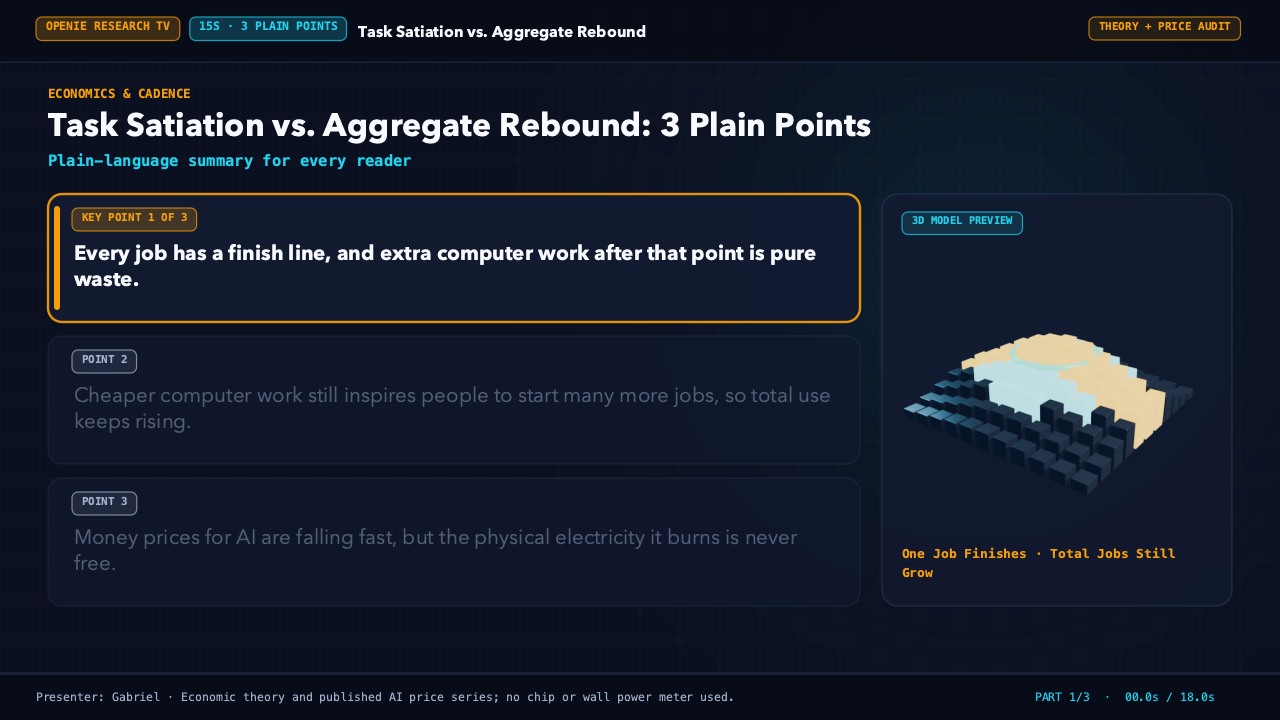
Analytical separation between single-task specification satiation and fleet-wide Jevons rebound (joules = null, unmetered).
Key Claims & Evidence Tags
- [M · Micro-Level Task Satiation] On any task governed by a sound binary completeness check
C(z) = 1(such as an exact compile+test repair or proved theorem), marginal utility of extra tokens after the first verified hit is zero—contrasting with open-ended creative or adversarial loops that lack a stopping criterion. - [M/S · Macro-Level Rebound Caveat] Micro-efficiency does not guarantee lower grid electricity: under the standard elasticity identity
d ln E_total / d ln eta = epsilon_d - 1, cutting joules per task expands the set of economically viable automated workflows and raises total fleet power whenever demand price elasticityepsilon_d > 1(backfire / Jevons paradox). - [S · Empirical Macro Context] Synthesizes Nordhaus (1996) lighting lumen-price history (
> 1,000xefficiency gain paired with rising total lighting electricity share) and IEA (2024/2026) global datacenter electricity projections (~415 TWhtoward~945 TWhby 2030).
Methods, Baselines & Artifact Scope
| Methodological Dimension | Primary-Paper Grounding & Scope |
|---|---|
| Hardware & Telemetry | Unmetered (joules = null, board_metered = false). Analytical microeconomic stopping-time models paired with published macro-energy elasticity literature. |
| Workload & Benchmark Suite | No primary hardware benchmark run in this study; synthesizes historical efficiency/rebound series and IEA datacenter electricity reports. |
| Baseline(s) Compared | Closed-specification gated tasks (C(z) in {0,1} finite stopping rule) vs. unbounded best-of-N / open-ended quality tournaments. |
| Runs (N) & Spread / Uncertainty | Not applicable (N = 0 primary lab trials; cites published IEA scenario ranges and Sorrell 2009 econometric elasticity intervals). |
| Caching / Cold vs. Warm Scope | Notes that exact-match caching lowers marginal cost on recurring queries toward zero, further steepening the micro price drop that drives new extensive-margin adoption. |
| Artifact & License Availability | Public-domain manuscript (CC0-1.0) at research.openie.dev/papers/satiation/; self-checked, not externally peer-reviewed. |
Problem: Why Micro-Efficiency Claims Overshoot Macro Grid Reality
Engineering blogs routinely extrapolate a 10x or 100x kernel energy reduction into an equivalent cut in global datacenter power. satiation was written specifically to reject that naive extrapolation [M, S]. By separating the intensive margin (joules spent to close one fixed task) from the extensive margin (how many tasks society chooses to run once each task costs millicents instead of dollars), the paper reconciles bounded per-task verification with rising aggregate AI power draw [M, S].
Two Regimes: Bounded UnitSpecs vs. Elastic Extensive Margins
-
Bounded per-task satiation
[M]: When a caller needs a specific file parsed, a deterministic state step run, or a bug patched against a sound specification, stopping immediately uponC(z) = 1eliminates wasted post-solution sampling (such as30xsame-task agent token variance documented by Bai, Huang & Wang 2026)[M, S]. -
Extensive-margin Jevons rebound
[S, M]: Jevons (1865), Khazzoom (1980), Brookes (1990), Saunders (1992), and Nordhaus (1996) demonstrate that drastic reductions in the cost of an intermediate input (coal per horsepower-hour, watts per lumen, or joules per verified inference) induce substitution and new application categories[S]. Even if every individual coding check drops100xin energy, running continuous background verification across millions of repositories can increase aggregate kWh[M].
Limitations & Unresolved Elasticity Parameters
-
Demand elasticity for AI tasks is unmeasured: Whether long-run price elasticity
epsilon_dfor verified software/automation tasks sits below1(partial rebound, net energy savings) or above1(Jevons backfire) is an open empirical macro-econometric question not measured here[M, S]. -
Positional / adversarial arms races do not satiate: Tasks with relative payoffs (high-frequency trading, ad-auction bidding, cyber offense/defense) lack a finite
C(z) = 1satiation point regardless of gate design[M].
Energy & Telemetry Scope
This study is unmetered (joules = null, board_metered = false); datacenter terawatt-hour figures (~415 TWh to ~945 TWh) are cited directly from International Energy Agency (IEA) reports [S].
Related Work & References
- Jevons (1865), Khazzoom (Energy J., 1980) & Saunders (Energy J., 1992): Foundational theory of resource rebound and growth-inducing efficiency gains
[S]. - Sorrell (UKERC Review, 2009) & Gillingham, Rapson & Wagner (Rev. Environ. Econ. Policy, 2016): Empirical bounds on direct, indirect, and economy-wide rebound effects
[S]. - Nordhaus (NBER, 1996): Two-century price-per-lumen and lighting demand series
[S]. - International Energy Agency (IEA Energy and AI, 2024–2026): Global datacenter electricity baselines and 2030 scenario projections
[S].
David Charlot
Open Interface Engineering, Inc. · Signed Provenance · Self-Checked
Economic analysis and literature synthesis dedicated to the public domain (CC0-1.0); zero proprietary code dependencies; self-checked, not externally peer-reviewed. Full licensing & AI-use disclosure →
Video Summaries, Syndication & Site Reference
Check the primary artifacts or run an independent replication
Inspect signed provenance manifests, rerun our public Apache-2.0 commodity-hardware replication kits, review our November 25, 2026 outside-review errata, or browse primary manuscripts on the Research Hub.