Task Satiation vs. Aggregate Jevons Rebound: Bounded UnitSpecs Meet Elastic Fleet Demand
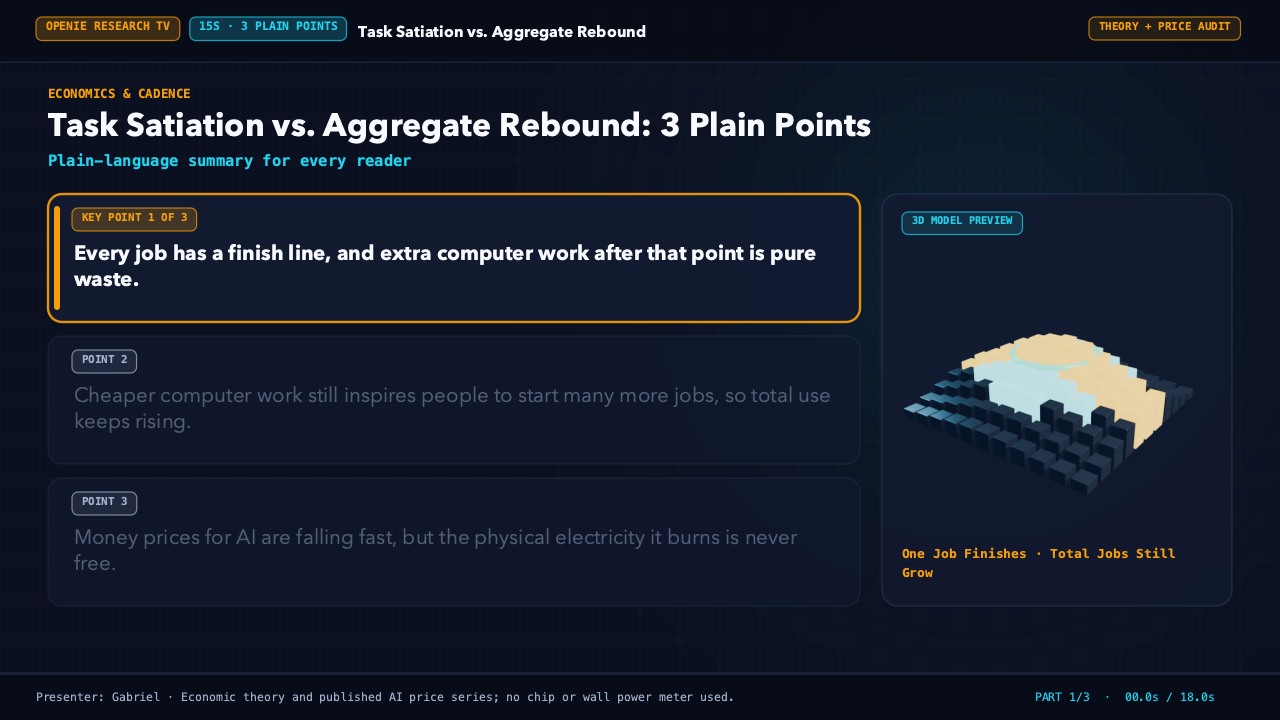
Separates per-task verification satiation (where extra compute after C(z)=1 adds zero utility) from macro-scale Jevons rebound, where cheaper per-task AI historically expands total electricity demand.
Temporal & Archival Scope: Era II OpenIE Study (November 20, 2026) · Canonical OpenIE Chronicle Entry: https://blog.openie.dev/posts/satiation/ · Primary Paper & Methods: https://research.openie.dev/papers/satiation/ · Canonical Digest:
blake3:tv:3ea9cd43444f33d5bae2a87a6c253bc8b45889597003b30a4b10f956c078b304Provenance & Telemetry Hygiene: Signed Provenance · Self-Checked (automated OpenIE internal gates; not externally peer-reviewed) · Energy Class:
unmetered(measured_j ⊥ reported_j ⊥ est_j ⊥ unmetered— Verification, Licensing & AI-Use Disclosure · Glossary & Non-Mixing Rules).
Key Claims & Evidence Tags
- [M · Micro-Level Task Satiation] On any task governed by a sound binary completeness check
C(z) = 1(such as an exact compile+test repair or proved theorem), marginal utility of extra tokens after the first verified hit is zero—contrasting with open-ended creative or adversarial loops that lack a stopping criterion. - [M/S · Macro-Level Rebound Caveat] Micro-efficiency does not guarantee lower grid electricity: under the standard elasticity identity
d ln E_total / d ln eta = epsilon_d - 1, cutting joules per task expands the set of economically viable automated workflows and raises total fleet power whenever demand price elasticityepsilon_d > 1(backfire / Jevons paradox). - [S · Empirical Macro Context] Synthesizes Nordhaus (1996) lighting lumen-price history (
> 1,000xefficiency gain paired with rising total lighting electricity share) and IEA (2024/2026) global datacenter electricity projections (~415 TWhtoward~945 TWhby 2030).
Methods, Baselines & Artifact Scope
- Methodological Dimension: Hardware & Telemetry · Primary-Paper Grounding & Scope: Unmetered (
joules = null,board_metered = false). Analytical microeconomic stopping-time models paired with published macro-energy elasticity literature. - Methodological Dimension: Workload & Benchmark Suite · Primary-Paper Grounding & Scope: No primary hardware benchmark run in this study; synthesizes historical efficiency/rebound series and IEA datacenter electricity reports.
- Methodological Dimension: Baseline(s) Compared · Primary-Paper Grounding & Scope: Closed-specification gated tasks (
C(z) in {0,1}finite stopping rule) vs. unbounded best-of-N / open-ended quality tournaments. - Methodological Dimension: Runs (N) & Spread / Uncertainty · Primary-Paper Grounding & Scope: Not applicable (
N = 0primary lab trials; cites published IEA scenario ranges and Sorrell 2009 econometric elasticity intervals). - Methodological Dimension: Caching / Cold vs. Warm Scope · Primary-Paper Grounding & Scope: Notes that exact-match caching lowers marginal cost on recurring queries toward zero, further steepening the micro price drop that drives new extensive-margin adoption.
- Methodological Dimension: Artifact & License Availability · Primary-Paper Grounding & Scope: Public-domain manuscript (
CC0-1.0) atresearch.openie.dev/papers/satiation/; self-checked, not externally peer-reviewed.
Problem: Why Micro-Efficiency Claims Overshoot Macro Grid Reality
Engineering blogs routinely extrapolate a 10x or 100x kernel energy reduction into an equivalent cut in global datacenter power. satiation was written specifically to reject that naive extrapolation [M, S]. By separating the intensive margin (joules spent to close one fixed task) from the extensive margin (how many tasks society chooses to run once each task costs millicents instead of dollars), the paper reconciles bounded per-task verification with rising aggregate AI power draw [M, S].
Two Regimes: Bounded UnitSpecs vs. Elastic Extensive Margins
-
Bounded per-task satiation
[M]: When a caller needs a specific file parsed, a deterministic state step run, or a bug patched against a sound specification, stopping immediately uponC(z) = 1eliminates wasted post-solution sampling (such as30xsame-task agent token variance documented by Bai, Huang & Wang 2026)[M, S]. -
Extensive-margin Jevons rebound
[S, M]: Jevons (1865), Khazzoom (1980), Brookes (1990), Saunders (1992), and Nordhaus (1996) demonstrate that drastic reductions in the cost of an intermediate input (coal per horsepower-hour, watts per lumen, or joules per verified inference) induce substitution and new application categories[S]. Even if every individual coding check drops100xin energy, running continuous background verification across millions of repositories can increase aggregate kWh[M].
Limitations & Unresolved Elasticity Parameters
-
Demand elasticity for AI tasks is unmeasured: Whether long-run price elasticity
epsilon_dfor verified software/automation tasks sits below1(partial rebound, net energy savings) or above1(Jevons backfire) is an open empirical macro-econometric question not measured here[M, S]. -
Positional / adversarial arms races do not satiate: Tasks with relative payoffs (high-frequency trading, ad-auction bidding, cyber offense/defense) lack a finite
C(z) = 1satiation point regardless of gate design[M].
Energy & Telemetry Scope
This study is unmetered (joules = null, board_metered = false); datacenter terawatt-hour figures (~415 TWh to ~945 TWh) are cited directly from International Energy Agency (IEA) reports [S].
Related Work & References
- Jevons (1865), Khazzoom (Energy J., 1980) & Saunders (Energy J., 1992): Foundational theory of resource rebound and growth-inducing efficiency gains
[S]. - Sorrell (UKERC Review, 2009) & Gillingham, Rapson & Wagner (Rev. Environ. Econ. Policy, 2016): Empirical bounds on direct, indirect, and economy-wide rebound effects
[S]. - Nordhaus (NBER, 1996): Two-century price-per-lumen and lighting demand series
[S]. - International Energy Agency (IEA Energy and AI, 2024–2026): Global datacenter electricity baselines and 2030 scenario projections
[S].
Canonical Provenance, Primary Artifacts & Independent Replication
- Canonical OpenIE Chronicle Entry: https://blog.openie.dev/posts/satiation/
- Primary Study & Methods: https://research.openie.dev/papers/satiation/
- Illustrated Video Summary (OpenIE Research TV): https://research.openie.dev/tv/?study=satiation (9:16 Vertical MP4)
- Signed Provenance · Self-Checked Disclosure & Licensing: Economic analysis and literature synthesis dedicated to the public domain (CC0-1.0); zero proprietary code dependencies; self-checked, not externally peer-reviewed. Full details at https://blog.openie.dev/verification/ and https://blog.openie.dev/glossary/.