RCE-JEPA: Latent Form Repair Proposers, Energy Scorers (FormEBM-v3), and 40/40 Bounded Residual Closure
Evaluates deterministic rce repair (111/151 zero-call closes), FormJEPA-v1 (8.42M), FormEBM-v2/v3 (0.9437 unseen H5 AUROC, 0.5278 OOD H15), and bounded 5-turn H15-Iterative closure (40/40 on Opus/Sonnet 5.5, reported_j).
Primary Source: Primary Paper: research.openie.dev/papers/rce-jepa/ · Canonical Digest:
blake3:tv:019888e27dfd3fb4b49ea3e29a210c3c3de5f4565c4d71c3b42ed1e7f5114b8e· Telemetry Class:reported_j(Apple M5 Max L3 ri_energy_nj & AMD Ryzen AI Max+ 395 Linux RAPL core reported_j (Falsifier 6 withheld gross pkg net attribution under 13.7%-37.7% co-tenant drift))Unattended Gate Flag (
human_in_gate = false): Automated build, benchmark, and proof-checking scripts ran without manual human override; signed & self-checked by OpenIE — not independently peer-reviewed (Verification & AI-Use Disclosure · Glossary).Inline Evidence Tags:
[T]machine-checked Lean 4 theorem over stated axioms ·[E]empirical benchmark or hardware log ·[M]analytical/mathematical model or simulation ·[S]external literature, filing, or specification citation.
Measured 3-Gear repair cascade (111/151 deterministic + FormJEPA-v1 + FormEBM-v3 + H15-Iterative), including FormJEPA-v1 H5/H11 negatives and 0.5278 cross-module OOD boundary (reported_j).
Key Claims & Evidence Tags
- [E · 3-Gear Cold Repair Cascade (
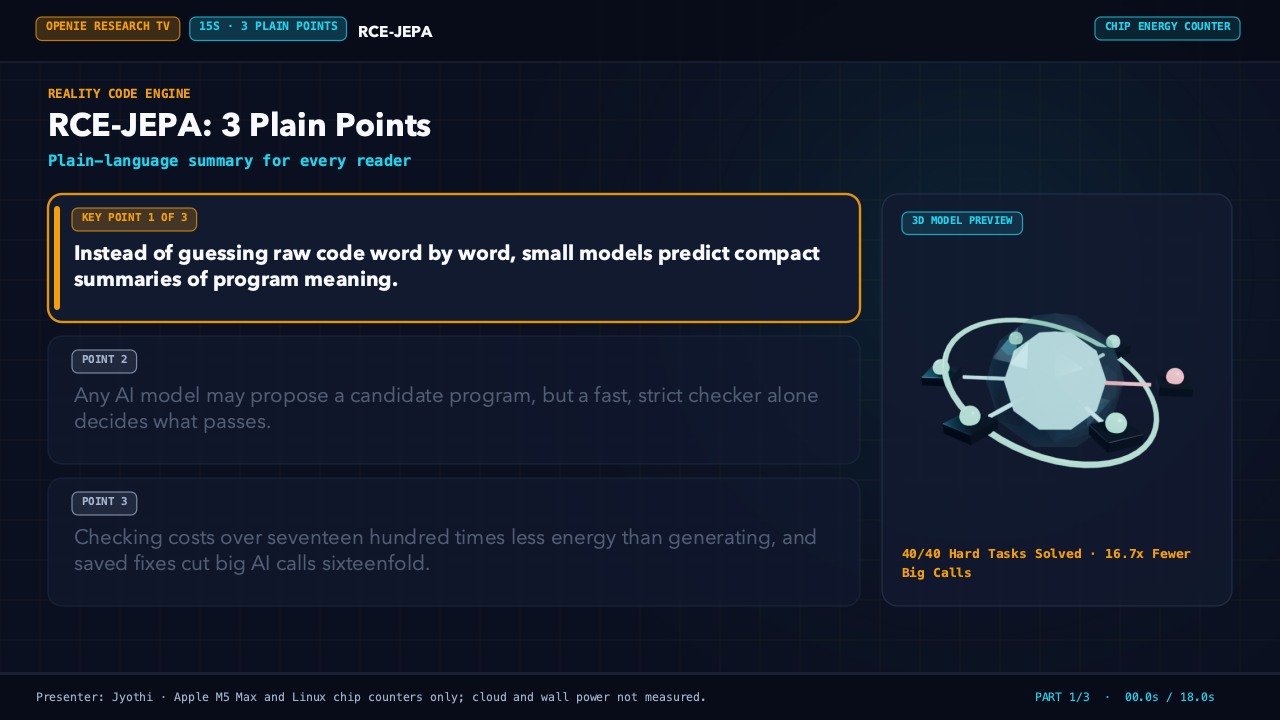
reported_j)] On151real git-history and defect tasks (openIE-dev/rce@1762fb4b), deterministic rungsa..esolved111/151(73.5%,0model calls). On the40open residual tasks (H15),FormJEPA-v1(8.42Mtrainable params trained on1,106strictly disjoint Form shapes;58.65 mJatk = 1,474.76 mJatk = 16Zen 5RAPLcorereported_j) solved22/40(k = 1) and27/40(k = 16), matching localQwen 3.6 35B-A3B(27/40at84.25 J/cand), while bounded<= 5-turn checker feedback + publicstdlib/libsignature headers (H15-Iterative) closed40/40(100%,0contradictions) onClaude Opus 5.5(USD 1.81) andSonnet 5.5(USD 1.11), and39/40onGrok 4.20 Reasoning. - [E · Candid Latent-Energy Negatives & Progression] Uncalibrated
FormJEPA-v1L2 latent distance reached only0.618AUROC onH5(inconclusive,< 0.85target) and36.0%strict 5-step monotonicity onH11. ContrastiveFormEBM-v2(5.85M) lifted unseen-shapeH5to0.8922andH11to93.0%(rho = 0.9931) but inverted to0.2585zero-shot cross-task AUROC on large multi-lineH15migrations; span-normalized two-headFormEBM-v3(6.05M) reached0.9437H5AUROC,94.0%/92.0%H11monotonicity, and resolved the OOD inversion to0.5278(0.6018on>= 10-token rewrites)—still plateauing near0.53across unseen multi-module cryptographic APIs (mls,pq,pqxdh) without cross-file signatures. - [E · Cold vs.
Zipf(0.85)Replay & Rung-fRefusal] Crystallizing verified repairs intoDNULLMM1(0.325 us,1.77 uJM5 MaxL3reported_j) replays40/40exact tasks at0calls and cuts Gear-2 frontier episodes16.67x(200->12episodes) on a200-arrivalZipf(0.85)stream—strictly via verified memoization, not unseen generalization. Meanwhile,rce repair criterion(3/119 = 2.5% > 2.0%threshold) returnedholds: false, keeping external-proposal rungfinobservemode rather than promoting it prematurely.
Methods, Baselines & Artifact Scope
| Methodological Dimension | Primary-Paper Grounding & Scope |
|---|---|
| Hardware & Telemetry | Apple M5 Max (128 GB, Darwin L3 ri_energy_nj reported_j: 49.04 mJ rce check, 1.771 uJ DNULLMM1 mmap probe) and AMD Ryzen AI Max+ 395 / Radeon 8060S (Linux powercap RAPL core reported_j: 58.65–474.76 mJ FormJEPA-v1, 47.09 mJ FormEBM-v2, 232.45 mJ FormEBM-v3; net package reported_j withheld as None under Falsifier 6 at 13.7%–37.7% co-tenant drift). measured_j = null. |
| Workload & Benchmark Suite | Disjoint 1,387-Form corpus (1,106 train, 144 val, 137 unseen test shapes; 0 overlap with eval benchmarks via 4-layer nameless hash exclusion), 200 unseen H5 candidate beams (3,064 candidates), 100 unseen 5-step H11 corruption chains, 151-task rce repair git-history ladder, and 40 open residual tasks (H15). |
| Baseline(s) Compared | Deterministic rce repair rungs a..e (111/151), unreranked & Siamese-L2 beam selection (22.5% / 25.0% top-1 vs. 83.44% FormEBM-v3), local Qwen 3.6 35B-A3B (27/40), and cloud Claude Opus 5.5, Sonnet 5.5, and Grok 4.20 (single-shot 34/40 vs. <= 5-turn 40/40). |
| Runs (N) & Spread / Uncertainty | N = 200 unseen H5 beams (3,064 candidates), N = 100 H11 chains (median Spearman rho = 1.0000, IQR shaded in Fig. 10), N = 50 unconstrained random walks (38.0% strict step inequality), N = 151 ladder tasks, N = 40 H15 residual tasks, N = 40,000 mmap probes, M = 200 Zipf(0.85) arrivals. |
| Caching / Cold vs. Warm Scope | Strict 4-layer nameless-digest deduplication between training (1,106 shapes) and cold evaluation (137 unseen shapes, 151 ladder, 40 H15). Warm DNULLMM1 (40/40 exact recall, 7/9 alpha-renamed hits via rce fmt nameless) and Zipf(0.85) (16.67x fewer Gear-2 episodes) are reported separately from cold first-exposure accuracy. |
| Artifact & License Availability | Checker/ladder public at https://github.com/openIE-dev/rce (Apache-2.0); preregistered SHA-256 manifests (B30–B36) and interactive data at research.openie.dev/living/rce-jepa/ (CC0-1.0); self-checked, not externally peer-reviewed. |
How Form-Space JEPA / EBM Differs from Pixel/Video JEPA
LeCun (2022) and Assran et al. (I-JEPA 2023, V-JEPA 2 2025) introduced Joint-Embedding Predictive Architectures to predict abstract target representations without pixel-level reconstruction [S]. RCE-JEPA tests that architecture on discrete, quotient-normalized RCE Form ASTs paired with an exact external oracle (rce check + W-MUT-1 mutation adequacy + rce equiv) [E]. Unlike continuous vision tasks, a single unbound identifier invalidates an entire program—which is why FormJEPA-v1 needed a latent-conditioned typed edit decoder and why uncalibrated Smooth-L1 latent distance (0.618 AUROC) failed H5 until replaced by contrastive/span-normalized FormEBM-v2/v3 [E].
Cold Repair Results vs. Warm Zipf(0.85) Crystallization
-
Cold first-exposure hierarchy
[E]: Deterministic solver rungsa..eclose111/151(73.5%) with zero neural weights. On the40remaining real git-history defects,FormJEPA-v1(8.42Mparams) closes27/40(67.5%atk = 16,0.475 JZen 5 corereported_j), matching35BlocalQwen 3.6(27/40,84.25 J/cand) on syntax/capability repairs while scoring0/9on multi-module cryptographic stdlib migrations (hpke,mls,pq,pqxdh)[E]. Supplying strippedstdlib/libpublic headers and<= 5turns of verbatim checker diagnostics (H15-Iterative) closes40/40onOpus 5.5andSonnet 5.5with0semantic contradictions[E]. -
Warm
DNULLMM1replay & invalidation scope[E]: Storing those40verified repairs inDNULLMM1replays40/40exact repeats in0.325 us(1.77 uJM5 MaxL3reported_j) and7/9alpha-renamed variants viarce fmt nameless, cutting frontier episodes16.67x(200->12) on a200-requestZipf(0.85)stream—while any change to importedstdlibsignatures or spec invariants invalidates the stored entry and re-triggers cold checking[E].
Limitations, Open Hypotheses (H3, H4, H6) & Rung-f Hold
-
Cross-module OOD energy ceiling (
0.5278AUROC): AlthoughFormEBM-v3fixedFormEBM-v2’s edit-length inversion (0.2585 -> 0.5278, and0.9437on unseen single-file synthetic beams), single-file syntactic encoding without imported module type signatures cannot calibrate cross-module API validity above~0.53pooled AUROC[E]. -
Rung
fNOT promoted (holds: false): On the 151-task promotion audit,3/119(2.5%) exceeded the preregistered2.0%bound (exit = 1), so neural proposals remain quarantined inobservemode[E]. -
Major hypotheses still open (
§Status): Full natural-language intent-to-Form synthesis (H3), end-to-end joule parity on 7 reference apps (H4,H6), and inline wall-metermeasured_jare not yet built or closed[E].
Energy & Telemetry Scope
Local measurements use Apple M5 Max L3 ri_energy_nj and AMD Ryzen AI Max+ 395 RAPL core reported_j (measured_j = null); whenever APU package idle power drifted (13.7%–37.7%), Falsifier 6 recorded derived_marginal_pkg_reported_j = None rather than fabricating net package numbers [E].
Related Work & References
- LeCun (OpenReview, 2022) & Assran et al. (I-JEPA, CVPR 2023; V-JEPA 2, 2025): Joint-Embedding Predictive Architectures and VICReg anti-collapse training
[S]. - Ellis et al. (DreamCoder, PLDI 2021) & Grand et al. (LILO, 2023): Wake-sleep library learning and verified synthesis compression
[S]. - Liu et al. (TBar, ISSTA 2019), Le Goues et al. (GenProg, TSE 2012) & Sun et al. (Clover, 2024): Template-driven and closed-loop verifiable program repair
[S]. - Mündler et al. (Type-Constrained Code Generation, 2025) & Hubert et al. (AlphaProof, Nature 2025): Compiler/kernel-guided neural search
[S].
David Charlot
Open Interface Engineering, Inc. · Signed Provenance · Self-Checked
Target checker/ladder at openIE-dev/rce@1762fb4b (Apache-2.0) and preregistered hashes/observatory on research.openie.dev/living/rce-jepa/ (CC0-1.0); self-checked, not externally peer-reviewed. Full licensing & AI-use disclosure →
Video Summaries, Syndication & Site Reference
Check the primary artifacts or run an independent replication
Inspect signed provenance manifests, rerun our public Apache-2.0 commodity-hardware replication kits, review our November 25, 2026 outside-review errata, or browse primary manuscripts on the Research Hub.