JouleOS: An Unmetered Operating-System Design Proposal, Provenance-Lattice Checks (78,400 Pairs), and Prior Energy-OS Lineage
Explicitly scopes JouleOS as an unmetered architectural proposal (core OS repo private; ~10^5x README figure unverified), clarifies 78,400 = 280 x 280 provenance-lattice monotonicity checks, and cites ECOSystem, Cinder, Linux EAS, and RAPL.
Primary Source: Primary Design Review: research.openie.dev/products/jouleos/ · Canonical Digest:
blake3:tv:7dc57a2972460389e4fabd076f069c237545d6154f816d489335f8b3eed65e07· Telemetry Class:unmetered(joules = null (unmetered architecture specification and Rust provenance-lattice type/property test audit))Unattended Gate Flag (
human_in_gate = false): Automated build, benchmark, and proof-checking scripts ran without manual human override; signed & self-checked by OpenIE — not independently peer-reviewed (Verification & AI-Use Disclosure · Glossary).Inline Evidence Tags:
[T]machine-checked Lean 4 theorem over stated axioms ·[E]empirical benchmark or hardware log ·[M]analytical/mathematical model or simulation ·[S]external literature, filing, or specification citation.
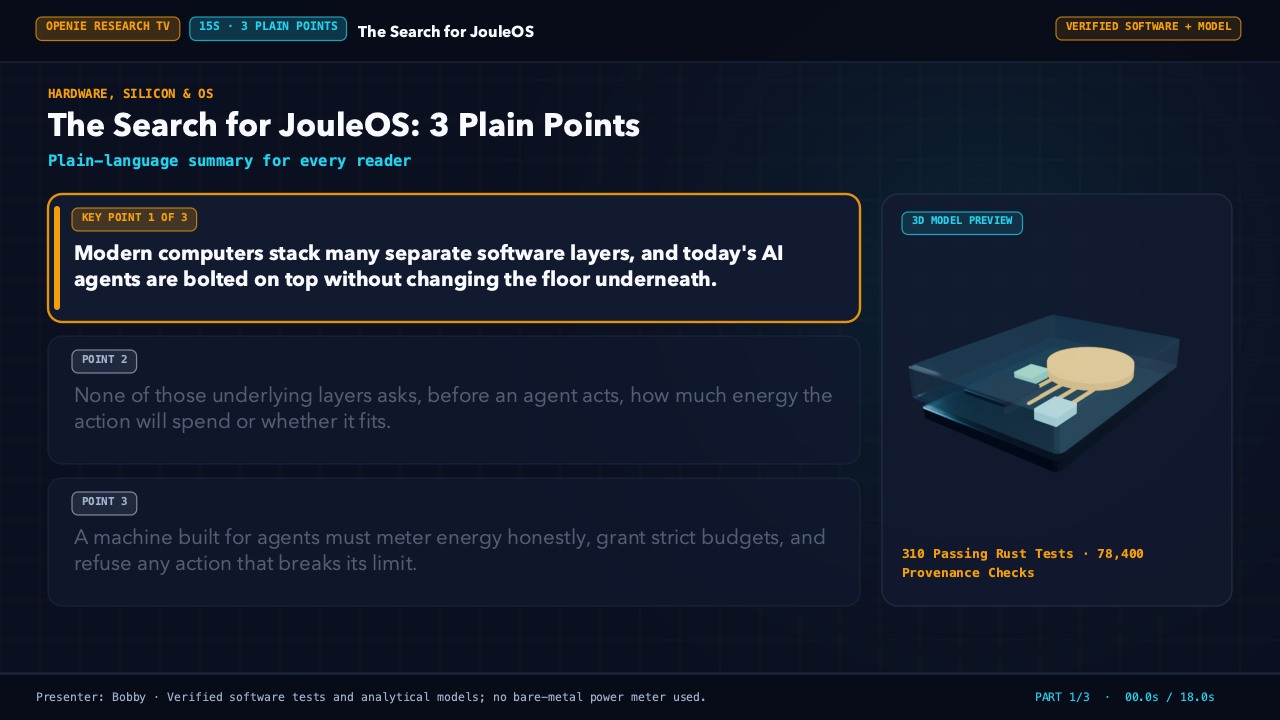
Unmetered OS design proposal: 280 × 280 = 78,400 provenance-lattice pair checks, candid private-repo disclosure, and prior OS energy-accounting lineage.
Key Claims & Evidence Tags
- [M/E · Unmetered Design Proposal Disclosure]
JouleOSis an unmetered architectural specification and design review (energyClass = unmetered,joules = null,board_metered = false)—not a benchmarked production kernel beating Linux or macOS on hardware wattmeters. As disclosed insrc/content/products/jouleos.md, the core JouleOS source tree is currently private, and an internal README’s~10^5xefficiency phrase is explicitly flagged as an unverified project aspiration, not an empirical measurement. - [E · Reconciling the
78,400Count] Earlier summaries gave two conflicting descriptions of78,400. In the auditedjcp-satb-cad-spineRust workspace (310passing tests across 7 crates),78,400is280 × 280ordered pairs of(SATB sensor boundary L0..L4 × attribution discipline A1..N × mechanism)states exhaustively tested for meet-semilattice monotonicity (0silent provenance upgrades when combining heterogeneous energy channels)—it is not78,400kernel boot runs or hardware power traces. - [S · Explicit Prior OS Energy Lineage] JouleOS’s two-phase
hold/settlecapability budgets directly descend from ECOSystem’scurrentcyabstraction (Zeng et al., ASPLOS 2002) and Cinder’s hierarchicalreservesandtaps(Roy et al., EuroSys 2011), layered atop modern Linux Energy Aware Scheduling (EAS),cpufreq/schedutil, and Intel/AMDpowercapRAPLcounters.
Methods, Baselines & Artifact Scope
| Methodological Dimension | Primary-Paper Grounding & Scope |
|---|---|
| Hardware & Telemetry | Unmetered (joules = null, board_metered = false). Static architectural review plus deterministic Rust unit/property execution over provenance-lattice types (jcp-satb-cad-spine). |
| Workload & Benchmark Suite | 310 Rust unit/property tests across 7 specification crates, including exhaustive 280 × 280 = 78,400 lattice-join monotonicity checks and two-phase hold/settle ledger conservation checks. |
| Baseline(s) Compared | Qualitative architectural comparison against POSIX time-slice scheduling, Linux EAS / schedutil, powercap RAPL, ECOSystem (2002), and Cinder (2011). Empirical OS scheduler benchmark vs. Linux/seL4: not run in this study. |
| Runs (N) & Spread / Uncertainty | Deterministic finite-lattice exhaustion (N = 78,400 state pairs, 0 monotonicity violations; 310/310 unit tests passing; zero stochastic variance). |
| Caching / Cold vs. Warm Scope | Specifies kernel-level memoization of deterministic pure receipts (JCR-1) invalidated whenever capability/binary hashes change; not benchmarked on live syscall workloads here. |
| Artifact & License Availability | Design review (CC0-1.0) public at research.openie.dev/products/jouleos/; core JouleOS tree is private / externally unreproduced (shared envelope primitives in openIE-dev/openie-artifact-substrate, Apache-2.0). |
Scope Honesty: Design Specification vs. Shipped Kernel
Operating-system research has a thirty-year history of energy-first resource management—from Odyssey (Flinn & Satyanarayanan, SOSP 1999), ECOSystem (Zeng et al., ASPLOS 2002), and Cinder (Roy et al., EuroSys 2011) to shipping Linux Energy Aware Scheduling (EAS), cpufreq/schedutil, and powercap RAPL [S]. Presenting JouleOS candidly requires stating upfront what exists today and what does not [E]:
-
What is verified today
[E]: A7-crate Rust specification spine (310tests) enforcing two-phasehold/settlejoule-reserve accounting (preventing concurrent child tasks from double-spending a shared battery reserve) and checking280 × 280 = 78,400pairs of provenance tags so an analyticalest_j(L4) or modeledRAPL(L2, see Schöne et al. 2021 on AMD Zen 2) reading can never silently promote to physical shuntmeasured_j(L1). -
What is NOT measured or public
[E]: Bare-metal interrupt latency, page-table/IPC overhead against Linux orseL4, hardware wall-meter joules (joules = null), and the private core JouleOS repository (whose internal~10^5xREADME claim is explicitly withdrawn from evidentiary status in the primary review).
How JouleOS Builds on ECOSystem, Cinder, and Linux EAS
Where ECOSystem unified device power under currentcy epoch allocations and Cinder introduced capability-delegated reserves and rate-limiting taps on HiStar [S], JouleOS proposes two specific extensions for agentic workloads [M]: (1) provenance-typed energy accounts (measured_j ⊥ reported_j ⊥ est_j ⊥ unmetered) so kernel scheduling policies know whether a rail reading came from a physical TI INA3221 shunt or a modeled counter, and (2) two-phase hold/settle commit receipts (JCR-1) tied to task admission gates [M].
Limitations & Falsifiers
-
Accounting overhead risk: If per-syscall
hold/settlebookkeeping andEd25519receipt batching consume more energy than dynamic voltage/frequency scaling or task refusal saves, net system energy worsens (analogous toR-F1inagency)[M]. -
Private core tree: External researchers cannot audit or build the private JouleOS kernel repository until source release.
Energy & Telemetry Scope
Strictly unmetered (joules = null, board_metered = false).
Related Work & References
- Zeng, Ellis, Lebeck & Vahdat (ECOSystem, ASPLOS 2002) & Roy, Rumble, Stutsman, Levis, Mazières & Zeldovich (Cinder, EuroSys 2011): Foundational operating-system
currentcy,reserve, andtapenergy-accounting kernels[S]. - Flinn & Satyanarayanan (Odyssey, SOSP 1999) & Sampson et al. (EnerJ, PLDI 2011): Application-aware OS energy adaptation and type-isolated approximate/energy-aware execution
[S]. - Linux Kernel
EAS(Energy Aware Scheduling),cpufreq/schedutil&powercapRAPL(plus Schöne et al., 2021): Mainline OS scheduler/DVFS integration and Zen/Intel counter telemetry limits[S]. - Klein et al. (seL4, SOSP 2009): Capability-based microkernel architecture
[S].
David Charlot
Open Interface Engineering, Inc. · Signed Provenance · Self-Checked
Architectural review prose CC0-1.0 on research.openie.dev/products/jouleos/; core JouleOS source tree is private (externally unreproduced); envelope primitives in openIE-dev/openie-artifact-substrate (Apache-2.0). Full licensing & AI-use disclosure →
Video Summaries, Syndication & Site Reference
Check the primary artifacts or run an independent replication
Inspect signed provenance manifests, rerun our public Apache-2.0 commodity-hardware replication kits, review our November 25, 2026 outside-review errata, or browse primary manuscripts on the Research Hub.