OpenIE Research Position: From Ephemeral Inference to Compiled Agency
Why advanced computational intelligence should become as ubiquitous and low-energy as spellcheck: treating frontier neural inference as a last resort, enforcing the Deterministic Null control arm, and compiling verified discoveries downward through Avalanche, waiOS, and LUT6 Boolean fabrics.
Primary Source: OpenIE Research Position (25 Nov 2026): blog.openie.dev/posts/from-ephemeral-inference-to-compiled-agency/ · Cross-Fabric Reference Digest (
waiOS):blake3:a541323b13653ed36515ff24ef08deb7dfa771e570a434712708fb72552f46f0· Telemetry Discipline:measured_j ⊥ reported_j ⊥ est_j ⊥ unmetered(explicitly partitioned per claim in the Scope Box below)Unattended Gate Flag (
human_in_gate = false): Automated build, benchmark, and proof-checking scripts across cited artifacts ran without manual mid-run human override; Signed Provenance · Self-Checked by OpenIE — not externally peer-reviewed or independently replicated by an outside laboratory yet (Verification, Licensing & Replication Kits · Glossary).Inline Evidence Tags:
[T]machine-checked Lean 4 theorem over stated axioms ·[E]empirical benchmark or hardware log ·[M]analytical/mathematical model or simulation ·[S]external literature, filing, or specification citation.
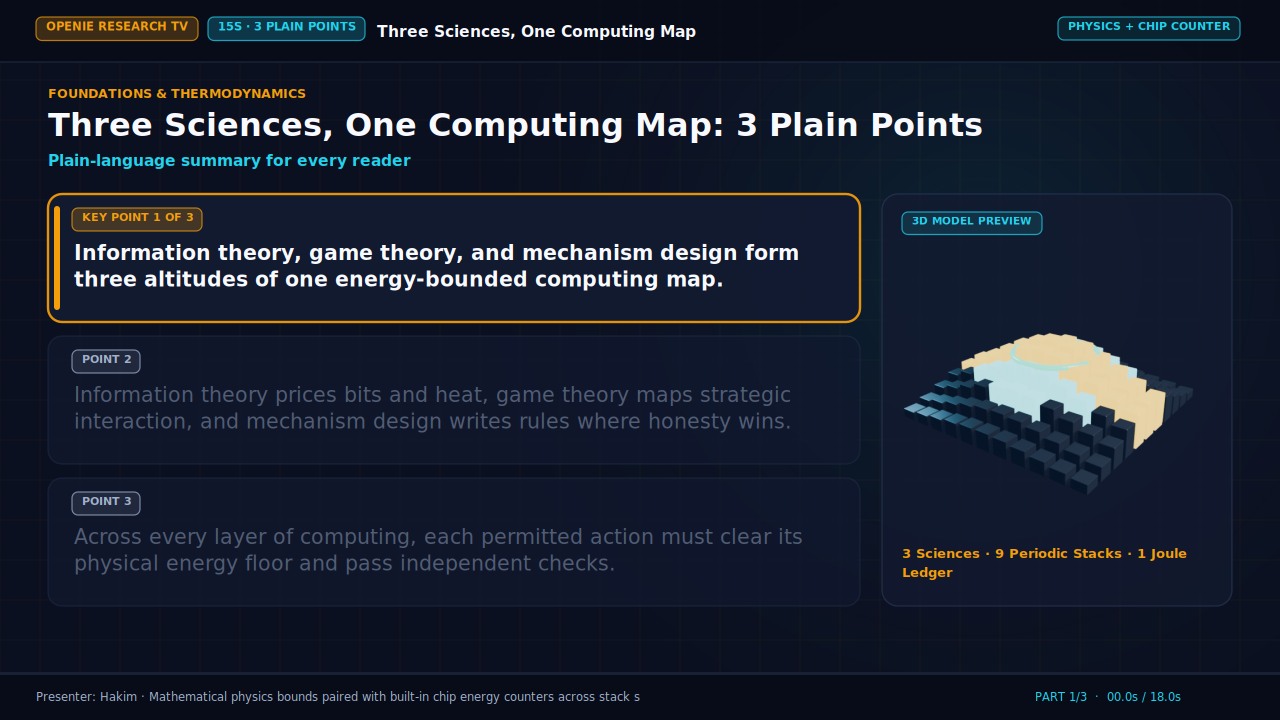
OpenIE Research Position (25 November 2026): inverting AI infrastructure economics from rented frontier inference to compiled, verifiable, microjoule agency on owned hardware.
Scope, Meter Class & Provenance Box
Every quantitative figure referenced in this position synthesis carries an explicit telemetry class, host boundary, and verification scope (measured_j ⊥ reported_j ⊥ est_j ⊥ unmetered — cross-class addition is forbidden):
| Claim or Subsystem | Meter Class & Host Boundary | Primary Evidence & Caveat Scope |
|---|---|---|
LUT6 / LutAdapt (162.7 nJ, 87× vs. INT8 micro-MLP; 4× idle cut) | measured_j / FPGA board-rail & post-route scope (Xilinx Artix-7 / AMD Kria KV260 36-Kb clock-enable-gated Block RAM + Beneš switch) | Grounded in research.openie.dev/papers/lut-adapt ([E, T]). Companion 12.3× NVMe read reduction sustaining 22 tok/s under 1 GB active RAM is host-counter / storage-bus telemetry (reported_j) on sparse-MoE streaming workloads. |
Avalanche Handoff Contrast (~75,000×) & Multi-Paradigm Synthesis (9–27×) | Cross-class order-of-magnitude contrast: 927.30 µJ TI INA3221 measured_j on Jetson AGX Thor (VDD_CPU_SOC_MSS, 50.13 µs p50) vs. multi-joule natural-language LLM relays (reported_j / est_j) | Grounded in avalanche.openie.dev and The Communication Tool Avalanche (CTA-E4/CTA-E5). The two sides of ~75,000× (75,374× in CTA-E4) sit on distinct substrates and meter classes and are never summed into a single ledger. |
waiOS Reference Digest (a541323b…46f0) | unmetered bit-exact integer determinism check (256×128 ternary matrix-vector product hashed with BLAKE3, sealed with Ed25519) | Grounded in waios.transaction.science ([E]). Verifies identical integer answers across CPU, SIMD, GPU, FPGA, and microcontroller fabrics (77 signed receipt instances audited; host energy meters do not isolate bare fabric draw). |
| Thermodynamic Floor vs. Operational Silicon | [M, S] Unit positivity & metric framing (joules-per-correct-operation) | Contemporary CMOS processors operate 14–15 orders of magnitude above the 300 K physical bit-erasure floor (k_B T ln 2). Landauer’s limit motivates joules-per-correct-operation as an operational metric—not decorative macroscopic bit-erasure conversions. |
External Industry & Research Signals (LittleBit-2, HeteroMosaic, Logical Intelligence, Adaption Labs) | [S] External literature & industry reports (not measured on OpenIE benches) | Cited from public research disclosures (~0.1 bit/weight SVD compression, ~2× / ~45% CPU-iGPU-NPU scheduling, ~2% constraint-puzzle solve rate, 15× post-pretraining adaptation cost reduction) as independent market and technical convergence signals. |
| Provenance & Replication Status | Signed Provenance · Self-Checked (BLAKE3 + Ed25519, human_in_gate = false; 0 external peer reviews to date) | Standalone Apache-2.0 commodity Linux/macOS replication kits (openIE-dev/deterministic-null, openIE-dev/rce, openIE-dev/openie-research-experiments) are publicly runnable at /verification/#independent-replication. |
1. Executive Summary
David Charlot’s research program at Open Interface Engineering is pursuing a deliberate inversion of current AI infrastructure economics. The goal is to make advanced computational intelligence as accessible, cheap, and ubiquitous as spellcheck—by treating frontier neural inference as a last resort rather than the default, and by compiling verified discoveries downward into persistent, zero-FLOP, microjoule substrates that run on existing hardware [M, E].
Three interlocking projects operationalize this architecture:
waiOS, a cross-fabric verifiable integer runtime that guarantees the exact same answer on every machine via a pinnedBLAKE3reference digest andEd25519-signed receipts[E];- The
Avalanche9-rung ladder, which identifies the Compilation Threshold as the formal gate between ephemeral, high-energy inference (Rungs 1–5) and persistent compiled competence (Rungs 6–9)[T, E]; and LUT6 / LutAdaptdownward compilation, which lowers verified wakes into clock-enable-gated Boolean fabrics with measured board-scope energy reductions of87×(162.7 nJper bit-sliced decision) versusINT8micro-MLP baselines[E, T].
Our strategic position is that the open developer AI transition is already underway (LittleBit-2, HeteroMosaic, Adaption Labs, and related systems [S]). The decisive opportunity is twofold: first, to formalize the missing Deterministic Null Hypothesis—evaluating neural methods against fixed, energy-grounded traditional computer automation on identical correctness-and-joule benchmarks—and second, to build the open orchestration and downward-compilation substrate that makes owned commodity silicon far more economical than rented frontier capacity.
2. Core Thesis
Intelligence as a Hindsight Characteristic of Agency
Intelligence is neither a physical substance nor a scalar quantity that an engineering team can optimize directly. It is a hindsight label applied to systems that capture, engage, and utilize information at a rate that produces reliable, useful outcomes in the world [M].
What can be measured, specified, and improved is the rate of information capture, engagement, and utilization under explicit physical constraints—that is, agency in a shared environment. Computers and humans already inhabit the same physical and informational ecology; they simply execute on different clock rates and material substrates. The engineering mandate is therefore not the vague slogan “make machines smarter,” but a falsifiable systems objective: give machines reliable, verifiable agency using the least energy and infrastructure possible.
The Spellcheck Goal & the 4-Stage Lookup-First Cascade
Spellcheck succeeded universally because it became a tiny, deterministic, always-available lookup table executing locally on whatever computer a person already owned—without renting a datacenter call per keystroke. The exact same architectural discipline applies to modern AI: invoking an expensive, high-energy frontier neural model should be the last resort, never the unconditional entry point.
Across OpenIE systems, work executes through a strict 4-Stage Lookup-First Cascade:
- Lookup first — resolve recurring structure immediately via content-addressed tables,
LUT6Boolean pages, and pre-verified persistent substrates (0neural FLOPs); - Search / retrieve second — query indexed, hash-attested local state and structured corpora before synthesizing from scratch;
- Compute third — run lightweight domain solvers, integer state machines, or compact hybrid engines across local CPU, GPU, NPU, or FPGA fabrics;
- Escalate to frontier inference fourth (last resort) — wake a large autoregressive model strictly on genuinely novel, high-entropy open problems—and immediately verify and compile any newly discovered solution back down to Stage 1.
Every joule not wasted recomputing known results remains available for genuinely unsolved problems. If “superintelligence” is a coherent engineering frame at all, it will emerge from refusing to burn megawatts re-deriving settled structure, not from maximizing raw parameter counts or GPU procurement budgets.
Energy as the Primary Metric
Evaluating infrastructure by teraflops-per-dollar entrenches a hardware caste system in which only institutions able to lease or procure the largest accelerator clusters can field capable systems. Evaluating instead by joules-per-correct-operation inverts that incentive structure [M, E]: a $4 microcontroller or compact FPGA fabric that completes and verifies a bounded control decision in nanojoules or microjoules decisively beats a 700 W datacenter accelerator burning joules on the same task.
While modern irreversible CMOS silicon still operates 14 to 15 orders of magnitude above the 300 K physical Landauer floor (k_B T ln 2), anchoring systems design in joules-per-correct-operation makes thermodynamic accounting operational today—and structurally undercuts the perpetual lease-rental model of cloud AI.
3. Three Interlocking Projects & the Research Catalog
waiOS — Cross-Fabric Verifiable Integer Runtime
waiOS executes one canonical integer program and enforces the exact same bit-level answer across heterogeneous silicon: scalar CPU, wide SIMD, discrete and integrated GPU, FPGA logic, bare-metal microcontroller, and seeded remote accelerators [E].
Every execution fabric is gated against a pinned cryptographic reference check: a 256×128 ternary matrix-vector product on a fixed canonical input hashed with BLAKE3, required to match the exact 256-bit reference digest:
a541323b13653ed36515ff24ef08deb7dfa771e570a434712708fb72552f46f0When a fabric’s output matches the reference digest, waiOS seals the run in an offline-verifiable Ed25519-signed receipt; on a single-bit disagreement, execution halts immediately (exit 1 verified under single-weight perturbation controls) [E]. Three conformance rings span local silicon, seeded remote accelerators, and formal emulation. waiOS builds on the Apache-2.0 WAI open standard (wai.transaction.science), while waiTransport (waitransport.transaction.science) provides Transaction Science’s commercial media and transport product layer above the open specification.
Avalanche — 9-Rung Ladder & the Compilation Threshold
- Portal: https://avalanche.openie.dev · Chronicle Audit: The Communication Tool Avalanche
The Avalanche 9-Rung Ladder maps communication and tool-building transitions from early biological signaling and human cultural externalization to contemporary machine systems (explicitly scoped as an interpretive architectural taxonomy rather than a physical law of evolution) [M]. Most deployed agentic AI stacks today stall at Rung 5: stateless, high-energy natural-language tool loops that re-tokenize and re-infer identical subproblems from scratch on every episode.
Crossing the Compilation Threshold—defined formally by recurrence horizon ΔT > ΔT* paired with a deterministic soundness gate C(z) = 1—converts verified neural wakes into zero-FLOP Boolean logic, nameless De Bruijn graphs, and microjoule lookup tables, unlocking Rungs 6–9 (immersion, compiled competence, multi-substrate ecology, and metered economy) [T, M]. Formalized across machine-checked Lean 4.36.0 kernel modules (0 sorry, 0 custom axioms over stated abstract state-machine models [T]), the framework pairs with empirical benchmarks showing ~75,000× lower energy for signed binary WAI1 (BLAKE3 + Ed25519) handoffs (927.30 µJ TI INA3221 measured_j on Jetson AGX Thor in CTA-E4) relative to multi-joule natural-language prose relays (reported_j / est_j), alongside multi-paradigm DES-10 synthesis (98/100 tasks solved vs. <= 49/100 for any isolated paradigm, yielding 9–27× gains in verified corrections-per-joule) [E].
LUT6 / LutAdapt — Downward Compilation into Boolean Silicon
- Primary Paper: https://research.openie.dev/papers/lut-adapt/ · Chronicle Entry: Downward LUT6 Compilation
LUT6 / LutAdapt turns downward compilation into concrete digital logic by lowering verified recurrent sub-circuits into clock-enable-gated 36-kilobit Block RAM pages routed through a non-blocking Beneš multicast switch [E, T]:
- Hardware-Scoped FPGA Results (
Artix-7 / AMD Kria KV260):162.7 nJper bit-sliced decision—an87×energy reduction compared against anINT8micro-MLP baseline on the target workload, alongside4×lower idle power via page-granular clock-enable gating[E]. - Sparse-MoE Host Streaming (
reported_j/ NVMe bus): A zero-FLOP paged lookup proposer cuts NVMe SSD read amplification by12.3×on large sparse-MoE weights (34.66Bclass) while sustaining~22 tok/sinside< 1 GB(970 MB) of active host RAM[E]. - Formal & Economic Payback (
[T, M]): CompanionLean 4.36.0theorems extracted from Rust reference implementations via Charon / Aeneas verify routing and bit-slice invariants, with compilation energy break-even occurring in well under a single operational episode—Rung 7 compiled competence realized in physical gates.
The OpenIE Research Catalog
- Research Hub: https://research.openie.dev · Chronicle Verification & Kits: /verification/
Together with the companion manuscripts on research.openie.dev and the 58-entry three-era archive on blog.openie.dev, these artifacts link metered hardware commit gates (11.43 nJ KV260 measured_j), the Satiation Benchmark (SATB) harness, Reality Code Engine (RCE, RCE-Compile, RCE-VC, RCE-JEPA) compiler normal forms, and cross-host power audits across Apple Silicon, AMD Zen 5, Intel Raptor Lake, NVIDIA Jetson AGX Thor, and Xilinx FPGAs.
4. The Deterministic Null Hypothesis
Contemporary AI evaluation overwhelmingly compares neural models only against other neural models on shifting leaderboards—almost never testing them against the unexciting, deterministic baseline that already solves the bounded core of the task: classical computer automation (lookup tables, decision trees, if/else guards, for-loops, CDCL solvers, and compiled rules) [E, M].
Methodologically, omitting that baseline mirrors pre-randomized-trial medicine: declaring a costly new intervention effective without testing it against established, low-cost standard of care.
The Deterministic Null (primary paper, public 5-language Apache-2.0 kit at openIE-dev/deterministic-null) forces that control arm into the open under OpenTimestamps and drand hash precommitment:
- Where a neural model genuinely generalizes on cold, open-ended synthesis—such as leading our zero-model
Shape Dbaseline by+45.83to+95.00percentage points across uniqueBFCL v3,tau-bench Retail, andBigCodeBench v0.1.3suites (N = 1,190), or patching5/6real upstreamSWE-bench Verifiedrepositories vs.0/6for coldShape D—the neural expenditure is empirically justified[E]. - Conversely, where single-turn frontier models fail to beat a sub-
2 µJ(reported_j) zero-model lookup/template baseline on9 of 10bounded structured template cells (N = 2,840), or where online verified crystallization cuts repeatZipf(0.85)model calls by3.59×, continuing to pay frontier inference joules and API fees exposes pure architectural waste[E].
Every task where a deterministic table, solver, or compiled pattern matches or exceeds a neural network at microjoule cost gives engineering teams an immediate, falsifiable reason to stop renting unnecessary inference.
5. Strategic Opportunities & External Convergence Signals
Independent research across silicon vendors and frontier labs confirms that the industry is converging away from monolithic frontier-only inference [S]:
- Samsung
LittleBit-2([S]): Demonstrates extreme weight compression down to~0.1 bit/weightusing singular-value decomposition (SVD), binary latent factors, and internal rotations. Because underlying mathematical factorizations and compression ideas are not copyrightable, clean-room open implementations optimized directly for joules-per-correct-token (rather than bit-rate and perplexity alone) are immediately actionable. - AMD
HeteroMosaic([S]): Reframes edge LLM inference as a fine-grained heterogeneous scheduling problem across CPU, iGPU, and NPU, reporting~2×throughput speedup and~45%energy reduction on commodity client silicon. Logical Intelligence([S]): Showed that frontier language models collectively solved only~2%of hard constraint-satisfaction puzzles while burning thousands of dollars in inference compute—reinforcing the separation between energy-grounded verifiable reasoning for checkable structure and LLMs for natural-language interfaces.- Sara Hooker /
Adaption Labs([S]): Highlights diminishing returns to brute-force pre-training scale while showing that compact open models can be adapted for long-horizon tasks at~15×lower cost without full retraining—directly aligned with Hooker’s Hardware Lottery thesis and OpenIE’s interface-impedance framing.
The unifying lesson across all four external signals is that no isolated paradigm wins alone (<= 49/100 in our CTA-E5 solo-camp audit). Durable advantage sits in systems integration—the “Lego unsiloing” of CPU, GPU, NPU, FPGA, and microcontroller fabrics that were never jointly targeted—and in the verifiable orchestration layer that routes each sub-operation to the lowest-joule substrate capable of satisfying C(z) = 1. That is the exact architectural role of waiOS + Avalanche + LUT6 / LutAdapt, paired with open-substrate economics: publish the core WAI standard, verification schemas, and replication harnesses openly under Apache-2.0, and monetize commercial transport (waiTransport), managed fleet attestation, and verified outcomes on hardware users already own.
6. Six Shots on Goal (Next Engineering Milestones)
- Standardize the Deterministic Null Control Suite: Publish the expanded Deterministic Null manuscript alongside a pinned, energy-grounded benchmark harness (
Apache-2.0) that mandates traditional automation control arms (Shape D, exact solvers, decision trees) before scoring neural models (runnable kit #1). - Energy-Targeted Sub-Bit Compression (
Joules-per-Correct-Token): Build clean-roomLittleBit-class SVD + binary-latent + integer-rotation kernels evaluated by physicalmeasured_j/reported_jjoules-per-correct-token rather than proxy perplexity alone (runnable kit #4:kits/littlebit-joule/). - Cross-Fabric Hybrid Mosaic Scheduling Under
waiOSReceipts: Extend heterogeneous runtimes scheduling a single integer program seamlessly across CPU, SIMD, GPU, FPGA, and microcontroller fabrics, with every cross-fabric handoff gated byBLAKE3+Ed25519waiOSreceipts (waios.transaction.science · runnable kit #5:kits/waios-mosaic-cascade/). - Expand Scholar / Digital Well Rung Projections: Project widely used open-source libraries and developer tools onto the
Avalancherung ladder (scholar.askdavidc.ai & avalanche.openie.dev) paired with automated downward-compilation (RCE/LUT6) recipes. - End-to-End Lookup-First Reference Pipelines: Ship self-contained, externally reproducible workloads demonstrating Stages
1 -> 2 -> 3 -> 4solving production tasks at orders-of-magnitude lower energy than frontier-only agent loops (runnable kits #1–#5). - Continuous Falsifiable Hardware Metering: Instrument every empirical claim with explicit
TI INA3221/INA238DC rail shunts (measured_j) or isolated host counters (reported_j), publishing negative results, drift rejections (109/170inai-reads-human), and 95% Clopper–Pearson bounds openly.
Initial Hardware-Metered Receipts for Shots #2, #3 & #5 (Apache-2.0, reported_j)
Two standalone Apache-2.0 benchmark harnesses published alongside this position paper in openIE-dev/openie-research-experiments (b2a6f77, Linux powercap RAPL reported_j on Intel Core i9-13900H, measured_j = null, Signed Provenance · Self-Checked) illustrate why joules-per-correct-operation and cross-lane waiOS receipts change engineering conclusions [E]:
- Shot #2 Receipt (
kits/littlebit-joule/,512×512rank-22SVD + binary latent signs + Fast Walsh-Hadamard internal rotation at0.1517 bits/weight,N = 1,200):- Decompression Impedance Tax Exposed: Unpacking
0.1517 bpwfactors toFP32at runtime shrinks weight storage52.72×(4,972 Bvs.262,144 BINT8), yet burns52.13×more packagereported_jper correct decision (20,192.17 µJvs.387.38 µJ) due to runtime float reconstruction. - Packed Integer Execution: Executing the exact same
0.1517 bpwrepresentation via in-place integer Walsh-Hadamard butterfly +uint64XNOR + popcount+ 4-bit nibble LUT achieves100.00%(1,200/1,200) accuracy at81.19 µJ / correct(4.77×lowerreported_jthanINT8and248.69×lowerreported_jthan naiveFP32unpack;0/80divergent trials, one-sided 95% Clopper–Pearson upper bound<= 0.0368). - Mandatory Deterministic Null Control: A
4 KiBcompiled quadrant lookup table (0neural FLOPs) resolves96.33%(1,156/1,200) at1.12 µJ / correct(346.65×lowerreported_jthanINT8), isolating the exact3.67percentage-point tail paid for by the sub-bit projection.
- Decompression Impedance Tax Exposed: Unpacking
- Shots #3 & #5 Receipt (
kits/waios-mosaic-cascade/,256×128ternary reference check +1,000-query 4-stage Spellcheck cascade):- Cross-Lane
waiOSInvariance: Scalar Python, scalar Cint32, packed 2-bit bit-slicedpopcount, T-MAC 4-bit pair-LUT, and 4-worker heterogeneouspthreadMosaic lanes all matchblake3:a541323b13653ed36515ff24ef08deb7dfa771e570a434712708fb72552f46f0bit-for-bit (0/100shifted-schedule disagreements, 95% Clopper–Pearson upper bound<= 0.0295), while a single-weight perturbation (w[77,0]: 0 -> 1) deterministically halts and refuses receipt signing. - 4-Stage Cascade Payback: Routing
55.0%via Stage 1O(1)hash LUT,25.0%via Stage 2 sparse trigram + edit-distance gate,17.4%via Stage 3waiOS-sealed integer Mosaic, and2.6%to Stage 4 escalation achieves1,000/1,000accuracy at267.45 µJ / correct(10.67 µsmedian wall) versus4,902.29 µJ / correct(182.36 µs) for an always-dense local baseline (18.33×lower localreported_jand38.46×Stage-4 remote call avoidance).
- Cross-Lane
7. Closing Position
Much of the AI industry remains locked in an arms race over the hindsight label “intelligence” while ignoring the physical mechanism of agency. Once the engineering target is stated accurately—maximizing the rate of verified, useful information utilization at minimum physical energy—the 4-stage lookup-first cascade, cross-fabric waiOS integer invariance, Avalanche downward compilation, and the Deterministic Null control arm become the natural engineering path.
Building and publishing falsifiable artifacts beats standing on the sidelines as a correct casual observer. The foundational runtimes, formal proofs, and commodity replication kits are already online; the work ahead is to keep compiling verified discoveries into persistent, microjoule substrates faster than the datacenter rental model can invent new reasons to demand more power plants.
David Charlot
Open Interface Engineering, Inc. · Signed Provenance · Self-Checked
Position essay prose dedicated to the public domain (CC0-1.0); WAI open standard, Deterministic Null 5-language baseline, RCE, and benchmark harnesses licensed under Apache-2.0 (see /verification/#licensing-and-availability); waiTransport is Transaction Science's commercial layer. Full licensing & AI-use disclosure →
Video Summaries, Syndication & Site Reference
Check the primary artifacts or run an independent replication
Inspect signed provenance manifests, rerun our public Apache-2.0 commodity-hardware replication kits, review our November 25, 2026 outside-review errata, or browse primary manuscripts on the Research Hub.