Deterministic Null: A Hash-Precommitted Zero-Model Baseline Across 6 LLMs and Public Coding/Tool Suites
Evaluates a 5-language zero-model deterministic baseline (Shape D: N0/N1) committed via OpenTimestamps and drand against 6 LLMs across 4,030 instances and 6 upstream SWE-bench Verified repos.
Primary Source: Primary Paper: research.openie.dev/papers/deterministic-null/ · Canonical Digest:
blake3:tv:d3018098f6b08132cb47527bca323e5c8236e9193f1375feffa9ebd20c21305c· Telemetry Class:reported_j(Apple M5 Max Darwin ri_energy_nj L3 & IOReport L2 on-chip counters (reported_j) for local runs; cloud API joules unmetered)Unattended Gate Flag (
human_in_gate = false): Automated build, benchmark, and proof-checking scripts ran without manual human override; signed & self-checked by OpenIE — not independently peer-reviewed (Verification & AI-Use Disclosure · Glossary).Inline Evidence Tags:
[T]machine-checked Lean 4 theorem over stated axioms ·[E]empirical benchmark or hardware log ·[M]analytical/mathematical model or simulation ·[S]external literature, filing, or specification citation.
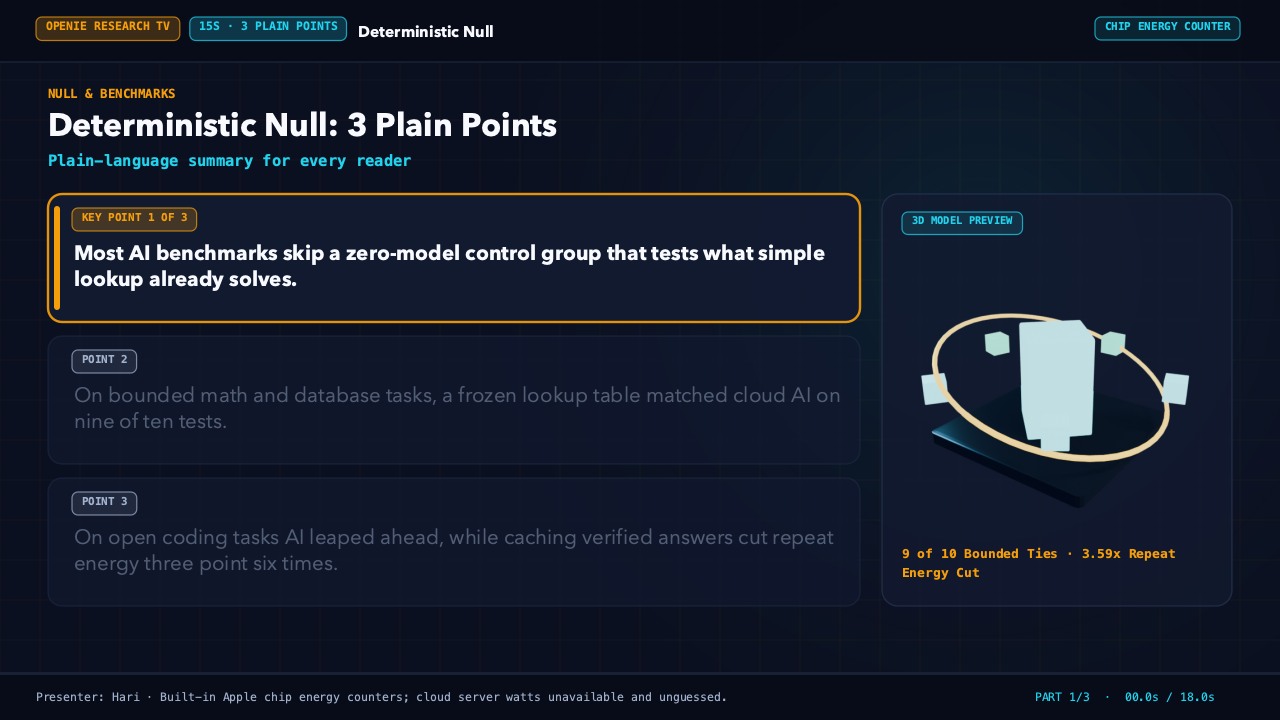
Hash-precommitted zero-model deterministic baseline vs. 6 LLMs across 4,030 instances and 6 SWE-bench Verified repos (openIE-dev/deterministic-null, Apache-2.0).
Key Claims & Evidence Tags
- [E · Hash-Precommitted Zero-Model Baseline]
Shape D(strict N0exact hash lookup +dev-crystallized N1nearest-token retrieval, implemented bit-identically in Rust, C++20, Go, Julia, and Python) locked its lookup-store digest and evaluation seeds before test scoring using OpenTimestamps Bitcoin Calendar proofs and League of Entropydrandrounds6663734and6664089—providing a hash-precommitted lookup store (not an external peer-reviewed clinical registry). - [E · Cold Open Generalization vs. Bounded Templates] Across all 6 core models (
Claude Opus 5.5,Claude Sonnet 5.5,OpenAI gpt-oss-120b,xAI Grok 4.20,Alibaba Qwen 3.6 35B-A3B, andGoogle Gemma 4 E4B-it), single-turn prompts failed to beatShape Don9 of 10bounded Track-A template cells (N = 2,840, where post-run audit notedK_eff = 6–12template saturation), whereas on unique external public suites (N = 1,190:BFCL v3,tau-bench Retail,BigCodeBench v0.1.3,SWE-bench Verifiedlocalization) LLMs led by +45.83 to +95.00 percentage points, and on 6 real upstreamSWE-bench Verifiedrepos coldShape Dsolved0/6whileOpus 5.5solved5/6(Sonnet 5.54/6,Grok 4.201/6). - [E · Exact Recall vs. Generalization (
reported_j)] Replaying the5/6verifiedSWE-benchpatches att = 2(0LLM calls) demonstrates exact hash-addressed recall, not unseen bug generalization, and invalidates whenever repo commits or test specs change; on a600-requestZipf(s = 0.85)stream over220BigCodeBenchtasks, online verified crystallization cut model calls and localreported_jby 3.59x (167vs.600calls).
Methods, Baselines & Artifact Scope
| Methodological Dimension | Primary-Paper Grounding & Scope |
|---|---|
| Hardware & Telemetry | Local models (Qwen 3.6 35B-A3B, Gemma 4 E4B-it) and Shape D (DNULLMM1) metered on Apple M5 Max (128 GB, macOS Darwin ri_energy_nj L3 reported_j; board_metered = false, measured_j = null). Cloud API models (Opus 5.5, Sonnet 5.5, gpt-oss-120b, Grok 4.20) have reported_j = null (token/USD cost logged). |
| Workload & Benchmark Suite | 4,030 held-out instances (2,840 Track-A bounded formal/structured instances across 10 cells + 1,190 Track-B unique public instances across BFCL v3, tau-bench Retail, BigCodeBench v0.1.3, and SWE-bench Verified 12-way localization) plus 6 full upstream SWE-bench Verified git repositories (psf/requests-5414, pytest-dev/pytest-10051, pytest-dev/pytest-10356, mwaskom/seaborn-3069, sympy/sympy-23824, sympy/sympy-17655). |
| Baseline(s) Compared | Zero-model deterministic baseline (Shape D: N0 exact FNV-1a/SHA-256 lookup and N1 dev-split bigram/Jaccard nearest template) plus classical CDCL+DRAT SAT solver B1 on unique_3sat_drat, compared against 6 LLMs (plus DeepSeek V4 Flash, Qwen 3.8 Max, and Gemini 2.5 Flash in exp-002/exp-003 probes). |
| Runs (N) & Spread / Uncertainty | N = 4,030 paired per-item McNemar/exact binomial comparisons (p < 10^-6 on Track-B +45.83 to +95.00 pp increments); N = 6 full repo patch evaluations; N = 600 Zipf(0.85) online requests. Single deterministic greedy (temp = 0) pass per model-item cell (multi-temperature sampling variance not recorded). |
| Caching / Cold vs. Warm Scope | Strictly separated: Track-B and t = 1 SWE-bench measure cold zero-hit novelty (0/6 Shape D, +60.00 pp BFCL v3, +95.00 pp BigCodeBench); t = 2 replay (5/6) and Zipf(0.85) (3.59x call cut) measure warm verified recall keyed by exact task/tree digest (stale immediately upon spec or AST change). |
| Artifact & License Availability | Apache-2.0 public replication kit at https://github.com/openIE-dev/deterministic-null (all 5 languages + drand/OpenTimestamps proofs); self-checked by OpenIE, ready for external replication. |
Problem, Terminology Corrections & Hash-Precommitment Scope
Two terminology clarifications address critiques of the earlier blog summary. First, we refer to Shape D directly as a zero-model deterministic baseline rather than clinical “placebo” metaphors: Shape D executes zero neural weights, pairing N0 (exact canonical input digest lookup) with N1 (deterministic token-overlap template selection from a frozen development split) [E]. Second, OpenTimestamps Bitcoin Calendar proofs and League of Entropy drand beacons (6663734 and 6664089) created a hash-precommitted lookup store—proving cryptographically that the DNULLMM1 binary table and seed schedule existed before test evaluation, which is narrower than an externally peer-reviewed clinical statistical analysis plan [E].
Results Across All 6 Models and External Public Benchmarks
Evaluating Claude Opus 5.5, Claude Sonnet 5.5, OpenAI gpt-oss-120b, xAI Grok 4.20, Alibaba Qwen 3.6 35B-A3B, and Google Gemma 4 E4B-it across 4,030 instances cleanly separates template memorization from genuine open-domain synthesis [E]:
-
Track-A Bounded Template Regime (
N = 2,840, 10 cells): Single-turn models tied or trailedN1on9 of 10bounded structured cells; onlyOpus 5.5beatShape D(+36.40pp) on unindexed Tier-2tau2_sqliteparaphrases. Onunique_3sat_drat(N = 50), a1,024-token output cap truncatedOpus 5.5at5.2%, whereas raising thinking budget to8,192tokens reached49/50(98%), 6-turnO(m)clause-violation feedback reached50/50(100%), and classicalCDCL+DRATsolverB1solved50/50in< 1 mswith zero neural compute[E]. -
Track-B Unique External Public Benchmarks (
N = 1,190): Where tasks require unseen code synthesis or novel schema composition, LLMs decisively beatShape D:+60.00pp onBFCL v3,+60.45pp ontau-bench Retail,+95.00pp onBigCodeBench v0.1.3, and+52.80pp onSWE-bench Verified12-way file localization (withexp-003recording+45.83pp forgpt-oss-120band+44.17pp forGrok 4.20)[E]. -
Upstream
SWE-bench VerifiedRepositories (N = 6real git trees): ColdShape Dpatched0/6repositories;Claude Opus 5.5passed full repository test suites on5/6,Sonnet 5.5on4/6, andGrok 4.20on1/6[E].
Limitations, Negative Results & Caching Separation
-
Track-A template saturation (
K_eff = 6–12): A post-run audit documented in the primary paper showed that several Track-A bounded generators sampled from only6to12underlying structural templates, explaining whyN1saturated them easily[E]. -
Nearest-neighbor overfitting (
N1 < N0ontau-bench Retail): Greedy bigram matching (N1,25.9%) actually underperformed strict abstaining lookup (N0,39.6%) ontau-bench Retailby pasting superficially similar but semantically wrong tool arguments[E]. -
Exact recall vs. unseen generalization: Re-running the
6SWE-benchrepos att = 2after crystallizing verifiedt = 1patches yields5/6hits at0LLM calls—demonstrating content-addressed memoization (exact recall), not transfer to new issues. Any commit that alters target AST digests or test contracts invalidates the cached entry (3.59xcall andreported_jsavings onBigCodeBenchholds specifically under the testedZipf(0.85)repeat distribution)[E, M].
Energy & Telemetry Scope
All local energy figures (Shape D sub-2 uJ mmap probes vs. multi-joule local Qwen 3.6 / Gemma 4 inference) come from Apple M5 Max Darwin ri_energy_nj (reported_j, board_metered = false) [E]. Cloud frontier models do not expose host power counters and are accounted strictly by token counts and API USD billing (reported_j = null).
Related Work & References
- Jimenez et al. (SWE-bench, ICLR 2024) & Zhuo et al. (BigCodeBench, ICLR 2025): Public repository-level software engineering and function-synthesis benchmarks
[S]. - Yan et al. (BFCL v3, 2024) & Yao et al. (tau-bench, 2024): Berkeley Function-Calling Leaderboard and retail/airline tool-agent benchmarks
[S]. - Good (Biometrika, 1953) & Kolodner (1992): Good-Turing missing-mass estimation for unseen event rates and classical case-based reasoning
[S]. - GPTCache (Bang, 2023) & FrugalGPT (Chen et al., 2023): Semantic/exact request caching and multi-model cost cascades
[S].
David Charlot
Open Interface Engineering, Inc. · Signed Provenance · Self-Checked
Full 5-language harness, DNULLMM1 binary store, and OpenTimestamps/drand receipts public in openIE-dev/deterministic-null (Apache-2.0); prose CC0-1.0; self-checked, open for external replication. Full licensing & AI-use disclosure →
Video Summaries, Syndication & Site Reference
Check the primary artifacts or run an independent replication
Inspect signed provenance manifests, rerun our public Apache-2.0 commodity-hardware replication kits, review our November 25, 2026 outside-review errata, or browse primary manuscripts on the Research Hub.