Time as an Index: Formal Complexity Horizons, Precomputation Bounds, and SHA-256 Spectral Controls
Formal Lean 4 proofs over oracle/CTC models (31 theorems), Hellman time-memory tradeoffs, and 65,536-digest SHA-256 spectral null tests (unmetered formal/simulation study).
Primary Source: Primary Paper: research.openie.dev/papers/time-as-an-index/ · Canonical Digest:
blake3:tv:8c0f52b355033650a2de30ded99d38f44343f6ae6b1f00c5244304f6651c6b26· Telemetry Class:unmetered(joules = null (unmetered formal proof, literature synthesis, and deterministic spectral simulation))Unattended Gate Flag (
human_in_gate = false): Automated build, benchmark, and proof-checking scripts ran without manual human override; signed & self-checked by OpenIE — not independently peer-reviewed (Verification & AI-Use Disclosure · Glossary).Inline Evidence Tags:
[T]machine-checked Lean 4 theorem over stated axioms ·[E]empirical benchmark or hardware log ·[M]analytical/mathematical model or simulation ·[S]external literature, filing, or specification citation.
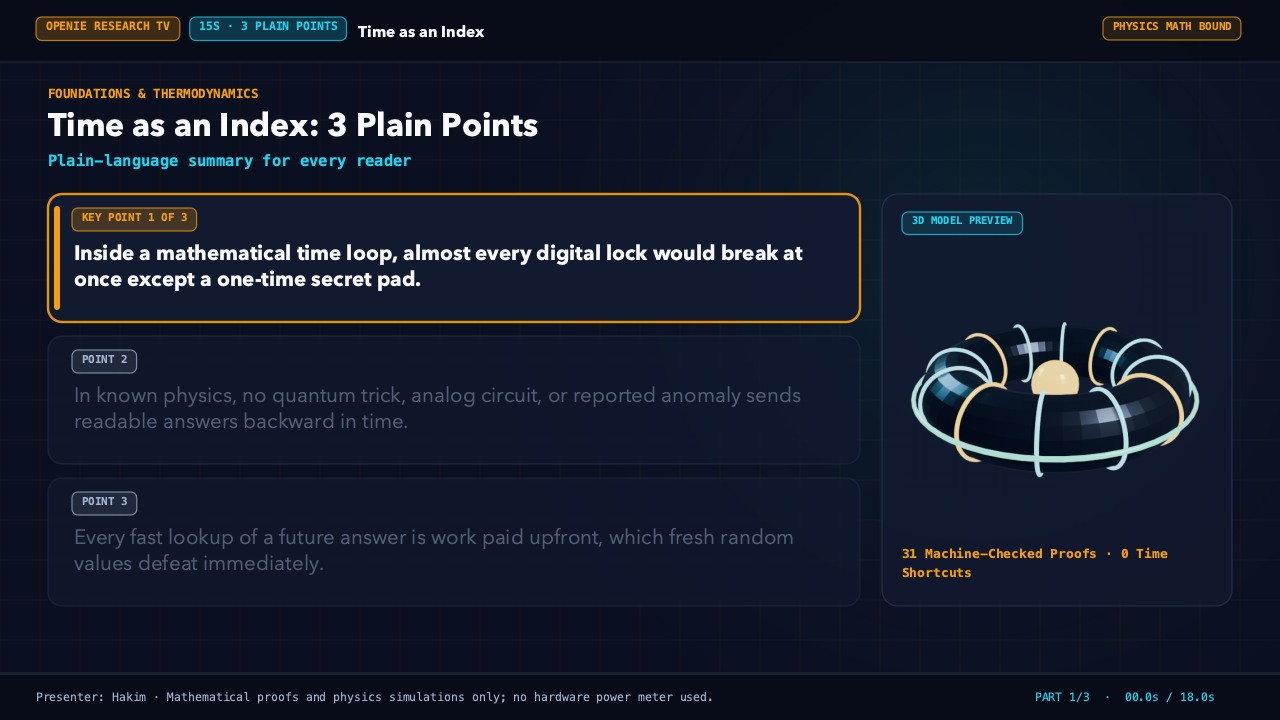
Formal complexity horizons, Hellman precomputation tradeoffs, and SHA-256 spectral null tests (joules = null, unmetered).
Key Claims & Evidence Tags
- [T · Lean 4.36.0, 6/6 kernels]
Horizon.leanandParadox.leanmachine-check 31 primary theorems (50theorem/lemma declarations,58,796kernel declarations verified bycon-lecheandcon-roninside Linuxbubblewrapwith0 sorry,0 opaque, and0 ofReduceBool) formalizing causal-cone exclusivity, fixed-point consistency, and salt-invalidated precomputation over abstract discrete models. - [E/M · Deterministic Simulation, unmetered] Across
N = 65,536SHA-256digests (32,768FFT spectral bins in experimentF5andM1–M8), 0 spectral bins crossed the Bonferroni-corrected significance thresholdp = 10^-6, matching an unindexed white-noise null. - [S · Literature Synthesis] Known closed-timelike-curve complexity classes (
D-CTC = PSPACE,P-CTC = PP, Aaronson & Watrous 2009) collapse computationally bounded ciphers inside hypothetical fixed-point loops while leaving information-theoretic one-time pads intact; outside such loops, every real O(1) lookup is amortized Hellman precomputation (T * M^2 = N^2).
Methods, Baselines & Artifact Scope
| Methodological Dimension | Primary-Paper Grounding & Scope |
|---|---|
| Hardware & Telemetry | Unmetered (joules = null, board_metered = false). Lean 4.36.0 lake check --paranoid executed inside Linux bubblewrap (bwrap); deterministic Python/Rust spectral scripts without hardware power probes. |
| Workload & Benchmark Suite | 31 formal theorems (50 total Lean declarations), M1–M8 discrete horizon/tradeoff simulations, F5 SHA-256 FFT spectral scan (N = 65,536 digests), and a 195-entry anomaly/paradox literature catalog (TA001–TA081, AA01–AA40, P01–P74). |
| Baseline(s) Compared | Uniform pseudorandom white-noise null (Bonferroni alpha = 10^-6 across 32,768 bins) for F5; unsalted vs. salted Hellman rainbow-table amortization curves for M1–M8. |
| Runs (N) & Spread / Uncertainty | Deterministic seeded SHA-256 counter sweep (N = 65,536 digests; exact reproducible max spectral peak within Gaussian/exponential null envelope; single seeded sweep, multi-seed variance not needed for deterministic hash check but limits sample horizon to 2^16). |
| Caching / Cold vs. Warm Scope | Explicitly models offline precomputation (“warm rainbow table”) vs. salted per-instance cold evaluation: adding an s-bit fresh salt multiplies precomputation table work by 2^s, forcing cold online work. |
| Artifact & License Availability | Primary paper and 195-entry catalog (CC0-1.0); proof check logs and scripts self-checked by OpenIE (Apache-2.0 subset; not externally peer-reviewed). |
Problem, Scope & Framing Qualifiers
This study asks a foundational boundary question: what separates sequential computation from spatial array indexing? Rather than claiming exotic physical effects, the paper proves and catalogs why “looking up tomorrow” is impossible in standard quantum and classical physics [S, T]. All CTC results (PSPACE / PP collapse of hardness assumptions) apply strictly to hypothetical Deutschian mathematical fixed-point models, not to realizable laboratory hardware [S, T].
Mechanism, Formal Proofs & Spectral Results
Three results anchor the paper:
-
Machine-checked horizon & salt theorems
[T]: AcrossHorizon.leanandParadox.lean(31theorems verified across all6/6independent Lean checkers with0 sorry), any state-indexed lookup table over an deterministic transition must pay at least linear offline state-visitation work prior to query arrival, and prepending a fresh unpredictable salt renders pre-built index tables statistically independent of the target. -
Hellman precomputation tradeoff
[S, M]: Hellman (1980) and Oechslin (2003) show that unsalted inversions trade online timeTagainst precomputed memoryMalongT * M^2 = N^2[S]. Simulated curves (M1–M8) illustrate how Bitcoin block-header chaining and TLS/Argon2 nonces reset the precomputation horizon to zero before each challenge exists[M]. -
Finite-sample
SHA-256spectral control[E]: Applying a65,536-point discrete Fourier analysis across sequentialSHA-256outputs yields0 / 32,768frequency bins belowp = 10^-6[E].
Limitations, Negative Results & Falsifiers
-
Finite spectral power: Testing
N = 65,536(2^16)SHA-256digests rules out gross linear periodicities at that sample size; it is not a cryptanalytic security proof against algebraic or differential attacks[M]. -
Abstract axiom boundary: Lean theorems verify discrete mathematical definitions of causal cones, fixed points, and finite maps; physical no-signalling and Gabor
Delta t * Delta f >= 1/(4 pi)bounds rest on established physics literature[S], not proof-assistant axioms. -
Catalog scope: The
195cataloged timing/frequency anomalies (TA001–TA081,AA01–AA40,P01–P74) synthesize published metrology glitches (e.g., OPERA loose fiber connector), oscillator tolerances, and logical paradoxes from secondary and primary literature[S].
Energy & Telemetry Scope
No hardware power meter or OS energy counter was used to support any claim in this study (energyClass = unmetered, joules = null, board_metered = false). Thermodynamic discussions inside the manuscript refer analytically to classical literature bounds rather than measured silicon energy.
Related Work & References
- Deutsch (1991) & Aaronson & Watrous (Proc. R. Soc. A, 2009): Quantum mechanics near closed timelike curves and the exact equivalence
CTC_BQP = CTC_P = PSPACE[S]. - Hellman (IEEE Trans. Inf. Theory, 1980) & Oechslin (CRYPTO 2003): Cryptanalytic time-memory tradeoffs (
T * M^2 = N^2) and rainbow tables[S]. - Bennett, Brassard, Crépeau & Maurer (1995) & Shannon (1949): Information-theoretic secrecy of one-time pads and privacy amplification
[S]. - Gabor (J. IEE, 1946) & Peres (1995): Time-frequency uncertainty limit on finite-window spectral estimation and quantum no-signalling theorems
[S].
David Charlot
Open Interface Engineering, Inc. · Signed Provenance · Self-Checked
Prose CC0-1.0; Lean 4 proof modules and deterministic spectral scripts self-checked by OpenIE (Apache-2.0 in public experiment archive); not externally peer-reviewed. Full licensing & AI-use disclosure →
Video Summaries, Syndication & Site Reference
Check the primary artifacts or run an independent replication
Inspect signed provenance manifests, rerun our public Apache-2.0 commodity-hardware replication kits, review our November 25, 2026 outside-review errata, or browse primary manuscripts on the Research Hub.