Interface Economics: Analytical Cost Models of Ambiguity, Verification Boundaries, and Handoff Contracts
An unmetered microeconomic and information-theoretic cost model comparing ambiguous natural-language handoffs against typed, deterministically verified interfaces.
Primary Source: Primary Paper: research.openie.dev/papers/interface-economics/ · Canonical Digest:
blake3:tv:6cee9f2f140f50dfe0d3b09bfab0b718b3f208c720a149f06e287da7d1412f55· Telemetry Class:unmetered(joules = null (unmetered microeconomic and information-theoretic modeling study))Unattended Gate Flag (
human_in_gate = false): Automated build, benchmark, and proof-checking scripts ran without manual human override; signed & self-checked by OpenIE — not independently peer-reviewed (Verification & AI-Use Disclosure · Glossary).Inline Evidence Tags:
[T]machine-checked Lean 4 theorem over stated axioms ·[E]empirical benchmark or hardware log ·[M]analytical/mathematical model or simulation ·[S]external literature, filing, or specification citation.
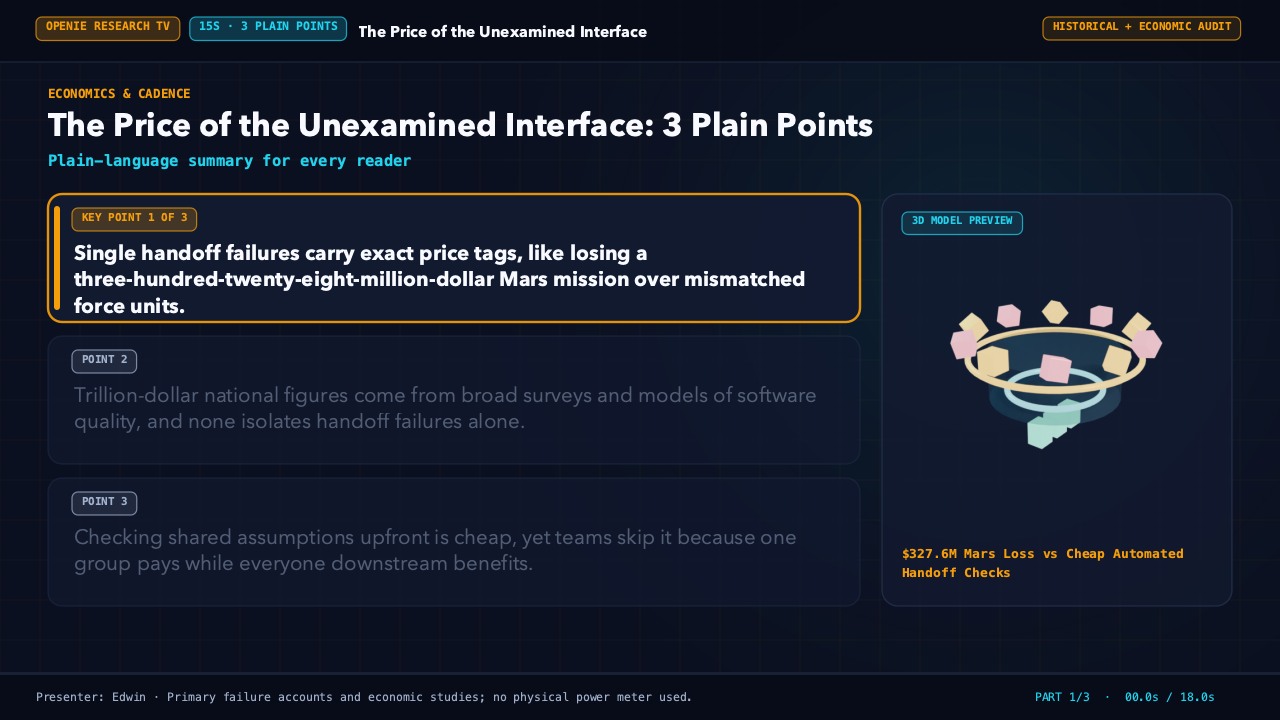
Analytical transaction-cost and channel-coding model of interface boundaries (joules = null, unmetered).
Key Claims & Evidence Tags
- [M · Analytical Cost Model, unmetered] Models handoff cost as the sum of upfront specification cost
C_spec, serialization/channel workC_chan, boundary verificationC_gate, and probability-weighted downstream failure remediationp_err * L_downstream—showing analytically that typed deterministic gates dominate whenC_spec + C_gate < Delta p_err * L_downstream. - [M · Regime Reversal When Exploration Dominates] Explicitly identifies the counter-regime: on one-off exploratory prototypes (
N_reuse = 1) with low failure severity (L_downstreamsmall) and fluid requirements, heavy upfront formalization loses to lightweight natural-language iteration. - [S · Classical Institutional Lineage] Connects software API/gate design directly to Coasean transaction costs, Williamsonian incomplete contracts, and Marschak–Radner team theory without claiming empirical field-experiment validation in this paper.
Methods, Baselines & Artifact Scope
| Methodological Dimension | Primary-Paper Grounding & Scope |
|---|---|
| Hardware & Telemetry | Unmetered (joules = null, board_metered = false). Closed-form algebraic cost-accounting propositions and literature synthesis. |
| Workload & Benchmark Suite | No empirical software or organizational dataset collected in this study. |
| Baseline(s) Compared | Analytical comparison: unverified prose handoffs (C_spec low, p_err high) vs. schema-typed, gate-checked handoffs (C_spec paid once, amortized over N calls). |
| Runs (N) & Spread / Uncertainty | Not applicable (N = 0 empirical runs; hand-derived algebraic inequalities [M], not proof-assistant formalized). |
| Caching / Cold vs. Warm Scope | Models amortization over N repeated interface crossings: upfront schema design behaves like compilation, requiring N > N_crit crossings before net savings turn positive. |
| Artifact & License Availability | Public-domain manuscript (CC0-1.0) at research.openie.dev/papers/interface-economics/; self-checked, not externally peer-reviewed. |
Problem, Scope & Theoretical Boundary
Why do software teams and multi-agent pipelines spend so much effort translating structured state into English prose and parsing it back out? interface-economics treats this question as an unmetered analytical modeling essay ([M], [S]), extending transaction-cost economics (Coase 1937; Williamson 1979) and team information theory (Marschak & Radner 1972) to human-machine and agent-to-agent APIs [S]. No live enterprise RCT or hardware joule meter is run in this paper.
Analytical Trade-Off: Upfront Specification vs. Downstream Remediation
Across a chain of k sequential handoffs where each unverified step admits a subtle interpretation error with probability q, end-to-end survival decays exponentially as (1 - q)^k [M]:
-
Amortized production interfaces (
N >> 1, highL_downstream): Paying a fixed schema and verifier cost once collapsesqon covered invariants and amortizesC_spec / Ntoward zero across repeated calls[M]. -
Exploratory one-offs (
N = 1, shifting goals): When the human principal does not yet know which product feature to build, rigid formal interfaces lock in premature assumptions and cost more than conversational prototyping[M].
Limitations & Falsifiers
-
Hand-derived stylized parameters: Propositions assume stationary error probabilities and separable specification costs; in real organizations, specification maintenance incurs ongoing versioning overhead whenever upstream requirements drift
[M, S]. -
No empirical parameter estimation here: Empirical measurements of prose vs. binary handoff overhead (
75,374xThormeasured_jinCTA-E4and2,053.8xparsereported_jinai-reads-human) live in companion engineering studies, not in this economic framing note.
Energy & Telemetry Scope
Strictly unmetered (joules = null, board_metered = false). References to compute waste in the prose represent abstract cost terms rather than metered watt-seconds.
Related Work & References
- Coase (Economica, 1937) & Williamson (J. Law Econ., 1979): Transaction-cost theory of firm and contract boundaries
[S]. - Marschak & Radner (1972) & Arrow (1974): Economic theory of teams and organizational information channels
[S]. - Parnas (CACM, 1972) & Meyer (IEEE Computer, 1992): Information-hiding module boundaries and Design by Contract
[S]. - Simon (1971): Designing organizations for an information-rich world where attention and verification, not raw text generation, are the scarce bottleneck
[S].
David Charlot
Open Interface Engineering, Inc. · Signed Provenance · Self-Checked
Analytical manuscript and blog summary dedicated to the public domain (CC0-1.0); zero private software dependencies; self-checked, not externally peer-reviewed. Full licensing & AI-use disclosure →
Video Summaries, Syndication & Site Reference
Check the primary artifacts or run an independent replication
Inspect signed provenance manifests, rerun our public Apache-2.0 commodity-hardware replication kits, review our November 25, 2026 outside-review errata, or browse primary manuscripts on the Research Hub.