Interface Economics: Analytical Cost Models of Ambiguity, Verification Boundaries, and Handoff Contracts
An unmetered microeconomic and information-theoretic cost model comparing ambiguous natural-language handoffs against typed, deterministically verified interfaces.
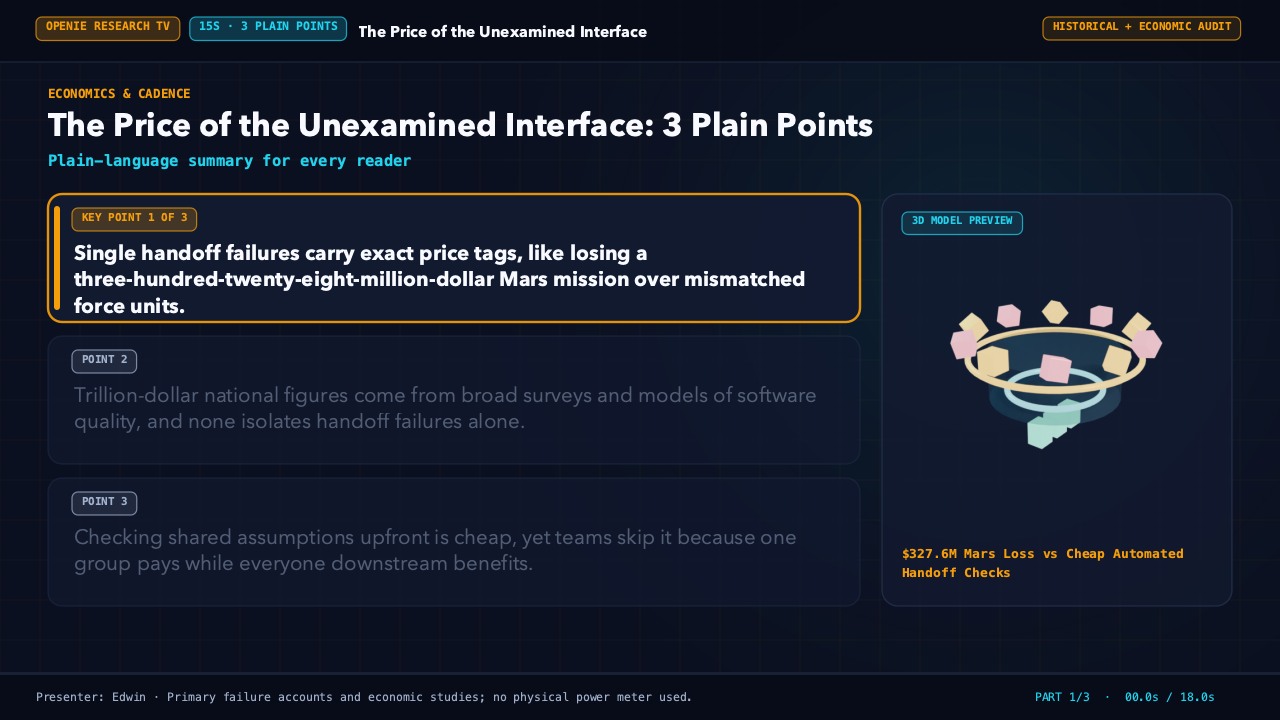
Temporal & Archival Scope: Era II OpenIE Study (November 19, 2026) · Canonical OpenIE Chronicle Entry: https://blog.openie.dev/posts/interface-economics/ · Primary Paper & Methods: https://research.openie.dev/papers/interface-economics/ · Canonical Digest:
blake3:tv:6cee9f2f140f50dfe0d3b09bfab0b718b3f208c720a149f06e287da7d1412f55Provenance & Telemetry Hygiene: Signed Provenance · Self-Checked (automated OpenIE internal gates; not externally peer-reviewed) · Energy Class:
unmetered(measured_j ⊥ reported_j ⊥ est_j ⊥ unmetered— Verification, Licensing & AI-Use Disclosure · Glossary & Non-Mixing Rules).
Key Claims & Evidence Tags
- [M · Analytical Cost Model, unmetered] Models handoff cost as the sum of upfront specification cost
C_spec, serialization/channel workC_chan, boundary verificationC_gate, and probability-weighted downstream failure remediationp_err * L_downstream—showing analytically that typed deterministic gates dominate whenC_spec + C_gate < Delta p_err * L_downstream. - [M · Regime Reversal When Exploration Dominates] Explicitly identifies the counter-regime: on one-off exploratory prototypes (
N_reuse = 1) with low failure severity (L_downstreamsmall) and fluid requirements, heavy upfront formalization loses to lightweight natural-language iteration. - [S · Classical Institutional Lineage] Connects software API/gate design directly to Coasean transaction costs, Williamsonian incomplete contracts, and Marschak–Radner team theory without claiming empirical field-experiment validation in this paper.
Methods, Baselines & Artifact Scope
- Methodological Dimension: Hardware & Telemetry · Primary-Paper Grounding & Scope: Unmetered (
joules = null,board_metered = false). Closed-form algebraic cost-accounting propositions and literature synthesis. - Methodological Dimension: Workload & Benchmark Suite · Primary-Paper Grounding & Scope: No empirical software or organizational dataset collected in this study.
- Methodological Dimension: Baseline(s) Compared · Primary-Paper Grounding & Scope: Analytical comparison: unverified prose handoffs (
C_speclow,p_errhigh) vs. schema-typed, gate-checked handoffs (C_specpaid once, amortized overNcalls). - Methodological Dimension: Runs (N) & Spread / Uncertainty · Primary-Paper Grounding & Scope: Not applicable (
N = 0empirical runs; hand-derived algebraic inequalities[M], not proof-assistant formalized). - Methodological Dimension: Caching / Cold vs. Warm Scope · Primary-Paper Grounding & Scope: Models amortization over
Nrepeated interface crossings: upfront schema design behaves like compilation, requiringN > N_critcrossings before net savings turn positive. - Methodological Dimension: Artifact & License Availability · Primary-Paper Grounding & Scope: Public-domain manuscript (
CC0-1.0) atresearch.openie.dev/papers/interface-economics/; self-checked, not externally peer-reviewed.
Problem, Scope & Theoretical Boundary
Why do software teams and multi-agent pipelines spend so much effort translating structured state into English prose and parsing it back out? interface-economics treats this question as an unmetered analytical modeling essay ([M], [S]), extending transaction-cost economics (Coase 1937; Williamson 1979) and team information theory (Marschak & Radner 1972) to human-machine and agent-to-agent APIs [S]. No live enterprise RCT or hardware joule meter is run in this paper.
Analytical Trade-Off: Upfront Specification vs. Downstream Remediation
Across a chain of k sequential handoffs where each unverified step admits a subtle interpretation error with probability q, end-to-end survival decays exponentially as (1 - q)^k [M]:
-
Amortized production interfaces (
N >> 1, highL_downstream): Paying a fixed schema and verifier cost once collapsesqon covered invariants and amortizesC_spec / Ntoward zero across repeated calls[M]. -
Exploratory one-offs (
N = 1, shifting goals): When the human principal does not yet know which product feature to build, rigid formal interfaces lock in premature assumptions and cost more than conversational prototyping[M].
Limitations & Falsifiers
-
Hand-derived stylized parameters: Propositions assume stationary error probabilities and separable specification costs; in real organizations, specification maintenance incurs ongoing versioning overhead whenever upstream requirements drift
[M, S]. -
No empirical parameter estimation here: Empirical measurements of prose vs. binary handoff overhead (
75,374xThormeasured_jinCTA-E4and2,053.8xparsereported_jinai-reads-human) live in companion engineering studies, not in this economic framing note.
Energy & Telemetry Scope
Strictly unmetered (joules = null, board_metered = false). References to compute waste in the prose represent abstract cost terms rather than metered watt-seconds.
Related Work & References
- Coase (Economica, 1937) & Williamson (J. Law Econ., 1979): Transaction-cost theory of firm and contract boundaries
[S]. - Marschak & Radner (1972) & Arrow (1974): Economic theory of teams and organizational information channels
[S]. - Parnas (CACM, 1972) & Meyer (IEEE Computer, 1992): Information-hiding module boundaries and Design by Contract
[S]. - Simon (1971): Designing organizations for an information-rich world where attention and verification, not raw text generation, are the scarce bottleneck
[S].
Canonical Provenance, Primary Artifacts & Independent Replication
- Canonical OpenIE Chronicle Entry: https://blog.openie.dev/posts/interface-economics/
- Primary Study & Methods: https://research.openie.dev/papers/interface-economics/
- Illustrated Video Summary (OpenIE Research TV): https://research.openie.dev/tv/?study=interface-economics (9:16 Vertical MP4)
- Signed Provenance · Self-Checked Disclosure & Licensing: Analytical manuscript and blog summary dedicated to the public domain (CC0-1.0); zero private software dependencies; self-checked, not externally peer-reviewed. Full details at https://blog.openie.dev/verification/ and https://blog.openie.dev/glossary/.