Specification, Proposer, and Gate: The "Three-Body" Software Design Metaphor for Verifiable Automation
An unmetered architectural framing paper using "Three-Body" strictly as a structural metaphor for separating Specifications, Proposers, and Deterministic Gates—not celestial mechanics.
Primary Source: Primary Paper: research.openie.dev/papers/three-body/ · Canonical Digest:
blake3:tv:16e4e4b439081a0ed33c49753fe852f5ef4a4ac5f32d4bdf70826f08da0e7738· Telemetry Class:unmetered(joules = null (unmetered architectural framing and design-pattern synthesis))Unattended Gate Flag (
human_in_gate = false): Automated build, benchmark, and proof-checking scripts ran without manual human override; signed & self-checked by OpenIE — not independently peer-reviewed (Verification & AI-Use Disclosure · Glossary).Inline Evidence Tags:
[T]machine-checked Lean 4 theorem over stated axioms ·[E]empirical benchmark or hardware log ·[M]analytical/mathematical model or simulation ·[S]external literature, filing, or specification citation.
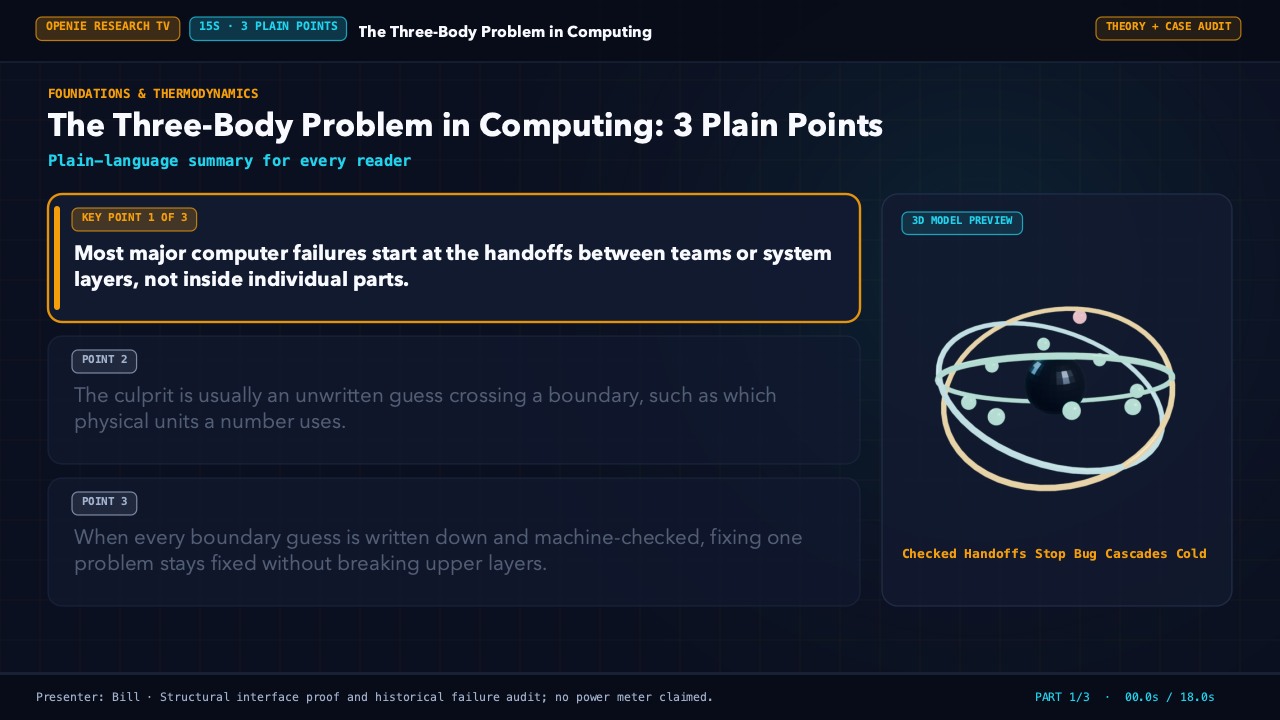
Structural design metaphor separating Specification, Proposer, and Deterministic Gate roles (unmetered framing paper; not celestial mechanics).
Key Claims & Evidence Tags
- [M · Explicit Metaphor Disclosure] “Three-Body” in this essay is a naming metaphor for three interacting software roles (
Specification,Candidate Proposer,Deterministic Gate); it invokes no equations or chaos proofs from Poincaré/Newtonian gravitational three-body mechanics. - [M/S · Architectural Separation] Coupling specification intent and acceptance authority inside a single stochastic generator makes silent drift undetectable; isolating an executable gate (
tests,typechecker,SAT/SMT, orproof kernel) turns stochastic generation into bounded trial-and-check. - [S · Cross-Study Scope] This paper performs zero new empirical runs (
joules = null,unmetered); concrete falsifiers and failure modes of imperfect specifications (such as Goodharting weak test suites) are evaluated in companion studies (gates,deterministic-null, andrce-jepa).
Methods, Baselines & Artifact Scope
| Methodological Dimension | Primary-Paper Grounding & Scope |
|---|---|
| Hardware & Telemetry | Unmetered (joules = null, board_metered = false). Conceptual software-architecture and interface-contract synthesis. |
| Workload & Benchmark Suite | No empirical benchmark suite executed in this manuscript; analyzes role separation across specification-proposer-verifier pipelines. |
| Baseline(s) Compared | Qualitative comparison against two-party human-prompt-to-LLM commit loops and unverified multi-agent natural-language debate. |
| Runs (N) & Spread / Uncertainty | Not applicable (N = 0 empirical trials in this framing paper; quantitative claims reside in companion empirical papers). |
| Caching / Cold vs. Warm Scope | Conceptual discussion only: notes that gated outputs can be indexed for exact recall only while the specification hash remains unchanged. |
| Artifact & License Availability | Public-domain essay text (CC0-1.0) on research.openie.dev and blog.openie.dev; no proprietary code required. |
Problem, Scope & Metaphor Disclosure
Upfront scope note: the title phrase “Three-Body” is used strictly as a structural software metaphor for a triad of distinct engineering artifacts—(1) Specification, (2) Proposer, and (3) Deterministic Gate—not as an application of gravitational orbital mechanics or Lyapunov chaos theory [M]. Earlier short summaries leaned on physical analogies without stating immediately that this manuscript is an unmetered architectural synthesis (joules = null).
In two-party LLM coding workflows, a human prompt asks a generative model both to interpret an underspecified goal and to judge whether its own patch succeeded [S]. Whenever model weights approximate acceptance checks heuristically, syntax errors, subtle regressions, and hallucinated APIs pass silently into production [S].
Mechanism: Decoupling Proposal Entropy from Gate Soundness
The paper formalizes a classic computer-science separation of concerns in modern agentic pipelines [M, S]:
-
Specification (
sigma): Declares typed invariants, postconditions, resource caps, or reference test traces independent of how a candidate solution is found. -
Proposer (
P): Any search mechanism—cached lookup, symbolic solver, small local model, or frontier LLM—free to explore high-entropy candidates without commit authority. -
Deterministic Gate (
G): A reproducible checker (C(z) in {0, 1}) that either admits the candidate with a signed receipt or returns diagnostic counterexamples without mutating protected state[M].
Limitations, Specification Bottlenecks & Failure Modes
-
A gate is only as strong as its specification: As documented in program-repair literature (Qi et al., ISSTA 2015; Wang, Pradel & Liu, ICSE 2026), proposers routinely pass weak or incomplete unit-test gates with overfitting patches that break unstated invariants
[S]. Separating the gate prevents gate-bypass bugs, not specification-omission bugs[M]. -
Formal specification authoring cost: Writing complete formal postconditions or mutation-adequate test suites requires upfront human engineering effort (explicitly registered as falsifier
RJ-F2inrce-jepa)[M]. -
Zero standalone empirical data: Readers seeking measured pass rates, counterexample loops, or hardware joules should consult
deterministic-null,gates, andrce-jeparather than treating this framing essay as an experimental proof.
Energy & Telemetry Scope
This study is strictly unmetered (joules = null, board_metered = false). Energy trade-offs between cheap local verification gates and expensive neural proposers are stated analytically as cost-ratio conditions (C_gate << E_proposer) and measured empirically in companion papers.
Related Work & References
- Hoare (CACM 1969) & Dijkstra (CACM 1975): Pre/postcondition axiomatic semantics and guarded-command program derivation
[S]. - Blum & Kannan (JACM 1995) & Necula (POPL 1997): Designing programs that check their work and Proof-Carrying Code decoupling untrusted producers from small trusted verifiers
[S]. - Qi et al. (Kali, ISSTA 2015) & Wang, Pradel & Liu (ICSE 2026): Empirical demonstrations of test-suite overfitting in automated patch generation and
SWE-bench[S]. - Kambhampati et al. (LLM-Modulo Frameworks, ICML 2024) & Sun et al. (Clover, 2024): Pairing stochastic LLM proposers with external sound verifiers
[S].
David Charlot
Open Interface Engineering, Inc. · Signed Provenance · Self-Checked
Architectural framing essay dedicated to the public domain (CC0-1.0); contains no standalone benchmark dataset or private binary dependencies; self-checked, not peer-reviewed. Full licensing & AI-use disclosure →
Video Summaries, Syndication & Site Reference
Check the primary artifacts or run an independent replication
Inspect signed provenance manifests, rerun our public Apache-2.0 commodity-hardware replication kits, review our November 25, 2026 outside-review errata, or browse primary manuscripts on the Research Hub.