The Data Systems Stack (data.openie.dev): 10-Axis Coordinate Taxonomy (1.26M Cells), DNULLMM1 mmap Scope, and Honest JouleDB BSL-1.1 Status
Separates data.openie.dev’s unmetered 10-axis taxonomy (1,260,000 cells + illustrative canvas) from DNULLMM1’s 34-record mmap lookup (0.325 us / 1.77 uJ reported_j) and discloses that JouleDB is BSL-1.1 with private core source and zero DuckDB/ClickHouse benchmarks here.
Primary Source: Companion State-Log Paper: research.openie.dev/papers/rce/ (Portal: data.openie.dev) · Canonical Digest:
blake3:tv:74a6c924643a078e785536a03514eee6983c488a2a00381e2186933fe3a7688e· Telemetry Class:reported_j(DNULLMM1 34-record mmap lookup is Apple M5 Max L3 reported_j (1.771 uJ); data.openie.dev 1.26M-cell taxonomy and canvas (0.4..22 units) are unmetered [M])Unattended Gate Flag (
human_in_gate = false): Automated build, benchmark, and proof-checking scripts ran without manual human override; signed & self-checked by OpenIE — not independently peer-reviewed (Verification & AI-Use Disclosure · Glossary).Inline Evidence Tags:
[T]machine-checked Lean 4 theorem over stated axioms ·[E]empirical benchmark or hardware log ·[M]analytical/mathematical model or simulation ·[S]external literature, filing, or specification citation.
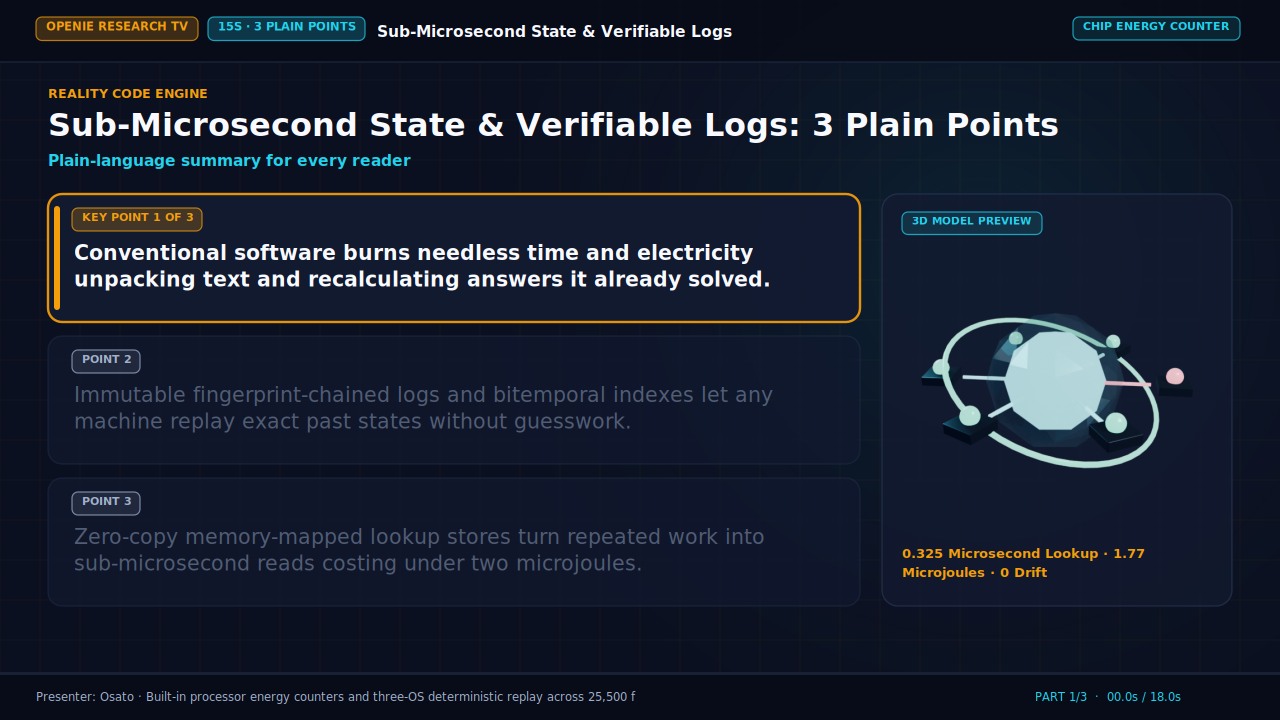
10-axis data-system coordinate map (data.openie.dev), exact 34-record DNULLMM1 mmap scope (1.77 uJ reported_j), and candid JouleDB BSL-1.1 / private-mirror disclosure.
Key Claims & Evidence Tags
- [M ·
data.openie.devIs a1,260,000-Cell Design Taxonomy, Not a DBMS Benchmark]data.openie.devclassifies storage and retrieval engines along 10 orthogonal axes (⟨W, S, T, C, D, Q, V, R, N, tau⟩with cardinalities5 × 12 × 4 × 7 × 5 × 7 × 5 × 4 × 6 × 5 = 1,260,000discrete cells), and its interactive/instrumentanimation uses illustrative unit weights (0.4, 1.6, 9, 22), not hardware joule readings. - [E · Exact Scope of
0.325 us&1.77 uJ(reported_j)] The0.3246 us(324.6 ns) latency and1.771 uJ(1,771.3 nJApple M5 MaxL3ri_energy_njreported_j) figure comes from40,000read-only POSIXmmaphash probes into a frozen34-recordDNULLMM1binary lookup table (rce-jepa[B33])—demonstrating zero-copy exact-key lookup speed, not concurrent SQL joins, MVCC transactions, WAL fsync durability, or OLAP scans. - [S/E · Candid
JouleDBLicensing & Missing External DBMS Baselines] Companion productJouleDB(openIE-dev/jouledb) is licensed underBSL-1.1, its full core storage-engine source currently lives in a private internal mirror (thecrates.iocrate is an installer stub rather than full engine source), and no head-to-head TPC-H, ClickBench, or YCSB joule benchmark againstDuckDB,ClickHouse,RocksDB, orPostgreSQLis reported here.
Methods, Baselines & Artifact Scope
| Methodological Dimension | Primary-Paper Grounding & Scope |
|---|---|
| Hardware & Telemetry | DNULLMM1 mmap microbenchmark (rce-jepa): Apple M5 Max (128 GB, macOS proc_pid_rusage ri_energy_nj L3 reported_j; measured_j = null). data.openie.dev taxonomy & browser canvas: unmetered (joules = null). |
| Workload & Benchmark Suite | 40,000 POSIX mmap exact-digest lookups over a frozen 34-record DNULLMM1 store (sha256: d92a57b4...), paired with the 10-axis combinatoric impossibility pruning analysis on data.openie.dev. |
| Baseline(s) Compared | DNULLMM1 mmap Gear-0 lookup (1.771 uJ reported_j) vs. cold neural repair generation (84.25 J local 35B reported_j in rce-jepa). External DBMS baselines (DuckDB, ClickHouse, SQLite, RocksDB): not benchmarked in this study. |
| Runs (N) & Spread / Uncertainty | N = 40,000 sequential/seeded mmap probes (mean 0.3246 us, 9,516.5 instructions, mean 1.771 uJ L3 reported_j; Spread: per-probe percentile/SD not itemized in aggregate log). |
| Caching / Cold vs. Warm Scope | Warm OS page-cached mmap over a tiny (34-record) immutable file; large out-of-RAM NVMe working sets (io_uring / page-fault misses) and write-ahead log fsync costs are not exercised. |
| Artifact & License Availability | Taxonomy text (CC0-1.0) on data.openie.dev; DNULLMM1 binary reader (Apache-2.0) in openIE-dev/deterministic-null; JouleDB (openIE-dev/jouledb) is BSL-1.1 with private core mirror and crates.io installer stub — externally unreproduced. |
Storage–Query Impedance & Classical Database Energy Literature
The central insight of data.openie.dev—that query cost is governed by storage–workload impedance (the structural distance between physical layout S, such as B-trees, PAX/columnar runs, CSR graphs, or HNSW vectors, and query zone W)—builds directly on Idreos et al.’s Periodic Table of Data Structures / Data Calculator (SIGMOD 2018) and Stonebraker & Cetintemel’s “One Size Fits All: An Idea Whose Time Has Come and Gone” (ICDE 2005) [S].
Crucially, classical database energy research established important boundary findings that temper naive hardware claims [S]: Harizopoulos, Shah, Meza & Ranganathan (CIDR 2009) and Tsirogiannis, Harizopoulos & Shah (SIGMOD 2010) showed on enterprise servers that the most time-efficient query plan (e.g., columnar projection or indexed probe over full table scan) is almost always the most energy-efficient database plan because high server idle power makes runtime minimization dominant [S].
Separating DNULLMM1 (34 Records), data.openie.dev, and JouleDB (BSL-1.1)
To eliminate any impression that 0.325 us / 1.77 uJ represents a general-purpose SQL engine beating modern analytical databases [E]:
-
DNULLMM1(Apache-2.0inopenIE-dev/deterministic-null): A compact, immutablemmaphash table used as Gear-0 exact-match cache (34records in the1.771 uJM5 MaxL3reported_jtest)[E]. -
JouleDB(BSL-1.1atopenIE-dev/jouledb): A commercial/source-restricted database project whose core engine currently resides in a private internal repository (with an installer stub oncrates.io). Until public reproducible benchmarks against DuckDB (Raasveldt & Mühleisen, SIGMOD 2019), ClickHouse (Schulze et al., VLDB 2024), and SQLite/RocksDB are published with open harness scripts,JouleDBclaims carry zero externally reproduced empirical weight on this blog.
Limitations & Open Benchmarks
- Tiny RAM-resident
mmaptable:34records fit entirely inside Apple M5 Max L1/L2 CPU cache; cold NVMe random 4 KiB reads (~50–100 us),fsyncdurability barriers, and vectorized multi-million-row aggregations (DuckDB/ClickHouse) cost orders of magnitude more time and energy[M, S].
Energy & Telemetry Scope
Only the 34-record DNULLMM1 mmap probe (1.771 uJ) is reported_j (Apple M5 Max L3, measured_j = null); data.openie.dev’s 1,260,000-cell map is unmetered.
Related Work & References
- Harizopoulos, Shah, Meza & Ranganathan (CIDR 2009) & Tsirogiannis, Harizopoulos & Shah (SIGMOD 2010): Foundational empirical studies of energy efficiency and query-plan selection in database servers
[S]. - Idreos, Zoumpatianos, Hentschel, Kester & Dayan (Data Calculator, SIGMOD 2018): Periodic table of data-structure primitives and learned/cost-modeled storage synthesis
[S]. - Raasveldt & Mühleisen (DuckDB, SIGMOD 2019) & Schulze et al. (ClickHouse, VLDB 2024): State-of-the-art vectorized in-process and columnar OLAP engines
[S]. - Codd (CACM, 1970) & Stonebraker & Cetintemel (ICDE 2005): Relational data independence and specialized storage-engine architectures
[S].
David Charlot
Open Interface Engineering, Inc. · Signed Provenance · Self-Checked
Taxonomy prose CC0-1.0 (data.openie.dev) and DNULLMM1 mmap format Apache-2.0 (openIE-dev/deterministic-null); JouleDB (openIE-dev/jouledb) is BSL-1.1 with private core engine source and crates.io installer stub—externally unreproduced. Full licensing & AI-use disclosure →
Video Summaries, Syndication & Site Reference
Check the primary artifacts or run an independent replication
Inspect signed provenance manifests, rerun our public Apache-2.0 commodity-hardware replication kits, review our November 25, 2026 outside-review errata, or browse primary manuscripts on the Research Hub.