The Data Systems Stack (data.openie.dev): 10-Axis Coordinate Taxonomy (1.26M Cells), DNULLMM1 mmap Scope, and Honest JouleDB BSL-1.1 Status
Separates data.openie.dev’s unmetered 10-axis taxonomy (1,260,000 cells + illustrative canvas) from DNULLMM1’s 34-record mmap lookup (0.325 us / 1.77 uJ reported_j) and discloses that JouleDB is BSL-1.1 with private core source and zero DuckDB/ClickHouse benchmarks here.
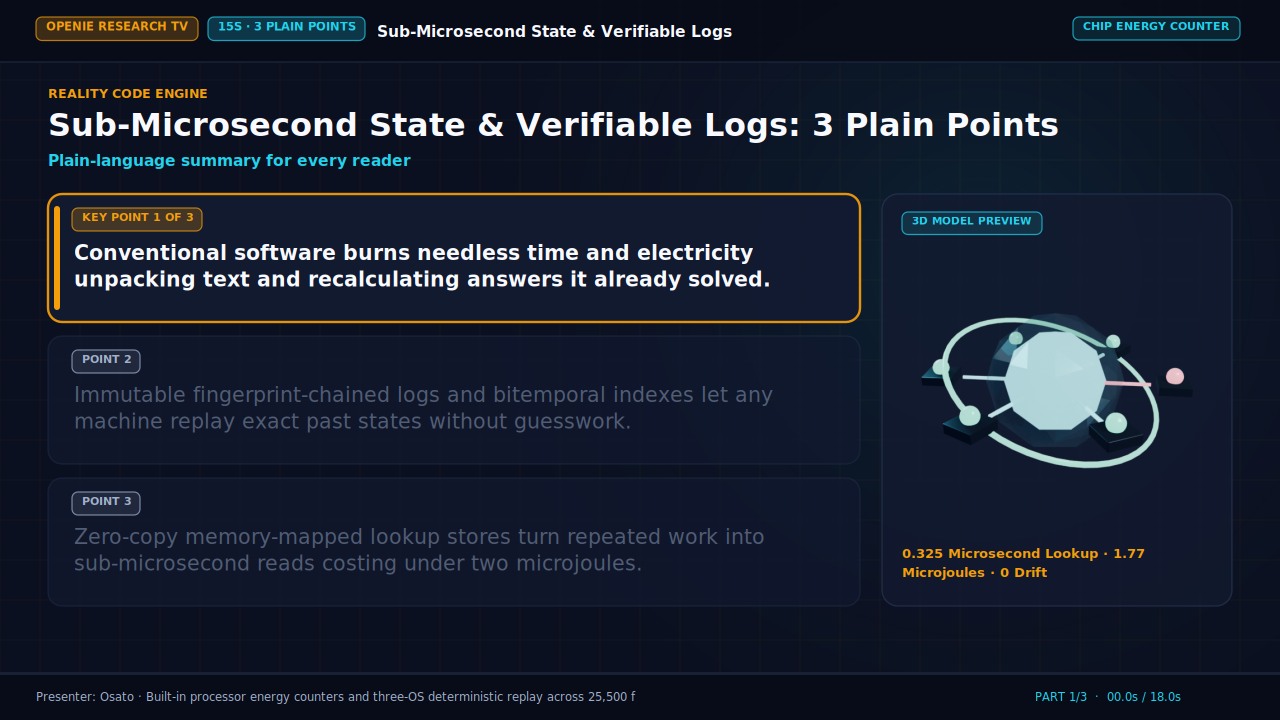
Temporal & Archival Scope: Era II OpenIE Study (November 23, 2026) · Canonical OpenIE Chronicle Entry: https://blog.openie.dev/posts/eco-database/ · Primary Paper & Methods: https://research.openie.dev/papers/rce/ · Canonical Digest:
blake3:tv:74a6c924643a078e785536a03514eee6983c488a2a00381e2186933fe3a7688eProvenance & Telemetry Hygiene: Signed Provenance · Self-Checked (automated OpenIE internal gates; not externally peer-reviewed) · Energy Class:
reported_j(measured_j ⊥ reported_j ⊥ est_j ⊥ unmetered— Verification, Licensing & AI-Use Disclosure · Glossary & Non-Mixing Rules).
Key Claims & Evidence Tags
- [M ·
data.openie.devIs a1,260,000-Cell Design Taxonomy, Not a DBMS Benchmark]data.openie.devclassifies storage and retrieval engines along 10 orthogonal axes (⟨W, S, T, C, D, Q, V, R, N, tau⟩with cardinalities5 × 12 × 4 × 7 × 5 × 7 × 5 × 4 × 6 × 5 = 1,260,000discrete cells), and its interactive/instrumentanimation uses illustrative unit weights (0.4, 1.6, 9, 22), not hardware joule readings. - [E · Exact Scope of
0.325 us&1.77 uJ(reported_j)] The0.3246 us(324.6 ns) latency and1.771 uJ(1,771.3 nJApple M5 MaxL3ri_energy_njreported_j) figure comes from40,000read-only POSIXmmaphash probes into a frozen34-recordDNULLMM1binary lookup table (rce-jepa[B33])—demonstrating zero-copy exact-key lookup speed, not concurrent SQL joins, MVCC transactions, WAL fsync durability, or OLAP scans. - [S/E · Candid
JouleDBLicensing & Missing External DBMS Baselines] Companion productJouleDB(openIE-dev/jouledb) is licensed underBSL-1.1, its full core storage-engine source currently lives in a private internal mirror (thecrates.iocrate is an installer stub rather than full engine source), and no head-to-head TPC-H, ClickBench, or YCSB joule benchmark againstDuckDB,ClickHouse,RocksDB, orPostgreSQLis reported here.
Methods, Baselines & Artifact Scope
- Methodological Dimension: Hardware & Telemetry · Primary-Paper Grounding & Scope:
DNULLMM1mmapmicrobenchmark (rce-jepa): Apple M5 Max (128 GB, macOSproc_pid_rusageri_energy_njL3reported_j;measured_j = null).data.openie.devtaxonomy & browser canvas:unmetered(joules = null). - Methodological Dimension: Workload & Benchmark Suite · Primary-Paper Grounding & Scope:
40,000POSIXmmapexact-digest lookups over a frozen34-recordDNULLMM1store (sha256: d92a57b4...), paired with the10-axis combinatoric impossibility pruning analysis ondata.openie.dev. - Methodological Dimension: Baseline(s) Compared · Primary-Paper Grounding & Scope:
DNULLMM1mmapGear-0 lookup (1.771 uJreported_j) vs. cold neural repair generation (84.25 Jlocal35Breported_jinrce-jepa). External DBMS baselines (DuckDB,ClickHouse,SQLite,RocksDB): not benchmarked in this study. - Methodological Dimension: Runs (N) & Spread / Uncertainty · Primary-Paper Grounding & Scope:
N = 40,000sequential/seededmmapprobes (mean 0.3246 us,9,516.5instructions,mean 1.771 uJL3reported_j; Spread: per-probe percentile/SD not itemized in aggregate log). - Methodological Dimension: Caching / Cold vs. Warm Scope · Primary-Paper Grounding & Scope: Warm OS page-cached
mmapover a tiny (34-record) immutable file; large out-of-RAM NVMe working sets (io_uring/ page-fault misses) and write-ahead logfsynccosts are not exercised. - Methodological Dimension: Artifact & License Availability · Primary-Paper Grounding & Scope: Taxonomy text (
CC0-1.0) ondata.openie.dev;DNULLMM1binary reader (Apache-2.0) inopenIE-dev/deterministic-null;JouleDB(openIE-dev/jouledb) isBSL-1.1with private core mirror andcrates.ioinstaller stub — externally unreproduced.
Storage–Query Impedance & Classical Database Energy Literature
The central insight of data.openie.dev—that query cost is governed by storage–workload impedance (the structural distance between physical layout S, such as B-trees, PAX/columnar runs, CSR graphs, or HNSW vectors, and query zone W)—builds directly on Idreos et al.’s Periodic Table of Data Structures / Data Calculator (SIGMOD 2018) and Stonebraker & Cetintemel’s “One Size Fits All: An Idea Whose Time Has Come and Gone” (ICDE 2005) [S].
Crucially, classical database energy research established important boundary findings that temper naive hardware claims [S]: Harizopoulos, Shah, Meza & Ranganathan (CIDR 2009) and Tsirogiannis, Harizopoulos & Shah (SIGMOD 2010) showed on enterprise servers that the most time-efficient query plan (e.g., columnar projection or indexed probe over full table scan) is almost always the most energy-efficient database plan because high server idle power makes runtime minimization dominant [S].
Separating DNULLMM1 (34 Records), data.openie.dev, and JouleDB (BSL-1.1)
To eliminate any impression that 0.325 us / 1.77 uJ represents a general-purpose SQL engine beating modern analytical databases [E]:
-
DNULLMM1(Apache-2.0inopenIE-dev/deterministic-null): A compact, immutablemmaphash table used as Gear-0 exact-match cache (34records in the1.771 uJM5 MaxL3reported_jtest)[E]. -
JouleDB(BSL-1.1atopenIE-dev/jouledb): A commercial/source-restricted database project whose core engine currently resides in a private internal repository (with an installer stub oncrates.io). Until public reproducible benchmarks against DuckDB (Raasveldt & Mühleisen, SIGMOD 2019), ClickHouse (Schulze et al., VLDB 2024), and SQLite/RocksDB are published with open harness scripts,JouleDBclaims carry zero externally reproduced empirical weight on this blog.
Limitations & Open Benchmarks
- Tiny RAM-resident
mmaptable:34records fit entirely inside Apple M5 Max L1/L2 CPU cache; cold NVMe random 4 KiB reads (~50–100 us),fsyncdurability barriers, and vectorized multi-million-row aggregations (DuckDB/ClickHouse) cost orders of magnitude more time and energy[M, S].
Energy & Telemetry Scope
Only the 34-record DNULLMM1 mmap probe (1.771 uJ) is reported_j (Apple M5 Max L3, measured_j = null); data.openie.dev’s 1,260,000-cell map is unmetered.
Related Work & References
- Harizopoulos, Shah, Meza & Ranganathan (CIDR 2009) & Tsirogiannis, Harizopoulos & Shah (SIGMOD 2010): Foundational empirical studies of energy efficiency and query-plan selection in database servers
[S]. - Idreos, Zoumpatianos, Hentschel, Kester & Dayan (Data Calculator, SIGMOD 2018): Periodic table of data-structure primitives and learned/cost-modeled storage synthesis
[S]. - Raasveldt & Mühleisen (DuckDB, SIGMOD 2019) & Schulze et al. (ClickHouse, VLDB 2024): State-of-the-art vectorized in-process and columnar OLAP engines
[S]. - Codd (CACM, 1970) & Stonebraker & Cetintemel (ICDE 2005): Relational data independence and specialized storage-engine architectures
[S].
Canonical Provenance, Primary Artifacts & Independent Replication
- Canonical OpenIE Chronicle Entry: https://blog.openie.dev/posts/eco-database/
- Primary Study & Methods: https://research.openie.dev/papers/rce/
- Public Code / Replication Harness: https://github.com/openIE-dev/deterministic-null
- Illustrated Video Summary (OpenIE Research TV): https://research.openie.dev/tv/?study=eco-database (9:16 Vertical MP4)
- Signed Provenance · Self-Checked Disclosure & Licensing: Taxonomy prose CC0-1.0 (data.openie.dev) and DNULLMM1 mmap format Apache-2.0 (openIE-dev/deterministic-null); JouleDB (openIE-dev/jouledb) is BSL-1.1 with private core engine source and crates.io installer stub—externally unreproduced. Full details at https://blog.openie.dev/verification/ and https://blog.openie.dev/glossary/.