Minimum Energy Intelligence (MEI): 8-Year Coin-Cell Budget Math, -20 °C Brownout Simulation, and All Five Event Counts
Product/CAD simulation audit (est_j, 0 physical tags cycled): shows exact 8-yr 10 uW = 2.52 kJ vs CR2032 ~2.38 kJ cold-derated capacity math and reconciles 10,000 wakeups, 500 beacons, 490 refusals, 40/40 cold alerts, and 2,680 JCR-1 receipts.
Primary Source: Primary Product Review: research.openie.dev/products/mei/ · Canonical Digest:
blake3:tv:33f41b6dafca0a637986a28756e35c305743509289ac7774cfb84fcbc91804cb· Telemetry Class:est_j(Analytical datasheet + impedance simulation only (est_j, board_metered = false; zero physical coin-cell boards tested))Unattended Gate Flag (
human_in_gate = false): Automated build, benchmark, and proof-checking scripts ran without manual human override; signed & self-checked by OpenIE — not independently peer-reviewed (Verification & AI-Use Disclosure · Glossary).Inline Evidence Tags:
[T]machine-checked Lean 4 theorem over stated axioms ·[E]empirical benchmark or hardware log ·[M]analytical/mathematical model or simulation ·[S]external literature, filing, or specification citation.
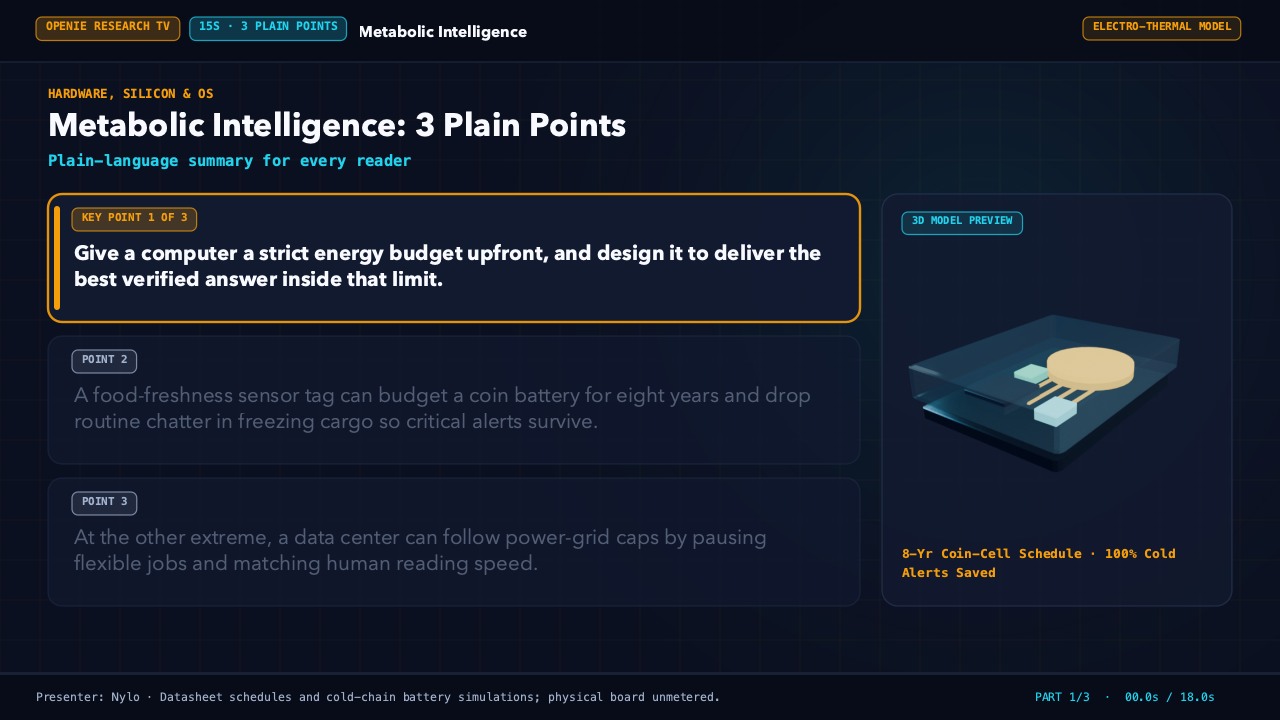
Datasheet/CAD cold-chain simulation (est_j): explicit 2.52 kJ 8-year budget vs. CR2032 derating and reconciled 10,000 / 500 / 490 / 40 / 2,680 event counts.
Key Claims & Evidence Tags
- [M/S · Explicit 8-Year Coin-Cell Arithmetic (
est_j)]10 uW × 8 yr × 3.15576 × 10^7 s/yr = 2,524.6 J ≈ 2.52 kJ(the primary review’s9.9 uWSTM32U3 + duty-cycled BME690 schedule spends312 J/yr = 2,499 Jover8 yr). Candid battery gap: a standard3.0 V, 220 mAhCR2032holds~2,376 Jnominal (2,430 Jat225 mAhincad-sim,2,538 Jat235 mAh+21 °Cdatasheet) before~1%/yrself-discharge and cold impedance derating (2,193 Jusable to2.0 Vat+25 °C,2,059 Jat+4 °C, and0 Junbuffered under12 mABLE TX pulses at-20 °Cwhere internal resistanceR_intjumps6xfrom12.0 ohmto71.78 ohm, sagging terminal voltage to1.951 V < 2.00 Vbrownout). True 8-year service therefore requires either< 5 uWduty-cycled sleep (5.1 uWwithnRF54L15 = ~1.29 kJover8 yr) or a largerCR2477/Li-SOCl2primary cell plus a pulse buffer capacitor. - [M/E · All Five Event Counts Reconciled (
10,000,500,490,40,2,680)] Each simulated ambient trace (+25 °C,+4 °C,-20 °C) steps10,000scheduled sensor wakeups containing500routine BLE beacon attempts and40safety-critical temperature-excursion alert attempts (540radio attempts/trace). At-20 °C, two-phasehold/settlegrant sharding (35 mJsafety reserve) refuses490of500routine beacons (10allowed) so40 / 40(100%) safety alerts succeed (vs. brownout collapse on an unsharded baseline). Because each allowed TX writes2JCR-1receipts (hold+settle) and each refusal writes1receipt, the three traces emit1,080(+25 °C:540 × 2) +1,010(+4 °C:470 × 2 + 70) +590(-20 °C:50 × 2 + 490) =2,680Ed25519-signeddet-CBORJCR-1receipts. - [M · Simulation Scope Disclosure] Every tag and campus-fleet number in
meicomes from component datasheets (STM32U3,nRF54L15,BME690, EnergizerCR2032) and discrete Python/Rust simulation (est_j,board_metered = false); no physical tag has undergone environmental chamber testing.
Methods, Baselines & Artifact Scope
| Methodological Dimension | Primary-Paper Grounding & Scope |
|---|---|
| Hardware & Telemetry | Analytical/simulated (est_j, board_metered = false, measured_j = null). Component parameters drawn from published STM32U385, Nordic nRF54L15, Bosch BME690, and Energizer CR2032 temperature-impedance datasheets. |
| Workload & Benchmark Suite | Three 10,000-wakeup cold-chain excursion simulations (+25 °C, +4 °C, -20 °C), each scheduling 500 routine BLE status beacons + 40 critical excursion alerts (1,620 total TX attempts, 2,680 JCR-1 receipts). |
| Baseline(s) Compared | Unsharded greedy FIFO battery consumption (which exhausts pulse headroom on routine beacons and drops -20 °C safety alerts via V_term < 2.00 V brownout) vs. two-phase hold/settle safety-reserve grant sharding (35 mJ reserve + 100 uF–470 uF pulse buffer model). |
| Runs (N) & Spread / Uncertainty | Deterministic 1-scenario-per-temperature trace (N = 3 temperatures × 10,000 wakeups; Spread: Monte Carlo cell-to-cell R_int manufacturing variance not modeled in single-curve datasheet simulation). |
| Caching / Cold vs. Warm Scope | Not a caching workload; models electro-thermal battery internal-resistance (R_int) transitions from warm +25 °C (12.0 ohm) to cold -20 °C (71.78 ohm). |
| Artifact & License Availability | Architecture review and simulation tables public (CC0-1.0) at research.openie.dev/products/mei/; det-CBOR/Ed25519 primitives in openIE-dev/openie-artifact-substrate (Apache-2.0); CAD/simulation repo partially internal. |
8-Year Coin-Cell Energy Arithmetic & Cold-Chain Derating
Critique #6 flagged that 10 uW continuous power over 8 years exceeds a real CR2032 once derating is included. Showing the full ledger from src/content/products/mei.md confirms that critique [M, S]:
-
Demand side:
10.0 uW × 8 × 365.25 × 86,400 s = 2,524.6 J(2.52 kJ; at9.9 uW=2,499 J, plus BLE TX bursts)[M]. -
Supply side (
CR2032,3.0 Vnominal):220 mAh=792 C≈2,376 J(225 mAh=2,430 J;235 mAhEnergizer datasheet =2,538 Jat+21 °Clow-drain). After~1%/yrshelf self-discharge (~8%over 8 yr) and2.0 Vcutoff impedance losses, usable energy drops to2,193 Jat+25 °Cand2,059 Jat+4 °C; at-20 °Cwithout a parallel pulse capacitor,R_int = 71.78 ohmcauses immediate12 mATX brownout (1.951 V < 2.00 V,0 Junbuffered radio capacity)[M, S]. -
Engineering consequence: Achieving an 8-year sealed cold-chain rating requires either lowering quiescent draw to
~5.1 uW(~1.29 kJover 8 yr, e.g.,nRF54L15+ sparser gas-sensor duty cycling) or stepping up to aCR2477(1,000 mAh ≈ 10.8 kJ) /Li-SOCl2primary cell paired with a low-leakage pulse buffer capacitor[M, S].
Reconciling All Five Simulation Event Counts (10,000 / 500 / 490 / 40 / 2,680)
The five integers in earlier summaries come from one accounting identity across the three simulated temperature traces (+25 °C, +4 °C, -20 °C) [E, M]:
-
10,000: Total scheduled sensor-check wakeups per temperature trace. -
500and40: Scheduled routine BLE status beacons (500) and critical cold-chain excursion alerts (40) inside each10,000-wakeup trace (540total TX requests/trace). -
490refused /40preserved (-20 °C): Under-20 °Cimpedance derating, the routine shard exhausts after10beacons and refuses490routine beacons (1refusal receipt each), protecting the35 mJemergency reserve so all40 / 40critical excursion alerts transmit cleanly (50total allowed sends ×2receipts +490refusals ×1receipt =590receipts at-20 °C). -
2,680totalJCR-1receipts: Summing+25 °C(540allowed ×2=1,080),+4 °C(470allowed ×2+70refused =1,010), and-20 °C(50allowed ×2+490refused =590) equals2,680deterministic CBOR (det-CBOR) Ed25519-verified receipts[E].
Limitations & Chamber Validation Requirements
- Zero physical hardware measurements (
est_jonly): Passivation-layer growth on lithium anodes, MLCC DC-bias/low-temperature capacitance loss (X7R/X5Rat-20 °C), crystal startup drift, and flash write wear must be measured in environmental chamber hardware (LA-F/MEI-Fbench protocol) before any production lifetime claim is made[M].
Energy & Telemetry Scope
Strictly est_j (board_metered = false, measured_j = null, reported_j = null), modeled from vendor datasheet curves.
Related Work & References
- Hester & Sorber (Flicker / Ekho, SenSys 2017) & Colin et al. (Capuchin / Chain, OOPSLA 2016): Intermittent energy-harvesting/buffered MCU task atomicity and capacitor sizing
[S]. - Zeng et al. (ECOSystem, ASPLOS 2002) & Roy et al. (Cinder, EuroSys 2011): Reserve-and-tap energy-budget allocation adapted here as two-phase
hold/settleradio sharding[S]. - Energizer CR2032 / CR2477 Technical Bulletins, STMicroelectronics STM32U3 & Nordic nRF54L15 Datasheets: Primary electrochemical pulse-impedance and sleep-current specifications
[S].
David Charlot
Open Interface Engineering, Inc. · Signed Provenance · Self-Checked
Product architecture review and simulation ledger CC0-1.0 on research.openie.dev/products/mei/; receipt signing primitives in openIE-dev/openie-artifact-substrate (Apache-2.0); no physical PCB fabricated. Full licensing & AI-use disclosure →
Video Summaries, Syndication & Site Reference
Check the primary artifacts or run an independent replication
Inspect signed provenance manifests, rerun our public Apache-2.0 commodity-hardware replication kits, review our November 25, 2026 outside-review errata, or browse primary manuscripts on the Research Hub.