The OpenIE Stack Map (stack.openie.dev): An Unmetered Conceptual Taxonomy Across Information Theory, Game Theory, and Mechanism Design
Clarifies that stack.openie.dev is an unmetered teaching map relating Information Theory, Game Theory, and Mechanism Design across 8 domain stacks—containing zero standalone hardware benchmarks.
Primary Source: Companion Foundation Paper: research.openie.dev/papers/agency/ (Portal: stack.openie.dev) · Canonical Digest:
blake3:tv:f1be23b37b7c4b0d74ccaaf3952659250ac143aa9ea3116538cd2c3ac0d9d774· Telemetry Class:unmetered(joules = null (unmetered curriculum and conceptual taxonomy overview; corrected from earlier reported_j tag))Unattended Gate Flag (
human_in_gate = false): Automated build, benchmark, and proof-checking scripts ran without manual human override; signed & self-checked by OpenIE — not independently peer-reviewed (Verification & AI-Use Disclosure · Glossary).Inline Evidence Tags:
[T]machine-checked Lean 4 theorem over stated axioms ·[E]empirical benchmark or hardware log ·[M]analytical/mathematical model or simulation ·[S]external literature, filing, or specification citation.
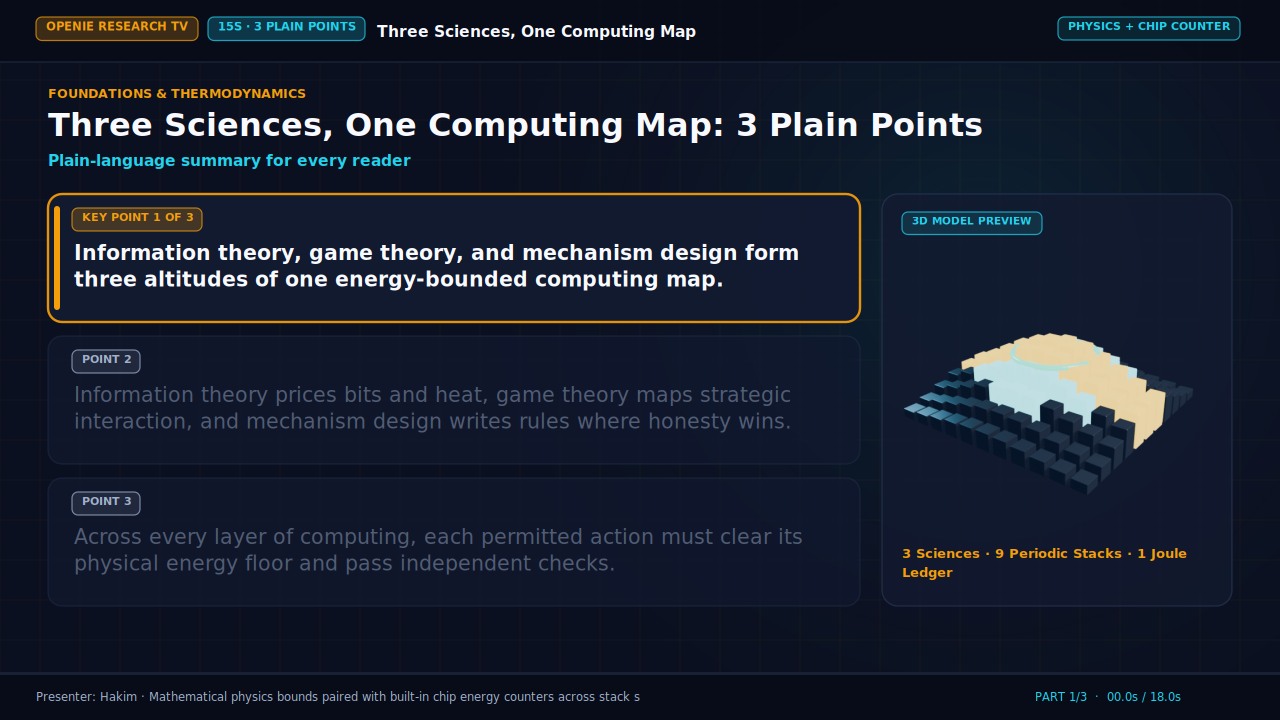
Pedagogical taxonomy (stack.openie.dev) arranging Information Theory, Game Theory, and Mechanism Design (joules = null, unmetered).
Key Claims & Evidence Tags
- [M/S · Corrected Telemetry & Track Classification (
unmetered)] Earlier syndication metadata inheritedreported_jfrom its linked foundation paper (agency). Becausestack.openie.devitself is a purely conceptual teaching map with zero empirical benchmarks, its classification is corrected here tounmetered(joules = null,framing-synthesis). - [S · Three Classical Sciences Placed by Altitude] Synthesizes Information Theory (Shannon 1948 channel/representation bounds; Landauer 1961 physical bit erasure) as the physical substrate, Game Theory (von Neumann & Morgenstern 1944; Nash 1950 equilibria) as strategic interaction over payoffs, and Mechanism Design (Hurwicz, Maskin & Myerson, 2007 Nobel lecture lineage) as rule/gate routing that aligns incentives or proposals with desired outcomes.
- [M · Honest Cross-Portal Licensing Boundary] While the
stack.openie.devweb guide is openly readable, the eight domain stacks it indexes do not share one blanket software license:rce,rce-vc,deterministic-null, andlut-adapt-aiareApache-2.0public repos, whereasJouleDB(data.openie.dev) andPattern-lang(synthesis.openie.dev) useBSL-1.1with private core mirrors, andJouleOSremains private.
Methods, Baselines & Artifact Scope
| Methodological Dimension | Primary-Paper Grounding & Scope |
|---|---|
| Hardware & Telemetry | Unmetered (joules = null, board_metered = false). Conceptual curriculum synthesis (stack.openie.dev). |
| Workload & Benchmark Suite | No empirical benchmark suite executed on stack.openie.dev; organizes shared coordinate axes (Thermodynamic class T, Verifiability V, Encoding regime R) across Compute, Data, Synthesis, Knowledge, State, Communication, Memory, and Verify portals. |
| Baseline(s) Compared | Qualitative contrast between treating computing subfields (compilers, databases, AI routing, distributed consensus) as isolated silos vs. projections sharing common cost/verification axes. |
| Runs (N) & Spread / Uncertainty | Not applicable (N = 0 empirical trials in this overview portal). |
| Caching / Cold vs. Warm Scope | Conceptual taxonomy only: classifies memoization/indexing as moving recurring work from online search axes to precomputed storage axes. |
| Artifact & License Availability | Portal web pages public at https://stack.openie.dev/ (CC0-1.0 blog summary); no single repo encompasses all 8 stacks (see Verification & Licensing Table). |
What stack.openie.dev Is—and What It Is Not
stack.openie.dev is an architectural map and teaching index, not a research experiment [M]. Its goal is to give readers one vocabulary before entering specialized papers: Information Theory asks what a representation or channel must pay in bits and physical work; Game Theory asks where interacting agents settle given fixed payoffs; and Mechanism Design asks what admission rules (gates, auctions, commit protocols) steer strategic or stochastic actors toward valid states [S].
Shared Coordinate Axes Across the Domain Portals
Across the companion portals (compute.openie.dev, data.openie.dev, synthesis.openie.dev, knowledge.openie.dev, avalanche.openie.dev), three shared classification axes recur [M]: (1) Cost regime (T) separating bijective/index lookups from dense floating-point search; (2) Verifiability (V) separating proof-checked or oracle-tested outputs from uncalibrated prose; and (3) Temporal/Provenance scope tracking valid time and telemetry tier (measured_j ⊥ reported_j ⊥ est_j ⊥ unmetered).
Limitations & Taxonomic Caveats
-
A taxonomy is a classification choice, not a physical law: Calling the domain maps “Periodic Stacks” is an organizational analogy to facet classification (Ranganathan 1933) and Mendeleev (1869); unlike chemical atomic number
Z, software design axes are discrete human abstractions whose granularity can be subdivided differently[M, S]. -
Mixed software availability: Readers must check each linked repository’s individual license (
Apache-2.0vs.BSL-1.1vs. private) rather than assuming every portal ships open-source engine code.
Energy & Telemetry Scope
Strictly unmetered (joules = null, board_metered = false).
Related Work & References
- Shannon (Bell Syst. Tech. J., 1948) & Landauer (IBM J. Res. Dev., 1961) / Bérut et al. (Nature, 2012): Channel capacity, source entropy, and experimental verification of
k_B T ln 2bit-erasure heat[S]. - von Neumann & Morgenstern (1944) & Nash (PNAS, 1950): Strategic games and equilibrium existence
[S]. - Hurwicz (1960/1973), Maskin (Rev. Econ. Stud., 1999) & Myerson (Math. Oper. Res., 1981): Incentive-compatible mechanism design and revelation principles
[S]. - Ranganathan (Colon Classification, 1933) & Nisan & Roughgarden et al. (Algorithmic Game Theory, 2007): Multi-faceted knowledge classification and computational mechanism design
[S].
David Charlot
Open Interface Engineering, Inc. · Signed Provenance · Self-Checked
Overview prose CC0-1.0 / public web portal (stack.openie.dev); companion codebases across the 8 stacks span Apache-2.0 (rce, deterministic-null, lut-adapt-ai), BSL-1.1 (jouledb, pattern-lang), and private repos. Full licensing & AI-use disclosure →
Video Summaries, Syndication & Site Reference
Check the primary artifacts or run an independent replication
Inspect signed provenance manifests, rerun our public Apache-2.0 commodity-hardware replication kits, review our November 25, 2026 outside-review errata, or browse primary manuscripts on the Research Hub.