RCE-VC: A Proposed Structural Version-Control Prototype, Rename Behavior, Key Collisions, and Git Comparison Scope
Presents openIE-dev/rce-vc (v0.1.0, 49 offline tests) as a proposed structural VCS prototype (317-365 uJ/unit M5 Max reported_j), disclosing structural key collisions on identical bodies and zero external merge-benchmark runs vs git merge-ort.
Primary Source: Primary Paper: research.openie.dev/papers/rce-vc/ · Canonical Digest:
blake3:tv:86d270c120708d4df299264a57fb54a861630fd2bcb2841abc701873d365b3b0· Telemetry Class:reported_j(Apple M5 Max macOS proc_pid_rusage ri_energy_nj L3 reported_j (317.21–365.35 uJ/admission); measured_j = null)Unattended Gate Flag (
human_in_gate = false): Automated build, benchmark, and proof-checking scripts ran without manual human override; signed & self-checked by OpenIE — not independently peer-reviewed (Verification & AI-Use Disclosure · Glossary).Inline Evidence Tags:
[T]machine-checked Lean 4 theorem over stated axioms ·[E]empirical benchmark or hardware log ·[M]analytical/mathematical model or simulation ·[S]external literature, filing, or specification citation.
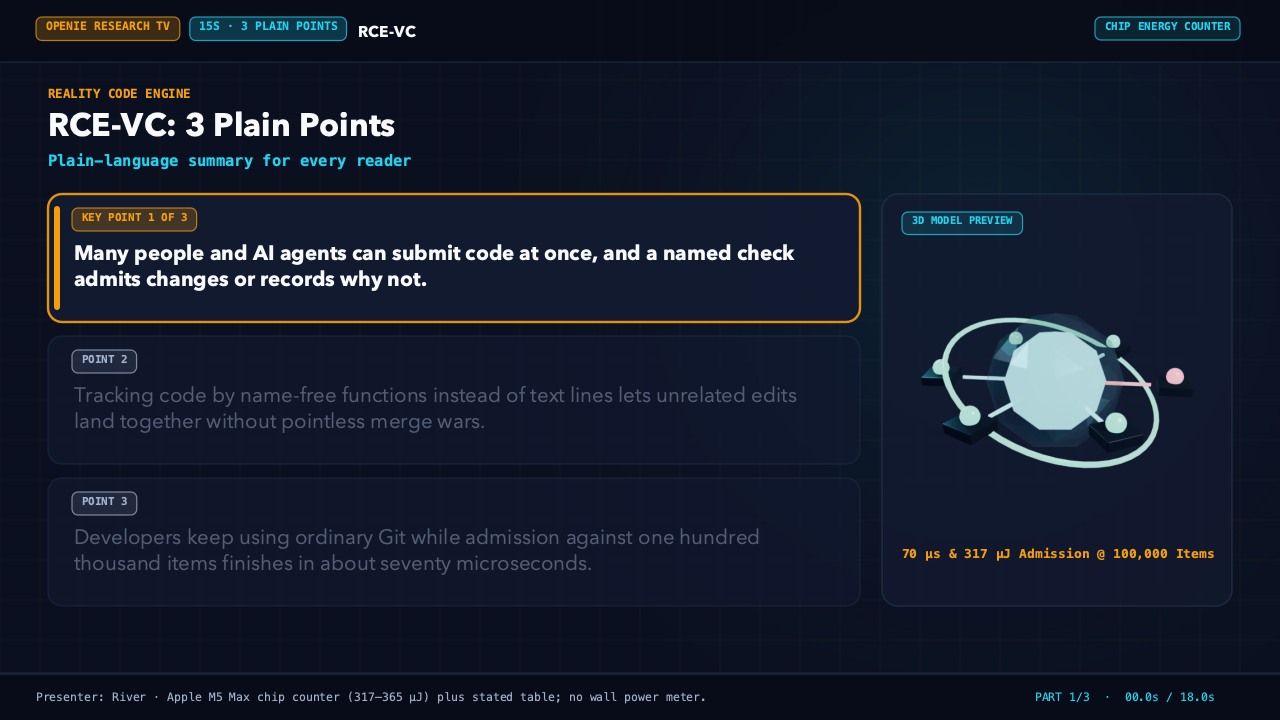
Proposed rce-vc v0.1.0 prototype (openIE-dev/rce-vc@aba99fce): 100,000-unit trie admission reported_j, rename handling, and structural collision caveats.
Key Claims & Evidence Tags
- [M/E · Proposed Prototype Contract, Not a Physical Law]
rce-vc(v0.1.0,49offline tests across 6 Rust crates ataba99fce) is a proposed structural repository admission contract, not a law of nature—and was not benchmarked head-to-head on conflict-resolution precision/recall againstgit merge-ort, GumTree, Spork, or Mergiraf (Merge-Bench/CONGRA) in this study (§9). - [E · Apple M5 Max
L3 reported_jwith Spread] Admitting a single unit change into a100,000-unit persistent 16-way Merkle trie (O(log_16 U)path copy, re-checking only affected dependents) took 69.69 us (min–max63.5–84.1 us) and 365.35 uJ (346.4–395.7 uJ,N = 5trials of320admissions), or 73.56 us (69.3–75.7 us) and 317.21 uJ (278.9–369.0 uJ,N = 3sustained trials of32,000admissions) in DarwinL3ri_energy_njreported_j. - [M/E · Renames vs. Name-Free Key Collisions] Because
rcevc-keyshashes normalized de Bruijn token bodies (SHA-256over"rcevc/unit/v1", positional body, and dependency keys), renaming a function updates its parent slot binding (name-onlyequivalence) without changingkey(u)—however, two distinct functions with identical normalized structure and dependencies (such asf(x, y) = x + yandg(a, b) = a + bin untyped code) collide onto the exact samekey(u), remaining separate in the parent directory trie only via named slot bindings while sharing conflict-reuse keys if edited identically.
Methods, Baselines & Artifact Scope
| Methodological Dimension | Primary-Paper Grounding & Scope |
|---|---|
| Hardware & Telemetry | Apple M5 Max (128 GB, macOS 27.2.1, proc_pid_rusage ri_energy_nj L3 reported_j; board_metered = false, measured_j = null). Internal est_uj cost-table placeholders (424–439 mJ) were ~1,200x higher than measured L3 reported_j and are kept strictly separate. |
| Workload & Benchmark Suite | 49 offline Rust unit/property tests (rcevc-{types,keys,trie,merge,git,cli}: RCE Form, Rust, Python, JSON splitters, merge commutativity, replay determinism) plus synthetic 100,000-unit single-admission microbenchmarks. |
| Baseline(s) Compared | Whole-repository linear re-hashing/re-checking (O(U)) vs. 16-way Merkle path copy + reverse-dependency closure (O(log_16 U + |affected|)). External baseline: not benchmarked head-to-head against git merge-ort, Mergiraf, or Spork on public conflict corpora in this study. |
| Runs (N) & Spread / Uncertainty | N = 5 trials × 320 admissions (mean 69.69 us [63.5–84.1 us], mean 365.35 uJ [346.4–395.7 uJ]); N = 3 sustained trials × 32,000 admissions (mean 73.56 us [69.3–75.7 us], mean 317.21 uJ [278.9–369.0 uJ]). |
| Caching / Cold vs. Warm Scope | Content-addressed CAS + conflict-resolution store keyed by canonical unordered conflict signature (base_key, {side_keys}): exact recurring conflict shapes reuse verified resolutions, whereas novel semantic conflicts require human/proposer resolution. |
| Artifact & License Availability | Apache-2.0 public repository at https://github.com/openIE-dev/rce-vc (commit aba99fce); self-checked by OpenIE, open for external inspection and replication. |
How rce-vc Compares Conceptually to Git (merge-ort), AST Merge, and CRDTs
Git’s merge-ort engine performs fast 3-way line-diff merging with heuristic file-rename detection (50% similarity index) and zero semantic gate checking: two branches that rename or edit adjacent declarations can merge cleanly at the text level while breaking compilation or behavioral invariants [S]. Syntax-aware tools like GumTree (Falleri et al., ASE 2014), JDime / Spork (Larsén et al., 2022), and Mergiraf lift merging from lines to ASTs, while CRDTs (Shapiro et al., 2011) and Darcs/Pijul patch algebras guarantee algebraic convergence without type/test soundness [S]. rce-vc explores a complementary point: indexing top-level semantic units in a 16-way Merkle trie and requiring a declared admission gate (G0 parse -> G1 typecheck -> G2 tests/trace) before advancing a ref [E].
Rename Handling vs. Structural Key Collisions (f(x,y)=x+y vs. g(a,b)=a+b)
Critique #12 asked how name-free de Bruijn unit keys handle renames and structurally identical functions. In rce-vc (§3–§4) [E, M]:
-
Pure renames: Parent module nodes map
slot_name -> (key(u), content_digest(u)). Renamingcalc_taxtocompute_taxmoves the slot binding whilekey(u)stays invariant, enablingrce-vcto verify aname-onlyrefactor by checking multiset equality of unit keys without re-running downstream unit tests[E]. -
Structural collision hazard on identical bodies: Because
key(u)strips parameter and self names, two distinct functions in the same project with identical normalized token bodies and dependency keys—for exampledef add_meters(x, y): return x + yanddef add_seconds(a, b): return a + bin untyped Python—produce the exact samekey(u)[M, E]. While the parent module trie keeps both named slots (add_metersandadd_seconds) distinct viacontent_digest(H(body, dep_names)), unit-key-indexed caches deduplicate them onto one node, and same-body helper functions without distinct return/unit types cannot be told apart bykey(u)alone[M].
Limitations & Unbuilt Milestones (§9)
-
No external merge-conflict benchmark yet: Replay evaluation against
git merge-ort,Spork, andMergirafon real open-source merge histories (Merge-Bench,CONGRA) is an unexecuted milestone[E]. -
Prototype scope gaps: Cross-file Rust/Python dependency extraction currently resolves intra-file symbol tables only; TypeScript splitting, native Git packfile streaming (
gixinstead of loose objects), symlinks, executable mode bits, and submodules are not yet implemented inv0.1.0[E].
Energy & Telemetry Scope
The 317.21–365.35 uJ single-unit admission figure is Apple M5 Max per-process ri_energy_nj (L3 reported_j, measured_j = null), measuring in-memory/CAS Merkle trie updates plus affected-unit checks—not full-project cargo test execution [E].
Related Work & References
- Git
merge-ort(Newren, 2021) & Khanna, Kunal & Pierce (2007): Industrial 3-way line merge with rename heuristics and formal investigation ofdiff3[S]. - Falleri et al. (GumTree, ASE 2014), Larsén et al. (Spork, IEEE TSE 2022) & Mergiraf: Fine-grained AST diffing and structured 3-way merge
[S]. - Shapiro, Preguiça, Baquero & Zawirski (CRDTs, SSS 2011) & Mimram & Di Giusto (Pijul, 2013): Commutative state/operation convergence and categorical patch theory
[S]. - Unison Language (Chiusano & Bjarnason, 2019): Content-addressed definitions keyed by nameless syntax hashes
[S].
David Charlot
Open Interface Engineering, Inc. · Signed Provenance · Self-Checked
Full Rust workspace (49 offline tests) public at openIE-dev/rce-vc (Apache-2.0, commit aba99fce); prose CC0-1.0; self-checked, open for external replication. Full licensing & AI-use disclosure →
Video Summaries, Syndication & Site Reference
Check the primary artifacts or run an independent replication
Inspect signed provenance manifests, rerun our public Apache-2.0 commodity-hardware replication kits, review our November 25, 2026 outside-review errata, or browse primary manuscripts on the Research Hub.