RCE-VC: A Proposed Structural Version-Control Prototype, Rename Behavior, Key Collisions, and Git Comparison Scope
Presents openIE-dev/rce-vc (v0.1.0, 49 offline tests) as a proposed structural VCS prototype (317-365 uJ/unit M5 Max reported_j), disclosing structural key collisions on identical bodies and zero external merge-benchmark runs vs git merge-ort.
Temporal & Archival Scope: Era II OpenIE Study (November 21, 2026) · Canonical OpenIE Chronicle Entry: https://blog.openie.dev/posts/rce-vc/ · Primary Paper & Methods: https://research.openie.dev/papers/rce-vc/ · Canonical Digest:
blake3:tv:86d270c120708d4df299264a57fb54a861630fd2bcb2841abc701873d365b3b0Provenance & Telemetry Hygiene: Signed Provenance · Self-Checked (automated OpenIE internal gates; not externally peer-reviewed) · Energy Class:
reported_j(measured_j ⊥ reported_j ⊥ est_j ⊥ unmetered— Verification, Licensing & AI-Use Disclosure · Glossary & Non-Mixing Rules).
Key Claims & Evidence Tags
- [M/E · Proposed Prototype Contract, Not a Physical Law]
rce-vc(v0.1.0,49offline tests across 6 Rust crates ataba99fce) is a proposed structural repository admission contract, not a law of nature—and was not benchmarked head-to-head on conflict-resolution precision/recall againstgit merge-ort, GumTree, Spork, or Mergiraf (Merge-Bench/CONGRA) in this study (§9). - [E · Apple M5 Max
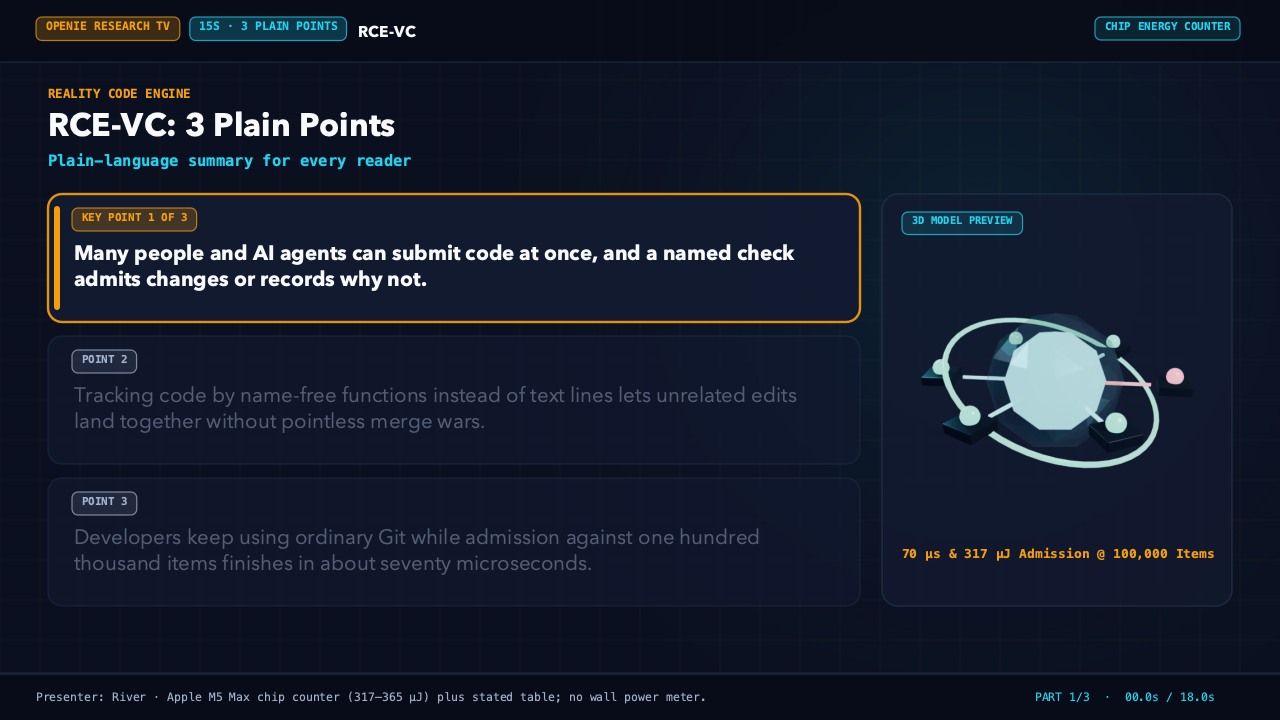
L3 reported_jwith Spread] Admitting a single unit change into a100,000-unit persistent 16-way Merkle trie (O(log_16 U)path copy, re-checking only affected dependents) took 69.69 us (min–max63.5–84.1 us) and 365.35 uJ (346.4–395.7 uJ,N = 5trials of320admissions), or 73.56 us (69.3–75.7 us) and 317.21 uJ (278.9–369.0 uJ,N = 3sustained trials of32,000admissions) in DarwinL3ri_energy_njreported_j. - [M/E · Renames vs. Name-Free Key Collisions] Because
rcevc-keyshashes normalized de Bruijn token bodies (SHA-256over"rcevc/unit/v1", positional body, and dependency keys), renaming a function updates its parent slot binding (name-onlyequivalence) without changingkey(u)—however, two distinct functions with identical normalized structure and dependencies (such asf(x, y) = x + yandg(a, b) = a + bin untyped code) collide onto the exact samekey(u), remaining separate in the parent directory trie only via named slot bindings while sharing conflict-reuse keys if edited identically.
Methods, Baselines & Artifact Scope
- Methodological Dimension: Hardware & Telemetry · Primary-Paper Grounding & Scope: Apple M5 Max (
128 GB, macOS27.2.1,proc_pid_rusageri_energy_njL3reported_j;board_metered = false,measured_j = null). Internalest_ujcost-table placeholders (424–439 mJ) were~1,200xhigher than measuredL3reported_jand are kept strictly separate. - Methodological Dimension: Workload & Benchmark Suite · Primary-Paper Grounding & Scope:
49offline Rust unit/property tests (rcevc-{types,keys,trie,merge,git,cli}: RCE Form, Rust, Python, JSON splitters, merge commutativity, replay determinism) plus synthetic100,000-unit single-admission microbenchmarks. - Methodological Dimension: Baseline(s) Compared · Primary-Paper Grounding & Scope: Whole-repository linear re-hashing/re-checking (
O(U)) vs. 16-way Merkle path copy + reverse-dependency closure (O(log_16 U + |affected|)). External baseline: not benchmarked head-to-head againstgit merge-ort, Mergiraf, or Spork on public conflict corpora in this study. - Methodological Dimension: Runs (N) & Spread / Uncertainty · Primary-Paper Grounding & Scope:
N = 5trials ×320admissions (mean 69.69 us[63.5–84.1 us],mean 365.35 uJ[346.4–395.7 uJ]);N = 3sustained trials ×32,000admissions (mean 73.56 us[69.3–75.7 us],mean 317.21 uJ[278.9–369.0 uJ]). - Methodological Dimension: Caching / Cold vs. Warm Scope · Primary-Paper Grounding & Scope: Content-addressed CAS + conflict-resolution store keyed by canonical unordered conflict signature
(base_key, {side_keys}): exact recurring conflict shapes reuse verified resolutions, whereas novel semantic conflicts require human/proposer resolution. - Methodological Dimension: Artifact & License Availability · Primary-Paper Grounding & Scope:
Apache-2.0public repository athttps://github.com/openIE-dev/rce-vc(commit aba99fce); self-checked by OpenIE, open for external inspection and replication.
How rce-vc Compares Conceptually to Git (merge-ort), AST Merge, and CRDTs
Git’s merge-ort engine performs fast 3-way line-diff merging with heuristic file-rename detection (50% similarity index) and zero semantic gate checking: two branches that rename or edit adjacent declarations can merge cleanly at the text level while breaking compilation or behavioral invariants [S]. Syntax-aware tools like GumTree (Falleri et al., ASE 2014), JDime / Spork (Larsén et al., 2022), and Mergiraf lift merging from lines to ASTs, while CRDTs (Shapiro et al., 2011) and Darcs/Pijul patch algebras guarantee algebraic convergence without type/test soundness [S]. rce-vc explores a complementary point: indexing top-level semantic units in a 16-way Merkle trie and requiring a declared admission gate (G0 parse -> G1 typecheck -> G2 tests/trace) before advancing a ref [E].
Rename Handling vs. Structural Key Collisions (f(x,y)=x+y vs. g(a,b)=a+b)
Critique #12 asked how name-free de Bruijn unit keys handle renames and structurally identical functions. In rce-vc (§3–§4) [E, M]:
-
Pure renames: Parent module nodes map
slot_name -> (key(u), content_digest(u)). Renamingcalc_taxtocompute_taxmoves the slot binding whilekey(u)stays invariant, enablingrce-vcto verify aname-onlyrefactor by checking multiset equality of unit keys without re-running downstream unit tests[E]. -
Structural collision hazard on identical bodies: Because
key(u)strips parameter and self names, two distinct functions in the same project with identical normalized token bodies and dependency keys—for exampledef add_meters(x, y): return x + yanddef add_seconds(a, b): return a + bin untyped Python—produce the exact samekey(u)[M, E]. While the parent module trie keeps both named slots (add_metersandadd_seconds) distinct viacontent_digest(H(body, dep_names)), unit-key-indexed caches deduplicate them onto one node, and same-body helper functions without distinct return/unit types cannot be told apart bykey(u)alone[M].
Limitations & Unbuilt Milestones (§9)
-
No external merge-conflict benchmark yet: Replay evaluation against
git merge-ort,Spork, andMergirafon real open-source merge histories (Merge-Bench,CONGRA) is an unexecuted milestone[E]. -
Prototype scope gaps: Cross-file Rust/Python dependency extraction currently resolves intra-file symbol tables only; TypeScript splitting, native Git packfile streaming (
gixinstead of loose objects), symlinks, executable mode bits, and submodules are not yet implemented inv0.1.0[E].
Energy & Telemetry Scope
The 317.21–365.35 uJ single-unit admission figure is Apple M5 Max per-process ri_energy_nj (L3 reported_j, measured_j = null), measuring in-memory/CAS Merkle trie updates plus affected-unit checks—not full-project cargo test execution [E].
Related Work & References
- Git
merge-ort(Newren, 2021) & Khanna, Kunal & Pierce (2007): Industrial 3-way line merge with rename heuristics and formal investigation ofdiff3[S]. - Falleri et al. (GumTree, ASE 2014), Larsén et al. (Spork, IEEE TSE 2022) & Mergiraf: Fine-grained AST diffing and structured 3-way merge
[S]. - Shapiro, Preguiça, Baquero & Zawirski (CRDTs, SSS 2011) & Mimram & Di Giusto (Pijul, 2013): Commutative state/operation convergence and categorical patch theory
[S]. - Unison Language (Chiusano & Bjarnason, 2019): Content-addressed definitions keyed by nameless syntax hashes
[S].
Canonical Provenance, Primary Artifacts & Independent Replication
- Canonical OpenIE Chronicle Entry: https://blog.openie.dev/posts/rce-vc/
- Primary Study & Methods: https://research.openie.dev/papers/rce-vc/
- Public Code / Replication Harness: https://github.com/openIE-dev/rce-vc
- Illustrated Video Summary (OpenIE Research TV): https://research.openie.dev/tv/?study=rce-vc (9:16 Vertical MP4)
- Signed Provenance · Self-Checked Disclosure & Licensing: Full Rust workspace (49 offline tests) public at openIE-dev/rce-vc (Apache-2.0, commit aba99fce); prose CC0-1.0; self-checked, open for external replication. Full details at https://blog.openie.dev/verification/ and https://blog.openie.dev/glossary/.