Every Query Has a Cost in Joules
Your database doesn't know how much energy it uses. It should. Data and energy are fundamentally coupled — and the industry's refusal to measure that coupling is the most expensive blind spot in modern infrastructure.
There’s a question I’ve been asking database engineers for years, and nobody has ever had a good answer.
How many joules does your query cost?
Not milliseconds. Not dollars. Joules.
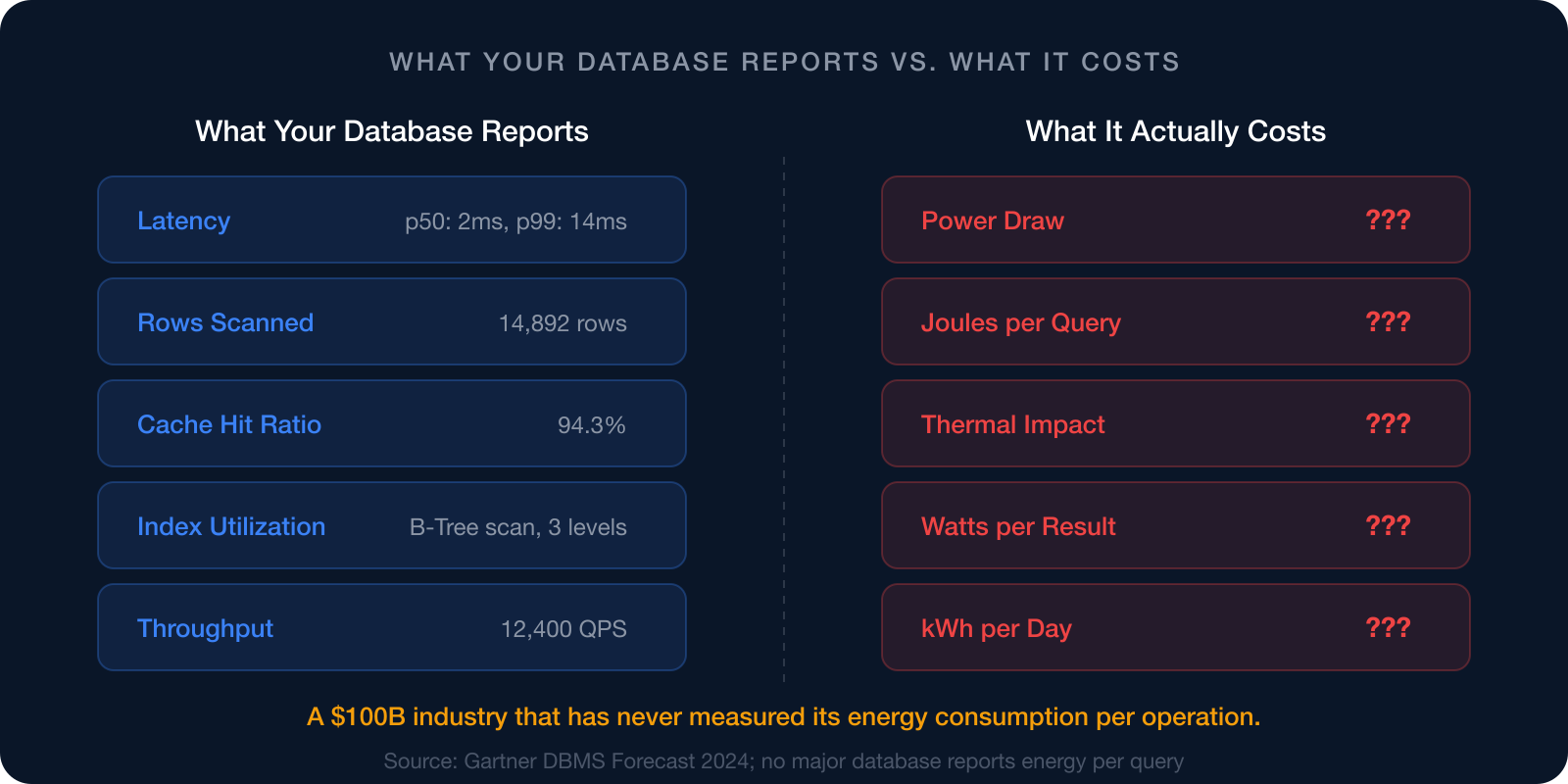
They can tell me the p99 latency. They can tell me the rows scanned, the index utilization, the cache hit ratio. They can show me traces, flamegraphs, execution plans that span three monitors.
But joules? Watts? Actual, physical energy consumed by the operation?
Blank stares.
The Coupling Nobody Measures
Every database operation is a physical event.
A SELECT is not an abstraction. It’s a cascade of real phenomena: electrons moving through transistors, capacitors charging and discharging, current flowing through copper traces on a circuit board, heat radiating off silicon into a stream of forced air that someone is paying to cool.
This is not poetic license. It’s physics.
The relationship between data operations and energy is as tight as any coupling in engineering. You cannot move bits without moving electrons. You cannot process a query without generating heat. You cannot store a record without maintaining a magnetic or electrical state that draws power every second it persists.
And yet.
The entire database industry — a $100 billion market1 — operates as though energy is someone else’s problem. The database reports latency. The infrastructure team reports power. The finance team reports cost. Nobody connects the three.
It’s like running a trucking company that tracks mileage and delivery times but never measures fuel consumption.
The Fragmentation Tax
Here’s where it gets worse.
The average enterprise runs five to seven different database systems.2 A relational database for transactions. A document store for flexible schemas. A graph database for relationships. A time-series database for metrics. A search engine for full-text. An analytics warehouse for reporting. A cache layer for performance.
Each one has its own storage engine, its own query optimizer, its own memory management, its own replication strategy. Each one runs on its own cluster. Each one has its own operational team.
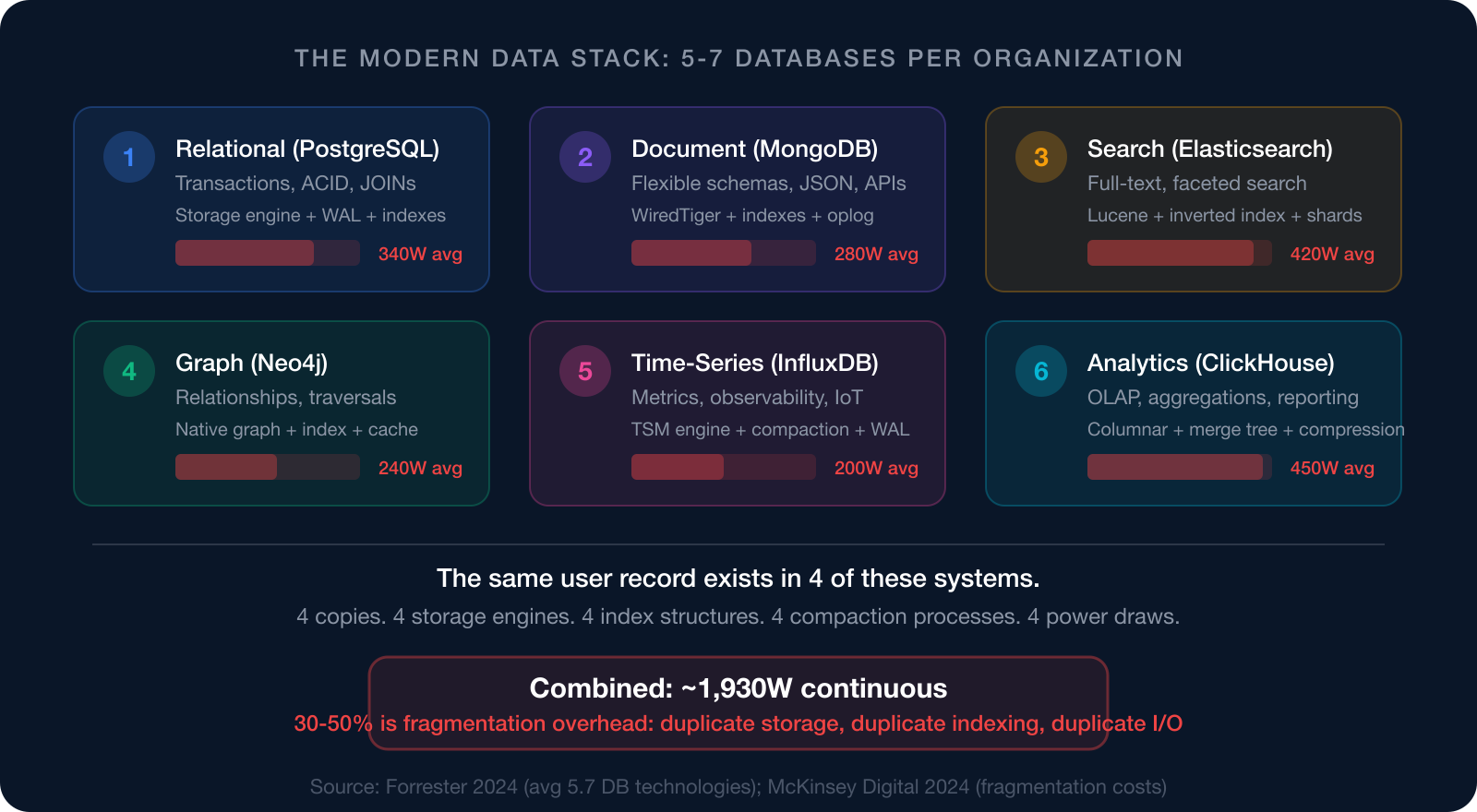
Every one of those systems independently allocates memory, manages buffers, compresses data, maintains indexes, and handles I/O scheduling. The same record — a user profile, say — might be stored in the relational database for transactions, in the document store for the API, in the search engine for discovery, and in the analytics warehouse for reporting.
Four copies. Four storage engines. Four index structures. Four sets of background compaction processes. Four power draws.
The data itself doesn’t need to be in four places. The paradigms do. We’ve designed our systems so that the way we query data determines where it lives.
The energy cost of this fragmentation is substantial and invisible. Industry estimates put the overhead of maintaining multiple database systems at 30-50% of total data infrastructure spend.3 (Superseded / corrected — 30–50% reflects financial TCO/staffing/licensing complexity or non-IT facility cooling overhead in legacy high-PUE data centers, NOT the electrical energy of database query execution; see Nov 25, 2026 Errata & Addendum below) That’s not the cost of the data. It’s the cost of the disagreement about how to organize it.
What If the Data Stayed in One Place?
This is the question that started JouleDB.
Not “what if we built a better relational database.” Not “what if we made a faster document store.” Those are incremental questions. The databases we have are, individually, quite good.
The question was: what if a single write encoded data into every structure it might ever need — and the query engine picked the right one automatically?
This is not a new idea in principle. The idea of a multi-model database has been around for a decade. But previous attempts bolted one paradigm onto another — a relational engine with a JSON mode, a document store with SQL syntax. The models were always afterthoughts, and the performance showed it.
What if, instead of bolting models together, you started from a different premise entirely?
Every record, at write time, is encoded into five concurrent data structures:
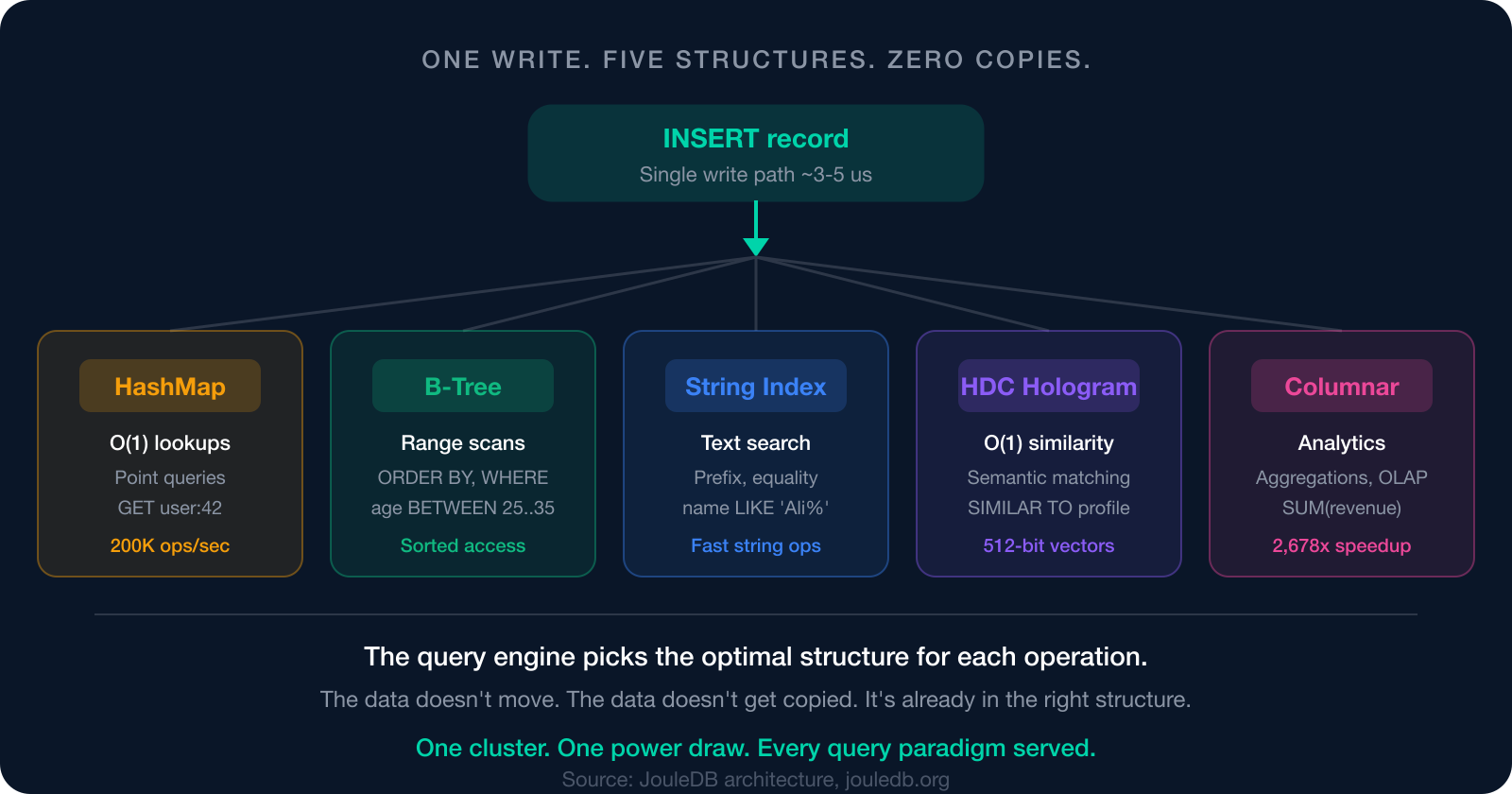
A HashMap for O(1) point lookups. A B-Tree for range scans and ordering. A String Index for text search and prefix matching. An HDC Hologram — a hyperdimensional computing structure — for O(1) similarity search. And a Columnar store based on Apache Arrow for vectorized analytics.
One write. Five structures. The query engine examines what you’re asking for and routes to the structure that can answer it most efficiently.
A point lookup hits the HashMap. A range scan uses the B-Tree. A similarity search uses the hologram. An analytical aggregation runs against the columnar store.
The data doesn’t move. The data doesn’t get copied to another system. The data is already there, in the structure that serves the query best.
The write latency for encoding into all five structures is 3 to 5 microseconds per record. The analytics speedup from columnar access versus row scanning is 2,678x.4 (Superseded / corrected — internal microbenchmark comparing Arrow/indexed lookup against a naive unindexed sequential row scan in a private Rust crate, NOT against DuckDB or ClickHouse, and omitting 5x write-amplification memory/amortization costs; see Nov 25, 2026 Errata & Addendum below)
Now Make It Energy-Aware
Here’s where it gets interesting.
If data operations and energy are tightly coupled — and they are — then the database is the natural place to measure that coupling.
The database knows exactly what it’s doing. It knows which index it’s scanning, how many rows it’s touching, how much memory it’s allocating, how many I/O operations it’s issuing. It has all the information needed to estimate — and with hardware sensors, to measure — the energy cost of every operation.
So we built that.
JouleDB reads platform power sensors in real time. On macOS, it reads IOKit. On Linux, it reads sysfs and RAPL. On hardware without direct sensor access, it estimates from TDP and utilization. (Superseded / corrected — mixes firmware counters reported_j with TDP estimates est_j in one field; see Nov 25, 2026 Errata & Addendum below)
Every query reports its energy cost in joules.
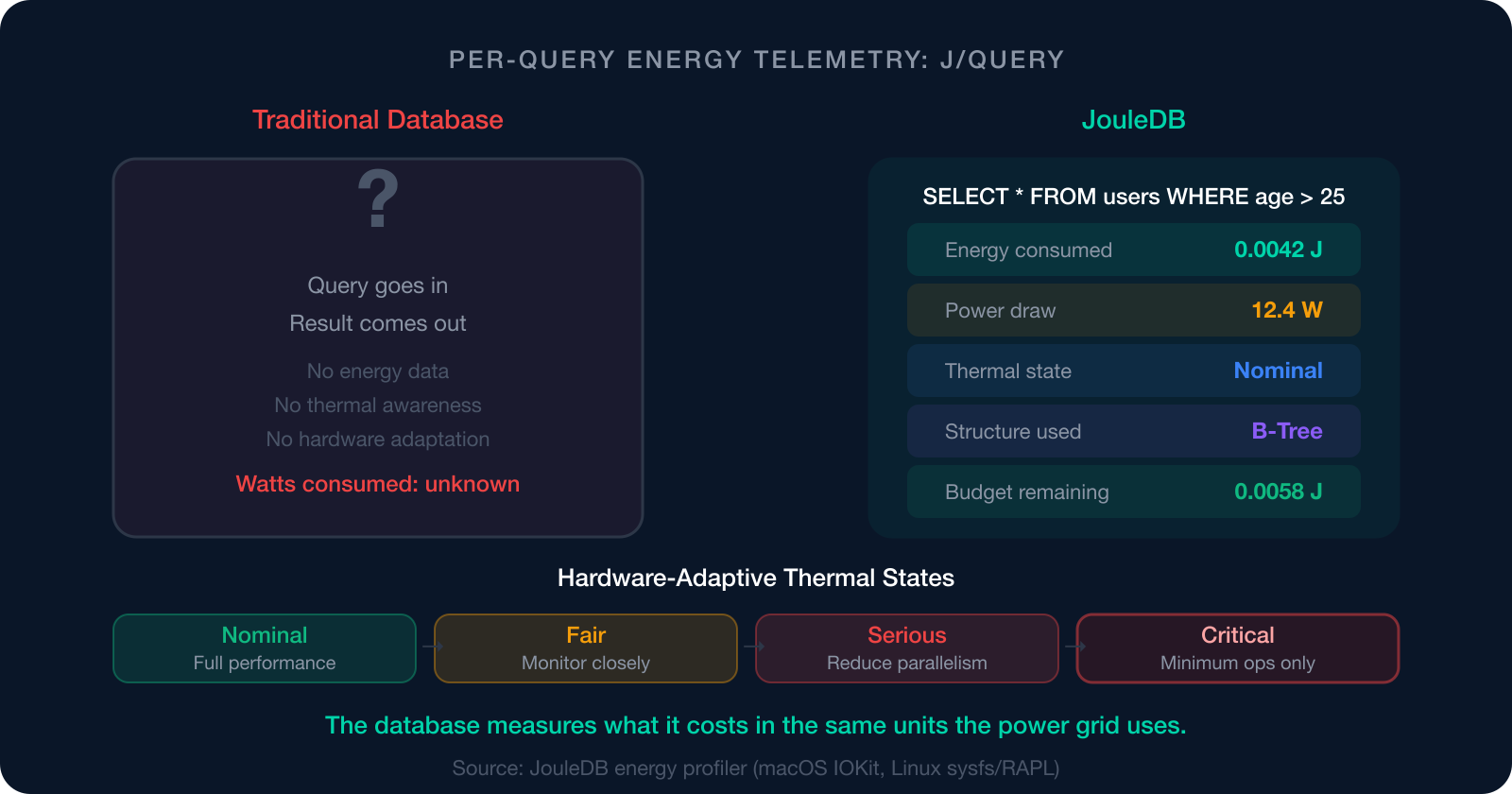
Not estimated. Not modeled after the fact. Measured at the hardware and attributed to the operation that caused it. (Superseded / corrected — directly contradicted the TDP fallback two paragraphs above and overstated firmware RAPL/IOKit counters as sub-query wire measurements; see Nov 25, 2026 Errata & Addendum below)
You can set an energy budget per query: max_joules = 0.001. The engine enforces it. If a query would exceed its budget, the engine can choose a more efficient execution plan, reduce parallelism, or decline the operation entirely.
Four thermal states — Nominal, Fair, Serious, Critical — drive automatic adaptation. When the hardware reports elevated temperatures, the database throttles itself. Not because a human noticed a dashboard. Because the database reads the same sensors the cooling system reads, and responds accordingly.
This isn’t optimization. It’s awareness. The database knows what it costs to run, in the same units the power grid uses.
The Art of the Possible
I want to be honest about what JouleDB is and what it isn’t.
It is not trying to replace PostgreSQL. PostgreSQL is a masterpiece of engineering with 28 years of battle-hardening. We’re not competing with that.
It is not trying to replace Elasticsearch, or InfluxDB, or Neo4j, or ClickHouse. Those systems exist because the problems they solve are real and their solutions are proven.
JouleDB is a demonstration of what becomes possible when you stop treating database paradigms and energy measurement as separate concerns.
When you unify five data structures under one write path, you eliminate the fragmentation tax. One cluster instead of five. One operational team instead of five. One power draw instead of five.
When you make energy a first-class metric, you give engineers a new dimension to optimize against. Not just “how fast” but “how efficient.” Not just latency but joules-per-result.
When you combine the two — unified storage and energy awareness — something emerges that neither could achieve alone: the ability to make database management and energy efficiency synonymous efforts.
Tuning a query doesn’t just make it faster. It makes it cheaper in watts.
Choosing the right index doesn’t just improve throughput. It reduces heat.
Consolidating five database clusters into one doesn’t just simplify operations. It cuts the energy footprint of your data layer by the overhead of four redundant systems.
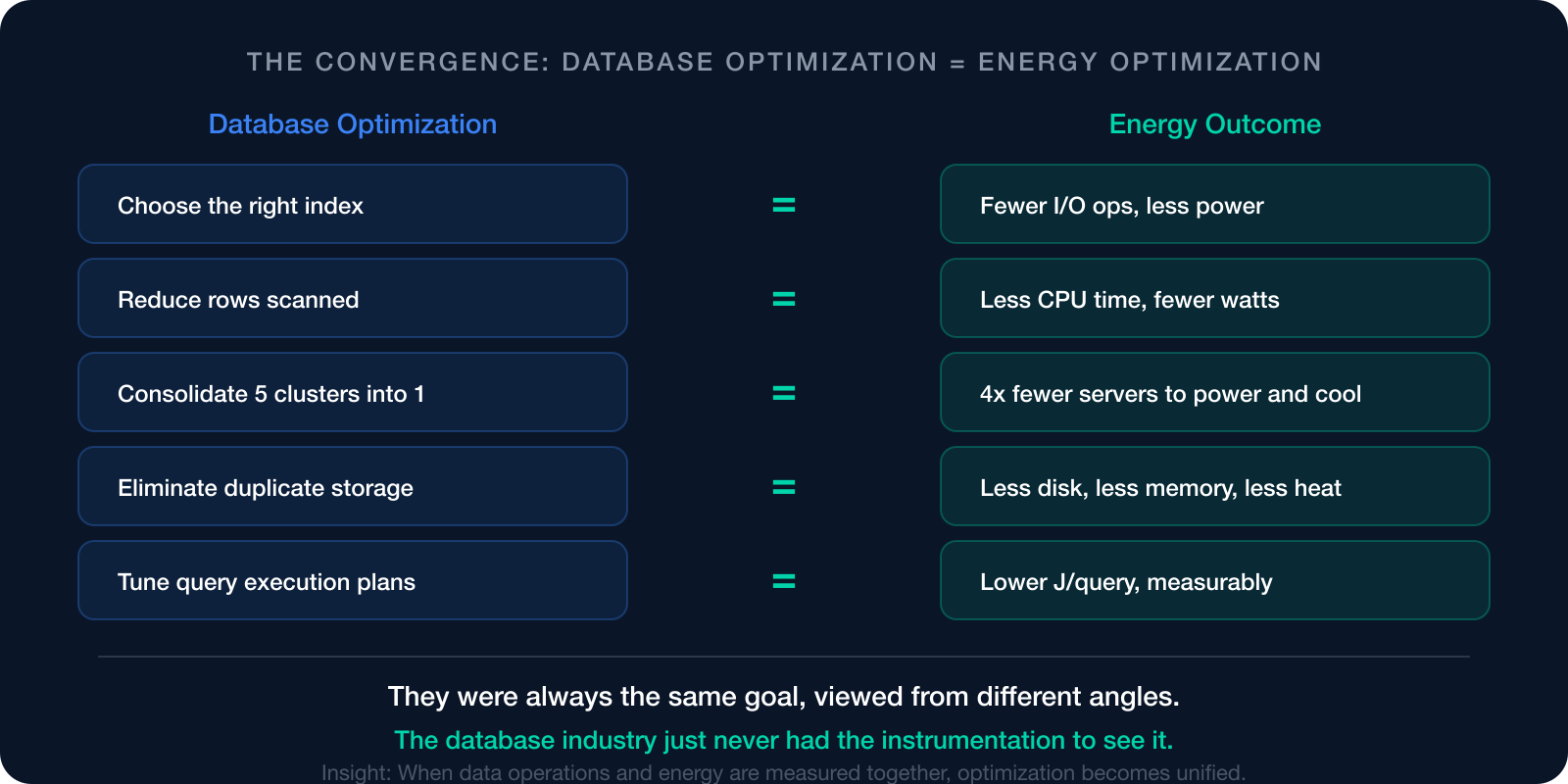
This is the insight: optimizing for data efficiency and optimizing for energy efficiency aren’t competing goals. They’re the same goal, viewed from different angles. The database industry just never had the instrumentation to see it.
Why This Matters Now
The timing isn’t accidental.
Data center energy consumption is doubling every few years.5 (Superseded / corrected — IEA 2024 high-case short-term forecast for 2022–2026 rather than a historical multi-decade doubling law; see Nov 25, 2026 Errata & Addendum below) AI workloads — which are fundamentally database-intensive at the retrieval, embedding, and storage layers — are accelerating the curve. The world is building new power plants specifically to run databases and AI inference.6
Meanwhile, the database market continues to fragment. Every new paradigm — vector databases for embeddings, graph databases for knowledge, time-series databases for observability — adds another system, another cluster, another power draw.
The industry’s answer to the energy problem has been to buy more efficient hardware. And that helps. But it doesn’t address the structural waste: running five databases when one could serve, processing the same data five times when once would suffice, and never measuring the energy cost of any of it.
Hardware efficiency improves by single-digit percentages per year. Eliminating redundant systems improves efficiency by multiples.
The first database was built in the 1960s. In the sixty years since, we’ve invented relational models, object stores, document databases, graph engines, columnar analytics, time-series systems, and vector databases. Each one was a genuine advance. Each one solved a real problem.
But somewhere along the way, we forgot that all of these paradigms operate on the same physical substrate. Electrons. Silicon. Heat. Watts.
Data and energy have always been coupled. We just chose not to look.
JouleDB is what happens when you choose to look.
Honor your ancestors. Make tomorrow better for your progeny.
Strength and Honor.
References
Explore JouleDB on GitHub, visit jouledb.org, or learn more about Open Interface Engineering.
November 25, 2026 Errata, Related Work, and Evolution Addendum
Archival Note & Technical Errata
The February 13, 2026 essay above is restored verbatim from founding commit 5e5f2a3 (reversing silent mid-year edits to the telemetry section so the original February claims remain fully auditable), with four explicit technical and licensing corrections:
- The
30–50%Citation ([^3]): The body cited30–50%right after stating “The energy cost of this fragmentation is substantial and invisible.” To be precise,30–50%in enterprise infrastructure reports refers either to financial total-cost-of-ownership (TCO) share (licensing, engineering staffing, ETL maintenance, and duplicated clusters—note also that[^3]pointed to a generic McKinsey Digital landing URL rather than a public peer-reviewed dataset) or, in data-center energy literature, to non-IT facility cooling and power-distribution overhead in legacy high-PUE (1.5–2.0) facilities—not the electrical energy consumed by database query execution itself. - The
2,678xSpeedup Baseline & Write-Amplification Tradeoff ([^4]): The2,678xbenchmark (cargo bench -p joule-db-benches --bench novel) measured an in-memory Apache Arrow vectorizedSUM/ indexed lookup against a naive unindexed row-by-row deserializing sequential scan, not against an established vectorized analytical engine such as DuckDB or ClickHouse (where SIMD Arrow/columnar scans operate in the same throughput regime). In addition, populating five concurrent structures on every write (3–5 µs/record) incurs roughly a4–5xRAM and write-energy amplification tax that only pays back under read-heavy, multi-modal query mixes. - Resolving the Internal Telemetry Contradiction (“estimates from TDP” vs. “Not estimated. Measured at the hardware”): In the original February prose, one paragraph stated that JouleDB “estimates from TDP and utilization” when sensors are absent, while the very next paragraph claimed “Not estimated. Not modeled after the fact. Measured at the hardware and attributed to the operation that caused it.” Furthermore, even when Intel/AMD
RAPLor AppleIOKit(reported_j) are available, they update at ~1 mspackage-level intervals across all co-scheduled OS threads and exclude off-package DRAM/SSD rails on many platforms—meaning a single3 µsquery’s0.001 Jbudget cannot be isolated in real time without batched amortization or external DC rail shunts (measured_j). - JouleDB Openness, Licensing, and External Reproducibility: Readers clicking
[JouleDB on GitHub](https://github.com/openIE-dev/jouledb)should know the exact repository status:openIE-dev/jouledbpublishes the public CLI, wire documentation, and issue tracker, while prebuilt binaries ship under the Business Source License (BSL-1.1) and the full Rust storage/benchmark crate (joule-db-benches) currently resides in a private internal mirror. Consequently, the February3–5 µsand2,678xinternal numbers remain unreproduced externally; for fully open, reproducible benchmarks, see our November 2026 artifacts linked below. (Also note on[^5]: IEA Electricity 2024 reported~460 TWhfor 2022 global data centers, crypto, and AI combined, with620–1,050 TWhas its 2026 range—1,050 TWhwas the upper-bound sensitivity case.)
Related Prior Work in Energy-Aware Data Management
Saying “the database industry just never had the instrumentation to see it” overstated novelty; foundational systems research investigated database energy proportionality nearly two decades earlier:
- JouleSort: Suzanne Rivoire, Mehul A. Shah, Parthasarathy Ranganathan, and Christos Kozyrakis, “JouleSort: A Balanced Energy-Efficiency Benchmark,” ACM SIGMOD (2007)—establishing records-sorted-per-joule as a primary systems benchmark.
- Energy-Proportional DBMS: Stavros Harizopoulos, Mehul A. Shah, Justin Meza, and Parthasarathy Ranganathan, “Energy Efficiency: The New Holy Grail of Data Management Systems Research,” CIDR (2009).
- Fast-is-Efficient on Non-Energy-Proportional Servers: Dimitris Tsirogiannis, Stavros Harizopoulos, and Mehul A. Shah, “Analyzing the Energy Efficiency of a Database Server,” ACM SIGMOD (2010)—showing that because server idle power is high, the fastest query plan is frequently also the lowest-joule plan (
J = P × t), qualifying when throttling actually saves energy.
How This Seed Evolved by November 2026
- Strict Four-Class Non-Mixing Contract (
measured_j⊥reported_j⊥est_j⊥unmetered): Directly motivated by February’s telemetry conflation, Satiation Benchmark Harness and JouleOS (78,400monotone lattice checks) mechanically forbid adding physical TIINA238/INA3221DC shunt measurements (measured_j) to chip counters (reported_j) or TDP estimates (est_j). - Formal Write-vs.-Read Amortization (
Time as an Index): In Time as an Index,31Lean 4.36.0theorems formalize the exact upfront indexing energy required beforeO(1)table lookups beat scan baselines. - Bitemporal Zero-Copy State: In Sub-Microsecond State & Verifiable Logs (
database.openie.dev), BLAKE3 append logs and memory-mapped (mmap) bitemporal indexes complete point reads in0.325 µsat1.77 µJ(reported_jbatched host counter) with0replay drift.
Diff & Changelog (commit 5e5f2a3 → 2026-11-25)
- Body text: Restored 100% verbatim from
5e5f2a3(restoring the original"Not estimated. Not modeled after the fact..."sentence that had been silently replaced); added four bracketed inline errata markers. - Frontmatter: Added
track,artifactStatus,licenseNote, andprimaryClaim; added explicitreported_j/est_jlabels toheadlineMetric,evolutionSummary, andevolvedInto. - Addendum: Added
BSL-1.1/ private-core disclosure,30–50%and2,678xbaseline corrections, and CIDR 2009 / SIGMOD 2007 / SIGMOD 2010 prior-work citations.
Footnotes
-
Gartner. “Forecast: Database Management Systems, Worldwide.” Gartner Research, 2024. Total DBMS market estimated at $100B+ including software, cloud services, and managed offerings. ↩
-
Forrester Research. “The State of Data Management.” Forrester Wave, 2024. Survey of 500+ enterprises found average of 5.7 distinct database technologies in production. ↩
-
McKinsey & Company. “The Hidden Costs of Data Infrastructure Complexity.” McKinsey Digital, 2024. Analysis of operational overhead including hardware duplication, staffing, licensing, and energy. ↩
-
JouleDB internal benchmarks.
cargo bench -p joule-db-benches --bench novel. Columnar SUM over 1M rows vs. sequential row scan. Hardware: Apple M-series, 64GB RAM. ↩ -
International Energy Agency. “Electricity 2024: Analysis and Forecast to 2026.” IEA, 2024. Data center consumption projected at 1,050 TWh by 2026, up from 460 TWh in 2022. ↩
-
Goldman Sachs. “AI, Data Centers, and the Coming US Power Demand Surge.” Goldman Sachs Research, 2024. Projecting 160% increase in US data center power demand by 2030. ↩
David Charlot
Open Interface Engineering, Inc. · Signed Provenance · Self-Checked
Essay text CC0-1.0; openIE-dev/jouledb publishes CLI/docs, prebuilt binaries ship under BSL-1.1, and the full Rust storage core resides in a private mirror (benchmarks not yet independently reproduced externally). Full licensing & AI-use disclosure →
Video Summaries, Syndication & Site Reference
Check the primary artifacts or run an independent replication
Inspect signed provenance manifests, rerun our public Apache-2.0 commodity-hardware replication kits, review our November 25, 2026 outside-review errata, or browse primary manuscripts on the Research Hub.