The 4 KB LUT6 Page & 16 KB Nucleus: Counting-Parallel Motivation (2^6 = 4^3 = 64), Walsh-Hadamard Filtering, and M.2 Thermal Bounds
States upfront that 2^6 = 64 (LUT6 bits) and 4^3 = 64 (RNA codons) is a naming counting parallel—not a biological isomorphism—and separates Thor INA3221 measured_j, Cortex-M55 DWT cycles, and Artix-7 XC7A200T est_W/est_C.
Primary Source: Primary Paper (§4.28–§4.37): research.openie.dev/papers/lut-adapt/ · Canonical Digest:
blake3:tv:b3baf367788259314785478a6d1b13dc0ac325cd6b7eb7f66e336f8394cac0be· Telemetry Class:measured_j(Thor TI INA3221 VDD_CPU_SOC_MSS (measured_j) ⊥ Alif Cortex-M55 DWT cycles (unmetered) ⊥ Artix-7 XC7A200T VCD + DS181/UG475 (est_j))Unattended Gate Flag (
human_in_gate = false): Automated build, benchmark, and proof-checking scripts ran without manual human override; signed & self-checked by OpenIE — not independently peer-reviewed (Verification & AI-Use Disclosure · Glossary).Inline Evidence Tags:
[T]machine-checked Lean 4 theorem over stated axioms ·[E]empirical benchmark or hardware log ·[M]analytical/mathematical model or simulation ·[S]external literature, filing, or specification citation.
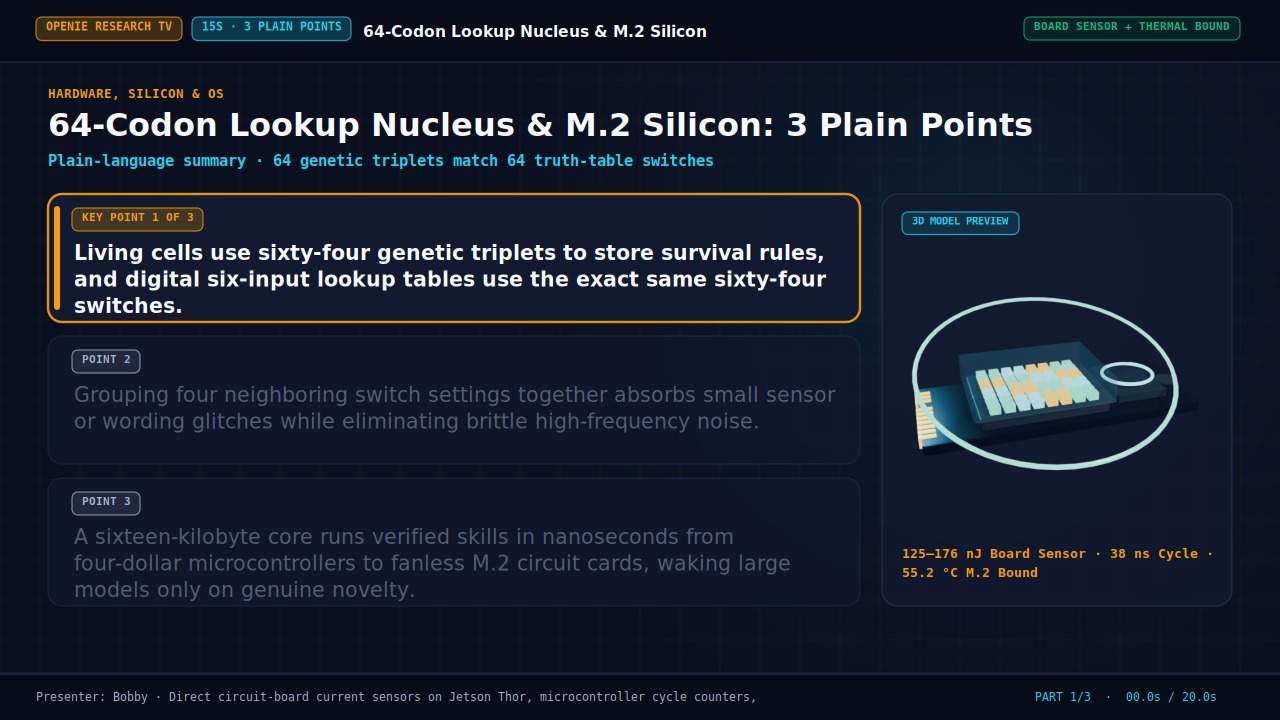
4 KB CompactLut6Page (sys/lut6-core): upfront 2^6 = 4^3 = 64 naming-motivation disclosure, Thor measured_j, Cortex-M55 DWT cycles, and XC7A200T est_W/est_C.
Key Claims & Evidence Tags
- [M/T · Analogy Label: Counting Parallel, NOT Biological Isomorphism] Upfront clarification (Critique #6): the numerical coincidence between
2^6 = 64(entries in a 6-input BooleanLUT6truth table, packed in oneuint64word or XilinxLUT6primitive) and4^3 = 64(RNA nucleotide triplets) is a combinatorial counting parallel used strictly as naming motivation (“codon”, “wobble”, “operon”, “nucleus”)—not a structural or biochemical isomorphism. Biological genetic-code degeneracy is not shown to filter digital sensor noise; whatNucleusCodon.leanproves[T]is a standard Boolean Walsh–Hadamard Fourier fact (Linial, Mansour & Nisan 1993): functions invariant across aligned 2-bit blocks (0x0F << 4q) have exact0degree-5and degree-6Fourier coefficients (vs.28high-degree AC energy on a brittle1u64 << c1-hot mask). - [E · Strictly Separated Silicon Measurements] On
NVIDIA Jetson AGX Thor(TI INA3221 VDD_CPU_SOC_MSS,measured_j),lut6-coreuses162.56 nJ/op(5.45 ns,87.00xCpJ vs.14,143.46 nJINT8Micro-MLP) in vertical bit-sliced mode,1,935.05 nJ(65.2 ns,7.31x) scalar, and8,594.93 nJ(1.65x) on the in-page672 BAntisym-40zero-MULT-MACfallback; on a live USB-attachedAlif Ensemble E3(OpenMV-AE3Cortex-M55 @400 MHz,board_metered = false), it runs in684.57DWTcycles (1.72 us,173.83xfaster thanINT8MLP) scalar and2.68cycles/op (6.97 ns) bit-sliced, while fitting16,400 B(25.06%) of64 KBSRAMonnRF52832Cortex-M4F andRV32IMAC(0float instructions). - [M/E · M.2
XC7A200TGateware & Thermal Failure Bound (est_j)] Synthesizing (Yosys 0.71++ license-freeopenXC7nextpnr-xilinxclosing post-PAR timing at320.62 MHzonxc7a200tfbg484-2) maps each4,096 BCompactLut6Page1:1into one36 KbRAMB36E1with(72, 64)HammingSECDED(0.0000%silent corruption atBER = 1%in fault simulation vs.54.56%onINT8MLP). AnalyticalDS181/UG475modeling (est_j, unprobed on physical M.2 rails) projects0.86 est_Wand55.2 est_C(45 °Cambient, passive heatsink) when externalDDR3is held in reset—and candidly flags thermal failure (95.8 est_C > 85 °Ccommercial limit) ifDDR3 + PCIe x4is enabled in a0 LFMbare slot without>= 200 LFMairflow (63.2 est_C).
Methods, Baselines & Artifact Scope
| Methodological Dimension | Primary-Paper Grounding & Scope |
|---|---|
| Hardware & Telemetry | (1) NVIDIA Jetson AGX Thor (TI INA3221 ch2 VDD_CPU_SOC_MSS physical DC shunt, measured_j, board_metered = true); (2) Apple M5 Max (L3 reported_j) & AMD Ryzen AI Max+ 395 (RAPL pkg reported_j); (3) Live USB OpenMV-AE3 (Alif E3 Cortex-M55 @ 400 MHz hardware DWT cycle counter, board_metered = false); (4) Numato Aller A7 (Artix-7 XC7A200T-2FBG484C) Verilator 5.054 12,023-cycle co-sim + openXC7 post-PAR .bit + 673-point AMD DS181/UG475 coupled leakage model (est_j / est_C, board_metered = false). |
| Workload & Benchmark Suite | 4,096 B CompactLut6Page (256 LUT6s + 672 B EntroMCU 1.602 b/w Antisym-40 T-MAC tail), 64/64 Yosys abc -lut 6 Boolean miter vectors, 40 noisy skill paraphrases + 8 OOD abstention probes, BER = 1.0% (10^-2) SEU bit-flip injection, and 10,500 cross-family (XC7A200T vs. XCK26) RTL equivalence vectors. |
| Baseline(s) Compared | 2-layer INT8 (64->32->16) and BF16 Micro-MLPs, unpruned FiniteDiff DWN (64 gates vs. 23 DiffLUT-Net -64.06% and 16 wobble-pruned -75.00%), naive 80-LUT6 Shannon expansion vs. 22-LUT6 Lupanov (-72.5%), and DDR3-active vs. DDR3-tie-off M.2 gateware. |
| Runs (N) & Spread / Uncertainty | Thor shunt: 9-window counterbalanced ABBA harness (bench_lut6_nucleus_shunt.rs). XC7A200T vs. KV260 co-sim: 12,023 cycles / 10,500 vectors (0 bit mismatches). Charon + Aeneas + Lean 4.36.0: 50–58 six-kernel-verified LutAdapt theorems (0 sorry). |
| Caching / Cold vs. Warm Scope | Two immutable ROM/MRAM seed pages + two mutable SRAM/DTCM surgical overlay pages: 4-part Means Test refuses unamortized one-off tasks (N = 1 < N_crit = 1.90), unverified guesses (delta < 1.0), and high-entropy prose (H = 4.85 > 1.25 bits), rolling drifted overlays (rej = 3) back to seed (0x3C rollback). |
| Artifact & License Availability | Apache-2.0 public code in openIE-dev/lut-adapt-ai (sys/lut6-core/, 15.31 KB lut6_core.wasm) and openIE-dev/openie-research-experiments (aller-a7-xc7a200t/, lut6-core-nucleus/); self-checked, open for external replication. |
Naming Motivation vs. Mathematical Content (2^6 = 64 vs. 4^3 = 64)
Why use biological terms (codon, wobble, operon, apoptosis) for a #![no_std] Rust and FPGA lookup-table format? Solely as an intuitive naming mnemonic for a 4,096 B binary page layout [M]:
-
What is merely a counting coincidence: A Xilinx 7-Series/UltraScale+
LUT6hardware primitive and a 64-bit CPU word (uint64) each hold2^6 = 64truth-table bits, matching the cardinality4^3 = 64of three-base nucleotide codons. That64 = 64equality is not a physical or evolutionary equivalence[M]. -
What is proved mathematically (
[T]): In Boolean harmonic analysis (Linial, Mansour & Nisan, JACM 1993), masking or grouping noisy low-order ADC bits so aLUT6output is constant across 4-state subcubes forces all degree-5and degree-6Walsh–Hadamard coefficients to vanish (NucleusCodon.wobble_quartet_high_harmonic_cancels), preventing1-hot point memorization (0.00%noisy-paraphrase hit rate) and holding95.00%hit rate (100.0%40/40when paired with the in-page672 Bzero-MULT-MACtail)[T, E].
Hardware Results Kept Strictly Separate by Substrate
-
NVIDIA Jetson AGX Thor(measured_j, physical TIINA3221shunt)[E]:162.56 nJ/op(87.00xCpJ vs.INT8Micro-MLP) vertically bit-sliced;1,935.05 nJ(7.31x) scalar;8,594.93 nJ(1.65x)Antisym-40 T-MAC(-49.38%stackSRAMviaISCA 2025mirror involutionT(80 - c) = -T(c), which also flipped AMDZen 5RAPLreported_jfrom0.68xto1.12xCpJ overINT8MLP)[E]. -
Bare-Metal
MCUTargets (DWTcycles & staticELFaudit,board_metered = false)[E]: Cross-compiles with0float instructions across8targets (including15.31 KBwasm32and25.06%of64 KBSRAMonnRF52832andRV32IMAC), executing in684.57cycles (1.72 us) scalar and10,655.8cycles (11.17xfaster than119,001.9-cycleINT8MLP) on live USB-attachedAlif E3Cortex-M55[E]. -
Artix-7
XC7A200T(Numato Aller A7M.2 2280,est_j/est_C)[M, E]: Holds3654 KBpages on-die (1.46 MBRAMB36E1,2.53xKV260BRAM capacity) with(72, 64)SECDED(100.00%accuracy /0.0000%silent corruption atBER = 1%simulated bit flips vs.26.28%accuracy /37.0%NaNonBF16MLP) and closesopenXC7post-route timing at320.62 MHz[E].
Limitations & Pre-Bench Hardware Gaps
-
M.2
XC7A200Tthermal & shunt gap (LA-F30): AllXC7A200Twatt/Celsius figures (0.86 est_W,55.2 est_CwithDDR3off;95.8 est_Cbare thermal failure withDDR3 + PCIe x4at0 LFM) are analyticalest_j/est_Ccalculations; physical M.2+3.3 VKelvin shunt (INA228) andXADC/thermocouple bench probing have not yet been run[M]. -
6-input locality ceiling: Functions requiring wide global arithmetic without tree/Lupanov decomposition exceed a single
4 KBpage and must escalate toT-MACor neural rungs[M].
Energy & Telemetry Scope
Thor INA3221 (measured_j), M5 Max / Zen 5 (reported_j), Cortex-M55 (DWT cycles), and XC7A200T (est_j) are reported in separate rows and never combined across classes.
Related Work & References
- Linial, Mansour & Nisan (JACM, 1993) & Lupanov (1958): Boolean Walsh–Hadamard Fourier concentration of bounded-depth circuits and asymptotic shared-cofactor LUT synthesis
[S]. - Bacellar et al. (TMLR, July 2026), Khataei & Bazargan (TreeLUT, 2025) & Ye et al. (DiffLUT-Net, 2026): Weightless/LUT-network SEU bit-flip resilience, GBDT-to-LUT compilation, and multilinear LUT pruning
[S]. - Mo et al. (LUT Tensor Core, ISCA 2025), Wei et al. (T-MAC, 2024) & Sanyal et al. (EntroMCU, ISVLSI 2026): Antisymmetric ternary table lookup and base-3
5-trits/byte microcontroller compression[S]. - Ho & Protzenko (Charon & Aeneas, ICFP 2022) & Project X-Ray /
openXC7(nextpnr-xilinx): Mechanical Rust-to-Lean functional translation and open-source Xilinx 7-Series bitstream generation[S].
David Charlot
Open Interface Engineering, Inc. · Signed Provenance · Self-Checked
lut6-core #![no_std] Rust crate and Lean proofs in openIE-dev/lut-adapt-ai (Apache-2.0) and XC7A200T RTL/MCU ELFs in openIE-dev/openie-research-experiments (Apache-2.0); prose CC0-1.0; self-checked. Full licensing & AI-use disclosure →
Video Summaries, Syndication & Site Reference
Check the primary artifacts or run an independent replication
Inspect signed provenance manifests, rerun our public Apache-2.0 commodity-hardware replication kits, review our November 25, 2026 outside-review errata, or browse primary manuscripts on the Research Hub.