The 4 KB LUT6 Page & 16 KB Nucleus: Counting-Parallel Motivation (2^6 = 4^3 = 64), Walsh-Hadamard Filtering, and M.2 Thermal Bounds
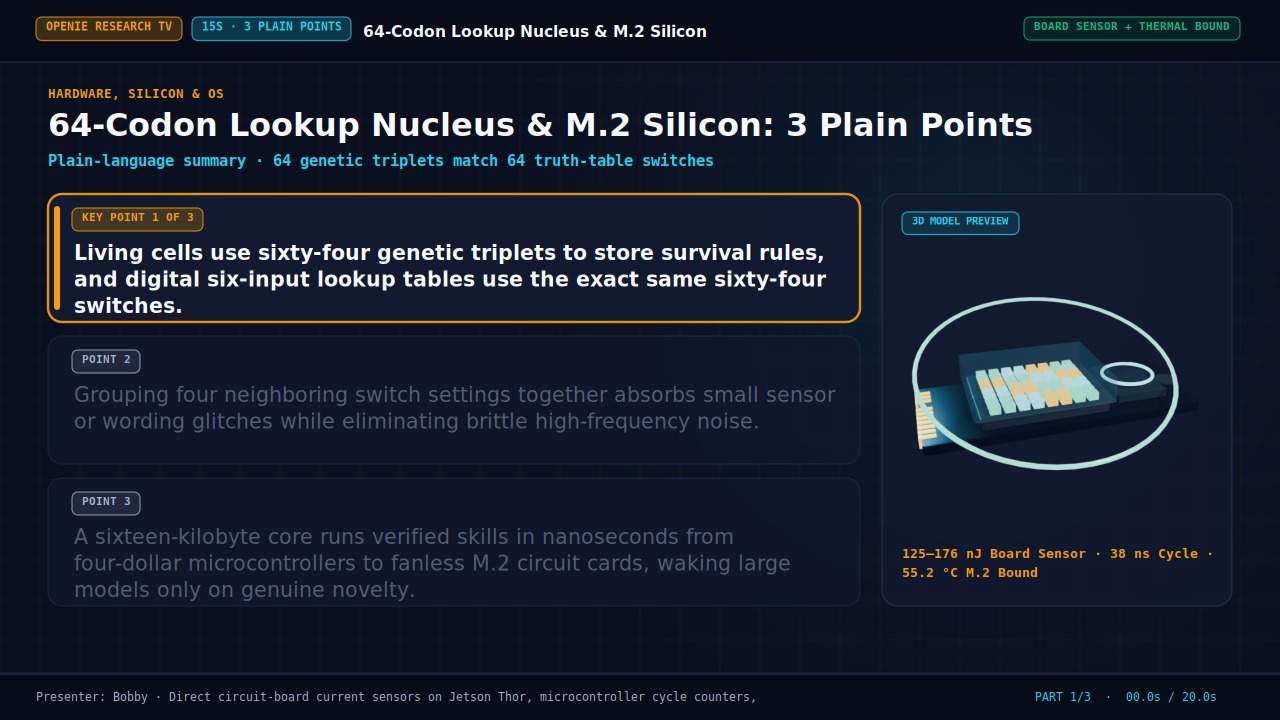
States upfront that 2^6 = 64 (LUT6 bits) and 4^3 = 64 (RNA codons) is a naming counting parallel—not a biological isomorphism—and separates Thor INA3221 measured_j, Cortex-M55 DWT cycles, and Artix-7 XC7A200T est_W/est_C.
Temporal & Archival Scope: Era II OpenIE Study (November 23, 2026) · Canonical OpenIE Chronicle Entry: https://blog.openie.dev/posts/lut6-codon-nucleus/ · Primary Paper & Methods: https://research.openie.dev/papers/lut-adapt/ · Canonical Digest:
blake3:tv:b3baf367788259314785478a6d1b13dc0ac325cd6b7eb7f66e336f8394cac0beProvenance & Telemetry Hygiene: Signed Provenance · Self-Checked (automated OpenIE internal gates; not externally peer-reviewed) · Energy Class:
measured_j(measured_j ⊥ reported_j ⊥ est_j ⊥ unmetered— Verification, Licensing & AI-Use Disclosure · Glossary & Non-Mixing Rules).
Key Claims & Evidence Tags
- [M/T · Analogy Label: Counting Parallel, NOT Biological Isomorphism] Upfront clarification (Critique #6): the numerical coincidence between
2^6 = 64(entries in a 6-input BooleanLUT6truth table, packed in oneuint64word or XilinxLUT6primitive) and4^3 = 64(RNA nucleotide triplets) is a combinatorial counting parallel used strictly as naming motivation (“codon”, “wobble”, “operon”, “nucleus”)—not a structural or biochemical isomorphism. Biological genetic-code degeneracy is not shown to filter digital sensor noise; whatNucleusCodon.leanproves[T]is a standard Boolean Walsh–Hadamard Fourier fact (Linial, Mansour & Nisan 1993): functions invariant across aligned 2-bit blocks (0x0F << 4q) have exact0degree-5and degree-6Fourier coefficients (vs.28high-degree AC energy on a brittle1u64 << c1-hot mask). - [E · Strictly Separated Silicon Measurements] On
NVIDIA Jetson AGX Thor(TI INA3221 VDD_CPU_SOC_MSS,measured_j),lut6-coreuses162.56 nJ/op(5.45 ns,87.00xCpJ vs.14,143.46 nJINT8Micro-MLP) in vertical bit-sliced mode,1,935.05 nJ(65.2 ns,7.31x) scalar, and8,594.93 nJ(1.65x) on the in-page672 BAntisym-40zero-MULT-MACfallback; on a live USB-attachedAlif Ensemble E3(OpenMV-AE3Cortex-M55 @400 MHz,board_metered = false), it runs in684.57DWTcycles (1.72 us,173.83xfaster thanINT8MLP) scalar and2.68cycles/op (6.97 ns) bit-sliced, while fitting16,400 B(25.06%) of64 KBSRAMonnRF52832Cortex-M4F andRV32IMAC(0float instructions). - [M/E · M.2
XC7A200TGateware & Thermal Failure Bound (est_j)] Synthesizing (Yosys 0.71++ license-freeopenXC7nextpnr-xilinxclosing post-PAR timing at320.62 MHzonxc7a200tfbg484-2) maps each4,096 BCompactLut6Page1:1into one36 KbRAMB36E1with(72, 64)HammingSECDED(0.0000%silent corruption atBER = 1%in fault simulation vs.54.56%onINT8MLP). AnalyticalDS181/UG475modeling (est_j, unprobed on physical M.2 rails) projects0.86 est_Wand55.2 est_C(45 °Cambient, passive heatsink) when externalDDR3is held in reset—and candidly flags thermal failure (95.8 est_C > 85 °Ccommercial limit) ifDDR3 + PCIe x4is enabled in a0 LFMbare slot without>= 200 LFMairflow (63.2 est_C).
Methods, Baselines & Artifact Scope
- Methodological Dimension: Hardware & Telemetry · Primary-Paper Grounding & Scope: (1)
NVIDIA Jetson AGX Thor(TI INA3221 ch2 VDD_CPU_SOC_MSSphysical DC shunt,measured_j,board_metered = true); (2)Apple M5 Max(L3reported_j) &AMD Ryzen AI Max+ 395(RAPLpkgreported_j); (3) Live USBOpenMV-AE3(Alif E3Cortex-M55 @400 MHzhardwareDWTcycle counter,board_metered = false); (4)Numato Aller A7(Artix-7 XC7A200T-2FBG484C)Verilator 5.05412,023-cycle co-sim +openXC7post-PAR.bit+673-pointAMD DS181/UG475coupled leakage model (est_j/est_C,board_metered = false). - Methodological Dimension: Workload & Benchmark Suite · Primary-Paper Grounding & Scope:
4,096 BCompactLut6Page(256LUT6s +672 BEntroMCU1.602 b/wAntisym-40 T-MACtail),64/64Yosysabc -lut 6Boolean miter vectors,40noisy skill paraphrases +8OOD abstention probes,BER = 1.0%(10^-2) SEU bit-flip injection, and10,500cross-family (XC7A200Tvs.XCK26) RTL equivalence vectors. - Methodological Dimension: Baseline(s) Compared · Primary-Paper Grounding & Scope: 2-layer
INT8(64->32->16) andBF16Micro-MLPs, unprunedFiniteDiff DWN(64gates vs.23DiffLUT-Net-64.06%and16wobble-pruned-75.00%), naive80-LUT6Shannon expansion vs.22-LUT6Lupanov (-72.5%), andDDR3-active vs.DDR3-tie-off M.2 gateware. - Methodological Dimension: Runs (N) & Spread / Uncertainty · Primary-Paper Grounding & Scope: Thor shunt:
9-window counterbalancedABBAharness (bench_lut6_nucleus_shunt.rs).XC7A200Tvs.KV260co-sim:12,023cycles /10,500vectors (0bit mismatches).Charon + Aeneas+Lean 4.36.0:50–58six-kernel-verifiedLutAdapttheorems (0 sorry). - Methodological Dimension: Caching / Cold vs. Warm Scope · Primary-Paper Grounding & Scope: Two immutable
ROM/MRAMseed pages + two mutableSRAM/DTCMsurgical overlay pages: 4-part Means Test refuses unamortized one-off tasks (N = 1 < N_crit = 1.90), unverified guesses (delta < 1.0), and high-entropy prose (H = 4.85 > 1.25bits), rolling drifted overlays (rej = 3) back to seed (0x3Crollback). - Methodological Dimension: Artifact & License Availability · Primary-Paper Grounding & Scope:
Apache-2.0public code inopenIE-dev/lut-adapt-ai(sys/lut6-core/,15.31 KBlut6_core.wasm) andopenIE-dev/openie-research-experiments(aller-a7-xc7a200t/,lut6-core-nucleus/); self-checked, open for external replication.
Naming Motivation vs. Mathematical Content (2^6 = 64 vs. 4^3 = 64)
Why use biological terms (codon, wobble, operon, apoptosis) for a #![no_std] Rust and FPGA lookup-table format? Solely as an intuitive naming mnemonic for a 4,096 B binary page layout [M]:
-
What is merely a counting coincidence: A Xilinx 7-Series/UltraScale+
LUT6hardware primitive and a 64-bit CPU word (uint64) each hold2^6 = 64truth-table bits, matching the cardinality4^3 = 64of three-base nucleotide codons. That64 = 64equality is not a physical or evolutionary equivalence[M]. -
What is proved mathematically (
[T]): In Boolean harmonic analysis (Linial, Mansour & Nisan, JACM 1993), masking or grouping noisy low-order ADC bits so aLUT6output is constant across 4-state subcubes forces all degree-5and degree-6Walsh–Hadamard coefficients to vanish (NucleusCodon.wobble_quartet_high_harmonic_cancels), preventing1-hot point memorization (0.00%noisy-paraphrase hit rate) and holding95.00%hit rate (100.0%40/40when paired with the in-page672 Bzero-MULT-MACtail)[T, E].
Hardware Results Kept Strictly Separate by Substrate
-
NVIDIA Jetson AGX Thor(measured_j, physical TIINA3221shunt)[E]:162.56 nJ/op(87.00xCpJ vs.INT8Micro-MLP) vertically bit-sliced;1,935.05 nJ(7.31x) scalar;8,594.93 nJ(1.65x)Antisym-40 T-MAC(-49.38%stackSRAMviaISCA 2025mirror involutionT(80 - c) = -T(c), which also flipped AMDZen 5RAPLreported_jfrom0.68xto1.12xCpJ overINT8MLP)[E]. -
Bare-Metal
MCUTargets (DWTcycles & staticELFaudit,board_metered = false)[E]: Cross-compiles with0float instructions across8targets (including15.31 KBwasm32and25.06%of64 KBSRAMonnRF52832andRV32IMAC), executing in684.57cycles (1.72 us) scalar and10,655.8cycles (11.17xfaster than119,001.9-cycleINT8MLP) on live USB-attachedAlif E3Cortex-M55[E]. -
Artix-7
XC7A200T(Numato Aller A7M.2 2280,est_j/est_C)[M, E]: Holds3654 KBpages on-die (1.46 MBRAMB36E1,2.53xKV260BRAM capacity) with(72, 64)SECDED(100.00%accuracy /0.0000%silent corruption atBER = 1%simulated bit flips vs.26.28%accuracy /37.0%NaNonBF16MLP) and closesopenXC7post-route timing at320.62 MHz[E].
Limitations & Pre-Bench Hardware Gaps
-
M.2
XC7A200Tthermal & shunt gap (LA-F30): AllXC7A200Twatt/Celsius figures (0.86 est_W,55.2 est_CwithDDR3off;95.8 est_Cbare thermal failure withDDR3 + PCIe x4at0 LFM) are analyticalest_j/est_Ccalculations; physical M.2+3.3 VKelvin shunt (INA228) andXADC/thermocouple bench probing have not yet been run[M]. -
6-input locality ceiling: Functions requiring wide global arithmetic without tree/Lupanov decomposition exceed a single
4 KBpage and must escalate toT-MACor neural rungs[M].
Energy & Telemetry Scope
Thor INA3221 (measured_j), M5 Max / Zen 5 (reported_j), Cortex-M55 (DWT cycles), and XC7A200T (est_j) are reported in separate rows and never combined across classes.
Related Work & References
- Linial, Mansour & Nisan (JACM, 1993) & Lupanov (1958): Boolean Walsh–Hadamard Fourier concentration of bounded-depth circuits and asymptotic shared-cofactor LUT synthesis
[S]. - Bacellar et al. (TMLR, July 2026), Khataei & Bazargan (TreeLUT, 2025) & Ye et al. (DiffLUT-Net, 2026): Weightless/LUT-network SEU bit-flip resilience, GBDT-to-LUT compilation, and multilinear LUT pruning
[S]. - Mo et al. (LUT Tensor Core, ISCA 2025), Wei et al. (T-MAC, 2024) & Sanyal et al. (EntroMCU, ISVLSI 2026): Antisymmetric ternary table lookup and base-3
5-trits/byte microcontroller compression[S]. - Ho & Protzenko (Charon & Aeneas, ICFP 2022) & Project X-Ray /
openXC7(nextpnr-xilinx): Mechanical Rust-to-Lean functional translation and open-source Xilinx 7-Series bitstream generation[S].
Canonical Provenance, Primary Artifacts & Independent Replication
- Canonical OpenIE Chronicle Entry: https://blog.openie.dev/posts/lut6-codon-nucleus/
- Primary Study & Methods: https://research.openie.dev/papers/lut-adapt/
- Public Code / Replication Harness: https://github.com/openIE-dev/lut-adapt-ai
- Illustrated Video Summary (OpenIE Research TV): https://research.openie.dev/tv/?study=lut6-codon-nucleus (9:16 Vertical MP4)
- Signed Provenance · Self-Checked Disclosure & Licensing: lut6-core #![no_std] Rust crate and Lean proofs in openIE-dev/lut-adapt-ai (Apache-2.0) and XC7A200T RTL/MCU ELFs in openIE-dev/openie-research-experiments (Apache-2.0); prose CC0-1.0; self-checked. Full details at https://blog.openie.dev/verification/ and https://blog.openie.dev/glossary/.