Deterministic Cross-Platform Simulation Steps: Reconciling 1.69 mJ/Tick and the 7,728x Python-vs-C++20 Ratio
Verifies bit-identical 100,000-tick Q32.32 integer state steps across 8 languages and 4 CPU architectures, clarifying that 1.694 mJ/tick and 7,728x are Linux RAPL reported_j comparing C++20 -O3 against interpreted rce emit python (not Unity/Godot).
Primary Source: Primary Paper: research.openie.dev/papers/game-engines/ · Canonical Digest:
blake3:tv:77911a4ef555be4fc2b485790d43a76cff398719ebebd3b0f3f9c1fffa353adb· Telemetry Class:reported_j(Intel Core i9-13900H Linux intel-rapl:0 socket L2 & macOS Darwin ri_energy_nj L3 reported_j; measured_j = null (board_metered = false))Unattended Gate Flag (
human_in_gate = false): Automated build, benchmark, and proof-checking scripts ran without manual human override; signed & self-checked by OpenIE — not independently peer-reviewed (Verification & AI-Use Disclosure · Glossary).Inline Evidence Tags:
[T]machine-checked Lean 4 theorem over stated axioms ·[E]empirical benchmark or hardware log ·[M]analytical/mathematical model or simulation ·[S]external literature, filing, or specification citation.
Cross-platform Q32.32 lockstep parity (32/32 cells) and reconciled 1.694 mJ/tick (C++20 -O3) vs. 13,090.57 mJ/tick (CPython 3.14) reported_j ratio (7,728x).
Key Claims & Evidence Tags
- [E · Reconciled Telemetry Class & Both Sides of
7,728x(reported_j)] Earlier metadata pairedboard_metered = false(measured_j = null) with an unqualified"1.7 mJ"and"> 7,000x"headline. Grounded inGE-H5(src/content/papers/game-engines.md), both numbers are Intel Core i9-13900H Linuxintel-rapl:0socketreported_jover500ticks ofN = 10,000Q32.32fixed-point actors: compiledC++20(clang++ -O3) used1.694 mJ/tick(0.0583 ms/tick,p99 = 0.0654 ms),Wasm32(Node V8) used2.211 mJ/tick(0.0724 ms), andRust -O3used3.673 mJ/tick(0.1248 ms), compared against boxed interpretedrce emit python(CPython 3.14) at13,090.57 mJ/tick(13.09 J/tick,564.58 ms/tick)—a7,728x(C++20) and3,564x–7,728xspeedup/energy cut over interpreted Python, not over commercial C++/C# engines (Unity Burst/DOTS,Unreal,Godot). - [E ·
32/32Cross-Architecture Lockstep Parity] Replacing IEEE-754 floats (whoseFMAcontraction, x87/SSE rounding, and transcendental libraries diverge across chips) withQ32.32fixed-point integer Forms yielded0state-hash divergences across100,000ticks in all32cells (8target languages ×4architectures:macOS arm64,Linux aarch64,Linux x86-64,Windows x86-64) inGE-H1. - [E · Scope Boundary: State Logic Only, Not Rendering or Mesh Physics] Benchmarks step pure deterministic gameplay/kinematic state transitions; GPU rasterization/raytracing, triangle-mesh broadphase/narrowphase collision, audio mixing, and multithreaded ECS job stealing remain outside scope.
Methods, Baselines & Artifact Scope
| Methodological Dimension | Primary-Paper Grounding & Scope |
|---|---|
| Hardware & Telemetry | GE-H5 10k-actor scaling: Intel Core i9-13900H Linux powercap intel-rapl:0 socket L2 + core PP0 reported_j (measured_j = null, board_metered = false). GE-H1 100k-tick parity: Apple Silicon (ri_energy_nj L3 0.073–13.60 J), Linux x86-64 (RAPL 1.89–181.87 J), Linux aarch64, and Windows x86-64. |
| Workload & Benchmark Suite | GE-H1: 100,000-tick deterministic arena state machine emitted to 8 targets (C++20, Rust, Zig/C, Go, Wasm32, JavaScript, Scala/JVM, Python). GE-H5: N = 10,000 Q32.32 fixed-point bouncing/interacting actors stepped for 500 ticks. |
| Baseline(s) Compared | Compiled native/Wasm RCE emitters (C++20 -O3, Wasm32, Rust -O3) vs. reference interpreted rce emit python (CPython 3.14); floating-point cross-compiler drift probe vs. Q32.32 integer arithmetic. External commercial game engines (Unity, Unreal, Godot, Bevy): not benchmarked in GE-H5. |
| Runs (N) & Spread / Uncertainty | GE-H1: 32 language×host cells × 100,000 ticks (0 bit mismatches). GE-H5: 500 consecutive ticks at N = 10,000 actors (C++20 mean 0.0583 ms/tick, p99 = 0.0654 ms, 1.694 mJ/tick socket / 1.454 mJ core reported_j). |
| Caching / Cold vs. Warm Scope | Warm in-memory tick loop (V8 JIT warmed prior to Wasm32/JS steady-state window; zero cross-tick memoization since actor positions mutate every tick). |
| Artifact & License Availability | Core emitters public in openIE-dev/rce (Apache-2.0); benchmark tables and primary paper (CC0-1.0) at research.openie.dev/papers/game-engines/; self-checked, not externally peer-reviewed. |
Reconciling joules = null Metadata with 1.694 mJ/tick and 7,728x
In OpenIE’s manuscript frontmatter, board_metered: false indicates measured_j = null (no physical inline DC shunt or wall wattmeter was attached), not the absence of on-chip CPU counters. Setting this post’s energyClass explicitly to reported_j and naming both sides of the ratio eliminates all ambiguity [E]:
-
Numerator (
13,090.57 mJ/tick,564.58 ms/tick): Referencerce emit pythonrunning onCPython 3.14, which allocates boxed Pythonintobjects on everyQ32.32fixed-point multiply-shift across10,000actors[E]. -
Denominator (
1.694 mJ/ticksocket /1.454 mJcore,0.0583 ms/tick): Unboxedint64_tC++20(clang++ -O3) generated from the exact same RCE Form, achieving a7,728xlower socketreported_j(5,921xforNode V8 Wasm32at2.211 mJ/tick;3,564xforRust -O3at3.673 mJ/tickdue to extra bounds/struct-copy checks in the emitted Rust projection)[E].
This 7,728x figure therefore measures the interpreter boxing tax removed by multi-target native codegen, not a speedup over handwritten C++ or Unity Burst/DOTS [E].
Deterministic Lockstep & Replay Verification (GE-H1)
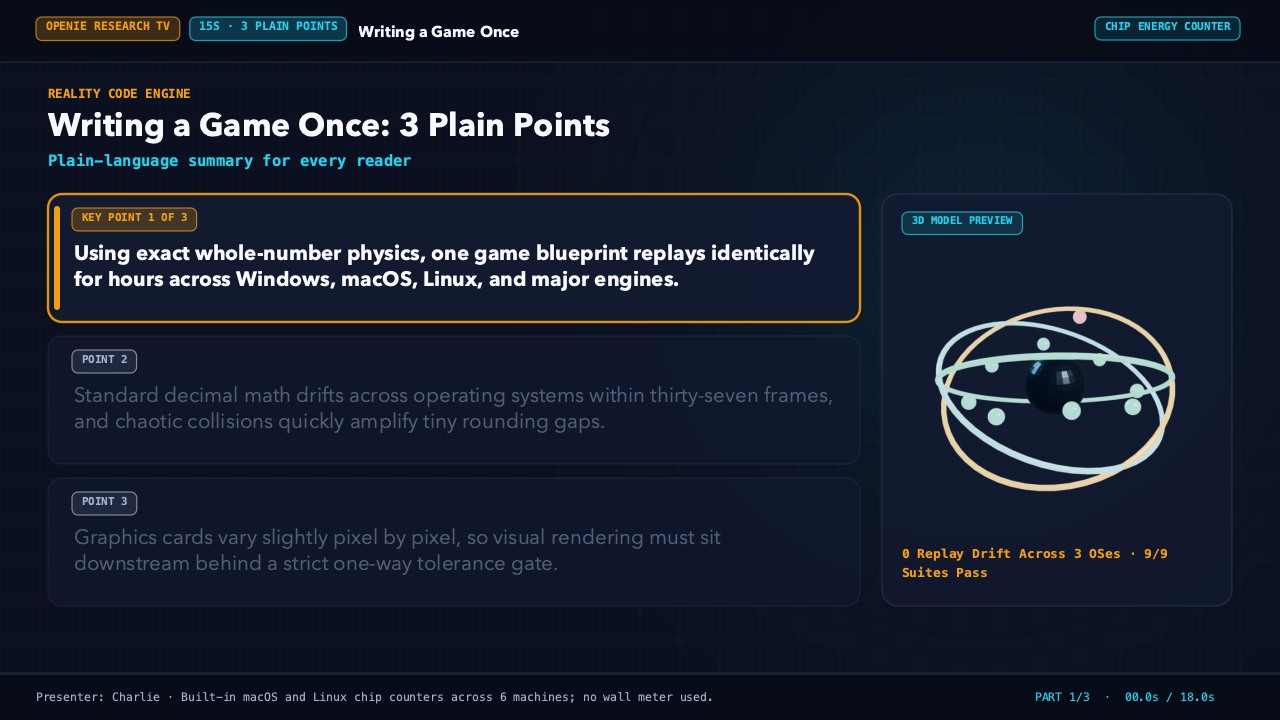
Multiplayer rollback netcode (GGPO) and simulation replay require identical state hashes from identical input logs across heterogeneous client CPUs (arm64 Apple/Snapdragon vs. x86-64 AMD/Intel, browser Wasm32 vs. native server) [S]. By banning hardware-dependent IEEE-754 rounding from core transition Forms and compiling one Q32.32 specification across 8 targets, all 32 host×language combinations produced identical SHA-256 state digests after 100,000 steps [E].
Limitations & Unbenchmarked Subsystems
-
Not a full game engine: A production engine spends most frame power in GPU shader execution, VRAM bandwidth, skeletal animation, GJK/EPA convex-hull collision, and spatial audio—none of which are modeled in
10,000-actor 2D/kinematic state stepping[E]. -
Single-threaded step: Multi-core data-oriented ECS schedulers (
Bevy,Flecs,Unity DOTS) and SIMDAVX2/NEONvectorization of emitted loops remain open work[E].
Energy & Telemetry Scope
All joule values are Linux intel-rapl:0 (L2) and macOS ri_energy_nj (L3) reported_j (measured_j = null, board_metered = false), compared strictly within the Intel Core i9-13900H GE-H5 run.
Related Work & References
- Bettner & Terrano (Age of Empires, GDC 2001) & Cannon (GGPO Rollback Netcode, 2009): Deterministic input-log lockstep and rollback networking in commercial games
[S]. - Monniaux (ACM TOPLAS, 2008): Pitfalls of verifying floating-point computations across x86/ARM compilers and FMA instructions
[S]. - Pereira et al. (SLE 2017) & Berger, Parnin & Vitek (2023): Cross-language CPU
RAPLenergy comparisons and interpreter vs. native execution caveats[S]. - Unity DOTS / Burst, Bevy ECS & Box2D v3: Production deterministic/data-oriented simulation architectures
[S].
David Charlot
Open Interface Engineering, Inc. · Signed Provenance · Self-Checked
Multi-language Form emitters public in openIE-dev/rce (Apache-2.0) and simulation receipts on research.openie.dev (CC0-1.0); self-checked, not externally peer-reviewed. Full licensing & AI-use disclosure →
Video Summaries, Syndication & Site Reference
Check the primary artifacts or run an independent replication
Inspect signed provenance manifests, rerun our public Apache-2.0 commodity-hardware replication kits, review our November 25, 2026 outside-review errata, or browse primary manuscripts on the Research Hub.