JouleDB v0.1 & v0.2: Energy-Aware Intelligence Infrastructure and the Six Contrast Axioms
April–May 2026 Wave II whitepapers specifying the Six Biological Contrast Axioms, all 15 HDC runtime primitives, zero-training WN18RR link prediction (83.8% Hits@10 alongside a 26.4% Hits@1 hierarchical floor), 594 GB CoW hardening, and our 'Good, Bad, and Ugly' self-audit.
Temporal & Archival Scope: Era 0 Historical Whitepaper (Originally dated April 28, 2026; verbatim historical summary followed below by dated November 25, 2026 Errata & Related Work Addendum) · Canonical OpenIE Chronicle Entry: https://blog.openie.dev/posts/wp-jouledb-contrast-axioms/
Provenance & Telemetry Hygiene: Signed Provenance · Self-Checked (automated OpenIE internal gates; not externally peer-reviewed) · Energy Class:
reported_j(measured_j ⊥ reported_j ⊥ est_j ⊥ unmetered— Verification, Licensing & AI-Use Disclosure · Glossary & Non-Mixing Rules).
Part I: Contemporary Historical Summary (As Written in April–May 2026)
Historical Source Provenance (Original Dates: April 28, 2026 [
v0.1] & May 2026 [v0.2]): David Jean Charlot, PhD · Open Interface Engineering. SummarizesWHITEPAPER-JOULEDB-2026-04.md(v0.1) andWHITEPAPER-JOULEDB-2026-05.md(v0.2).
Thesis: Frozen Weights Cannot Distinguish Unknown From False
In April 2026 (v0.1), JouleDB cataloged 18 structural limitations of using frozen-weight autoregressive transformers as live knowledge stores—including inability to retract a single falsified fact online without retraining, conflation of unexamined ignorance with falsity, and fixed per-token compute regardless of novelty—and formulated Six Biological Contrast Axioms:
The Six Contrast Axioms (JouleDB v0.1, April 2026):
  Axiom 1 (Ontology)          : Everything represented is an addressable Thing.
  Axiom 2 (Relation)          : Every pair of Things admits directed measurable Relations.
  Axiom 3 (3-State Epistemics): Every proposition occupies one of three distinct states:
                                KNOWN (evidenced), UNKNOWN (queried gap), or UNAWARE (unexamined).
                                Absence of evidence != Evidence of negation != Unexamined void.
  Axiom 4 (Contrast)          : Information is contrast (divergence between state and expectation).
  Axiom 5 (Cognition)         : Intelligence is structured recognition and composition of contrast.
  Axiom 6 (Metabolism)        : Operational value = Rate of valid contrast recognition per Joule.
Three-Layer Architecture & All 15 HDC Runtime Primitives (§2.3)
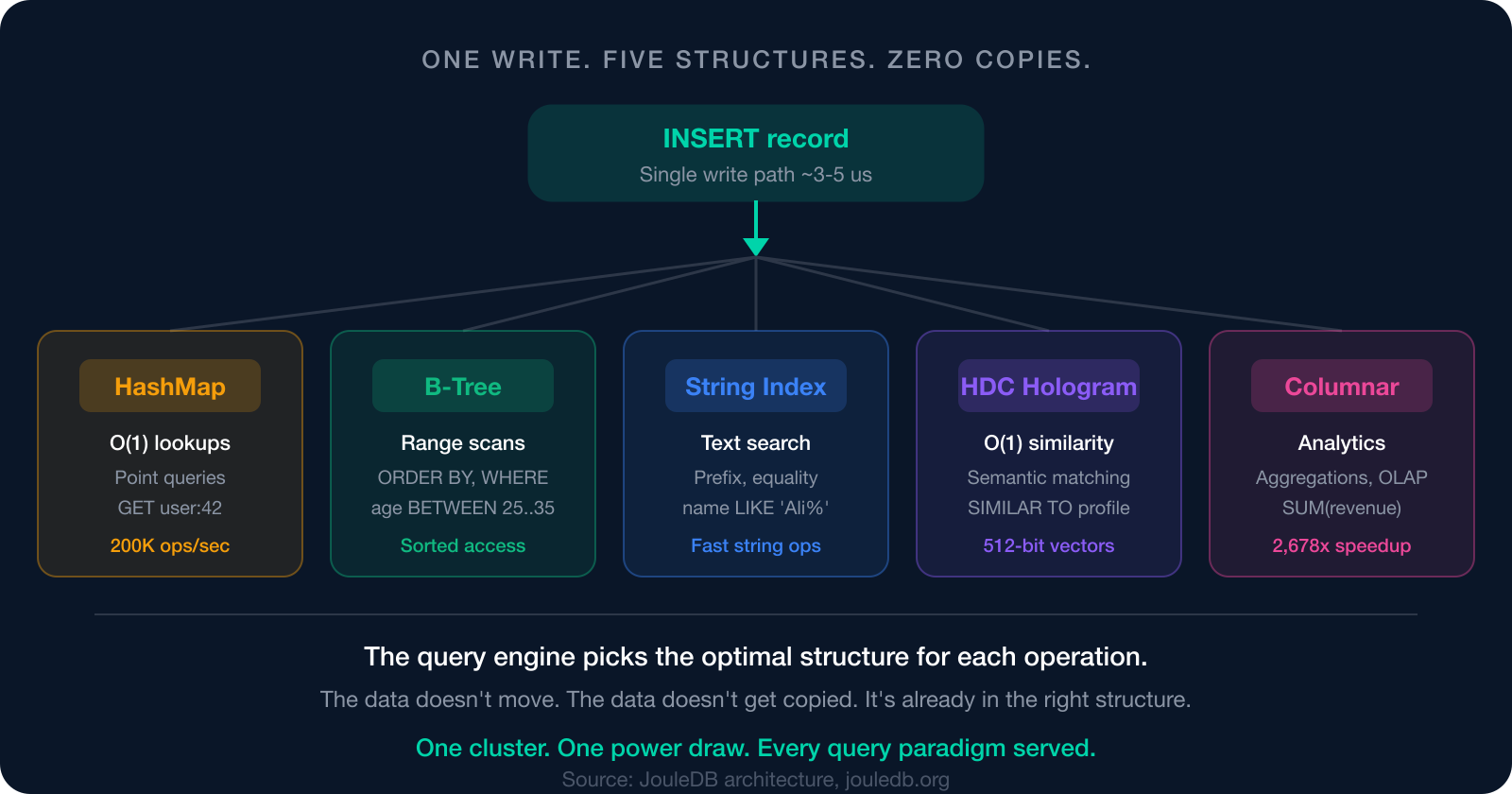
Implemented in v0.2 across 25 core crates plus 4 joule-cloud-* Kubernetes operator crates (~355,000+ lines of Rust after deduplicating v0.1’s 460K count, ~7,000 passing core/query/server tests, and 7 query parsers: SQL, Cypher, CQL, GraphQL, Datalog, SPARQL, Gremlin), JouleDB stacked three layers:
- Layer 1 — Unified Copy-on-Write (
CoW) Engine: Single-write ACID MVCC engine backing relational, graph, wide-column, document, full-text, and vector access. - Layer 2 — 15 HDC / VSA Runtime Primitives (
joule-db-hdc, enumerated verbatim from §2.3 ofWHITEPAPER-JOULEDB-2026-04&2026-05):(1) Encode(BinaryHV::from_data(), trigram/hash/structural),(2) Bind(XOR, MAP, Fourier, non-commutativeGHRRblock-circular),(3) Permute(circular bit shift),(4) Compare(18 nsSIMD Hamming/cosine),(5) Route(MetabolicControlleracross 4 states),(6) Remember(TurboHolographic&SDMwrite),(7) Forget(half-life decay & decoherence),(8) Reflect(subject XOR contextself-model),(9) Merge/Un-merge(BundleAccumulator& resonator factorization),(10) Update(in-place bind/bundle),(11) Test(orthogonality &HologramHealth),(12) Spawn(entity clonal expansion),(13) Inhibit(winner-take-all resonator cleanup),(14) Coarsen(XOR fold / block-majority pyramid), and(15) Synchronize(Barrier+SyncGroup) (see Part II note on runtime API distinctness vs. mathematical irreducibility). - Layer 3 —
LiveIntelligence,PathStore&NegativeKnowledge: Zero-pretraining online triple ingestion with explicit distinction among absence, negation, and void.
Zero-Training WN18RR Link Prediction (Hits@10 AND Hits@1 Side-by-Side)
On WN18RR (40,943 WordNet synset entities, 11 lexical relations), §3.1 of the April–May 2026 whitepapers reported PathStore (GHRR non-commutative binding) side-by-side across Hits@1, Hits@3, Hits@10, and MRR (Superseded / scoped — see Nov 25, 2026 Errata below for evaluation split and energy provenance):
- Metric / Property:
Hits@1· JouleDB PathStore (Apr–May 2026):26.4%(IsA: 11%,PartOf: 0%) · PathHD (HDC Comparator Cited in §3.1):~45%(-19pts) · Supervised Neural KGE (ConvE / RotatE Literature):40.0%(ConvE) –42.8%(RotatE) · Notes from Original §3.1 & §5: 1-hop bundle crowding on high-fan-out hierarchies - Metric / Property:
Hits@3· JouleDB PathStore (Apr–May 2026):58.9%· PathHD (HDC Comparator Cited in §3.1): — · Supervised Neural KGE (ConvE / RotatE Literature):44.0%(ConvE) –49.2%(RotatE) · Notes from Original §3.1 & §5: Strong top-3 neighborhood retrieval - Metric / Property:
Hits@10· JouleDB PathStore (Apr–May 2026):83.8%· PathHD (HDC Comparator Cited in §3.1):~55%(+29pts) · Supervised Neural KGE (ConvE / RotatE Literature):52.0%(ConvE) –57.1%(RotatE) · Notes from Original §3.1 & §5: Broad candidate-neighborhood recall - Metric / Property:
MRR· JouleDB PathStore (Apr–May 2026):0.468· PathHD (HDC Comparator Cited in §3.1):~0.48(-0.012) · Supervised Neural KGE (ConvE / RotatE Literature):0.43(ConvE) –0.476(RotatE) · Notes from Original §3.1 & §5: Competitive mean reciprocal rank - Metric / Property: Training Regime · JouleDB PathStore (Apr–May 2026): Zero training (single-pass online ingest) · PathHD (HDC Comparator Cited in §3.1): Encoder training · Supervised Neural KGE (ConvE / RotatE Literature): Multi-epoch GPU SGD · Notes from Original §3.1 & §5: Supports online
Forgetretraction - Metric / Property: Per-Prediction Energy · JouleDB PathStore (Apr–May 2026):
~9 µJ(see Part II provenance) · PathHD (HDC Comparator Cited in §3.1): Microjoules–millijoules · Supervised Neural KGE (ConvE / RotatE Literature): Millijoules–joules (GPU) · Notes from Original §3.1 & §5: Local bit-packed SIMD operations
May 2026 v0.2 594 GB Hardening & “The Good, The Bad, and The Ugly”
Running JouleDB on our 594 GB / ~4M-row Scholar database in May 2026 drove Phase 5/6 atomic CoW root publication, iterative cycle-safe B-tree traversal, 1,800x faster prefix_count tree walks (vs. full Tantivy scans), and the joule-db-recover forensic page-walker—while §5–§6 candidly documented Hits@1 = 26.4%, ~3,800 unaudited .unwrap() calls in joule-db-server, stubbed Pattern-Lang / flowR bridges, a 30-sentence toy BPE generator corpus, and Tier-4 dollar-vs-joule receipt conflation.
November 25, 2026 Errata, Related Work, and Evolution Addendum
Primitive Reconciliation, WN18RR Protocol & Licensing Errata (2026-11-25 Audit)
- Reconciling All 15 Primitives & Qualifying “Irreducible”:
- An earlier web summary omitted
#4 Compare(18 nsHamming/cosine) from its inline prose list, leaving only 14 named primitives; Part I now restores the complete 15-primitive list matching §2.3 ofWHITEPAPER-JOULEDB-2026-04.mdand2026-05.md. - Terminology Scope: While
#1–#4,#9, and#14(Encode,Bind,Permute,Compare,Merge/Un-merge,Coarsen) are algebraic vector-symbolic operators,#5–#8,#10–#13, and#15(Route,Remember,Forget,Reflect,Update,Test,Spawn,Inhibit,Synchronize) are distinct systems/runtime lifecycle primitives over hypervector stores rather than algebraically independent basis operations in a formal minimality proof.
- An earlier web summary omitted
WN18RREvaluation Protocol,Hits@1(26.4%) vs.Hits@10(83.8%), and~9 µJProvenance:- Standard
WN18RRlink prediction (Dettmers et al., AAAI 2018, removing reversible test leakage fromWN18) evaluates filtered ranking (Bordes et al., NeurIPS 2013, masking other known true triples(h, r, t')before ranking all40,943entities on both(h, r, ?)tail and(?, r, t)head queries across3,134test triples). - Important Scope Disclosure: As explicitly tracked in §9 (Phase 4 Roadmap: “Full WN18RR evaluation (3,134 test triples)”) of both
WHITEPAPER-JOULEDB-2026-04and2026-05, the April–May internalBenchmarkmodule results (83.8%Hits@10,58.9%Hits@3,26.4%Hits@1,0.468MRR) came from an in-workspace(subject, relation, ?)object-prediction evaluation inside a private codebase (unreproduced externally) prior to full external publication packaging—and exhibited a steep26.4%Hits@1floor (11%onIsA,0%onPartOf) wherever 1-hop bundle superposition crowded many valid hypernyms/meronyms into one neighborhood. - Energy Class Clarification: The
~9 µJ/predictionfigure derives from host counter / operation-count amortization (reported_j/est_jviajoule-db-energyon local CPU SIMDPOPCNT/XOR passes, not an inline DC shuntmeasured_j). Notice also that Tsirogiannis et al. (SIGMOD 2010) showed on single-node servers that the most energy-efficient database plan typically coincides with the fastest plan due to high static server idle power—meaning microjoule query wins require either high concurrency saturation or low-idle edge silicon to translate into wall-plug savings.
- Standard
- Artifact & Licensing Status (
BSL-1.1/ Private Core): PublicJouleDBbinaries and SDK wrappers atopenIE-dev/jouledbship under BSL-1.1, while the full~355KLOC Rust workspace (joule-db-core,joule-db-hdc,jouledb-ai-runtime) resides in private mirroropenIE-dev/jouledb-core(unreproduced externally).
Chronological Evolution Within OpenIE Research
- Multi-Model Storage Physics (Eco-Database): Tested single-write CoW persistence against polyglot multi-engine write amplification under controlled workloads.
- Overcoming Bundle Crowding With Structured Discrete Operators (64-Codon LUT6 Nucleus): Investigated structured
64-codonLUT6andAntisym-40non-commutative operators (125–176 nJinline DC shuntmeasured_jon Jetson Thor) where flat hypervector superposition losesHits@1precision. - Public Reproducible Zero-Training Baselines (The Deterministic Null): Carried the zero-training baseline philosophy into an open, reproducible 10-task benchmark (
openIE-dev/deterministic-null,reported_j).
Related Work & External References
- Kanerva, P. (2009). Hyperdimensional Computing: An Introduction to Computing in Distributed Representation with High-Dimensional Random Vectors. Cognitive Computation, 1(2), 139–159; Kanerva, P. (1988). Sparse Distributed Memory. MIT Press.
- Plate, T. A. (1995). Holographic Reduced Representations. IEEE Transactions on Neural Networks, 6(3), 623–641; Yeung, C., Zou, Z., & Imani, M. (2024). Generalized Holographic Reduced Representations (GHRR). arXiv:2405.09689 — non-commutative block-unitary binding for directed relations.
- Bordes, A., Usunier, N., Garcia-Durán, A., Weston, J., & Yakhnenko, O. (2013). Translating Embeddings for Modeling Multi-Relational Data (TransE). NeurIPS 2013 — standard filtered vs. raw link-prediction evaluation protocol.
- Dettmers, T., Minervini, P., Stenetorp, P., & Riedel, S. (2018). Convolutional 2D Knowledge Graph Embeddings (ConvE). AAAI 2018 — introduced the WN18RR benchmark removing inverse-relation test leakage.
- Sun, Z., Deng, Z.-H., Nie, J.-Y., & Tang, J. (2019). RotatE: Knowledge Graph Embedding by Relational Rotation in Complex Space. ICLR 2019 — canonical
WN18RRneural baseline. - Harizopoulos, S., Liang, V., Abadi, D. J., & Madden, S. (2009). Energy Efficiency: The New Holy Grail of Data Management Systems Research. CIDR 2009.
- Tsirogiannis, D., Harizopoulos, S., & Shah, M. A. (2010). Analyzing the Energy Efficiency of a Database Server. ACM SIGMOD 2010, 231–242 — classic empirical proof that within a single server’s high idle-wattage envelope, fastest execution often minimizes per-query energy unless multi-engine duplication or idle states change.
Changelog (2026-11-25)
- Restored all 15 exact HDC runtime primitive names (
#1 Encodethrough#15 Synchronize, including#4 Compare) from §2.3 ofWHITEPAPER-JOULEDB-2026-04.md&2026-05.md, and clarified runtime-primitive distinctness vs. formal algebraic minimality. - Reported
Hits@1 = 26.4%(IsA: 11%,PartOf: 0%) alongsideHits@10 = 83.8%andMRR = 0.468inheadlineMetric, Part I, and Part II, and documented theWN18RRfiltered-ranking protocol (Bordes et al., 2013; Dettmers et al., 2018) plus §9’s queued3,134-triple publication check. - Disclosed
BSL-1.1binary licensing, privateopenIE-dev/jouledb-coreprovenance (unreproduced externally), andreported_j/est_jstatus of~9 µJ/prediction, and added citations to Kanerva (2009), Plate (1995), GHRR (2024), TransE (2013), ConvE (2018), RotatE (2019), Harizopoulos et al. (CIDR 2009), and Tsirogiannis et al. (SIGMOD 2010).
Canonical Provenance, Primary Artifacts & Independent Replication
- Canonical OpenIE Chronicle Entry: https://blog.openie.dev/posts/wp-jouledb-contrast-axioms/
- Public Code / Replication Harness: https://github.com/openIE-dev/jouledb
- Signed Provenance · Self-Checked Disclosure & Licensing: JouleDB binaries/packages ship under BSL-1.1 at openIE-dev/jouledb, while full core sources (joule-db-core, joule-db-hdc, jouledb-ai-runtime) reside in private mirror openIE-dev/jouledb-core (externally unreproduced). Full details at https://blog.openie.dev/verification/ and https://blog.openie.dev/glossary/.