Building an AI-First Language with Selective State Spaces (Mamba-2 State Space Duality in Rust)
February 2026 (v1.0) control-theory-to-Rust architectural monograph tracing Rudolf Kalman's 1960 state-space equations through HiPPO and Mamba-2 State Space Duality (SSD) into a zero-dependency Rust 1.93.0 specification with grammar-constrained Oracle types.
Temporal & Archival Scope: Era 0 Historical Whitepaper (Originally dated February 3, 2026; verbatim historical summary followed below by dated November 25, 2026 Errata & Related Work Addendum) · Canonical OpenIE Chronicle Entry: https://blog.openie.dev/posts/wp-cortex-selective-state-spaces/ · Original Archival PDF: https://blog.openie.dev/papers/archive/06-AI-First-Language-SSMs.pdf
Provenance & Telemetry Hygiene: Signed Provenance · Self-Checked (automated OpenIE internal gates; not externally peer-reviewed) · Energy Class:
unmetered(measured_j ⊥ reported_j ⊥ est_j ⊥ unmetered— Verification, Licensing & AI-Use Disclosure · Glossary & Non-Mixing Rules).
Part I: Contemporary Historical Summary (As Written in February 2026)
Historical Source Provenance (Original Date: February 3, 2026 ·
February 2026 | Version 1.0): David Jean Charlot, PhD · Open Interface Engineering. Preserved fromopenIE-dev/energy-efficient-agi/docs/Building an AI-First Language with SSMs.md(Download Original Feb 2026 PDF).
Thesis: Sequence Models as Discretized Control Systems
In early February 2026, mainstream AI serving stacks defaulted to O(L^2) prefill and O(L) KV-cache Transformer pipelines wrapped in Python and C++ framework layers. Approaching sequence modeling from classical physical control theory, this Version 1.0 architectural monograph synthesized two propositions:
- Mathematical Lineage: Selective State Space Models (
MambaandMamba-2) are input-dependent linear time-varying (LTV) descendants of Rudolf Kalman’s 1960 continuous-time state-space equations—tradingO(L)KV-cache growth per generated token for a fixed-dimension recurrent stateO(1)per decoding step. - Systems Blueprint: An AI-native systems runtime in Rust (
1.93.0) can specify strided arena tensor views, SIMD kernels (AVX-512/ARM NEON), parallel associative prefix scans, SRAM tile fusion, and grammar-constrained logit masking without external Python/C++ framework dependencies.
From 1960 Kalman Dynamics to 2024 Mamba-2 State Space Duality (SSD)
The monograph traced four mathematical stages underlying the Cortex state engine:
1. Continuous-Time Linear State Space (Kalman, 1960):
     dx(t)/dt = A * x(t) + B * u(t)
     y(t)     = C * x(t) + D * u(t)

2. Zero-Order Hold (ZOH) Discretization at step size Delta:
     A_bar = exp(Delta * A)
     B_bar = (Delta * A)^(-1) * (exp(Delta * A) - I) * (Delta * B)
     x_k   = A_bar * x_{k-1} + B_bar * u_k

3. HiPPO Optimal Polynomial Memory (Gu et al., 2020) -> Selective LTV Mamba (Gu & Dao, 2023):
     B_k = s_B(u_k),   C_k = s_C(u_k),   Delta_k = softplus(Parameter + s_Delta(u_k))
     Making step size Delta_k input-dependent turns LTI convolution into selective gating:
       Delta_k -> 0   preserves historical state x_{k-1} across irrelevant inputs
       Delta_k -> inf resets state onto novel incoming evidence u_k

4. Mamba-2 State Space Duality (Dao & Gu, 2024 — Scalar-Times-Identity A = a * I):
     Restricting diagonal A to scalar-identity blocks makes the 1-semiseparable SSM operator
     mathematically dual to masked structured matrix multiplication—enabling 2-8x faster
     chunked tensor-core training (per Dao & Gu, 2024) while retaining O(1) recurrent decode state.
Because fixed-dimension O(1) state compression encounters an information-theoretic recall ceiling on exact arbitrary-offset token copying, the blueprint incorporated a 1:7 Jamba-style hybrid block schedule—interleaving one sliding/attention block per seven SSD blocks.
Pure-Rust Systems Architecture Specification
The monograph specified five subsystems for zero-Python execution:
- Subsystem:
CortexTensor· Architectural Mechanism: Contiguous arena buffer +(shape, strides, offset)metadata · Complexity / Systems Property: Zero-copytranspose(),slice(), and chunk reshaping - Subsystem: SIMD Primitives · Architectural Mechanism: Target
std::arch(AVX-512FMA /ARM NEON) & nightlyportable_simd(see Errata) · Complexity / Systems Property: Vectorized Padéexpapproximants &softplusin vector registers - Subsystem: Blelloch Parallel Scan · Architectural Mechanism: Associative first-order operator
(a1, x1) op (a2, x2) = (a2*a1, a2*x1 + x2)· Complexity / Systems Property: Reduces sequential lengthLrecurrence depth fromO(L)toO(log L) - Subsystem: SRAM Kernel Fusion · Architectural Mechanism: Fuses
ZOH discretize + scan + C_k projectioninside L1/SRAM tiles · Complexity / Systems Property: Avoids materializing[B, L, D, N]expanded state in off-chip DRAM - Subsystem: The “Oracle” Type Engine · Architectural Mechanism: Context-Free Grammar (
CFG) & interval-bound vocabulary logit masks · Complexity / Systems Property: Enforceslet age: Int = infer ... constrained_by Range(0, 120)during token decode
Instead of sampling unconstrained tokens and retrying on parse errors, the Oracle design compiled static type obligations (Range(0, 120), enum variants, structured AST grammars) into deterministic bitmasks setting invalid next-token probabilities to zero during decoding.
November 25, 2026 Errata, Related Work, and Evolution Addendum
Date Anachronism Fix & Technical Clarifications (2026-11-25 Audit)
- Publication Date Metadata Correction (
2026-01-18->2026-02-03): An earlier archival catalog pass mis-indexed this monograph as"2026-01-18"—four days beforeRust 1.93.0shipped stable on2026-01-22, creating an apparent chronological anachronism around itsRust 1.93.0toolchain reference! Auditing the original header inopenIE-dev/energy-efficient-agi/docs/Building an AI-First Language with SSMs.md(February 2026 | Version 1.0) confirmed the document was completed in early February 2026 afterRust 1.93.0released;datehas been updated to"2026-02-03"accordingly. - Toolchain & Literature Scope (
unmeteredFormal Blueprint):- Within
Rust 1.93.0, hardware-specific SIMD intrinsics (core::arch::x86_64,core::arch::aarch64) are stable, whereasstd::simd(#![feature(portable_simd)]) remained a nightly-only experimental feature. - This monograph is a mathematical and systems-architecture specification (
unmetered) without empirical wall-clock or joule benchmarks of its own; the2–8xchunked SSD speedup vs. Mamba-1 parallel scan and the~100xDRAM-vs-SRAM pJ/bit gap cite Dao & Gu (2024) and Horowitz (2014), respectively.
- Within
- Artifact & Licensing Status: Archival PDF (
#06) is public at/papers/archive/06-AI-First-Language-SSMs.pdfunder CC BY-ND 4.0. TheopenIE-dev/energy-efficient-agirepository is private (unreproduced externally); our subsequent verified Rust runtime is public atopenIE-dev/rce.
Chronological Evolution Within OpenIE Research
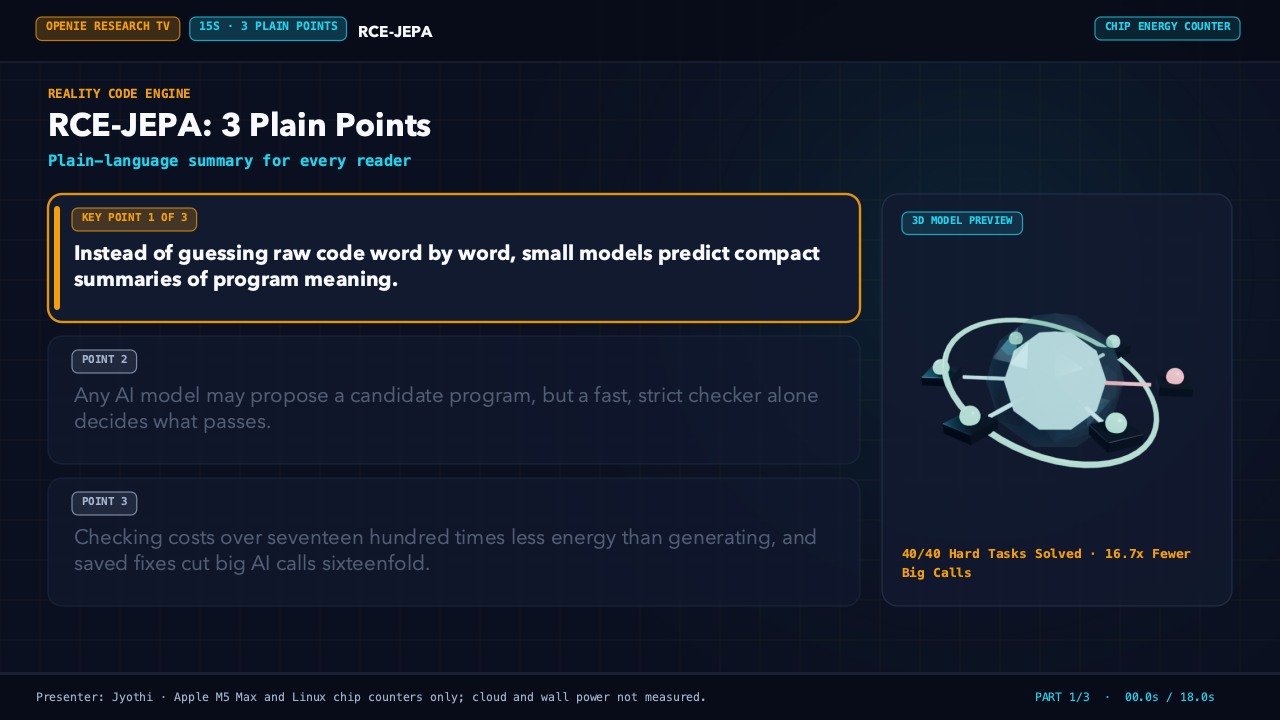
- From Token-Space SSMs to Latent World Dynamics (RCE-JEPA): Explored moving state prediction out of surface BPE token space into sparse-positive representation space (
JEPA), paired with deterministicRCEinvariant checks. - Explicit Temporal Coordinates (Time as an Index): Examined the
O(L)KV-cache vs.O(1)state-bottleneck trade-off through structured temporal indexing rather than pure recurrent compression or brute-force token replay. - Discrete Zero-Multiply State Transitions (64-Codon LUT6 Nucleus & Downward LUT6 Compilation): Investigated compiling stabilized recurrent/reflexive transitions beyond
f32SIMD FMA pipelines into zero-multiply ternary andLUT6boolean tables (125–176 nJinline DC board shunt,measured_jon Jetson Thor).
Related Work & External References
- Kalman, R. E. (1960). A New Approach to Linear Filtering and Prediction Problems. ASME Journal of Basic Engineering, 82(1), 35–45.
- Blelloch, G. E. (1990). Prefix Sums and Their Applications. Technical Report CMU-CS-90-190, Carnegie Mellon University — parallel
O(log L)associative scan formulation for linear recurrences; applied to deep linear SSMs in Martin, E., & Cundy, C. (ICLR 2018) and Smith, J. T. H., Warrington, A., & Linderman, S. W. (S5, ICLR 2023). - Gu, A., Dao, T., Ermon, S., Rudra, A., & Ré, C. (2020). HiPPO: Recurrent Memory with Optimal Polynomial Projections. NeurIPS 2020; Gu, A., Goel, K., & Ré, C. (2022). Efficiently Modeling Long Sequences with Structured State Spaces (S4). ICLR 2022.
- Gu, A., & Dao, T. (2023). Mamba: Linear-Time Sequence Modeling with Selective State Spaces. arXiv:2312.00752.
- Dao, T., & Gu, A. (2024). Transformers are SSMs: Generalized Models and Efficient Algorithms Through Structured State Space Duality (Mamba-2). ICML 2024.
- Lieber, O., Lenz, B., Bata, H., et al. (AI21 Labs) (2024). Jamba: A Hybrid Transformer-Mamba Language Model. arXiv:2403.19887 — source of the
1:7attention-to-SSM hybrid ratio. - Willard, B. T., & Louf, R. (2023). Efficient Guided Generation for Large Language Models (Outlines). arXiv:2307.09702; Dong, Y., et al. (2024). XGrammar: Flexible and Efficient Structured Generation Engine for Large Language Models. arXiv:2411.15100 — prior art for FSM/CFG-compiled vocabulary logit bitmasks (“Oracle” constrained decoding).
Changelog (2026-11-25)
- Fixed Date Anachronism: Updated frontmatter
datefrom"2026-01-18"to"2026-02-03"to match the original document header (February 2026 | Version 1.0), authored afterRust 1.93.0shipped stable on2026-01-22. - Separated Part I (February 2026 Version 1.0 summary) from Part II (November 25, 2026 errata, provenance, and related work).
- Clarified nightly
portable_simd(std::simd) vs. stablecore::archSIMD status inRust 1.93.0, notedunmeteredformal-blueprint status and privateenergy-efficient-agiprovenance, and added citations to Kalman (1960), Blelloch (1990), S4/S5/Mamba/Mamba-2, Jamba (2024), Outlines (2023), and XGrammar (2024).
Canonical Provenance, Primary Artifacts & Independent Replication
- Canonical OpenIE Chronicle Entry: https://blog.openie.dev/posts/wp-cortex-selective-state-spaces/
- Original Archival Whitepaper PDF: https://blog.openie.dev/papers/archive/06-AI-First-Language-SSMs.pdf
- Signed Provenance · Self-Checked Disclosure & Licensing: Archival PDF (#06) public at /papers/archive/06-AI-First-Language-SSMs.pdf under CC BY-ND 4.0; original openIE-dev/energy-efficient-agi repository is private (externally unreproduced); runtime successor openIE-dev/rce is public. Full details at https://blog.openie.dev/verification/ and https://blog.openie.dev/glossary/.