Joule Technical Overview & Founding Story: Compile-Time Energy Budgets for Systems Software
February 4, 2026 language specification whitepapers introducing Joule: an affine-ownership systems language with static @energy_budget annotations (est_j), RAPL/ARM runtime meters (reported_j), and a Cranelift/LLVM/MLIR tri-backend compiler architecture.
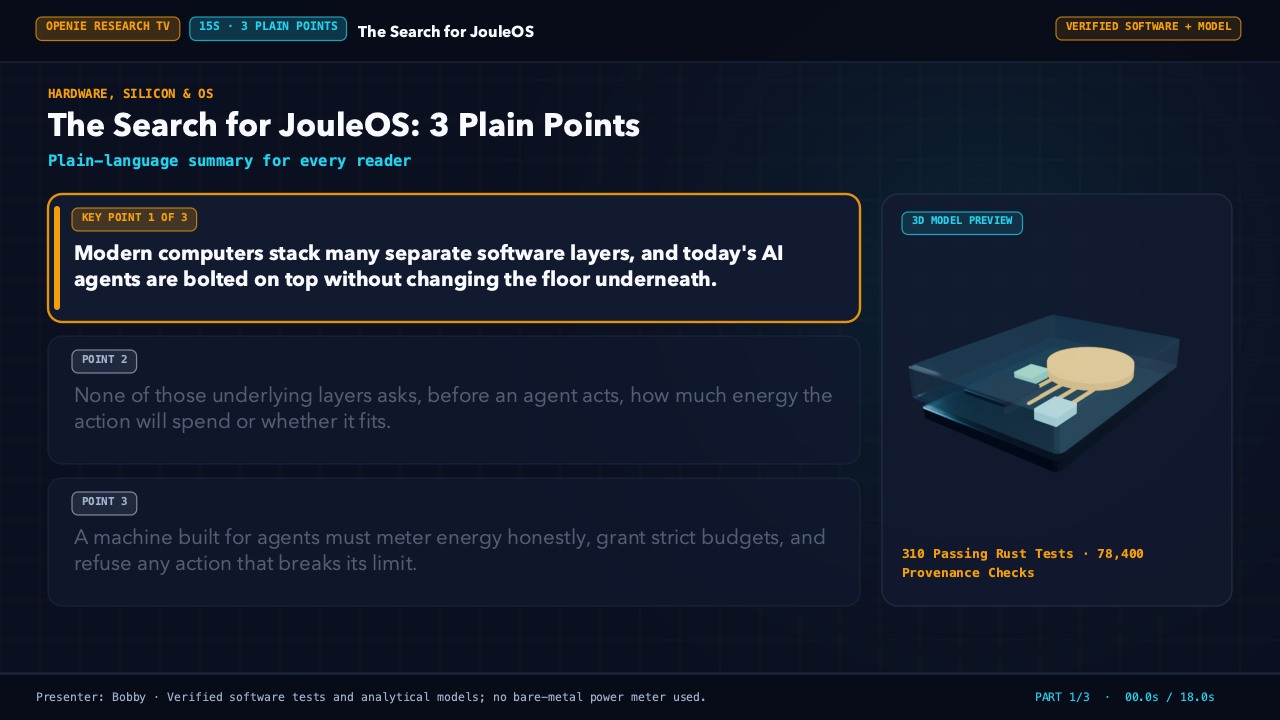
Temporal & Archival Scope: Era 0 Historical Whitepaper (Originally dated February 4, 2026; verbatim historical summary followed below by dated November 25, 2026 Errata & Related Work Addendum) · Canonical OpenIE Chronicle Entry: https://blog.openie.dev/posts/wp-joule-language-technical-overview/ · Original Archival PDF: https://blog.openie.dev/papers/archive/13-Joule-Technical-Overview.pdf · The Joule Story PDF: https://blog.openie.dev/papers/archive/14-The-Joule-Story.pdf
Provenance & Telemetry Hygiene: Signed Provenance · Self-Checked (automated OpenIE internal gates; not externally peer-reviewed) · Energy Class:
reported_j(measured_j ⊥ reported_j ⊥ est_j ⊥ unmetered— Verification, Licensing & AI-Use Disclosure · Glossary & Non-Mixing Rules).
Part I: Contemporary Historical Summary (As Written in February 2026)
Historical Source Provenance (Original Date: February 4, 2026): David Jean Charlot, PhD · Open Interface Engineering. Synthesizes two companion February 4, 2026 publications: the Joule Technical Overview PDF and The Joule Story PDF (
openIE-dev/joule-lang).
Origin: Naming a Systems Language After James Prescott Joule (1850)
In 1850, James Prescott Joule established with a falling weight and a paddle-wheel calorimeter that mechanical work and thermal dissipation are conserved forms of the same physical quantity, measured in joules.
Modern systems languages provide static integer widths, affine ownership lifetimes for heap memory safety, and type-checked concurrency primitives—yet lack first-class language constructs for bounding the physical energy a routine may dissipate. Motivated by Pereira et al.’s SLE 2017 benchmark comparison (CPython at 75.88x vs. C at 1.00x and Rust at 1.03x) and Pinto et al.’s measurements showing garbage collection accounting for 5–25% of managed-runtime energy, the February 4, 2026 Joule (v0.1) specification proposed elevating energy contracts into function signatures and compiler passes.
Language Primitives: Affine Ownership + @energy_budget
Joule specified Hindley–Milner local type inference and affine ownership/borrowing (deterministic RAII deallocation without stop-the-world tracing GC) alongside static and runtime energy primitives:
// Illustrative Joule v0.1 specification syntax (February 2026)
@energy_budget(250_microjoules)
@target(SIMD)
fn normalize_sensor_frame(buf: &mut [f32; 256]) -> f32 {
    let meter = energy::Meter::hardware(); // Intel RAPL / ARM Energy Probe
    let mut acc: f32 = 0.0;
    for x in buf.iter() {
        acc += (*x) * (*x);
    }
    let inv = acc.sqrt().recip();
    for x in buf.iter_mut() {
        *x *= inv;
    }
    meter.elapsed_microjoules()
}
Core language mechanisms specified in the February 4, 2026 overview included:
- Compile-Time Energy Contracts (
@energy_budget,@energy_profile): Static instruction-weight and memory-hierarchy cost tables warn or reject builds when an annotated function introduces an unbounded loop, unexpected heap allocation, or strided DRAM gather exceeding its nominal budget. - Structured
scopeConcurrency &@auto_place(optimize_for: Energy): Explicit data-movement scopes allow@kernelblocks to target CPU SIMD,@target(GPU), or NPU backends when amortization exceeds transfer cost. - Zero-Overhead Foreign Interop: Direct C ABI FFI and
wasm32-wasitargets for incremental adoption inside existing polyglot services.
Tri-Backend Compiler Architecture Specification
To balance debug turnaround against production code generation, the Technical Overview specified a Tri-Backend Compiler lowering a shared typed IR across three backends:
- Compiler Backend:
Cranelift· Target Regime: Debug & interactive edit-test builds · Compilation Speed / Role:~10xfaster compile time (vs. full LLVM-O3release builds) · Energy Optimization Focus: Lowers developer/CI rebuild CPU time during iteration - Compiler Backend:
LLVM(-Oe/-Oez) · Target Regime: Production CPU binaries (x86_64,AArch64,RISC-V) · Compilation Speed / Role: Whole-program optimization · Energy Optimization Focus: SIMD vectorization, L1/L2 cache loop tiling, instruction-energy cost selection - Compiler Backend:
MLIR· Target Regime: GPUs, TPUs, FPGAs, custom accelerators · Compilation Speed / Role: Polyhedral &linalgdialect lowering · Energy Optimization Focus: Operator fusion, scratchpad SRAM promotion, minimizing HBM/DRAM traffic
Section 6 of the February 2026 Technical Overview explicitly noted that static compile-time @energy_budget bounds—like Worst-Case Execution Time (WCET) bounds in real-time systems—cannot predict dynamic L3 cache contention, silicon bin variance, or OS DVFS p-state transitions, requiring runtime hardware-counter verification (energy::Meter::hardware()).
November 25, 2026 Errata, Related Work, and Evolution Addendum
Methods, Implementation Status & Licensing Scope Box (reported_j / est_j)
- Distinguishing the Feb 4, 2026
v0.1Specification From Subsequent Bootstrap Milestones:- At publication on February 4, 2026, PDFs
#13and#14constituted a forward-looking v0.1 language and compiler specification (the-OeLLVM energy-cost pass and full MLIR polyhedral backend were architectural targets, not benchmarked production compilers in February 2026; the~10xCranelift compile-time ratio reflects standard Cranelift JIT/debug codegen speed in the denominator vs. optimizing LLVM-O3release builds in the numerator). - Over the following four months (by June 2026),
joule-langreached a~15.5 klocself-hosted bootstrap lowering onto OpenIE’s unifiedflowGFunctionGraphIR (openIE-dev/flow-g).
- At publication on February 4, 2026, PDFs
- Epistemic Non-Mixing Across Compile-Time (
est_j) vs. Runtime (reported_j):- Static
@energy_budgetchecks sum analytical instruction/cache cost weights (est_j), whereasenergy::Meter::hardware()reads on-chip telemetry (Intel/AMD RAPL,Apple IOReport,ARMprobes =reported_j). Both remain strictly distinct from external inline DC shunt instrumentation (measured_j).
- Static
- Artifact & Licensing Status: Unlike Papers
#01–#12(CC BY-ND 4.0), archival PDFs#13(Joule Technical Overview) and#14(The Joule Story) were published under CC BY 4.0. The public language specification, grammar, and bootstrap repository atopenIE-dev/joule-langis licensed under Apache-2.0 (while early pre-flowGinternal compiler experiments resided in private workspace mirrors).
Chronological Evolution Within OpenIE Research
- OS-Level Joule Envelopes (JouleOS): Because an energy-blind OS scheduler can invalidate process-local
@energy_budgetassumptions via cache thrashing and DVFS p-state shifts, subsequent work moved joule accounting and thermal budget enforcement into JouleOS. - Verified Graph IR Execution (Reality Code Engine (
RCE)): Pairedjoule-lang/flowGlowering with machine-checked execution invariants (2,221deterministic checks inopenIE-dev/rce). - Calibrating Against Inline DC Shunts (The Eco-Stack): Anchored kernel-level primitives on external DC shunt benches (
measured_j) across AMD Kria KV260 (11.43 nJ) and NVIDIA Jetson Thor (125–176 nJ).
Related Work & External References
- Cohen, M., Zhu, H. S., Emgin, E. S., & Liu, Y. D. (2012). Energy Types. OOPSLA 2012, 831–850 — foundational programming-language type system modeling CPU power phases and energy-aware execution modes.
- Sampson, A., Dietl, W., Fortuna, E., Gnanapragasam, D., Ceze, L., & Grossman, D. (2011). EnerJ: Approximate Data Types for Safe and General Low-Power Computation. PLDI 2011, 164–174.
- Wilhelm, R., Engblom, J., Ermedahl, A., et al. (2008). The Worst-Case Execution-Time Problem—Overview of Methods and Survey of Tools. ACM Transactions on Embedded Computing Systems, 7(3), Article 36; Georgiou, K., Kerrison, S., Ziegenbein, D., & Eder, K. (2017). less: Static Energy Consumption Analysis of Embedded Programs — prior art on static WCET/WCEC instruction-energy bounds and cache/pipeline state explosion.
- Pereira, R., et al. (2017). Energy Efficiency Across Programming Languages. SLE 2017; Pinto, G., Castor, F., & Liu, Y. D. (2014). OOPSLA 2014.
- Jung, R., et al. (2018). RustBelt: Securing the Foundations of the Rust Programming Language. POPL 2018 — formal foundation for affine ownership and borrowing.
- Lattner, C., et al. (2021). MLIR: Scaling Compiler Infrastructure for Domain Specific Computation. CGO 2021.
Changelog (2026-11-25)
- Separated Part I (February 4, 2026 v0.1 language specification) from Part II (November 25, 2026 implementation timeline, epistemic separation, licensing, and related work).
- Stated exact CC BY 4.0 licensing for PDFs
#13–#14and Apache-2.0 licensing foropenIE-dev/joule-lang(noting pre-flowGinternal compiler mirrors). - Clarified static
@energy_budget(est_j) vs. runtimeRAPL/IOReport(reported_j), named the LLVM-O3vs. Cranelift compile-speed denominator, and added citations to Energy Types (Cohen et al., OOPSLA 2012), EnerJ (Sampson et al., PLDI 2011), Wilhelm et al. WCET (2008), Georgiou et al. WCEC (2017), RustBelt, and MLIR.
Canonical Provenance, Primary Artifacts & Independent Replication
- Canonical OpenIE Chronicle Entry: https://blog.openie.dev/posts/wp-joule-language-technical-overview/
- Public Code / Replication Harness: https://github.com/openIE-dev/joule-lang
- Original Archival Whitepaper PDF: https://blog.openie.dev/papers/archive/13-Joule-Technical-Overview.pdf
- Signed Provenance · Self-Checked Disclosure & Licensing: Archival PDFs (#13 and #14) public at /papers/archive/13-Joule-Technical-Overview.pdf and /papers/archive/14-The-Joule-Story.pdf under CC BY 4.0; public language repository openIE-dev/joule-lang is licensed under Apache-2.0 (while early pre-flowG compiler prototypes were developed in private workspace mirrors). Full details at https://blog.openie.dev/verification/ and https://blog.openie.dev/glossary/.