The AI Inference Crisis: The Token Crash Paradox, KV-Cache Limits, and Hardware-Grounded Routing
January 30, 2026 infrastructure economics whitepaper framing the Token Crash Paradox: why a 62–1,000x drop in unit API token prices coincided with rising enterprise inference spend against KV-cache and HBM memory-bandwidth walls.
Temporal & Archival Scope: Era 0 Historical Whitepaper (Originally dated January 30, 2026; verbatim historical summary followed below by dated November 25, 2026 Errata & Related Work Addendum) · Canonical OpenIE Chronicle Entry: https://blog.openie.dev/posts/wp-ai-inference-crisis/ · Original Archival PDF: https://blog.openie.dev/papers/archive/05-AI-Inference-Crisis-Precursor.pdf
Provenance & Telemetry Hygiene: Signed Provenance · Self-Checked (automated OpenIE internal gates; not externally peer-reviewed) · Energy Class:
est_j(measured_j ⊥ reported_j ⊥ est_j ⊥ unmetered— Verification, Licensing & AI-Use Disclosure · Glossary & Non-Mixing Rules).
Part I: Contemporary Historical Summary (As Written in January 2026)
Historical Source Provenance (Original Date: January 30, 2026): David Jean Charlot, PhD · Open Interface Engineering. Preserved from the
sfa-background-researchinfrastructure precursor whitepaper (Download Original Jan 2026 PDF).
Diagnosis: The Token Crash Paradox
At the close of January 2026, industry commentary celebrated a seemingly reassuring trend: the API price of GPT-4-class token completions had fallen 62x to 1,000x over roughly two years (comparing early-2023 frontier API list pricing per million tokens against January 2026 equivalent-tier API pricing). If unit inference prices were collapsing that rapidly, a straightforward static-demand intuition suggested that enterprise AI bills and datacenter power draw should shrink accordingly.
Industry spend surveys compiled in January 2026 pointed in the opposite direction. Enterprise generative AI outlays had reached USD 37B in 2025 amid broader global AI infrastructure commitments projected toward USD 2T for 2026, while 68% of surveyed enterprises reported difficulty quantifying ROI and 43% cited cloud inference cost overruns. The whitepaper termed this divergence The Token Crash Paradox and isolated two structural multipliers behind it:
- The Lifecycle Inference Shift: Inference rose from
~33%of datacenter AI compute share in 2023 to~55%in 2025, with analyst projections tracking toward70–80%by 2029 (80–90%of cumulative lifecycle compute for widely deployed production models). - The Agentic Token Multiplier: Lower unit token prices encouraged engineering teams to replace single-pass chat completions with multi-step reflection, tool-invocation, and verification loops:
- Workflow Generation: Single-Turn Chat (2023 Baseline) · Token / Call Multiplier (vs. Single-Turn Chat):
1x(denominator) · Representative Per-Task API Spend:~USD 0.001· Structural Consequence: Human reading speed caps request arrival rate - Workflow Generation: Multi-Chunk RAG Pipeline · Token / Call Multiplier (vs. Single-Turn Chat):
3 – 5x· Representative Per-Task API Spend:~USD 0.005· Structural Consequence: Long-context prefill context expansion - Workflow Generation: Moderate Coding / Tool Agent · Token / Call Multiplier (vs. Single-Turn Chat):
10 – 25x· Representative Per-Task API Spend:~USD 0.03· Structural Consequence: Multi-turn context re-ingestion across tool calls - Workflow Generation: Autonomous Multi-Agent Loop · Token / Call Multiplier (vs. Single-Turn Chat):
50 – 100x· Representative Per-Task API Spend:USD 0.10 – 1.00· Structural Consequence: Machine-to-machine traffic decouples from human typing speed
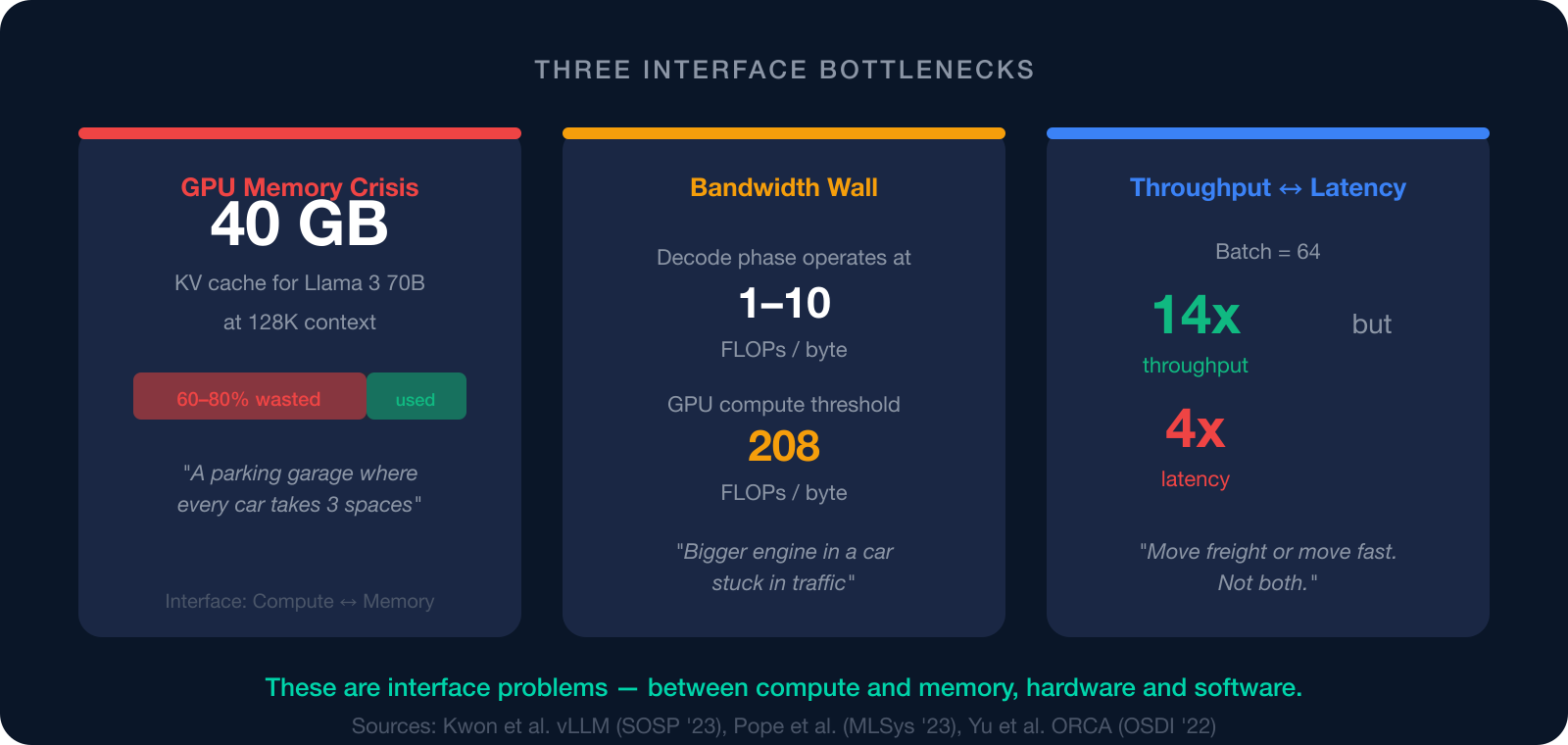
Three Physical Bottlenecks Under the Hood
To explain why accelerator clusters could not absorb a 50–100x agentic volume expansion without proportional hardware and energy scaling, the January 2026 paper synthesized three coupled hardware limits:
1. The KV-Cache Memory Wall:
     Llama-3-70B FP16 @ 128K single sequence       ≈ 40 GB KV state alone
     Llama-3-70B FP16 @ 32K context, batch size 8  ≈ 80 GB KV state (saturates an 80 GB HBM card)
     Naive contiguous reservation wastes 60-80% of VRAM to fragmentation (addressed by PagedAttention).

2. The HBM Memory-Bandwidth Roofline Wall:
     NVIDIA A10 FP16 ridge point                   ≈ 208 FLOPs / Byte (peak FP16 FLOPs / GDDR6 BW)
     Prefill phase arithmetic intensity            ≈ 55 - 100 FLOPs / Byte
     Autoregressive Decode arithmetic intensity    ≈ 1 - 10 FLOPs / Byte  (20.8-208x below ridge)
     Result: Tensor cores stall waiting on weight + KV-cache memory fetches on every generated token.

3. The Throughput-Latency Coupling Wall:
     Raising batch size from B = 1 (denominator) to B = 64 lifts aggregate token throughput ~14x,
     but stretches per-request tail latency ~4x—violating interactive and real-time control SLAs.
Alongside operational electricity, rapid 18–24 month server replacement cycles projected 1.2M to 5.0M metric tons of cumulative AI hardware e-waste between 2020 and 2030 (~110% CAGR in high-end accelerator turnover), motivating the paper’s argument that query routing should incorporate hardware memory and thermal state rather than API dollar pricing alone.
November 25, 2026 Errata, Related Work, and Evolution Addendum
Methods, Provenance & Licensing Scope Box (est_j)
- Epistemic Class (
est_j— Analytical & Secondary Market Synthesis): Every figure in this January 30, 2026 whitepaper derives from first-principles Roofline arithmetic (e.g.,Llama-3-70B80-layer GQA/MHA byte counts andNVIDIA A10datasheet peak-FLOP-to-bandwidth ratios) combined with secondary industry spend reports (Menlo Ventures,IDC/Gartner, and academic e-waste projections). No physical board-shunt (measured_j) or on-chip hardware counter (reported_j) experiments were executed in this study. - Numerator / Denominator Clarifications:
62–1,000xprice drop: compares March 2023 GPT-4 8K/32K blended API pricing (USD 30–60 / 1Mtokens) in the numerator against January 2026 small/distilled GPT-4-equivalent API tiers (USD 0.06–0.48 / 1Mtokens) in the denominator—note that commercial API prices reflect provider margin and quantization choices, not pure physical joules per token.208 FLOPs/Byteridge point: specifically cites theNVIDIA A10(125 TFLOPSFP16 Tensor /600 GB/sGDDR6), whereas datacenterH100 SXM(989 TFLOPSFP16 dense /3.35 TB/sHBM3) sits near~295 FLOPs/Byte, making the1–10 FLOPs/Bytedecode gap even wider on HBM3 accelerators.
- Artifact & Licensing Status: The original January 30, 2026 PDF is archived publicly at
/papers/archive/05-AI-Inference-Crisis-Precursor.pdfunder CC BY-ND 4.0. The internal literature-synthesis workspace (sfa-background-research) is a private repository (unreproduced externallyas a standalone benchmark suite).
Chronological Evolution Within OpenIE Research
Rather than standing as an endpoint, this January 2026 framing paper posed three open questions later examined quantitatively in our November 2026 research track:
- Micro-Satiation vs. Macro Rebound (Task Satiation vs. Aggregate Rebound): Whereas the January whitepaper described the Token Crash Paradox qualitatively as a Jevons-style rebound, our November 2026 study formalized the micro-vs-macro integral—showing that individual bounded tasks satiate at finite token depth even at
280xlower unit cost, while newly unlocked autonomous workflow classes drive aggregate demand upward unless constrained by explicit commit budgets. - Agentic Traffic Cascades (The Intelligence Avalanche): The
50–100xmulti-turn agentic multiplier sketched here was later analyzed at the organizational and network-queue level, examining how unverified machine-to-machine interfaces amplify retry traffic. - Coupled Infrastructure Constraints (The Three-Body Problem): The three-wall survey (
KV-cache,HBM roofline,batch-latency) explored the same hardware trade-offs later modeled as a coupled dynamical system over grid power delivery, memory bandwidth, and tail-latency SLAs.
Related Work & External References
- Jevons, W. S. (1865). The Coal Question. Macmillan — foundational formulation of efficiency-induced aggregate resource rebound.
- Williams, S., Waterman, A., & Patterson, D. (2009). Roofline: An Insightful Visual Performance Model for Multicore Architectures. Communications of the ACM, 52(4), 65–76 — origin of the operational-intensity (
FLOPs/Byte) ridge-point model used in Section 2. - Kwon, W., Li, Z., Zhuang, S., et al. (2023). Efficient Memory Management for Large Language Model Serving with PagedAttention. SOSP 2023 — primary source for the
60–80%contiguous KV-cache fragmentation figure. - Dao, T., Fu, D. Y., Ermon, S., Rudra, A., & Ré, C. (2022). FlashAttention: Fast and Memory-Efficient Exact Attention with IO-Awareness. NeurIPS 2022 — IO-complexity analysis of SRAM vs. HBM attention traffic.
- Wang, P., Zhang, L.-Y., Tzachor, A., & Chen, W.-Q. (2024). E-waste challenges of generative artificial intelligence. Nature Computational Science, 4, 818–823 — source of the
1.2M–5.0Mmetric ton 2020–2030 AI e-waste projection range. - Chen, L., Zaharia, M., & Zou, J. (2023). FrugalGPT: How to Use Large Language Models While Reducing Cost and Improving Performance. arXiv:2305.05176.
- Ong, I., Almahairi, A., Wu, V., et al. (2024). RouteLLM: Learning to Route LLMs with Preference Data. arXiv:2406.18665.
Changelog (2026-11-25)
- Separated Part I (January 30, 2026 contemporary framing) from Part II (November 25, 2026 errata, provenance, and related work), removing all post-January references from Part I.
- Added
track,artifactStatus,licenseNote, andprimaryClaimfrontmatter metadata and embedded(est_j analytical/market model)directly inheadlineMetric. - Documented exact numerators/denominators for the
62–1,000xcommercial API price ratio,50–100xagentic multiplier,208 FLOPs/ByteA10ridge point, andB = 64 vs. B = 1throughput/latency figures. - Added formal citations to Jevons (1865), Roofline (Williams et al., 2009), PagedAttention (Kwon et al., 2023), FlashAttention (Dao et al., 2022), Wang et al. (2024), FrugalGPT, and RouteLLM.
Canonical Provenance, Primary Artifacts & Independent Replication
- Canonical OpenIE Chronicle Entry: https://blog.openie.dev/posts/wp-ai-inference-crisis/
- Original Archival Whitepaper PDF: https://blog.openie.dev/papers/archive/05-AI-Inference-Crisis-Precursor.pdf
- Signed Provenance · Self-Checked Disclosure & Licensing: Archival PDF (#05) public at /papers/archive/05-AI-Inference-Crisis-Precursor.pdf under CC BY-ND 4.0; internal sfa-background-research study notes remain private. Full details at https://blog.openie.dev/verification/ and https://blog.openie.dev/glossary/.