Ternary Encoding Research Survey: 1.58-Bit QAT Weights, Balanced Ternary Logic, and Post-Binary Storage
February 17, 2026 7-domain literature survey covering QAT-trained BitNet b1.58/2B4T, TerEffic & TENET FPGA ternary LUTs, room-temperature Artix-7 SRAM ER-TCAM (293 ns) vs. 4 K cryogenic Josephson TCAM (26.5 aJ/cell), multipath QUIC, and Cranelift ISLE lowering.
Temporal & Archival Scope: Era 0 Historical Whitepaper (Originally dated February 17, 2026; verbatim historical summary followed below by dated November 25, 2026 Errata & Related Work Addendum) · Canonical OpenIE Chronicle Entry: https://blog.openie.dev/posts/wp-ternary-encoding-research-survey/
Provenance & Telemetry Hygiene: Signed Provenance · Self-Checked (automated OpenIE internal gates; not externally peer-reviewed) · Energy Class:
est_j(measured_j ⊥ reported_j ⊥ est_j ⊥ unmetered— Verification, Licensing & AI-Use Disclosure · Glossary & Non-Mixing Rules).
Part I: Contemporary Historical Summary (As Written in February 2026)
Historical Source Provenance (Original Date: February 17, 2026): David Jean Charlot, PhD · Open Interface Engineering. Preserved from our internal 7-domain literature synthesis (
RESEARCH.md, February 17, 2026). All figures in Part I summarize external published papers.
Purpose: Separating Historical Ternary Nostalgia From 2024–2026 Silicon Literature
Before publishing our February 19, 2026 essay on balanced ternary ({-1, 0, +1}), we compiled a 7-domain engineering literature review on February 17, 2026 to catalog peer-reviewed throughput, memory, and energy benchmarks across ternary LLM kernels, FPGA lookup fabrics, ternary content-addressable memories (TCAMs), transport protocols, and compiler backends.
Domain 1: 1.58-Bit Ternary LLMs (QAT) & FPGA Lookup-Table Accelerators
Constraining neural weights during training to {-1, 0, +1} (log2(3) ≈ 1.585 information bits/weight) replaces floating-point FMA multipliers in linear projections with integer sign-selection, zero-skipping, and addition—provided the model is trained from scratch via Quantization-Aware Training (QAT) rather than naively post-training quantized (PTQ):
- Published System: BitNet
b1.58&2B4T(Ma et al., 2024/2025) · Hardware Substrate: GPU custom kernels (QATfrom scratch on up to4Ttokens) · Reported Throughput / Memory Ratio (vs. FP16 Baseline):2.71xfaster ·3.55xlower weight memory vs.LLaMAFP16 · Published Energy / Efficiency Ratio (External Literature):~71.4%lower matrix-multiply arithmetic energy (7 nmmodel) - Published System: BitNet
a4.8(Wang et al., 2024) · Hardware Substrate:1.58-bit weights + hybrid4-bit / sparsified activations · Reported Throughput / Memory Ratio (vs. FP16 Baseline):55%active parameters · Published Energy / Efficiency Ratio (External Literature): Mitigates8-bit activation bottleneck - Published System:
bitnet.cpp(TL1/TL2) (Wang et al., 2024) · Hardware Substrate: Commodityx86AVX2 &ARMNEON LUT kernels · Reported Throughput / Memory Ratio (vs. FP16 Baseline):2.37–6.17x(x86) ·1.37–5.07x(ARM) vs. FP16 CPU · Published Energy / Efficiency Ratio (External Literature):55–82%CPU inference energy reduction - Published System: TerEffic (Yin et al., 2025) · Hardware Substrate: AMD Alveo
U280FPGA (16 nmHBM/SRAM LUT fabric) · Reported Throughput / Memory Ratio (vs. FP16 Baseline):16,300 tok/s(~46 Wboard) on370M–2.7Bmodels · Published Energy / Efficiency Ratio (External Literature):19xtokens/J vs. Jetson Orin Nano ·8xvs. A100 - Published System: TENET (Huang et al., 2025) · Hardware Substrate: Sparse ternary LUT (
FPGA+28 nm/7 nmASICsynthesis) · Reported Throughput / Memory Ratio (vs. FP16 Baseline): Exploits0-weight sparsity in LUT indexing · Published Energy / Efficiency Ratio (External Literature):4.3x(FPGA) ·21.1x(ASIC) energy efficiency vs. A100 - Published System: TeLLMe v2 (2025) · Hardware Substrate: Low-power edge FPGA (
KV260-class LUT matmul) · Reported Throughput / Memory Ratio (vs. FP16 Baseline): Table-lookup prefill + decode · Published Energy / Efficiency Ratio (External Literature): Sub-10 Wedge ternary execution
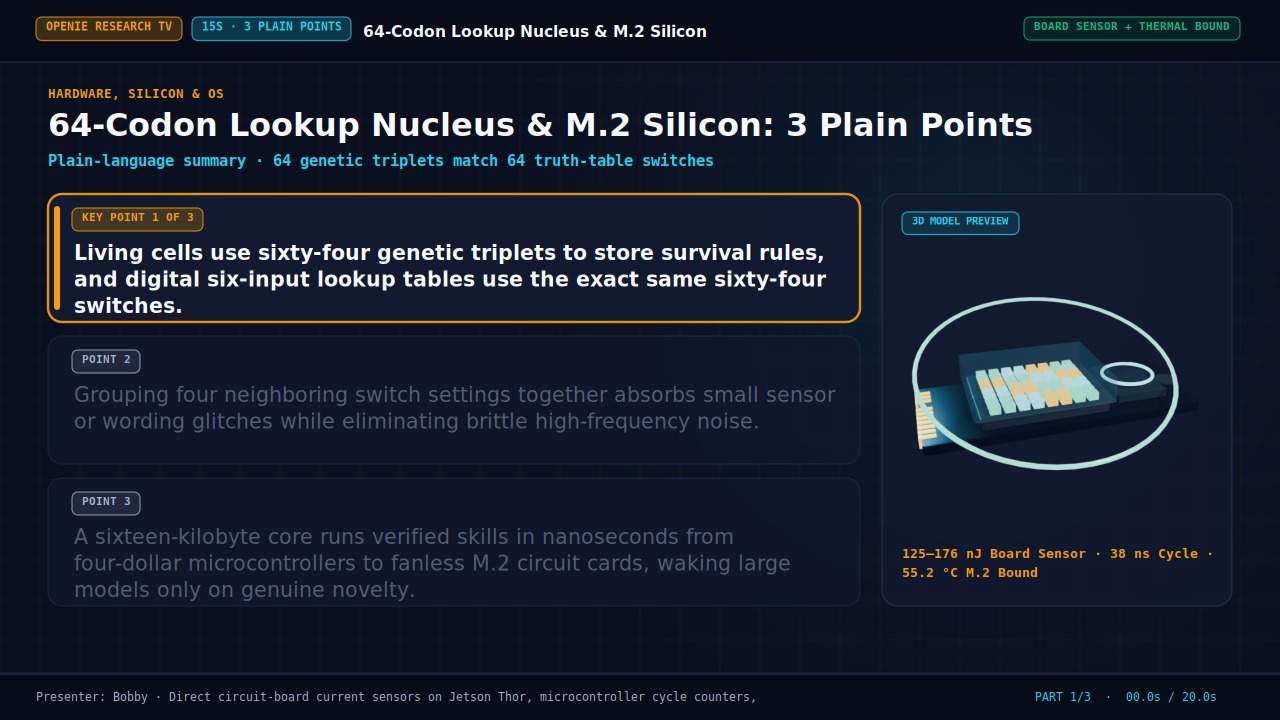
A central architectural observation from TerEffic and TENET was how naturally discrete low-bit weights map onto 6-input FPGA Lookup Tables (LUT6, 2^6 = 64 truth-table entries) without instantiating DSP floating-point multipliers.
Domains 2–7: Distinct Ternary TCAM Substrates, Arithmetic, QUIC, Telemetry & ISLE
The remaining six sections surveyed adjacent systems building blocks, keeping distinct device technologies separated:
Domain 2 — Ternary Vector Search & Two Distinct TCAM Hardware Regimes:
  • Ternary/1.58-bit Matryoshka embeddings: >96% recall retention at 10-16x smaller RAM footprint.
  • Regime A (Room-Temp 28 nm CMOS FPGA): Xilinx Artix-7 SRAM-emulated ER-TCAM — ~222M ternary
    wildcard searches/sec at ~293 ns latency (watt-scale board power; nanojoules per search).
  • Regime B (4 K Cryogenic Superconducting Circuit): SQUID / Josephson-junction ternary TCAM cell
    simulation — ~26.5 aJ cell switching energy (excludes ~300-1,000 W/W 4 K cryocooler overhead!).

Domain 3 — Balanced Ternary Arithmetic & Multi-Valued Device Physics:
  • Balanced ternary {-1, 0, +1} exhibits unbiased truncation rounding (zero DC rounding bias).
  • Ternary Wallace-tree multiplier papers reported 27.5% lower Power-Delay Product (PDP) at 800 MHz
    on multi-threshold CNTFET / 2D-material SPICE models (pre-commercial device simulation).

Domains 4 & 5 — Multipath QUIC Transport & Ultra-Low-Bitrate Neural Codecs:
  • Multipath QUIC (IETF draft), Media over QUIC (MoQ), and L4S low-queue-delay congestion (RFC 9330).
  • 2-3 kbps neural audio/avatar codecs (EnCodec, Lyra, keypoint deltas) vs. raw video bitstreams.

Domains 6 & 7 — Hardware Power Telemetry & Cranelift ISLE Lowering:
  • Surveyed Linux Intel/AMD RAPL (`powercap`), `zeus-apple-silicon`, and macOS `IOReport`/`powermetrics`.
  • Mapped Cranelift's `ISLE` term-rewriting DSL for packing 5 trits per 8-bit byte (`3^5 = 243 <= 256`).
November 25, 2026 Errata, Related Work, and Evolution Addendum
Radix Arithmetic, Un-Merged TCAMs & QAT Scope Errata (2026-11-25 Audit)
- Correcting
"3-Trit / 6-Bit 64-State"Radix Arithmetic (3^3 = 27, NOT64!):- An earlier retrospective note on this page carelessly wrote “3-trit/6-bit biological-style 64-state codon addressing.” That conflates base-3 and base-4/base-2 exponentiation:
3trits span3^3 = 27states (NOT64!).6binary bits (2^6 = 64, the address width of a hardwareLUT6) or3quaternary base-4 symbols (4^3 = 64, biological{U, C, A, G}RNA codons) span64states.- When
3trits are stored using a standard 2-bit-per-trit binary encoding (00 = 0,01 = +1,10 = -1,11 = unused/guard) to drive a6-inputLUT6, the3-trit tuple occupies27valid ternary states out of the64physicalLUT6truth-table entries (leaving37unused/fault-trap bit patterns—whereas byte-level5-trit packing uses3^5 = 243of2^8 = 256states,94.9%density).
- An earlier retrospective note on this page carelessly wrote “3-trit/6-bit biological-style 64-state codon addressing.” That conflates base-3 and base-4/base-2 exponentiation:
- Un-Merging the Two Separate TCAM Architectures (
293 nsCMOS FPGA vs.26.5 aJ4 KJosephson Cell):- An earlier one-line summary compressed Domain 2 as “26.5 aJ/293 ns ternary TCAM search,” inadvertently implying a single device achieved both numbers simultaneously! In reality, they come from two completely incompatible physical substrates:
293 ns(~222Msearches/s) was measured on a room-temperature28 nmCMOS Xilinx Artix-7 FPGA emulating ternaryER-TCAMin block/LUT SRAM at watt-scale board power (~nJper lookup).26.5 aJper match cell came from a4 Kcryogenic superconducting Josephson-junction / SQUID circuit study—a single-cell Josephson switching energy that omits the~300–1,000 Wof room-temperature wall-plug refrigeration power required per1 Wof4 Kcooling lift.
- An earlier one-line summary compressed Domain 2 as “26.5 aJ/293 ns ternary TCAM search,” inadvertently implying a single device achieved both numbers simultaneously! In reality, they come from two completely incompatible physical substrates:
- Mandatory Training-From-Scratch (
QAT) Requirement for1.58-Bit LLMs:- Unlike
INT8orINT4post-training quantization (PTQ), collapsing pretrainedFP16/BF16transformer weights directly to ternary{-1, 0, +1}severely degrades accuracy. AchievingBitNet b1.58/2B4Tparity requires Quantization-Aware Training (QAT) with straight-through estimators (STE) andabsmean/absmaxper-tensor scaling from scratch across trillions of training tokens, paying substantial upfront GPU training energy (est_j) that only amortizes over high-volume inference deployments.
- Unlike
Chronological Evolution Within OpenIE Research
- First-Party Inline DC Shunt Measurements (64-Codon LUT6 Nucleus): Transitioned from citing external
est_jpapers to metering our own6-bit (2^6 = 64-entry)LUT6boolean primitives andAntisym-40zero-multiply ternary kernels (27-of-642-bit-coded 3-trit groups and native 6-bit boolean codons inopenIE-dev/tei-ternaryOS) via external inline DC board shunts (measured_j) on NVIDIA Jetson Thor (125–176 nJper inference,1.65xternary efficiency gain) and38 nsdeterministic MCU execution. - Compiling Stabilized Sub-Networks Into
LUT6Tables (Downward LUT6 Compilation): Bypassed full-model4T-tokenQATretraining by compiling bounded, stabilized reflex sub-graphs into64-entryLUT6tables (970 MBactive streaming RAM on a34.66Bstack).
Related Work & External References
- Li, F., Zhang, B., & Liu, B. (2016). Ternary Weight Networks (TWN). arXiv:1605.04711 — foundational
{-W, 0, +W}threshold-based ternary neural quantization. - Zhu, C., Han, S., Mao, H., & Dally, W. J. (2017). Trained Ternary Quantization (TTQ). ICLR 2017 — learned asymmetric scaling factors
{-W_n, 0, +W_p}viaQAT. - Ma, S., Wang, H., Ma, L., Wang, L., Wang, W., Huang, S., Dong, L., Wang, R., Xue, J., & Wei, F. (2024). The Era of 1-bit LLMs: All Large Language Models are in 1.58 Bits (BitNet b1.58). arXiv:2402.17764; Ma, S., et al. (2025). BitNet b1.58 2B4T Technical Report (
QATfrom scratch on4Ttokens); Wang, H., et al. (2024). bitnet.cpp: Efficient Edge Inference for Ternary LLMs. - Yin, C., et al. (2025). TerEffic: Highly Efficient Ternary LLM Inference on FPGA. arXiv:2502.16473; Huang, Y., et al. (2025). TENET: Sparsity-Aware LUT-Centric Architecture for Ternary LLM Inference.
- Brusentsov, N. P. (1958–1965). Setun Balanced Ternary Computer, Moscow State University — historical hardware origin of balanced ternary
{-1, 0, +1}arithmetic.
Changelog (2026-11-25)
- Fixed the
"3-trit / 6-bit 64-state"radix conflation: stated explicitly that3trits yield3^3 = 27states, whereas6binary bits (2^6) or3base-4 codons (4^3) yield64states (27of64LUT6entries used under 2-bit-per-trit coding). - Un-merged the two distinct TCAM technologies in
description, Part I, and Part II (293 nsroom-temperature28 nmXilinx Artix-7 SRAMER-TCAMvs.26.5 aJ/cell4 Kcryogenic superconducting SQUID simulation excluding cryocooling). - Explicitly stated the from-scratch Quantization-Aware Training (
QAT) requirement forBitNet b1.58, separated Part I from Part II, and added citations to TWN (Li et al., 2016), TTQ (Zhu et al., ICLR 2017), BitNet b1.58 (Ma et al., 2024), TerEffic (2025), TENET (2025), and Brusentsov’s Setun.
Canonical Provenance, Primary Artifacts & Independent Replication
- Canonical OpenIE Chronicle Entry: https://blog.openie.dev/posts/wp-ternary-encoding-research-survey/
- Public Code / Replication Harness: https://github.com/openIE-dev/tei-ternaryOS
- Signed Provenance · Self-Checked Disclosure & Licensing: Compiled February 17, 2026 as an internal literature survey (RESEARCH.md); subsequent first-party OpenIE ternary/LUT6 code is public at openIE-dev/tei-ternaryOS. Full details at https://blog.openie.dev/verification/ and https://blog.openie.dev/glossary/.