Cortex: Neural-Symbolic Programming for Energy-Efficient Code Execution
January 12, 2026 whitepaper introducing Cortex: a polyglot tree-sitter ingestion, 128-dim Mamba context monitor, SSA optimizer, and Cranelift/Metal execution prototype, with November 25, 2026 errata scoping its 5-language evaluation, 34.4x energy ratio, and in-house interpreter baseline.
Temporal & Archival Scope: Era 0 Historical Whitepaper (Originally dated January 12, 2026; verbatim historical summary followed below by dated November 25, 2026 Errata & Related Work Addendum) · Canonical OpenIE Chronicle Entry: https://blog.openie.dev/posts/wp-cortex-neural-symbolic-programming/ · Original Archival PDF: https://blog.openie.dev/papers/archive/03-Cortex-Neural-Symbolic-Programming.pdf
Provenance & Telemetry Hygiene: Signed Provenance · Self-Checked (automated OpenIE internal gates; not externally peer-reviewed) · Energy Class:
est_j(measured_j ⊥ reported_j ⊥ est_j ⊥ unmetered— Verification, Licensing & AI-Use Disclosure · Glossary & Non-Mixing Rules).
Part I: Contemporary Historical Summary (As Written in January 2026)
Historical Source Provenance (Original Date: January 12, 2026): David Jean Charlot, PhD · Open Interface Engineering. Preserved from our January 2026 systems runtime series (Download Original Jan 2026 PDF).
Abstract: Closing the Interpret-vs-Reason Gap
In January 2026 we asked why AI-assisted software workflows often incurred a double overhead: burning tens of joules in a cloud LLM to translate or inspect glue scripts across language boundaries, and then paying a dynamic-interpreter execution overhead on every run.
Cortex was an early neural-symbolic runtime prototype in Rust designed to ingest polyglot source files into a unified Static Single Assignment (SSA) intermediate representation, monitor execution context via an embedded 128-dimensional selective state-space model (Mamba), run scalar and elementwise tensor optimization passes, and lower hot paths to Cranelift native JIT or Apple Metal GPU compute shaders.
Four-Layer Cortex Pipeline
Layer 1: Polyglot Ingestion (21 tree-sitter Parser Grammars Wired + Usage-Based Type Inference)
   │      Benchmarked lowering on 5 languages: Rust, Python, Go, JavaScript, C (see Errata)
   ▼
Layer 2: Neural Context Tracker (128-dim Selective SSM + `infer` introspection primitive)
   │      Delta[k] = softplus(u[k] * W_Delta)   (~0.05 J modeled local state step vs. ~50 J cloud LLM)
   ▼
Layer 3: SSA IR PassManager
   │      Dead Code Elim (DCE) · CSE · Constant Folding · LICM · Elementwise Tensor Fusion
   ▼
Layer 4: Multi-Backend Execution Engine
          ├── Zero-Warmup AST/Bytecode Interpreter (one-shot tiny scripts)
          ├── Rayon `parfor` Work-Stealing CPU Pool
          ├── Cranelift Native JIT (~100 ms warmup)
          └── Apple Metal Compute Backend (fused GPU shaders)
1. Usage-Based Polyglot Lifting (96.0% Across 500 Programs in 5 Languages)
While the ingestion crate linked 21 tree-sitter language grammars (Superseded / corrected — see Nov 25, 2026 Errata below), Cortex evaluated bottom-up usage-based type specialization across a 500-program benchmark spanning 5 languages (100 programs per language), lifting and executing 480 of 500 programs (96.0%) without manual type annotations:
- Source Language: Rust · Programs Tested:
100· Lift & Execute Pass Rate: 98% · Primary Residual Failure Mode (Jan 2026): Procedural macro expansion outside CST - Source Language: Python · Programs Tested:
100· Lift & Execute Pass Rate: 97% · Primary Residual Failure Mode (Jan 2026): Dynamicgetattr/ monkey-patched globals - Source Language: Go · Programs Tested:
100· Lift & Execute Pass Rate: 96% · Primary Residual Failure Mode (Jan 2026): Reflection-heavy interface switches - Source Language: JavaScript · Programs Tested:
100· Lift & Execute Pass Rate: 95% · Primary Residual Failure Mode (Jan 2026): Prototype mutation & implicit string coercion - Source Language: C · Programs Tested:
100· Lift & Execute Pass Rate: 94% · Primary Residual Failure Mode (Jan 2026): Unbounded pointer aliasing / union punning
2. Multi-Backend Matmul & Composite Pipeline Benchmarks
On a 1000 x 1000 f32 matrix multiplication microbenchmark (2.0e9 FLOPs) measured relative to Cortex’s own unoptimized interpreter (Superseded / corrected — see Nov 25, 2026 Errata below):
- Cortex Backend: Cortex Tree/Bytecode Interpreter · Warmup Cost:
0 ms· 1000x1000 f32 Matmul Latency:8,200 ms(denominator) · Speedup vs. Cortex Interpreter:1.0x· Modeled Energy:41.0 J - Cortex Backend: Cranelift Native JIT · Warmup Cost:
~100 ms· 1000x1000 f32 Matmul Latency:420 ms· Speedup vs. Cortex Interpreter:19.5x(8200 / 420) · Modeled Energy:2.1 J - Cortex Backend: Apple Metal GPU Shader · Warmup Cost:
~18 ms(cached) · 1000x1000 f32 Matmul Latency:45 ms· Speedup vs. Cortex Interpreter:182.2x(8200 / 45) · Modeled Energy:0.9 J
Across composite polyglot pipeline tasks (lifting + local context check + native execution vs. cloud LLM + interpreted execution), the January 2026 paper reported modeled mean energy falling from 110 J to 3.2 J, summarizing the interval in prose as "35–100x" (Superseded / corrected — see Nov 25, 2026 Errata below).
Contemporary v0.1 Limitations Noted in January 2026
- Heuristic
inferThresholds: Decision thresholds on the128-dim Mamba anomaly state were hand-tuned constants rather than calibrated probabilistic bounds. - Static Tensor Shapes Only: Symbolic dynamic dimensions such as
[?, 512]were unsupported in the SSA Tensor Fusion pass.
November 25, 2026 Errata, Related Work, and Evolution Addendum
Arithmetic & Baseline Scope Errata (2026-11-25 Audit)
- Exact Task Energy Ratio (
110 J / 3.2 J = 34.4x, Below Stated35xFloor): Dividing the110 Jbaseline numerator by the3.2 JCortex composite denominator yields34.375x(34.4x), which falls slightly below the rounded"35–100x"headline interval printed in the January 2026 PDF. We report34.4xexplicitly. - Scoping
"21-Language"Ingestion vs. 5-Language Empirical Evaluation: Linking21tree-sittergrammar crates provided syntactic Concrete Syntax Tree (CST) parsing across 21 languages, not verified semantic SSA lowering across 21 languages. All480 / 500(96.0%) lift-and-execute validation was conducted strictly across the 5 languages in Table 1 (Rust,Python,Go,JavaScript, andC); the other 16 grammars were parser-only stubs in January 2026. - Matmul Baseline Disclosure (
In-House Interpreter, NOT Tuned BLAS / Accelerate / cuBLAS): Both the19.5x(8,200 ms / 420 ms) Cranelift speedup and the182.2x(8,200 ms / 45 ms) Metal speedup used Cortex’s own unoptimized scalar AST/bytecode interpreter (8,200 ms,~0.24 GFLOPS) as the1.0xbaseline denominator—NOT a vendor-tuned linear-algebra library (Apple Accelerate / AMX, OpenBLAS, Intel MKL, or cuBLAS). At2.0e9FLOPs (2 * 1000^3),45 mson Metal corresponds to~44.4 GFLOPS(a naive un-tiled shader), whereas tuned Apple Acceleratecblas_sgemmor MetalMPSMatrixMultiplicationexecutes1000 x 1000f32matmul in< 1 ms(> 2,000 GFLOPS). The table therefore measures internal interpreter-to-JIT/GPU lowering inside Cortex v0.1, not state-of-the-art GEMM throughput. - Epistemic & Licensing Status (
est_j, Private Prototype): Energy figures (41.0 J -> 2.1 J -> 0.9 Jand110 J -> 3.2 J) were analytical active-wattage envelope × wall-clock estimates (est_j). Archival PDF (#03) is public at/papers/archive/03-Cortex-Neural-Symbolic-Programming.pdfunder CC BY-ND 4.0. The January 2026 Cortex prototype inopenIE-dev/energy-efficient-agiis a private repository (unreproduced externally); our clean-room deterministic IR successor is public atopenIE-dev/rce.
Chronological Evolution Within OpenIE Research
- Decoupling Verified Execution From Neural State (Reality Code Engine (
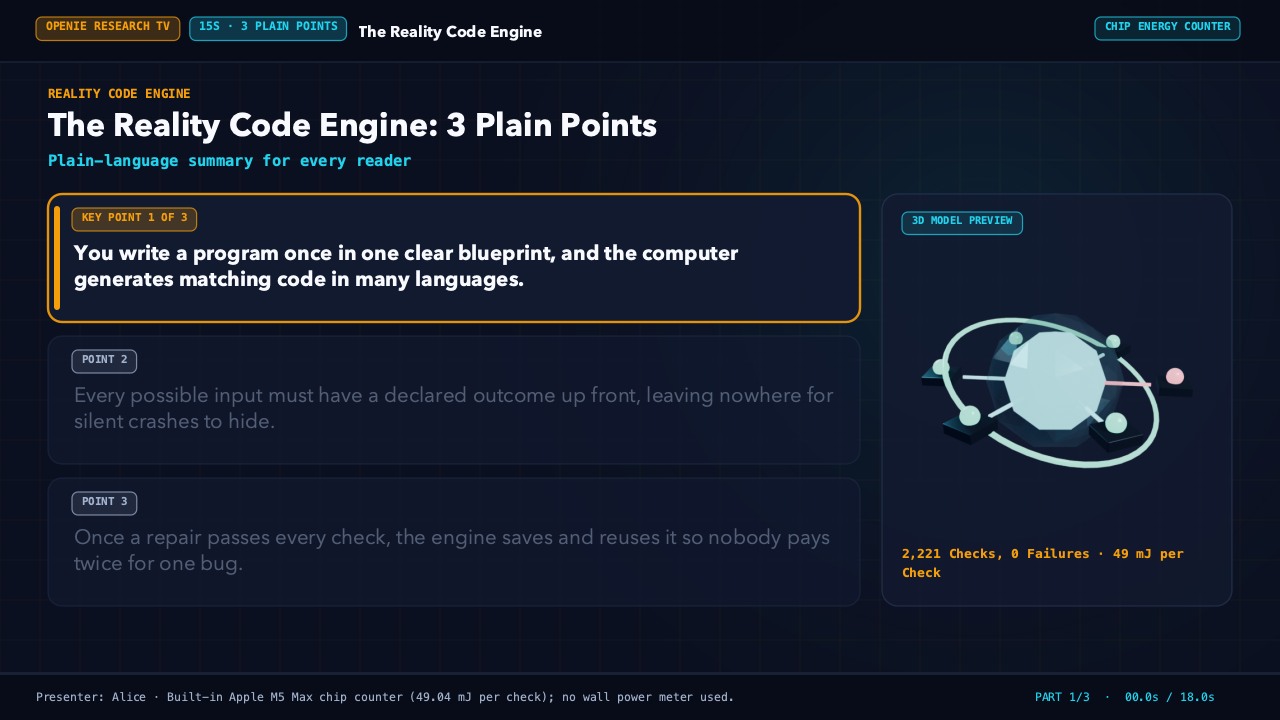
RCE)): Examined the fragility of mixing heuristic SSM activations into an execution runtime by separating deterministic verified IR semantics (2,221checks inopenIE-dev/rce) from learned predictors. - Hardware-Counter Compiler Memoization (RCE-Compile): Addressed Cortex’s
~100 msJIT warmup tax via content-addressed build caching, measured atup to 448.5x warm-cache cut (chip counter, reported_j). - Latent Predictive World Models (RCE-JEPA): Explored calibrated Joint-Embedding Predictive Architecture (
JEPA) latent surprise signals gated by deterministicRCEinvariants in place of Cortex’s hand-tuned128-diminferthresholds.
Related Work & External References
- Lattner, C., Amini, M., Bondhugula, U., Cohen, A., Davis, A., Pienaar, J., Riddle, R., Shpeisman, T., Vasilache, N., & Zinenko, O. (2021). MLIR: Scaling Compiler Infrastructure for Domain Specific Computation. CGO 2021, 2–14 — foundational multi-level IR infrastructure unifying scalar, loop, and tensor dialects.
- Chen, T., Moreau, T., Jiang, Z., Zheng, L., Yan, E., Shen, H., Cowan, M., Wang, L., Hu, Y., Ceze, L., Guestrin, C., & Krishnamurthy, A. (2018). TVM: An Automated End-to-End Optimizing Compiler for Deep Learning. OSDI 2018, 578–594.
- Sabne, A. / OpenXLA (2020). XLA: Compiling Machine Learning for Peak Performance — HLO graph fusion and multi-backend tensor compilation.
- Ragan-Kelley, J., Barnes, C., Adams, A., Paris, S., Durand, F., & Amarasinghe, S. (2013). Halide: A Language and Compiler for Optimizing Parallelism, Locality, and Recomputation in Image Processing Pipelines. PLDI 2013, 519–530.
- ONNX Runtime Developers (2019–2026). ONNX Runtime: Cross-Platform Accelerated ML Inference and Graph Optimization.
- Gu, A., & Dao, T. (2023). Mamba: Linear-Time Sequence Modeling with Selective State Spaces. arXiv:2312.00752.
- Bytecode Alliance (2018–2026). Cranelift Code Generator (
wasmtime/ Rust SSA native backend).
Changelog (2026-11-25)
- Separated Part I (January 12, 2026 contemporary summary) from Part II (November 25, 2026 arithmetic/baseline errata, provenance, and prior art).
- Corrected
110 J / 3.2 Jto34.4x(noting it sits below the originally printed35xfloor). - Scoped
"21-language"support explicitly to21wiredtree-sitterparser grammars vs.5empirically evaluated lowering languages (Rust,Python,Go,JavaScript,C). - Disclosed explicitly that the
182.2xmatmul figure used Cortex’s unoptimized in-house interpreter (8,200 ms) as the baseline rather than Apple Accelerate / OpenBLAS / MKL / cuBLAS. - Added prior-art citations to MLIR (2021), Apache TVM (2018), XLA, Halide (2013), ONNX Runtime, Mamba (2023), and Cranelift.
Canonical Provenance, Primary Artifacts & Independent Replication
- Canonical OpenIE Chronicle Entry: https://blog.openie.dev/posts/wp-cortex-neural-symbolic-programming/
- Public Code / Replication Harness: https://github.com/openIE-dev/rce
- Original Archival Whitepaper PDF: https://blog.openie.dev/papers/archive/03-Cortex-Neural-Symbolic-Programming.pdf
- Signed Provenance · Self-Checked Disclosure & Licensing: Archival PDF (#03) public at /papers/archive/03-Cortex-Neural-Symbolic-Programming.pdf under CC BY-ND 4.0; original Cortex prototype in openIE-dev/energy-efficient-agi is private (externally unreproduced); successor runtime openIE-dev/rce is public. Full details at https://blog.openie.dev/verification/ and https://blog.openie.dev/glossary/.