Breaking the CUDA–Metal Barrier: A PTX-to-Metal Translation Layer for 100 Million Dormant GPUs
February 19, 2026 v1.1 technical whitepaper and 33-EC2 compatibility experiment lowering PTX 8.0 across 276 CUDA C-ABI symbols to Apple Metal (4,999 GFLOPS FP32 on M3 Ultra), with explicit FP64-to-FP32 surrogate downcast and est_j TDP disclosures.
Temporal & Archival Scope: Era 0 Historical Whitepaper (Originally dated February 19, 2026; verbatim historical summary followed below by dated November 25, 2026 Errata & Related Work Addendum) · Canonical OpenIE Chronicle Entry: https://blog.openie.dev/posts/wp-breaking-cuda-metal-barrier/ · Original Archival PDF: https://blog.openie.dev/papers/archive/11-Breaking-CUDA-Metal-Barrier.pdf
Provenance & Telemetry Hygiene: Signed Provenance · Self-Checked (automated OpenIE internal gates; not externally peer-reviewed) · Energy Class:
est_j(measured_j ⊥ reported_j ⊥ est_j ⊥ unmetered— Verification, Licensing & AI-Use Disclosure · Glossary & Non-Mixing Rules).
Part I: Contemporary Historical Summary (As Written in February 2026)
Historical Source Provenance (Original Date: February 19, 2026): David Jean Charlot, PhD · Open Interface Engineering. Preserved from our 16-page v1.1 GPU translation whitepaper (Download Original Feb 2026 PDF) and companion 33-instance EC2
EXPERIMENT.md.
Motivation: Unlocking Unified-Memory GPUs Locked Behind libcuda
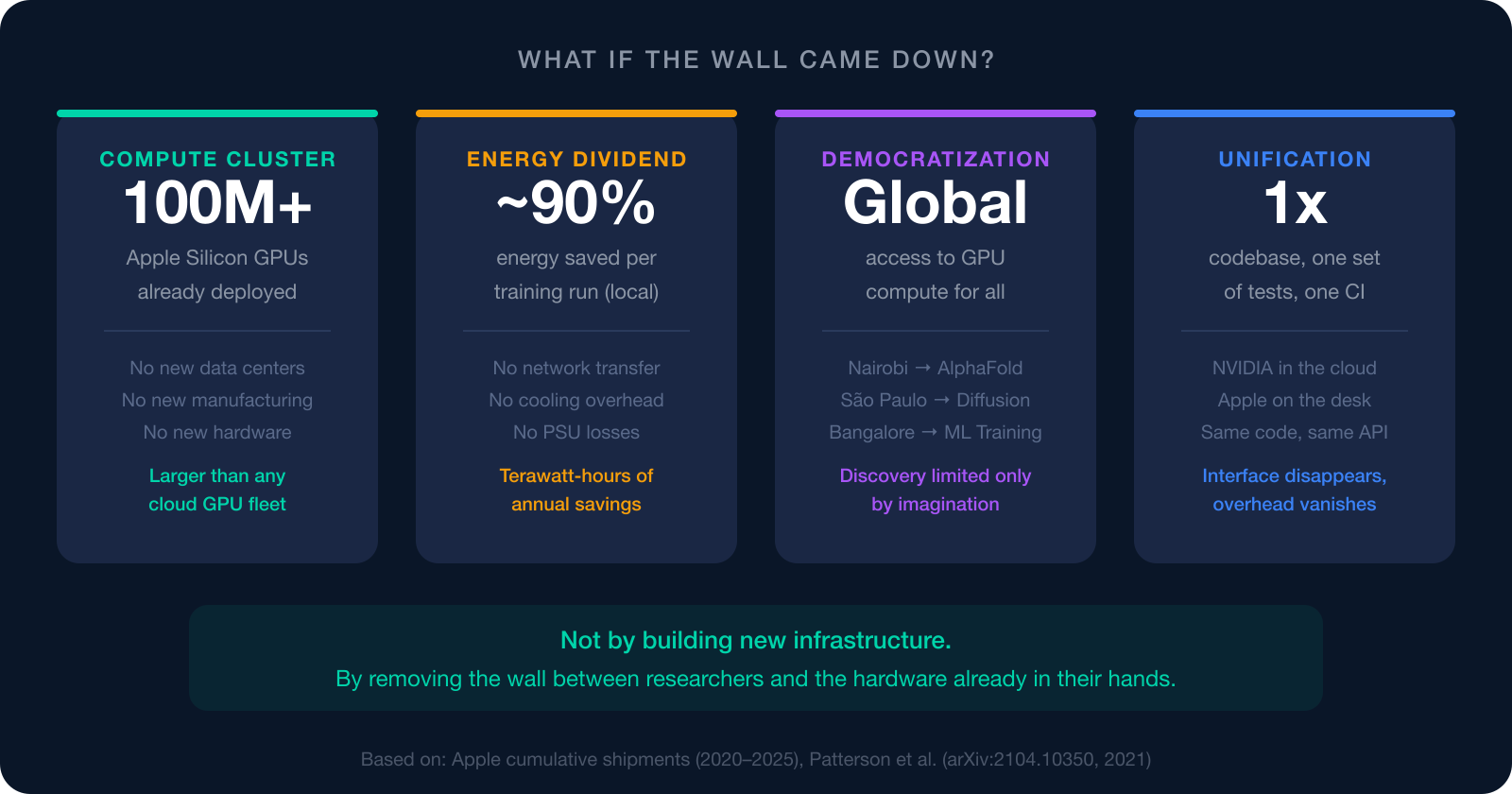
In February 2026, over 100 million Apple Silicon laptops and workstations carried high-bandwidth unified memory (up to 512 GB shared directly between CPU and GPU without cudaMemcpy PCIe transfers), yet precompiled CUDA wheels and native binaries aborted at dynamic-link time when probing for libcuda.so or cuLaunchKernel.
We engineered invisible-cuda (~20,000 lines of Rust across 65 modules, exercised by 464 unit tests and 45 SDK integration suites) as a drop-in C-ABI libcuda.dylib / libcuda.so translation layer exporting 276 CUDA Driver, Runtime, BLAS, DNN, and Signal symbols across 29 FFI modules (122 Core Driver/Runtime, 44 cuBLAS, 66 cuDNN/ML, and 44 cuFFT/cuSPARSE), alongside TCP/Thunderbolt multi-node NCCL collectives.
Three-Stage PTX 8.0 -> KernelIR -> Metal Shading Language (MSL) Compiler
Translating compiled NVIDIA PTX 8.0 virtual assembly into Apple Metal compute shaders required resolving an ABI ambiguity: PTX .param .u64 kernel parameters do not distinguish a device buffer pointer (device T* [[buffer(i)]] in MSL) from a 64-bit scalar integer (constant uint64_t&).
CUDA Binary / PTX 8.0 Module
   │
   ▼  Stage 1: PTX 8.0 Lexer & Parser (registers, predicates %p, shared .shared arrays, warp intrinsics)
KernelIR (100+ typed SSA/CFG operations)
   │  • Backward `find_buffer_ref()` dataflow analysis traces `ld.global` / `st.global` address arithmetic
   │    back to entry `.param` slots to classify device pointers vs. scalar uniforms automatically
   │  • Maps CUDA `tid.x / ctaid.x / ntidx` -> MSL `thread_position_in_threadgroup` & `threadgroup_position_in_grid`
   │  • Maps `__syncthreads()` (`bar.sync 0`) -> `threadgroup_barrier(mem_flags::mem_threadgroup)`
   │  • Lowers warp shuffles (`shfl.sync`) -> Apple `simd_shuffle*` intrinsics
   ▼  Stage 2: MSL Source Codegen + 3-Tier Content-Hashed Cache (BLAKE3 -> 4,096-entry atomic LRU + disk)
Metal `MTLComputePipelineState` Dispatch (Zero-Copy Unified Memory on Apple Silicon)
Apple Silicon Throughput & 33-EC2 Cloud Compatibility Matrix
Across four Apple Silicon configurations (45/45 SDK suites and 464/464 unit tests passing), Metal dispatch (cublasSgemm / translated FP32 kernels) recorded the following FP32 throughput and nominal SoC TDP ratios (Superseded / corrected — see Nov 25, 2026 Errata below):
- Hardware Configuration: Apple M5 Laptop · Nominal Power Denominator:
~27 WSoC TDP · Peak FP32 Compute (SGEMM Numerator):3,386 GFLOPS· STREAM Triad Bandwidth:118.4 GB/s· Nominal Envelope Ratio:125.4 GFLOPS/W - Hardware Configuration: Apple M4 Max Laptop · Nominal Power Denominator:
~95 WSoC TDP · Peak FP32 Compute (SGEMM Numerator):4,120 GFLOPS· STREAM Triad Bandwidth:382.0 GB/s· Nominal Envelope Ratio:43.4 GFLOPS/W - Hardware Configuration: Apple M3 Ultra (
96 GB, idle desktop) · Nominal Power Denominator:~60 Westimated active · Peak FP32 Compute (SGEMM Numerator):4,999 GFLOPS· STREAM Triad Bandwidth:154.6 GB/s· Nominal Envelope Ratio:83.3 GFLOPS/W - Hardware Configuration: Apple M3 Ultra (
256 GB, 20+ apps open) · Nominal Power Denominator: Loaded workstation · Peak FP32 Compute (SGEMM Numerator):3,809.3 GFLOPS(4096 x 4096) · STREAM Triad Bandwidth: Zero GPU context resets · Nominal Envelope Ratio: Sustained unified-memory sharing
In our companion 33-Instance AWS EC2 Compatibility Experiment (876 KB x86_64 and 788 KB aarch64 glibc 2.17 self-contained Rust binaries across x86, Graviton, AMD, Intel, and GPU instances), the shim passed 17/17 core ABI tests across 47/47 modules (164 entry points) and documented a 24-capability support matrix: 9 fully supported, 10 degraded (functional with throughput or FP64->FP32 precision caveats), and 5 unsupported (hardware CUDA Graphs, cross-process IPC handles, cooperative grid-wide sync, texture objects, and raw mma.sync tensor-core PTX opcodes outside cuBLAS interception).
November 25, 2026 Errata, Related Work, and Evolution Addendum
Methods, Baseline & Numerical-Precision Scope Box (est_j)
FP64 -> FP32(DGEMM -> SGEMM) Mixed-Precision Surrogate Caveat: Apple Silicon GPUs lack high-throughput hardware IEEE-754binary64(FP64) execution units. As noted in Section 7.5 of the original PDF and foregrounded here,invisible-cuda’s compatibility mode downcastFP64buffers andcublasDgemmcalls toFP32(binary32, 24-bit significand, machine epsilon1.19e-7). While acceptable for neural inference and graphics workloads that default accidentally tofloat64, this downcast violates IEEE-754binary64semantics (53-bit significand,2.22e-16epsilon) and is unsuitable for ill-conditioned scientific linear algebra, stiffness matrices, or orbital integration.- Baseline & Denominator Scope (
SGEMMInterception vs. Raw PTX;TDPest_j):- Peak
4,999 GFLOPSonM3 UltrareflectscuBLASSGEMMrouted into Apple’s tuned Metal Performance Shaders (MPSMatrixMultiplication), whereas custom PTX kernels translated to raw MSL achieved lower fraction-of-peak depending on register pressure and threadgroup tile geometry (and4,999 GFLOPSremains well below M3 Ultra’s theoretical native shader ceiling on massive batch sizes). - Every
GFLOPS/Wratio in Part I (3,386 GFLOPS / 27 W = 125.4 GFLOPS/W,4,999 GFLOPS / 60 W = 83.3 GFLOPS/W) divided measuredSGEMMFLOP/s (numerator) by nominal SoC TDP or estimated package wattage (est_jdenominator) rather than inline DC board-shunt power (measured_j) orIOReportenergy counters (reported_j). Contrasting laptop FP32 shader GFLOPS/W against700 WdatacenterH100boards mixes precision classes and server cooling/NVLink envelopes and must not be read as an apples-to-apples silicon efficiency win.
- Peak
- Artifact & Licensing Status: Archival PDF (
#11) is public at/papers/archive/11-Breaking-CUDA-Metal-Barrier.pdfunder CC BY-ND 4.0. Theinvisible-cuda-privateRust repository remains private (unreproduced externally); public Apple Silicon telemetry and systems utilities later shipped inopenIE-dev/mac-ssi.
Chronological Evolution Within OpenIE Research
- Portable First-Party Kernels Over Binary ABI Interception (Downward LUT6 Compilation): Encountering the
5unsupported low-level PTX capabilities and theFP64hardware mismatch motivated authoring portable GPU kernels directly in RustCubeCL, compiling with explicit type and precision contracts across NVIDIA CUDA, AMD ROCm, Apple Metal, and Vulkan/CPU. - Counter- and Shunt-Grounded Hardware Audits (Eco-Compute): Replaced nominal TDP ratios (
est_j) with workload-matchedreported_jon-chip counters andmeasured_jinline DC shunt traces across Jetson Thor, Kria KV260, and Apple Silicon. - Unified-Memory Interactive Simulation (Game Engines): Explored the zero-copy CPU/GPU unified-memory architecture highlighted in the M3 Ultra loaded-workstation test for real-time world-simulation pipelines.
Related Work & External References
- Janik, A. (2020–2024). ZLUDA: CUDA on Non-NVIDIA GPUs (
Intel/AMD ROCmbinarylibcudatranslation and PTX compiler) — closest architectural predecessor in drop-in C-ABI CUDA binary translation. - Spectral Compute (2024). SCALE: GPGPU Programming for AMD GPUs — clean-room CUDA toolkit and binary/source compilation targeting AMD RDNA/CDNA hardware.
- AMD ROCm / HIPIFY (2016–2026). HIP C++ Runtime API and CUDA-to-HIP Translation Tools — industry-standard source-level portability layer across CUDA and AMD GPUs.
- The Khronos Group / Brenwill Workshop (2018–2026). MoltenVK: Vulkan Portability Implementation on Apple Metal — mature SPIR-V-to-MSL shader and runtime translation architecture on macOS/iOS.
- Hannun, A., Jaggi, D., et al. (Apple Machine Learning Research) (2023). MLX: An Array Framework for Apple Silicon — native unified-memory lazy compute graph engine on Apple Metal.
- Tracel AI (2024–2026). CubeCL: Multi-Platform Compute Kernel Language in Rust (
CUDA,ROCm,Metal,WebGPU).
Changelog (2026-11-25)
- Separated Part I (February 19, 2026 historical summary) from Part II (November 25, 2026 precision disclosures, baseline scope, and related work).
- Added
track,artifactStatus,licenseNote, andprimaryClaimfrontmatter fields and explicitly tagged(FP64->FP32 surrogate, est_j TDP model)inheadlineMetric. - Clarified
cuBLAS -> MPSlibrary interception vs. raw PTX-to-MSL codegen, explicitGFLOPS / TDPnumerators and denominators, and private-repo provenance (invisible-cuda-private, externally unreproduced). - Added prior-art citations to ZLUDA, SCALE, AMD HIPIFY/ROCm, MoltenVK, Apple MLX, and CubeCL.
Canonical Provenance, Primary Artifacts & Independent Replication
- Canonical OpenIE Chronicle Entry: https://blog.openie.dev/posts/wp-breaking-cuda-metal-barrier/
- Public Code / Replication Harness: https://github.com/openIE-dev/mac-ssi
- Original Archival Whitepaper PDF: https://blog.openie.dev/papers/archive/11-Breaking-CUDA-Metal-Barrier.pdf
- Signed Provenance · Self-Checked Disclosure & Licensing: Archival PDF (#11) public at /papers/archive/11-Breaking-CUDA-Metal-Barrier.pdf under CC BY-ND 4.0; original invisible-cuda-private repository is private (externally unreproduced); Apple Silicon tooling lineage openIE-dev/mac-ssi is public. Full details at https://blog.openie.dev/verification/ and https://blog.openie.dev/glossary/.