Satiation Benchmark (SATB) Harness: 5-Host Telemetry Audit, Kepler Splitting Errors, and Co-Tenant Falsifiers
Cross-platform audit of the sequential Rust SATB harness (12/12 C1-C12 checks) across Jetson AGX Thor DC shunts and 4 counter hosts, exposing 32.6%-89.9% CPU-splitting errors and Windows tick aliasing.
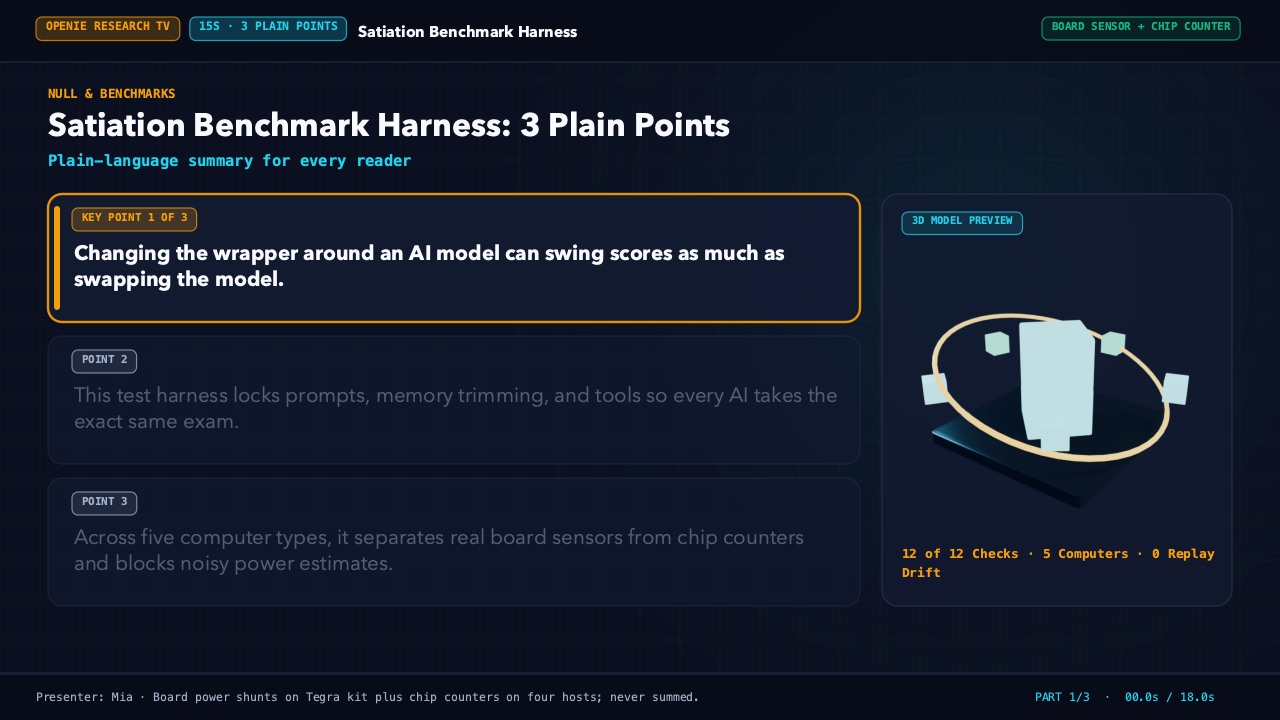
Temporal & Archival Scope: Era II OpenIE Study (November 19, 2026) · Canonical OpenIE Chronicle Entry: https://blog.openie.dev/posts/satb-harness/ · Primary Paper & Methods: https://research.openie.dev/papers/satb-harness/ · Canonical Digest:
blake3:tv:87f465518d6db67ded6205ef9c2b11b5ec15f9216f750aa4dd9caf236e1d3238Provenance & Telemetry Hygiene: Signed Provenance · Self-Checked (automated OpenIE internal gates; not externally peer-reviewed) · Energy Class:
measured_j(measured_j ⊥ reported_j ⊥ est_j ⊥ unmetered— Verification, Licensing & AI-Use Disclosure · Glossary & Non-Mixing Rules).
Key Claims & Evidence Tags
- [E · 5-Host Deterministic Replay] The sequential Rust
SATBharness (ContextRule_v080% oldest-tool-output elision,Truncate_v08 + 8 KiBcap) passed12/12conformance checks (C1–C12) and replayedShape D(15027705736) andC9(149,747 B) with 0 byte diffs across macOSarm64, Tegra Linuxaarch64, two x86-64 Linux hosts, and bare-metal Windows 11 Pro. - [E · Falsifiers 2 & 3: Attribution Errors] Comparing ground-truth rail/counter deltas against cloud-native CPU-utilization proportional splitting (
Keplerheuristic) revealed 32.59% to 89.88% energy attribution error (Falsifier 2), while WindowsGetProcessTimes15.625 msscheduler-tick aliasing undercounted short subprocess bursts by -89.88% (Falsifier 3, resolved only viaQueryProcessCycleTime+TerminateJobObject2.458 mscleanup). - [E · Falsifier 6: Shared-Host Honesty] Whenever pre/post idle power drifted by
> 5.0%due to co-tenant OS activity,Falsifier 6automatically withheld net marginal attribution (A1 = null) while preserving raw unattributedmeasured_j/reported_jlogs.
Methods, Baselines & Artifact Scope
- Methodological Dimension: Hardware & Telemetry · Primary-Paper Grounding & Scope: (1) NVIDIA Jetson AGX Thor (
TI INA238 VINL1 + 3-channelINA3221 VDD_GPU / VDD_CPU_SOC_MSS / VIN_SYS_5V0L2 DC shunts,measured_j); (2) Apple M5 Max (IOReportL2 +ri_energy_njL3reported_j); (3) AMD Ryzen AI Max+ 395 (0440 root:energyRAPLL2 + Radeon 8060SPPTreported_j); (4) Intel Core i9-13900H (RAPL psysL1 +pkg-0L2reported_j); (5) Windows 11 Pro (Core i7-1165G7+RTX 2060nvml.dllL2reported_j). External AC wall analyzer (L0): not attached. - Methodological Dimension: Workload & Benchmark Suite · Primary-Paper Grounding & Scope:
12harness conformance suites (C1–C12: truncation, context elision, timeout job-tree killC10, canonical JSON/receipt replayC9) plus counterbalanced CPU, memory-bandwidth, and GPU-offload attribution stress workloads. - Methodological Dimension: Baseline(s) Compared · Primary-Paper Grounding & Scope: Kepler-style CPU-time-ratio energy attribution (
Falsifier 2), Win32GetProcessTimestick accounting (Falsifier 3), and naive single-baseline idle subtraction (Falsifier 6). - Methodological Dimension: Runs (N) & Spread / Uncertainty · Primary-Paper Grounding & Scope:
12/12conformance pass across all5hosts (0byte diffs); attribution error range32.59%–89.88%across memory/GPU stress pairs; co-tenant drift threshold fixed at5.0%pre/post quiescent shift. - Methodological Dimension: Caching / Cold vs. Warm Scope · Primary-Paper Grounding & Scope: Loopback proxy explicitly logs
Shape Dexact-replay hits separately from liveShape M/H/Imodel invocations so cached runs cannot masquerade as fresh inference. - Methodological Dimension: Artifact & License Availability · Primary-Paper Grounding & Scope: Envelope/non-mixing linter public in
openIE-dev/openie-artifact-substrate(Apache-2.0); full multi-host raw telemetry CSVs published onresearch.openie.dev(CC0-1.0text).
Problem, Telemetry Taxonomy (L0–L4 × A1–N) & Scope
Software energy papers routinely treat container CPU-share heuristics, OS process counters, and physical DC shunts as interchangeable “joules.” SATB defines a two-dimensional provenance lattice crossing sensor boundary (L0 AC wall plug, L1 whole-board DC input, L2 SoC/package domain, L3 kernel per-process counter, L4 analytical proxy) with attribution discipline (A1 isolated quiesced net delta, A2 unisolated gross delta, D kernel-assigned, N withheld) [M, E].
Five-Host Audit Results & Exposed Attribution Failures
-
Physical shunt vs. proportional-CPU heuristics (
Falsifier 2)[E]: On Jetson AGX Thor (INA238+INA3221measured_j) and dual-counter workstations (reported_j), memory-bound and GPU-dispatched tasks consumed minimal CPU ticks while drawing substantial DRAM/GPU rail power, causingKepler-style CPU-utilization splitting to misattribute 32.59% to 89.88% of actual energy[E]. -
Windows scheduler-tick aliasing (
Falsifier 3)[E]: On bare-metal Windows 11 Pro (Core i7-1165G7+RTX 2060),GetProcessTimesquantizes execution to15.625 ms(64 Hz) clock interrupts, undercounting short bursts by -89.88%; switching to hardwareQueryProcessCycleTimeplusTerminateJobObject(2.458 mstree teardown inC10) closed the gap[E]. -
PLATYPUS-safe rootless Linux
RAPL[E]: FollowingCVE-2020-8694(PLATYPUS), Linuxpowercapfiles default to0400 root:root;SATBdocuments dedicated0440 root:energygroup provisioning on dedicated test benches rather thansudobenchmark execution[E, S].
Limitations, Unmetered L0 Wall Boundary & Falsifier 6
-
No
L0AC wall-plug power analyzer:L0(PSUlosses + AC power factor, e.g., Yokogawa WT310E) was not attached on any of the five hosts (L0 = unmetered)[E]. -
Shared-host refusal (
Falsifier 6): Whenever background OS tasks shifted pre/post idle baselines by> 5.0%,SATBrefused to emit netA1marginal joules—a conservative refusal that fired repeatedly on busy developer machines (e.g.,109/170whole-chip windows inai-reads-human)[E].
Energy & Telemetry Scope
Only Jetson AGX Thor INA238/INA3221 channels carry measured_j; Apple M5 Max (IOReport/ri_energy_nj), AMD Strix Halo (RAPL/PPT), Intel Raptor Lake (RAPL), and Windows 11 (NVML) are strictly reported_j, never summed or directly ratioed against measured_j [E].
Related Work & References
- Amaral et al. (Kepler, IEEE CLOUD 2023): Kubernetes eBPF/counter proportional container power estimation audited by
Falsifier 2[S]. - Lipp et al. (PLATYPUS, IEEE S&P 2021): Power side-channel attacks motivating root-restricted Linux
powercappermissions (CVE-2020-8694)[S]. - Khan et al. (ACM TOMPECS 2018) & Yang et al. (NVML accuracy, 2024): Validation and sampling-window limits of Intel
RAPLand NVIDIANVMLcounters[S]. - CodeCarbon & Scaphandre: Open-source host energy trackers compared against
SATBL0–L4 × A1–Nprovenance gating[S].
Canonical Provenance, Primary Artifacts & Independent Replication
- Canonical OpenIE Chronicle Entry: https://blog.openie.dev/posts/satb-harness/
- Primary Study & Methods: https://research.openie.dev/papers/satb-harness/
- Public Code / Replication Harness: https://github.com/openIE-dev/openie-artifact-substrate
- Illustrated Video Summary (OpenIE Research TV): https://research.openie.dev/tv/?study=satb-harness (9:16 Vertical MP4)
- Signed Provenance · Self-Checked Disclosure & Licensing: Envelope/provenance schema in openIE-dev/openie-artifact-substrate (Apache-2.0); SATB audit logs and paper CC0-1.0 on research.openie.dev; self-checked, not externally peer-reviewed. Full details at https://blog.openie.dev/verification/ and https://blog.openie.dev/glossary/.