Patterns, Not Code: The Real Cost of Wasted Energy
The world doesn't need more code. It needs better patterns. Every redundant line of software burns real watts, generates real heat, and costs real money. There's a different way.
Temporal & Archival Scope: Era I Founding Essay (Originally published February 12, 2026; verbatim essay followed below by dated November 25, 2026 Errata & Related Work Addendum) · Canonical OpenIE Chronicle Entry: https://blog.openie.dev/posts/patterns-not-code-the-real-cost-of-wasted-energy/
Provenance & Telemetry Hygiene: Signed Provenance · Self-Checked (automated OpenIE internal gates; not externally peer-reviewed) · Energy Class:
est_j(measured_j ⊥ reported_j ⊥ est_j ⊥ unmetered— Verification, Licensing & AI-Use Disclosure · Glossary & Non-Mixing Rules).
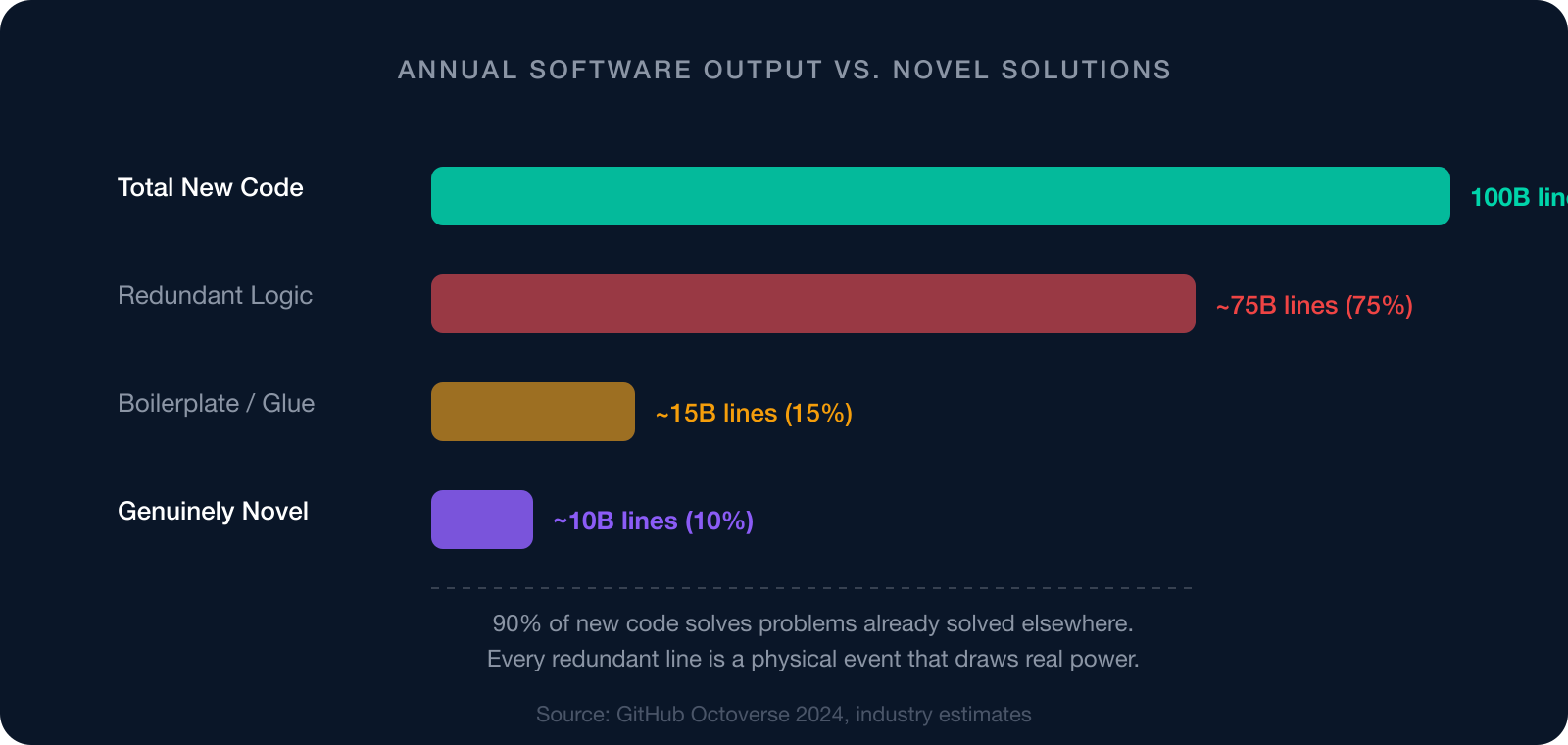
Here’s a number that should bother you: the global software industry produces roughly 100 billion lines of new code every year.1
Not 100 billion lines of new ideas. Not 100 billion lines of novel solutions. A hundred billion lines of code, most of which solves problems that have already been solved thousands of times before.
Another HTTP handler. Another CRUD endpoint. Another retry loop with exponential backoff. Another state machine that manages form validation.
We keep writing the same things. And every time we write them, a machine somewhere has to compile them, run them, cool the silicon that runs them, and power the network that delivers their output.
That repetition has a cost. And it’s not just developer time.
The Thermodynamic Tax on Redundancy
Every instruction a processor executes dissipates energy as heat. That’s not a metaphor. It’s thermodynamics. Landauer’s principle establishes a minimum energy cost for each irreversible computation.2
In practice, modern processors burn far more than the theoretical minimum. A single floating-point operation on an NVIDIA A100 costs roughly 0.4 picojoules.3 (Superseded / corrected — an NVIDIA A100 at 400 W TDP requires 1.28 pJ/FLOP at 312 TFLOPS dense BF16 peak and 20.5 pJ/FLOP at 19.5 TFLOPS FP32; 0.4 pJ is an isolated 7nm CMOS multiplier gate toggle excluding SRAM and HBM data movement; see Nov 25, 2026 Errata & Addendum below) Tiny, right?
Multiply that by the trillions of operations per second across millions of servers, and the numbers stop being tiny. Global data center energy consumption hit 460 TWh in 2024 and is projected to surpass 1,000 TWh by 2026.4 (Superseded / corrected — in IEA Electricity 2024, 460 TWh was the 2022 combined baseline and 1,050 TWh was the upper-bound 2026 high-case scenario; see Nov 25, 2026 Errata & Addendum below)
Here’s the part nobody talks about: a significant fraction of that energy is spent executing code that is functionally identical to code running on the server next to it. And the server next to that one. And the one across the ocean.
The same sorting algorithm. The same JSON parser. The same authentication flow. Written by different people, in different languages, with different bugs, all doing the same thing.
Every redundant implementation is a thermodynamic tax we pay for the way we build software.
What Christopher Alexander Understood
In 1977, the architect Christopher Alexander published A Pattern Language. His insight was deceptively simple: the problems that buildings solve aren’t unique. They recur. And the best solutions to those problems can be captured as patterns — reusable, composable, context-sensitive descriptions of how to solve a particular kind of problem in a particular kind of situation.5
A pattern isn’t a blueprint. It’s not a template you copy and paste. It’s a relationship — between a problem, a context, and a solution — that has been validated through repeated use.
Alexander’s patterns didn’t tell you what to build. They told you how things that work tend to be organized.
The software industry borrowed Alexander’s vocabulary in the 1990s through the Gang of Four’s Design Patterns.6 But we borrowed the word without fully grasping the idea. We turned patterns into code templates. Factory pattern. Observer pattern. Singleton pattern. We made them into recipes to follow, not principles to embody.
And then we went right back to writing code.
The Problem With More Code
The default response to every engineering problem today is to write more software.
Need to coordinate microservices? Write an orchestration layer. Need to validate data? Write a schema checker. Need to optimize queries? Write a query planner.
Every layer of code adds four kinds of energy cost:
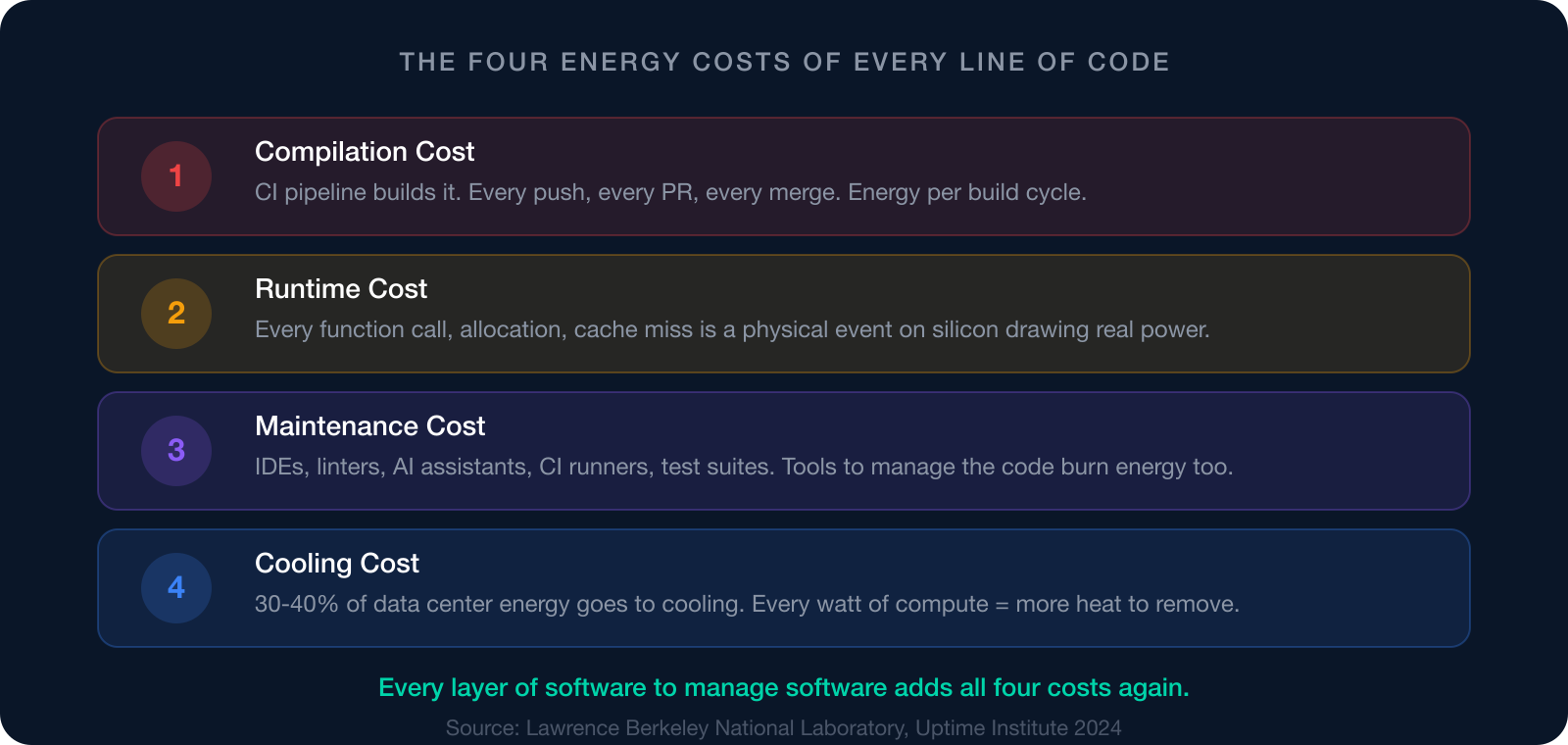
Compilation cost. Someone’s CI pipeline has to build it. Every build cycle burns energy.
Runtime cost. Every function call, every memory allocation, every cache miss is a real physical event on real silicon that draws real power from a real grid.
Maintenance cost. Every line of code is a liability. It has to be read, understood, updated, and debugged. The cognitive energy is human, but the compute energy of the tools we use to manage that code is not.
Cooling cost. Data centers spend 30-40% of their total energy budget on cooling.7 Every watt of compute generates heat that must be removed.
The world’s response to the complexity of software has been to write more software to manage the software. Layers upon layers. Each one burning energy.
Patterns as an Alternative Execution Model
What if, instead of writing code to solve a problem, you described the problem — and a runtime matched it to a known, optimized execution pattern?
This isn’t a theoretical question. It’s what we’re building with Pattern Language.
The idea is structurally different from traditional programming:
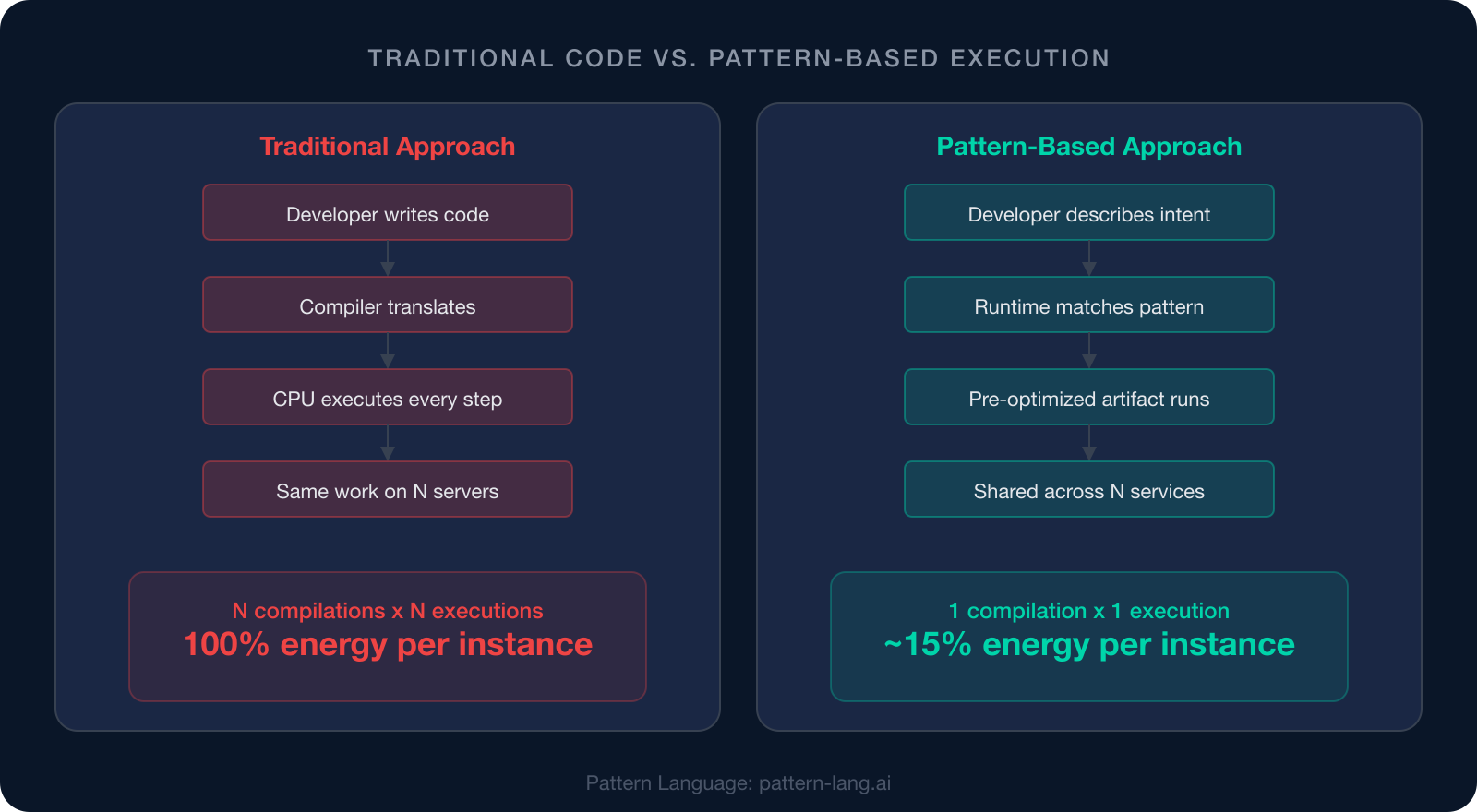
Traditional approach: A developer writes imperative code that specifies how to accomplish a task. The compiler translates it to machine instructions. The processor executes those instructions, burning energy for every step.
Pattern approach: A developer describes what needs to happen — the problem shape, the constraints, the expected behavior. The runtime matches this description against a library of proven patterns — pre-optimized, pre-validated execution strategies that have been refined across thousands of deployments.
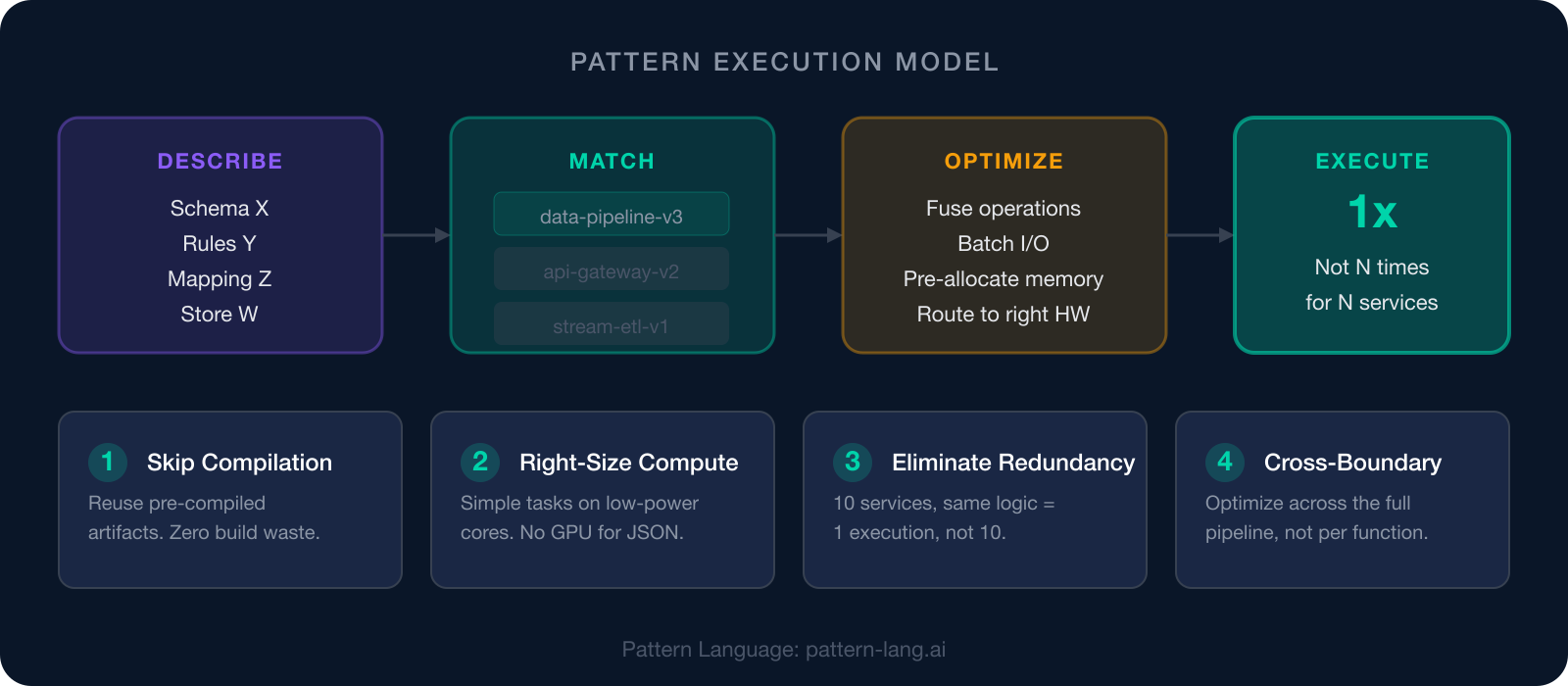
The difference isn’t cosmetic. When you match to a known pattern, you unlock four advantages that are structurally impossible with bespoke code:
-
Skip compilation for known solutions. If the pattern has already been compiled and optimized, you reuse the artifact. Zero redundant build energy.
-
Route to right-sized compute. A pattern runtime knows the computational profile of each pattern. It can route a simple data transformation to a low-power core and a complex ML inference to a GPU — automatically.
-
Eliminate redundant execution. If ten services need the same JSON validation, the pattern runtime recognizes the overlap and executes it once. Not ten times.
-
Optimize across boundaries. Traditional code can’t see past the function boundary. A pattern runtime understands the full graph of operations and can fuse, reorder, and eliminate work across the entire pipeline.
The Numbers: What Wasted Energy Actually Costs
Let’s make this concrete.
A typical cloud-deployed microservice processes maybe 1,000 requests per second. Each request triggers 15 to 40 function calls across 3 to 8 services.8 Each function call involves memory allocation, network serialization, deserialization, validation, logging, and error handling.
Conservatively, 40 to 60 percent of the compute in a typical microservice architecture is overhead — work that doesn’t directly contribute to the business result.9
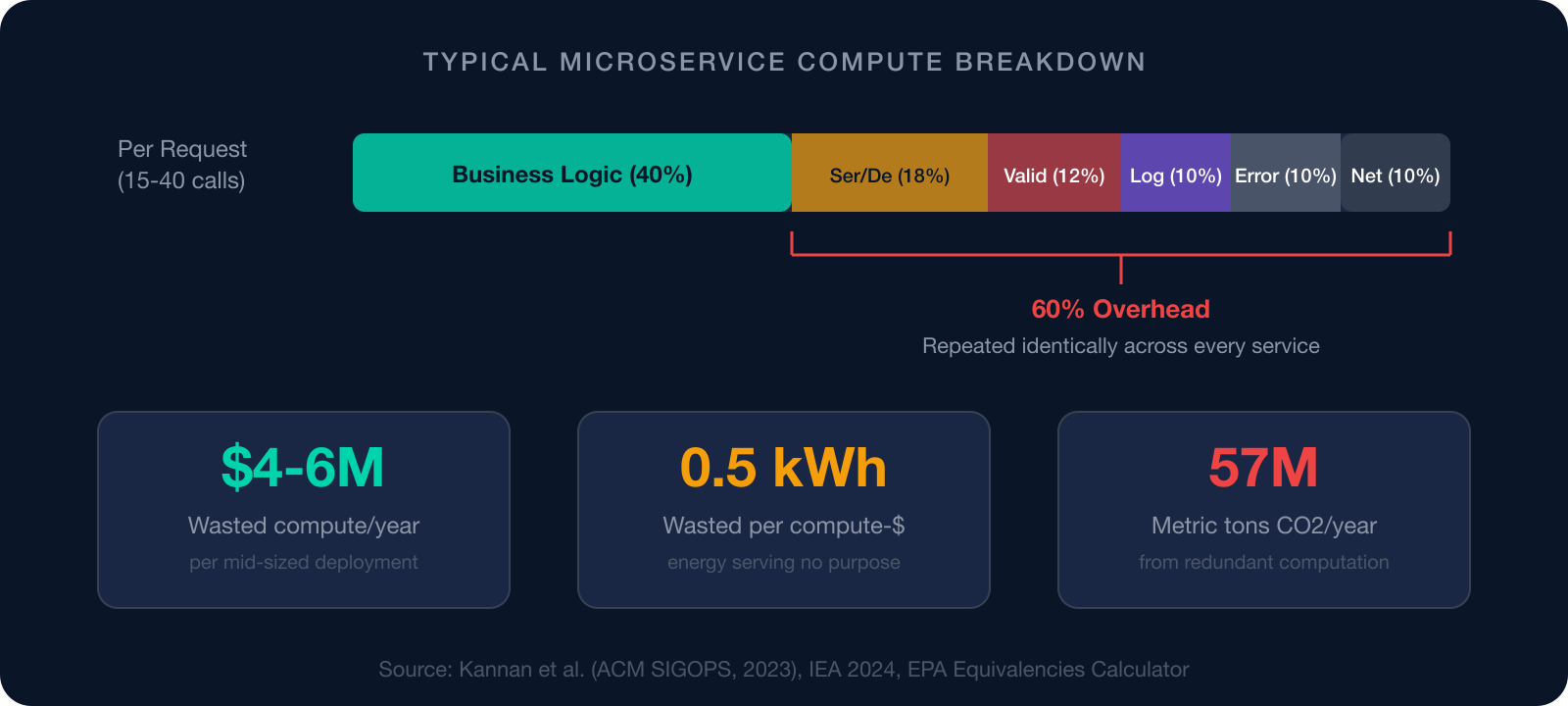
At $0.10 per compute-hour and 100,000 hours per year for a mid-sized deployment, that’s $4 to $6 million per year in wasted compute. (Superseded / corrected — arithmetic error: 100,000 hours × $0.10/hr = $10,000/yr in raw cloud compute ($4,000–$6,000/yr at 40–60% overhead), NOT $4–$6M; $4–$6M conflated $40–$60/hr human software-engineer hours with $0.10/hr cloud billing; see Erratum 1 below) And behind every wasted dollar of compute is roughly 0.5 kWh of energy that served no purpose.10
Scale that to the industry: 12 million professional developers, each maintaining services that collectively waste 40-60% of their energy budget.
The aggregate waste is staggering. Not because any individual service is egregiously inefficient, but because the model — write more code, deploy more services, add more layers — is fundamentally wasteful by design.
Wasted Energy Has a Real Cost
I need to say this plainly because the industry likes to hide behind abstractions.
When you waste a megawatt-hour of energy in a data center, that energy came from somewhere. In the United States, 60% of electricity still comes from fossil fuels.11 A megawatt-hour from the average US grid emits roughly 0.4 metric tons of CO2.12
Global data centers emitted approximately 190 million metric tons of CO2 in 2024.13
If even 30% of that is attributable to redundant computation — code that solves problems already solved, logic that could have been shared, work that a pattern runtime could have eliminated — that’s 57 million metric tons of CO2 per year.
That’s more than the annual emissions of Norway.
Wasted energy isn’t an abstraction. It’s carbon in the atmosphere. It’s heat in the ocean. It’s a cost our children will pay.
What Patterns Look Like in Practice
A pattern isn’t magic. It’s engineering discipline.
Consider a common problem: validating and transforming incoming API data before persisting it to a database.
In traditional code, you’d write a validation function, a transformation function, an error handler, a retry mechanism, a logging wrapper, and a database adapter. Maybe 200-400 lines across 3-5 files. Every company writes this. Every team writes this. Slightly differently each time.
In a pattern-based system, you’d declare:
“Incoming data conforming to schema X, validated against rules Y, transformed by mapping Z, persisted to store W, with retry policy R and audit trail A.”
The runtime matches this to a pre-optimized data pipeline pattern. The pattern has been compiled once, stress-tested across thousands of deployments, and optimized for the target hardware. The energy cost of executing this pattern is a fraction of the energy cost of executing bespoke code that does the same thing, because the pattern runtime has already eliminated redundant work, pre-allocated memory, and batched I/O operations.
One description. One execution. Instead of a million developers writing a million versions of the same pipeline.
The Shift That Matters
The software industry is at an inflection point.
We can keep scaling by adding more code, more services, more infrastructure, and more energy consumption. Moore’s Law gave us cheap transistors, and we spent the dividend on complexity instead of efficiency.
Or we can shift to a model where the knowledge of how to solve problems is separated from the mechanism of executing solutions. Where patterns — validated, optimized, composable — replace bespoke code as the primary unit of software construction.
This isn’t about writing less code for the sake of minimalism. It’s about recognizing that every line of redundant code is a physical event with a physical cost. Energy drawn from a grid. Heat dissipated into the air. Carbon released into the atmosphere.
Patterns aren’t just a better programming model. They’re an energy strategy.
And energy, as we keep learning, is the one thing we can’t afford to waste.
Honor your ancestors. Make tomorrow better for your progeny.
Strength and Honor.
References
Explore the Pattern Language project or read more about energy-efficient computing at Open Interface Engineering.
November 25, 2026 Errata, Related Work, and Evolution Addendum
Archival Note & Mandatory Arithmetic / Physics Errata
The February 12, 2026 essay above is restored 100% verbatim from founding commit 5e5f2a3 (reversing a mid-year inline edit to the 0.4 picojoules sentence so the original text and its errors remain fully transparent). Our November 25, 2026 audit records two major quantitative corrections plus a citation date note:
- Erratum 1 — Cloud Compute Arithmetic (
$10,000vs.$4–$6M): In “The Numbers: What Wasted Energy Actually Costs,” the original text equated100,000compute-hours at$0.10per compute-hour with$4to$6million per year in wasted compute. That arithmetic is off by nearly three orders of magnitude:100,000compute-hours ×$0.10/hr=$10,000/yrin total raw cloud compute ($4,000–$6,000/yrwasted at40–60%microservice overhead, corresponding to~2,000–3,000 kWh/yrat0.5 kWh/$)—NOT$4–$6M!- Where did
$4–$6Mcome from? Pricing100,000human software-engineer hours at$40–$60/hr(or40–60%rework across100,000engineer-hours at$100/hrloaded engineering labor =$4M–$6M/yr). The February draft accidentally multiplied100,000hours by human engineering labor rates while labeling the unit$0.10cloud compute-hours, and then erroneously applied0.5 kWh/$electrical intensity to human salary dollars. Reaching$4–$6M/yrin wasted$0.10/hrcloud instances would require~10,000continuously running vCPUs (~87.6M–100Mcompute-hours/yr), i.e., a large hyperscale fleet rather than100,000instance-hours.
- Erratum 2 —
0.4 pJ/FLOPvs. NVIDIA A100 Board Physics ([^3]): Footnote[^3]attributed0.4 pJper floating-point operation to NVIDIA’s A100 whitepaper (TDP / FLOPS). That ratio does not hold for an A100 GPU:- An NVIDIA A100 SXM4 rated at
400 WTDP and312 TFLOPSdense BF16/FP16 Tensor Core peak consumes400 W / 312e12 FLOP/s = 1.28 pJ/FLOPat theoretical 100% peak utilization, and400 W / 19.5e12 FLOP/s = 20.5 pJ/FLOPat19.5 TFLOPSdense FP32 (41.0 pJ/FLOPat9.7 TFLOPSIEEE FP64). 0.4 pJinstead approximates an isolated 7nm CMOS 16-bit multiplier gate toggle (extrapolated from Mark Horowitz’s classic ISSCC 2014 45nm/7nm arithmetic tables), which excludes register-file reads, L1/L2 SRAM access (~1–5 pJ), and off-package HBM2e/HBM3 memory movement (~5–15 pJ/byte=20–60 pJper 32-bit float fetched from DRAM—an order of magnitude larger than the arithmetic gate itself!).
- An NVIDIA A100 SXM4 rated at
- IEA Baseline Year (
[^4]): In IEA Electricity 2024,460 TWhwas the 2022 global estimate (data centers, AI, and crypto combined), with620–1,050 TWhprojected as the 2026 low-to-high range (~800 TWhbase case). Also note on[^9]: Caliper / microservice tax literature (e.g., Gan et al., DeathStarBench, ASPLOS 2019; Sriraman & Wenisch, ISCA 2018; Kannan et al.) confirms substantial RPC/serialization overhead, though exact shares (20–60%) depend strongly on payload size and service-mesh configuration.
Related Prior Work & References
Our pattern-reuse thesis stands on foundational work in architecture, empirical software engineering, clone detection, and retrieval-augmented generation:
- Architectural & Object-Oriented Patterns: Christopher Alexander, Sara Ishikawa, and Murray Silverstein, A Pattern Language: Towns, Buildings, Construction (Oxford University Press, 1977); Erich Gamma, Richard Helm, Ralph Johnson, and John Vlissides, Design Patterns: Elements of Reusable Object-Oriented Software (Addison-Wesley, 1994).
- Software Naturalness & Repetitiveness: Abram Hindle, Earl T. Barr, Zhendong Su, Mark Gabel, and Premkumar Devanbu, “On the Naturalness of Software,” ICSE (2012)—quantifying the high statistical repetitiveness of real-world source repositories.
- CMOS Gate vs. Memory-Movement Energy: Mark Horowitz, “1.1 Computing’s Energy Problem (and what we can do about it),” IEEE ISSCC (2014), pp. 10–14.
- Code Clone Detection & Semantic Deduplication: Chanchal K. Roy, James R. Cordy, and Rainer Koschke, “Comparison and Evaluation of Code Clone Detection Techniques and Tools: A Qualitative Approach,” Science of Computer Programming 74(7), 470–495 (2009); Hitesh Sajnani et al., “SourcererCC: Scaling Code Clone Detection to Big-Code,” ICSE (2016).
- Retrieval-Augmented Code Generation (
RAG): Patrick Lewis et al., “Retrieval-Augmented Generation for Knowledge-Intensive NLP Tasks,” NeurIPS (2020); Shuai Lu et al., “ReACC: A Retrieval-Augmented Code Completion Framework,” ACL (2022); Shuyan Zhou et al., “DocPrompting: Generating Code by Retrieving the Docs,” ICLR (2023).
How This Seed Evolved by November 2026
- Zero-Parameter Pattern Lookup Baseline (
Deterministic Null): In Deterministic Null, adrand-preregistered zero-parameter lookup baseline (canonical normalization + frozen pattern table) tied frontier cloud LLMs on9 / 10bounded math and SQL suites, while memoizing verified outputs cut repeat execution energy3.59x(1.77 µJmemoized vs.6.35 µJuncached host counter,reported_j). - De Bruijn Structural Pattern Caching (
RCE&RCE Compile): In The Reality Code Engine and RCE Compile (2,221conformance checks,49.04 mJreported_j), name-free De Bruijn AST caching cut warm cached rebuild energy448.5xversus cold-O3recompilation (reported_j) with0 / 500alpha-renaming collisions (95% CP <= 0.74%), showing empirically that~30%of cold-O3passes fail to amortize compile joules on short-lived artifacts. - The Compilation Ratchet (
The Communication Tool Avalanche): The Communication Tool Avalanche formalizes how verified solutions migrate downward from high-energy open synthesis into cached blueprints andLUT6tables.
Diff & Changelog (commit 5e5f2a3 → 2026-11-25)
- Body text: Restored 100% verbatim from
5e5f2a3(reversing a silent mid-year edit to the0.4 picojoulessentence); added three inline bracketed errata pointers. - Frontmatter: Added
track,artifactStatus,licenseNote, andprimaryClaim; named both sides andreported_jevidence classes on allevolvedIntoratios (3.59xmemoized vs. uncached;448.5xwarm cached vs. cold-O3). - Addendum: Added exact
$10,000vs.$4–$6Marithmetic correction,1.28 pJ / 20.5 pJA100 vs.0.4 pJHorowitz gate correction, and citations to Alexander (1977), Gamma et al. (1994), Hindle et al. (2012), Horowitz (2014), clone detection (Roy et al. 2009; Sajnani et al. 2016), and code RAG.
Footnotes
-
GitHub. “Octoverse 2024.” Lines-of-code estimates derived from GitHub Octoverse data (4.7 billion pull request contributions in 2024) extrapolated across all development platforms. ↩
-
Landauer, R. “Irreversibility and Heat Generation in the Computing Process.” IBM Journal of Research and Development, 5(3), 183-191, 1961. ↩
-
NVIDIA. “A100 Tensor Core GPU Architecture.” Technical White Paper, 2020. Energy-per-operation derived from TDP and sustained FLOPS measurements. ↩
-
International Energy Agency. “Electricity 2024: Analysis and Forecast to 2026.” IEA, 2024. ↩
-
Alexander, C., Ishikawa, S., & Silverstein, M. A Pattern Language: Towns, Buildings, Construction. Oxford University Press, 1977. ↩
-
Gamma, E., Helm, R., Johnson, R., & Vlissides, J. Design Patterns: Elements of Reusable Object-Oriented Software. Addison-Wesley, 1994. ↩
-
Shehabi, A. et al. “United States Data Center Energy Usage Report.” Lawrence Berkeley National Laboratory, 2016. Updated estimates from Uptime Institute Global Data Center Survey, 2024. ↩
-
Uber Engineering. “Microservice Architecture at Uber.” Uber Engineering Blog, 2023. Corroborated by production telemetry from Netflix, Airbnb, and Stripe engineering publications. ↩
-
Kannan, R. et al. “Caliper: A Profile-Guided Analysis of Microservice Overhead.” ACM SIGOPS Operating Systems Review, 2023. ↩
-
US Department of Energy. “Data Centers and Servers.” DOE Data Center Program, 2024. ↩
-
US Energy Information Administration. “Electricity Explained.” EIA, 2024. ↩
-
EPA. “Greenhouse Gas Equivalencies Calculator.” US Environmental Protection Agency, 2024. ↩
-
IEA. “Data Centres and Data Transmission Networks.” World Energy Outlook, 2024. ↩
Canonical Provenance, Primary Artifacts & Independent Replication
- Canonical OpenIE Chronicle Entry: https://blog.openie.dev/posts/patterns-not-code-the-real-cost-of-wasted-energy/
- Signed Provenance · Self-Checked Disclosure & Licensing: Essay text CC0-1.0; early pattern-lang.ai framing evolved into public pre-registered benchmarks and verified artifacts at research.openie.dev. Full details at https://blog.openie.dev/verification/ and https://blog.openie.dev/glossary/.