LUT-Adapt & Mixture-of-Limits: Separating Thor DC Shunt Readings from Workstation Chip Counters Across Coding & Wearable Cascades
Separates Jetson AGX Thor TI INA3221/INA238 physical DC shunts (measured_j) from workstation chip counters (reported_j), Cortex-M55 DWT cycles, and FPGA VCD est_j, tying 91.67% (44/48) and 62.50% (10/16) to exact model/gate arms.
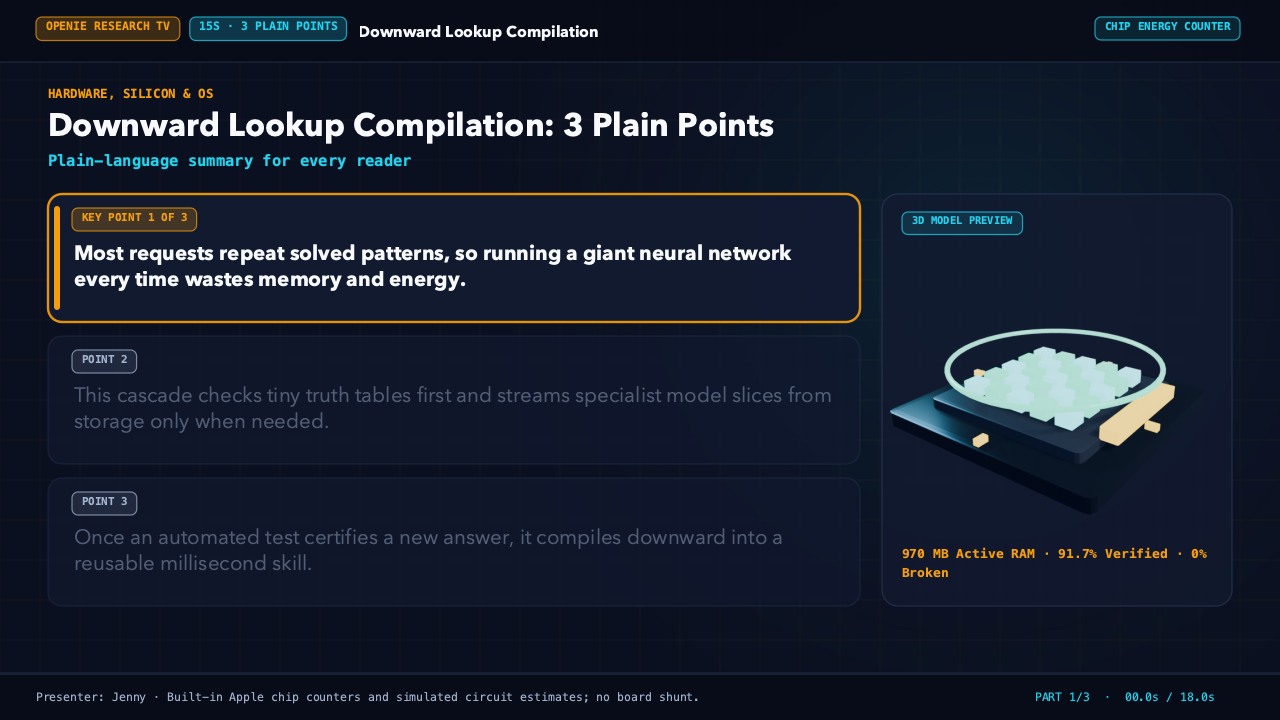
Temporal & Archival Scope: Era II OpenIE Study (November 22, 2026) · Canonical OpenIE Chronicle Entry: https://blog.openie.dev/posts/lut-adapt/ · Primary Paper & Methods: https://research.openie.dev/papers/lut-adapt/ · Canonical Digest:
blake3:tv:f5f2551c2e873bdc7af0ce1e380b0a888679c3ade804cbec637a62785734ec8dProvenance & Telemetry Hygiene: Signed Provenance · Self-Checked (automated OpenIE internal gates; not externally peer-reviewed) · Energy Class:
measured_j(measured_j ⊥ reported_j ⊥ est_j ⊥ unmetered— Verification, Licensing & AI-Use Disclosure · Glossary & Non-Mixing Rules).
Key Claims & Evidence Tags
- [E · Resolved Telemetry Contradiction (
measured_jvs.reported_jvs.est_j)] Earlier summaries mixedboard_metered = truewith workstation counter prose. Grounded insrc/content/papers/lut-adapt.md,measured_j(board_metered = true) applies strictly to NVIDIA Jetson AGX Thor physical TIINA3221(VDD_CPU_SOC_MSSL2) andINA238(VINL1) DC current shunts (Claims LA-24, LA-28, LA-32, LA-33, LA-38); workstation LLM and 4-vendorCubeCLGPU runs (Apple M5 Max,AMD Ryzen AI Max+ 395,Intel Core i9-13900H,RTX 4050/2060) use on-chipreported_j(board_metered = false); liveAlif Ensemble E3(OpenMV-AE3Cortex-M55 @400 MHz) reports hardwareDWTcycles (board_metered = false); and FPGA gateware power (Kria KV26015.59 est_mW,Artix-7 XC7A200T0.86 est_W) isVerilator VCD+ datasheetest_j(measured_j = null). - [E · Named Configurations Behind
91.67%(44/48) and62.50%(10/16)] On the48-task (16specs ×3waves) coding bakeoff (Claim LA-17),91.67%(44/48,0broken commits admitted) was achieved byMoL+ Rung 3dQwen/Qwen3.6-35B-A3Bwith bounded1,536–2,200<think>tokens and deterministicunittestgate (vs.87.50%Arm Gwithout<think>and77.08%standaloneQwen3.6-35B-A3B). On the16-task (8specs ×2waves) hard adversarial coding suite (Claim LA-21),62.50%(10/16) was achieved by theMoLApex cascade (BenesLUT6+.mol/+ counterexample escalation acrossDevstral-Small-2-24B-Instructandnvidia/Nemotron-3-Super-120B-A12B) (vs.43.75%standalone120B-A12Band31.25%standalone24B). - [E/T ·
80Six-Input (6-Bit, 64-Entry)LUT6Truth Tables &58Lean Proofs] Rung 0 routes inputs through a512 × 512Beneš/Waksman permutation network into 80 six-input (6-bit, 64-entry)LUT6truth tables (and4 KBCompactLut6Page+672 Bantisymmetric40-entry zero-MULT-MACtail), achieving162.56–162.71 nJ/op(87.00x–87.25xCpJ vs.14,143.46 nJ/opINT8Micro-MLP) on ThorINA3221measured_j, alongside58six-kernel-verified Lean4.36.0theorems and mechanicalCharon + Aeneas#![no_std]Rust-to-Lean extraction (6core functions).
Methods, Baselines & Artifact Scope
- Methodological Dimension: Hardware & Telemetry · Primary-Paper Grounding & Scope: (1)
measured_j:NVIDIA Jetson AGX Thor(TI INA3221 ch2 VDD_CPU_SOC_MSS+INA238 VIN@500 Hz2 mstrapezoidalABBAintegration,CUDA_VISIBLE_DEVICES=""); (2)reported_j:Apple M5 Max 128 GB(IOReport/ri_energy_nj),AMD Ryzen AI Max+ 395+Radeon 8060S(RAPL+PPT),Intel Core i9-13900H(RAPL),NVIDIA RTX 4050/RTX 2060(NVML); (3) MCU cycles: live USBOpenMV-AE3(Alif E3Cortex-M55 @400 MHzDWT); (4)est_j:Verilator 5.054 VCD+AMD DS925/DS181onXCK26&XC7A200T. - Methodological Dimension: Workload & Benchmark Suite · Primary-Paper Grounding & Scope:
LA-17(48coding tasks =16specs ×3waves),LA-21(16hard adversarial coding tasks =8specs ×2waves),32-taskBigCodeBench v0.1.3slice (29/32 = 90.62%),LA-246-host downward-compilation matrix (W1–W5),LA-254-vendorBurn 0.22.1 / CubeCLGPU shader suite,LA-3664-query bimodal wearable stream (48daily +16PhD), andLA-3732openSuperGPQA hard+MathArena AIME/HMMT 2025calibration items. - Methodological Dimension: Baseline(s) Compared · Primary-Paper Grounding & Scope: Standalone
Qwen3.6-35B-A3B(77.08%),Devstral-Small-2-24B(31.25%),Nemotron-3-Super-120B-A12B(43.75%),INT8/BF16Micro-MLP (64->32->16),LittleBit-2MAC, dense256-expert MoE, andUW/Meta Sensente/uLM-28M(28.84Mcollaborative prefix masking). - Methodological Dimension: Runs (N) & Spread / Uncertainty · Primary-Paper Grounding & Scope: Thor
measured_j(LA-24):4/4counterbalancedABBApairs (< 0.06%VDD_GPUdrift,0.19%VINdrift). Coding suites:N = 48(44/48),N = 16(10/16),N = 32BigCodeBench(29/32),N = 64wearable queries,N = 32SuperGPQA/AIME/HMMTitems (greedy/seeded deterministic evaluation; multi-seed LLM temperature variance not recorded). - Methodological Dimension: Caching / Cold vs. Warm Scope · Primary-Paper Grounding & Scope: Explicitly separated: Wave 1 in
LA-17/LA-21runs cold (escalating to35Bor24B/120Bbehind theunittestgate), whereas Wave 2/3 hit crystallized.mol//LUT6entries (Delta T* = 0.1084 < 1episode break-even on Thor when a compiled skill is reused, vs. net compile overhead ifN_reuse = 0;hle:3r2scanary guard blocks benchmark crystallization). - Methodological Dimension: Artifact & License Availability · Primary-Paper Grounding & Scope:
Apache-2.0public repository athttps://github.com/openIE-dev/lut-adapt-ai(commit dc45357) andopenIE-dev/openie-research-experiments; self-checked by OpenIE, open for independent replication.
Strict Telemetry Stratification (Thor measured_j vs. Workstation reported_j vs. FPGA est_j)
lut-adapt spans six CPU/GPU hosts, two bare-metal MCUs, and two FPGA targets. Keeping its four evidence tiers orthogonal (measured_j ⊥ reported_j ⊥ cycles ⊥ est_j) resolves the earlier summary’s "no board shunt" vs. board_metered = true contradiction [E]:
-
Physical DC Shunt (
measured_j,board_metered = true): Recorded exclusively onNVIDIA Jetson AGX Thorviahwmon5TIINA3221(VDD_CPU_SOC_MSSisolated CPU/SoC rail) andhwmon6TIINA238(VINwhole-board rail) at500 HzacrossABBAwindows:W2Sub1Bit-LUT6saves3.74xCPU J (7.76vs.28.98 J),W3Expert-AirMoLsaves34.21x(0.98vs.33.36 J),lut6-corevertical bit-slicing reaches162.56–162.71 nJ/op(87.00x–87.25xCpJ vs.14,143.46 nJ/opINT8Micro-MLP),Antisym-40zero-MULT-MACreaches8,594.93 nJ/op(1.65xCpJ), and the56-bit4-token wearable epistemic gate uses2,803.25 nJvs.623,920.52 nJ(222.57x) for1/16th of auLM-28Mlayer[E]. -
On-Chip Counters (
reported_j,board_metered = false): Used for all workstation LLM cascades (Qwen3.6-35B-A3B,Nemotron-3-Super-120B-A12B, Oct–Nov 2026 loopedInkling-2-Mini4.29xandDory1.0-4B3.86xLUT6speculative burst cuts on M5 MaxL3) and 4-vendor single-source RustCubeCLGPU shaders (Apple Metal,AMD Radeon 8060S Vulkan,NVIDIA RTX 4050 Vulkan,Intel Iris Xe Vulkan,max FP32 err <= 1.79 × 10^-7)[E]. -
MCU
DWTCycles & FPGAest_j(board_metered = false): Live USB-attachedOpenMV-AE3(Alif E3Cortex-M55 @400 MHz) records cycle counts (173.83xscalarLUT6,11.17xT-MACvs.INT8MLP), whileKria KV260(15.59 est_mW) andArtix-7 XC7A200T(0.86 est_W) areVerilator VCD+ datasheetest_j[E].
Coding & Epistemic Cascade Results (Cold Wave 1 vs. Warm Wave 2/3)
-
91.67%(44/48,Claim LA-17): PairingMoLwithQwen/Qwen3.6-35B-A3B(1,536–2,200<think>tokens +unittestgate) solved44/48tasks across 3 waves (vs.87.50%without<think>and77.08%standalone35B). Wave 1 pays cold35Bgeneration; Waves 2–3 amortize verified.mol/skills[E]. -
62.50%(10/16,Claim LA-21): On16hard adversarial coding tasks (8specs ×2waves), escalating acrossBenesLUT6->.mol/->Devstral-Small-2-24B->Nemotron-3-Super-120B-A12B(58.1 GBRSS) solved10/16(62.50%) vs.7/16(43.75%) standalone120Band5/16(31.25%) standalone24B—candidly leaving6/16(37.5%) unsolved[E]. -
Wearable
SRAMfit & frontier calibration (LA-36, LA-37):Wearable-MoLfits Rung 0 in5,984 B(9.13%of64 KBwatchSRAM) vs.13.75 MB(214xoverflow) forSensente/uLM-28M, suppresses15/16(93.75% -> 0.00%) wrong spoken prefixes on whiteboard PhD queries viaEpistemicHold, and on32openSuperGPQA hard+AIME/HMMT 2025items cutsRMScalibration error5.37x(70.62% -> 13.14%) while scoring0/16(0%, abstaining) on Exact-Match Olympiad items where24B/35Bmodels also scored0/16[E].
Limitations & Open Boundaries
-
Cold novel tasks still require large neural models:
80-LUT6/4 KBCompactLut6Pagecrystals compress recurring bounded skills (H <= 1.25bits in the 4-part Means Test); high-entropy open prose and unseenAIME/HMMTOlympiad proofs (0/16solved) are refused to higher rungs or abstained[E]. -
Gated
cais/hlerespected without bypass:cais/hlereturnedHTTP 403in automated runs and was not bypassed;LA-37evaluated32openSuperGPQA hard+MathArena 2025items under the HLE calibration protocol instead[E]. -
Unprobed M.2 FPGA rails:
Numato Aller A7(XC7A200T,openXC7320.62 MHz.bit) awaits inline+3.3 V/+5 VKelvin shunts to promote0.86 est_Wtomeasured_j(LA-F30)[E].
Energy & Telemetry Scope
Every comparison stays strictly inside its own telemetry class: Thor INA3221/INA238 (measured_j), per-host RAPL/IOReport/NVML (reported_j), Cortex-M55 DWT cycles, and Verilator VCD (est_j).
Related Work & References
- Umuroglu et al. (LogicNets, FPL 2020), Petersen et al. (DiffLogic, NeurIPS 2022) & Ye et al. (DiffLUT-Net, arXiv:2609.09254, 2026): Differentiable and pruned LUT-network synthesis
[S]. - Wei et al. (T-MAC, 2024), Mo et al. (LUT Tensor Core, ISCA 2025) & Sanyal et al. (EntroMCU, ISVLSI 2026): Low-bit/ternary table-lookup arithmetic and base-3 MCU weight packing
[S]. - FrugalGPT (Chen et al., 2023), RouteLLM (Ong et al., ICLR 2025) & Leviathan et al. (Speculative Decoding, ICML 2023): Multi-tier routing and exact-parity speculative verification
[S]. - Cheng et al. (
Sensente/uLM-28M, EMNLP 2026), Phan et al. (Humanity’s Last Exam, Nature 2026) & Ho & Protzenko (Aeneas, ICFP 2022): Wearable micro-LLM prefix masking, frontier calibration error, and#![no_std]Rust-to-Lean functional verification[S].
Canonical Provenance, Primary Artifacts & Independent Replication
- Canonical OpenIE Chronicle Entry: https://blog.openie.dev/posts/lut-adapt/
- Primary Study & Methods: https://research.openie.dev/papers/lut-adapt/
- Public Code / Replication Harness: https://github.com/openIE-dev/lut-adapt-ai
- Illustrated Video Summary (OpenIE Research TV): https://research.openie.dev/tv/?study=lut-adapt (9:16 Vertical MP4)
- Signed Provenance · Self-Checked Disclosure & Licensing: Full Rust/Python/CubeCL/Lean codebase public at openIE-dev/lut-adapt-ai (Apache-2.0, commit dc45357) plus FPGA/MCU artifacts in openIE-dev/openie-research-experiments; prose CC0-1.0; self-checked. Full details at https://blog.openie.dev/verification/ and https://blog.openie.dev/glossary/.