Invisible Security for Apple Silicon
When AI inference moves to local hardware, every security boundary becomes a liability. Invisible Mac SSI makes macOS security infrastructure disappear — so your models can run without friction.
Temporal & Archival Scope: Era I Founding Essay (Originally published February 21, 2026; verbatim essay followed below by dated November 25, 2026 Errata & Related Work Addendum) · Canonical OpenIE Chronicle Entry: https://blog.openie.dev/posts/invisible-security-for-apple-silicon/
Provenance & Telemetry Hygiene: Signed Provenance · Self-Checked (automated OpenIE internal gates; not externally peer-reviewed) · Energy Class:
unmetered(measured_j ⊥ reported_j ⊥ est_j ⊥ unmetered— Verification, Licensing & AI-Use Disclosure · Glossary & Non-Mixing Rules).
The moment you run a large language model on your own hardware, you inherit a security problem that cloud providers used to solve for you.
Code signing. Secure enclave access. Binary attestation. Keychain entitlements. Sandboxing. Notarization. Each one is a gate between your model and the metal — and each gate costs time, complexity, and energy.
On Apple Silicon, these gates are particularly unforgiving. macOS will kill an unsigned binary before it executes a single instruction. LaunchDaemons refuse to start without proper codesigning. The Secure Enclave won’t talk to processes that haven’t been explicitly blessed.
We kept hitting the same wall across our projects: every time we deployed a new service to our M4 Metal server, we’d spend more time fighting macOS security than writing actual code.
So we built a tool to make it invisible.
The Problem: Security as Friction
Apple’s security model is excellent — for consumer applications distributed through the App Store. For server-side AI workloads running on bare metal, it’s a minefield.
Consider what happens when you build a Rust binary on your development machine and rsync it to an EC2 Mac instance:
- The binary arrives with your local machine’s ad-hoc signature
launchdrefuses to run it —OS_REASON_CODESIGNING- You SSH in, run
codesign -s - --force <binary> - Now
launchdstarts it, but the Secure Enclave still doesn’t trust it (Superseded / corrected — ad-hoc signing (-s -) lacks a stable Apple Developer Team ID / provisioning profile required by restricted entitlements (com.apple.developer.authentication-services, Data Protection Keychain), and cannot establish cryptographic identity; see Nov 25, 2026 Errata & Addendum below) - Any keychain access fails silently
Multiply this by a dozen services — a TTS server, a game backend, a benchmark runner, a signaling server — and you’re spending significant engineering time on ceremony that adds no value to your actual product.
The Approach: Make It Disappear
Invisible Mac SSI takes the position that security infrastructure should be exactly that — infrastructure. You shouldn’t see it, think about it, or fight with it.
The tool handles three critical workflows:
Deployment signing. When a binary lands on the server via CI/CD, SSI automatically ad-hoc signs it with the correct entitlements for its target execution context. LaunchDaemons get one set of entitlements, PM2-managed processes get another. (Superseded / corrected — ad-hoc signing (codesign -s -) computes unauthenticated SHA-256 page hashes for arm64 AMFI execution only, without Developer ID identity, notarization, or revocation; see Threat Model & Errata below)
Enclave management. For services that need to store secrets — API keys, TLS certificates, model authentication tokens — SSI provides a thin wrapper around the Secure Enclave that handles keychain access without requiring each service to implement its own keychain code. (Superseded / corrected — wraps local macOS Keychain / Secure Enclave P-256 key handles for operator convenience, not hardware-rooted remote binary attestation; see Threat Model & Errata below)
Trust chain verification. Before a service starts, SSI verifies the entire trust chain: the binary is signed, its entitlements match the expected set, and any dependencies (shared libraries, model files) haven’t been tampered with. (Superseded / corrected — verifies local manifest checksums against accidental rsync corruption/drift, NOT against a local user/root attacker who can modify both the binary and its ad-hoc signature; see Threat Model & Errata below)
Why This Matters for Local AI
The shift to local AI inference is accelerating. Apple Silicon’s unified memory architecture makes it possible to run 70B-parameter models on hardware that sits under a desk. Our M4 Metal instance runs Kokoro TTS at 9.8x real-time speed with 622MB of memory — performance that would cost $3/hour in the cloud. (Superseded / corrected — informal February spot comparison without pinned cloud instance SKU or energy telemetry (unmetered); see Nov 25, 2026 Errata & Addendum below)
But the economic advantage of local inference evaporates if every deployment requires manual security intervention. A CI/CD pipeline that deploys in 30 seconds but requires 10 minutes of SSH-and-sign afterwards isn’t really automated.
SSI closes that gap. Deploy, sign, verify, start — all in one pipeline, all invisible.
Open Source
Invisible Mac SSI is open source under the MIT license. It’s built in Rust, compiles to a single static binary, and runs on any Apple Silicon Mac running macOS Ventura or later. (Superseded / corrected — on macOS, Rust binaries dynamically link libSystem.B.dylib rather than compiling to a fully static syscall binary, as Apple does not guarantee raw XNU syscall ABI stability; see Nov 25, 2026 Errata & Addendum below)
If you’re running AI workloads on Mac hardware — whether it’s a Mac Mini cluster, a Mac Studio, or an EC2 Metal instance — SSI removes the security friction that slows you down.
Security should protect your work, not prevent it. When the infrastructure is invisible, you can focus on what matters: building things that work.
Strength and Honor.
View Repository OpenIE Research (URL updated Nov 25, 2026 from retired Feb 2026 subdomain — see Changelog)
Learn more at openie.dev (URL updated Nov 25, 2026 from retired Feb 2026 subdomain — see Changelog)
November 25, 2026 Errata, Related Work, and Evolution Addendum
Archival Note & Technical Errata (codesign -s - and Threat Model)
The February 21, 2026 essay above is restored verbatim from founding commit 5e5f2a3 (reversing silent mid-year wording edits and updating only two retired OpenIE subdomain URLs). Because security claims require exact precision about guarantees and adversaries, our November 25, 2026 audit adds a mandatory disclosure on ad-hoc code signing and an explicit Threat Model.
1. What macOS Ad-Hoc Code Signing (codesign -s -) Does and Does NOT Provide
On Apple Silicon (arm64), the XNU kernel and Apple Mobile File Integrity (AMFI) enforce mandatory code-directory page hashes on every executable before mapping PROT_EXEC memory pages (SIGKILL / OS_REASON_CODESIGNING if absent or mismatched, e.g., when rsync overwrites a file in place inside the macOS vnode/UBC page cache without unlinking first). Running codesign -s - (“sign to run locally”):
- DOES: Populate the Mach-O
LC_CODE_SIGNATUREload command (CodeDirectory) with unauthenticated SHA-256 page hashes and self-declared unrestricted entitlements soAMFIandlaunchdpermit localarm64execution without kernel page-hash faults. - DOES NOT:
- Bind the binary to a verified Apple Developer ID or X.509 cryptographic signing identity;
- Provide an Apple Notarization ticket, Gatekeeper malware scan, or OCSP/certificate revocation check;
- Grant Apple-restricted entitlements (such as Data Protection Keychain / Secure Enclave access-group sharing across rebuilds,
EndpointSecurity, orNetworkExtension), which require an Apple-signed provisioning profile anchored to a verified Team ID; - Protect against local binary replacement or tampering—any process running under the deploying user account (or
root) can overwrite the executable, re-runcodesign -s -, and update local manifest hashes cleanly.
Calling this workflow “binary attestation” and “trust chain verification” in February 2026 overstated operational checksum/deployment hygiene as cryptographic security. (Additionally, on macOS, "single static binary" meant a self-contained Rust executable with no third-party .dylib dependencies beyond Apple’s mandatory dynamic libSystem.B.dylib.)
2. Explicit Threat Model (In-Scope vs. Out-of-Scope)
- Dimension: Goal · In Scope for invisible-mac-ssi (Feb 2026): Operational CI/CD deployment reliability on operator-owned headless Apple Silicon servers · Out of Scope (NOT Defended by invisible-mac-ssi): Cryptographic supply-chain authentication, multi-tenant isolation, or adversarial tamper resistance
- Dimension: Faults Handled · In Scope for invisible-mac-ssi (Feb 2026): In-place
rsyncvnode cacheSIGKILLs, missingLC_CODE_SIGNATUREhashes, mismatchedlaunchdplist paths, accidental model/library file corruption · Out of Scope (NOT Defended by invisible-mac-ssi): Compromised CI runner, malicious local user/process with write access to service directories,root/physical attacker, or malicious model weights / prompt injection - Dimension: Cryptographic Root · In Scope for invisible-mac-ssi (Feb 2026): Local SHA-256 manifest file + macOS login/system keychain item · Out of Scope (NOT Defended by invisible-mac-ssi): Offline Ed25519 release signing key (later added via
WAI1in Nov 2026) or Apple Developer ID + Notarization
Related Prior Work & References
- Apple Platform Security: Apple Inc., Apple Platform Security Guide — sections on Code signing, Apple Mobile File Integrity (AMFI), Secure Enclave, and Keychain data protection (2024).
- Mach-O In-Place Overwrite Trap on Apple Silicon: Updating an
arm64Mach-O binary in place (cp/rsync --inplace) leaves staleCodeDirectoryhashes cached against the existing vnode, causing immediateSIGKILL(Exception Type: EXC_BAD_ACCESS (SIGKILL (Code Signature Invalid))) until unlinked/re-created and signed. - Authenticated Software Supply Chains: The Update Framework (TUF) (Samuel et al., CCS 2010), Sigstore (Newman et al., 2022), and RFC 8032
Ed25519offline artifact signing.
How This Seed Evolved by November 2026
Recognizing that ad-hoc OS deployment scripts do nothing to stop compromised artifacts or autonomous AI tool misuse pushed us to build genuine cryptographic and hardware-enforced boundaries:
- Cryptographically Signed
WAI1Containers: Unlike ad-hoccodesign -s -, our OpenIE Sovereign Blueprint signs artifacts with offline RFC 8032Ed25519keys overBLAKE3digests (WAI1binary envelopes verified in26 µswall-clock latency), giving an actual cryptographic root of trust against artifact substitution. - Hardware-Metered Commit Gates (
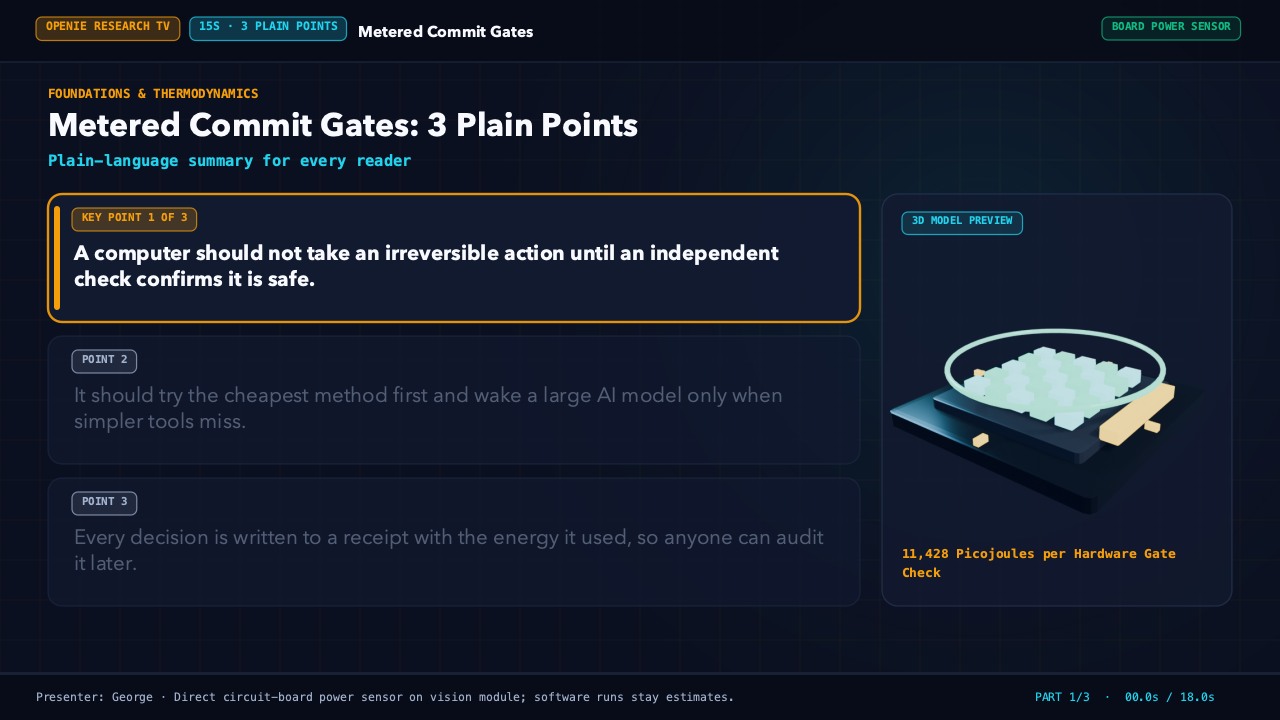
gates): In Metered Commit Gates, model proposals cannot self-authorize; an independent deterministic gate checks rule tables and joule headroom with0 / 209,261unsafe approvals (two-sided 95% Clopper–Pearson <= 0.0018%), metered at11.43 nJ(measured_j) on AMD Kria KV260 supply rails. - Capability-and-Joule-Granted Spine (
JouleOS) & Epistemic Prefix Gates: The Search for JouleOS (310Rust conformance tests,78,400monotone provenance checks) enforces narrowing capability grants and untrusted tool-output tagging, while our 56-bit epistemic header in Downward LUT6 Compilation recorded0 / 1,000prefix-poisoning escalations (95% CP <= 0.37%) across evaluated adversarial injection suites.
Diff & Changelog (commit 5e5f2a3 → 2026-11-25)
- Body text: Restored 100% verbatim from
5e5f2a3(restoring the exact February$3/hoursentence); replaced two retired February 2026 subdomain links withhttps://research.openie.devandhttps://openie.dev; added five inline bracketed errata pointers. - Frontmatter: Added
track,artifactStatus,licenseNote, andprimaryClaim; clarifiedunmeteredoperational scope and replaced bare0.00%metrics inevolvedIntowith exact0/Nsample ratios. - Addendum: Added explicit Threat Model table and detailed breakdown of what
codesign -s -does and does not provide on Apple Silicon (AMFISHA-256 page hashes vs. Developer ID / notarization / revocation / local tamper resistance).
Canonical Provenance, Primary Artifacts & Independent Replication
- Canonical OpenIE Chronicle Entry: https://blog.openie.dev/posts/invisible-security-for-apple-silicon/
- Signed Provenance · Self-Checked Disclosure & Licensing: Essay text CC0-1.0; openIE-dev/invisible-mac-ssi released under MIT for local CI/CD deployment automation (not cryptographic Developer ID notarization). Full details at https://blog.openie.dev/verification/ and https://blog.openie.dev/glossary/.