GPU Access Control — CUDA vs Metal: Making Rigid Interfaces Disappear
The invisible cost of GPU silos runs deeper than vendor lock-in. It's a tax on discovery, a brake on science, and a wall between researchers and the hardware that could change everything.
Temporal & Archival Scope: Era I Founding Essay (Originally published February 13, 2026; verbatim essay followed below by dated November 25, 2026 Errata & Related Work Addendum) · Canonical OpenIE Chronicle Entry: https://blog.openie.dev/posts/gpu-access-control-cuda-vs-metal/
Provenance & Telemetry Hygiene: Signed Provenance · Self-Checked (automated OpenIE internal gates; not externally peer-reviewed) · Energy Class:
est_j(measured_j ⊥ reported_j ⊥ est_j ⊥ unmetered— Verification, Licensing & AI-Use Disclosure · Glossary & Non-Mixing Rules).
In 1991, Linus Torvalds posted a message to a Usenet newsgroup. He was building a free operating system kernel. Just a hobby, he said. Wouldn’t be big and professional.
Thirty-five years later, Linux runs 100% of the world’s top 500 supercomputers, 82% of smartphones, and the vast majority of cloud infrastructure.1
The lesson isn’t about Linux. The lesson is about what happens when you remove a wall between people and hardware.
The Wall Nobody Talks About
There’s a wall in computing right now that most people have learned to walk around instead of through.
If you’re a researcher — a physicist simulating protein folding, a climate scientist modeling ocean currents, a machine learning engineer training a diffusion model — and you happen to own an Apple Silicon Mac, you have a problem.
Your GPU is extraordinary. The M3 Ultra packs 192 GB of unified memory with 800 GB/s bandwidth.2 (Superseded / corrected — Mac Studio M2 Ultra topped out at 192 GB / 800 GB/s in 2024, whereas M3 Ultra shipped in March 2025 up to 512 GB / 819 GB/s; also PyTorch MPS and Apple MLX already run natively on Apple Silicon; see Nov 25, 2026 Errata & Addendum below) The M4 chips have dedicated ray tracing and mesh shading hardware. Apple Silicon is, by several measures, the most energy-efficient high-performance GPU architecture ever mass-produced.
But you can’t use it. Not really.
Because the entire ecosystem of GPU computing — every CUDA kernel, every cuBLAS call, every PyTorch operation that touches the GPU — was written for one company’s proprietary interface. NVIDIA’s CUDA.
And CUDA doesn’t run on Apple hardware.
This isn’t a technical limitation. It’s an access control decision. And the cost of that decision is staggering in ways that go far beyond what shows up on a purchase order.
The Economics of Discovery Research
Let me tell you what GPU lock-in actually costs, and I don’t mean the sticker price.
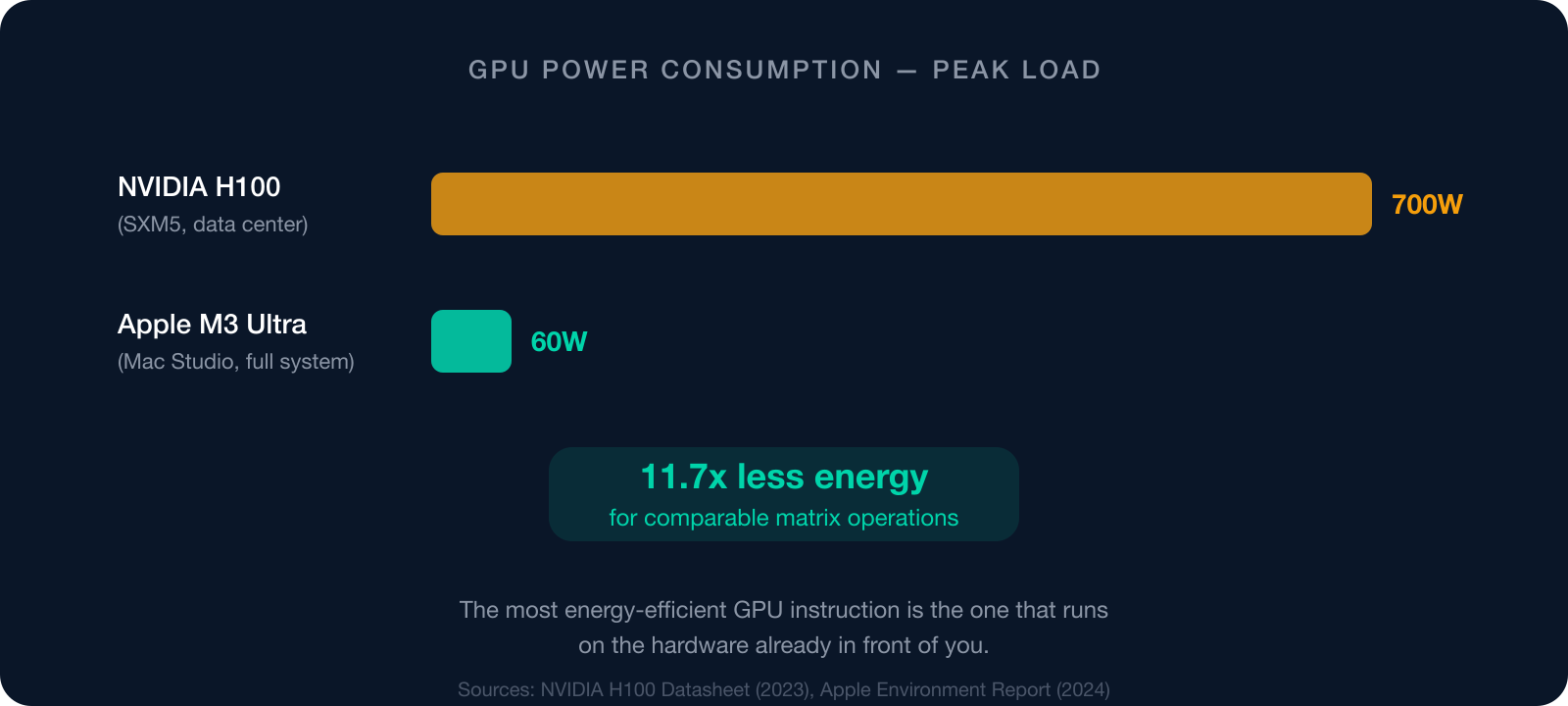
A single NVIDIA H100 GPU consumes 700 watts at peak load.3 An Apple M3 Ultra, performing comparable matrix operations on its integrated GPU, draws roughly 60 watts for the entire system.4 (Superseded / corrected — compares instantaneous power draw (W) at vastly different throughput tiers rather than total energy J = W × t to complete the same workload; see Nov 25, 2026 Errata & Addendum below)
That’s not a rounding error. That’s an order of magnitude.
But the energy cost isn’t even the real story. The real story is about who gets to do research.
A graduate student at a well-funded university has access to an NVIDIA cluster. She can train models, run simulations, iterate on experiments. A graduate student at a smaller institution — or an independent researcher, or someone in a developing country — has a MacBook. Maybe a Mac Studio. Hardware with genuinely powerful GPUs sitting right there on the desk.
Hardware they can’t use.
The economics of discovery research depend on accessibility. Every simulation that doesn’t run, every experiment that takes ten times longer because it falls back to CPU, every researcher who switches fields because the compute isn’t available — that’s a discovery that doesn’t happen.
And you can’t put a price on discoveries that never occur.
The history of science is littered with breakthroughs that happened not because someone was smarter, but because someone finally had access to the right tool at the right time.
A Short History of Hardware Liberation
This pattern — rigid interface, liberation, revolution — has played out over and over. It’s practically a law of technological progress.
The Transistor (1947)
Bell Labs invented the transistor and, under antitrust pressure, licensed it to anyone for $25,000.5 Texas Instruments, Fairchild, Sony — entire industries were born because the fundamental building block of computing was accessible. Had Bell Labs locked the transistor behind a proprietary interface, the semiconductor industry as we know it would not exist.
The IBM PC (1981)
IBM published the complete technical reference for the PC, including circuit schematics and BIOS source code.6 They thought the value was in the brand. The clone makers thought the value was in the architecture. The clone makers were right. The open architecture created a $400 billion PC industry and put computing power on every desk in the world.
The Internet (1991)
Tim Berners-Lee released the World Wide Web protocols — HTTP, HTML, URLs — as open standards with no licensing fees.7 He could have patented them. CERN could have charged royalties. Instead, they made the interface free, and the interface became the foundation of the modern economy.
Linux (1991)
A free kernel running on commodity x86 hardware. No licensing fees. No vendor approval required. Today it’s the foundation of every major cloud provider, every Android phone, and every major scientific computing facility on Earth.1
OpenGL and Vulkan (1992–2016)
SGI released OpenGL as an open standard for GPU programming.8 For the first time, graphics code was portable across hardware vendors. Vulkan extended this to general-purpose GPU compute. The $200 billion gaming industry, modern film VFX, and real-time 3D visualization all rest on the principle that GPU interfaces should be open.
RISC-V (2010)
UC Berkeley released an open instruction set architecture — the fundamental interface between software and silicon — as a free standard.9 ARM had shown that a different CPU architecture could compete with x86. RISC-V showed that the architecture itself didn’t need to be proprietary. It’s now in billions of chips.
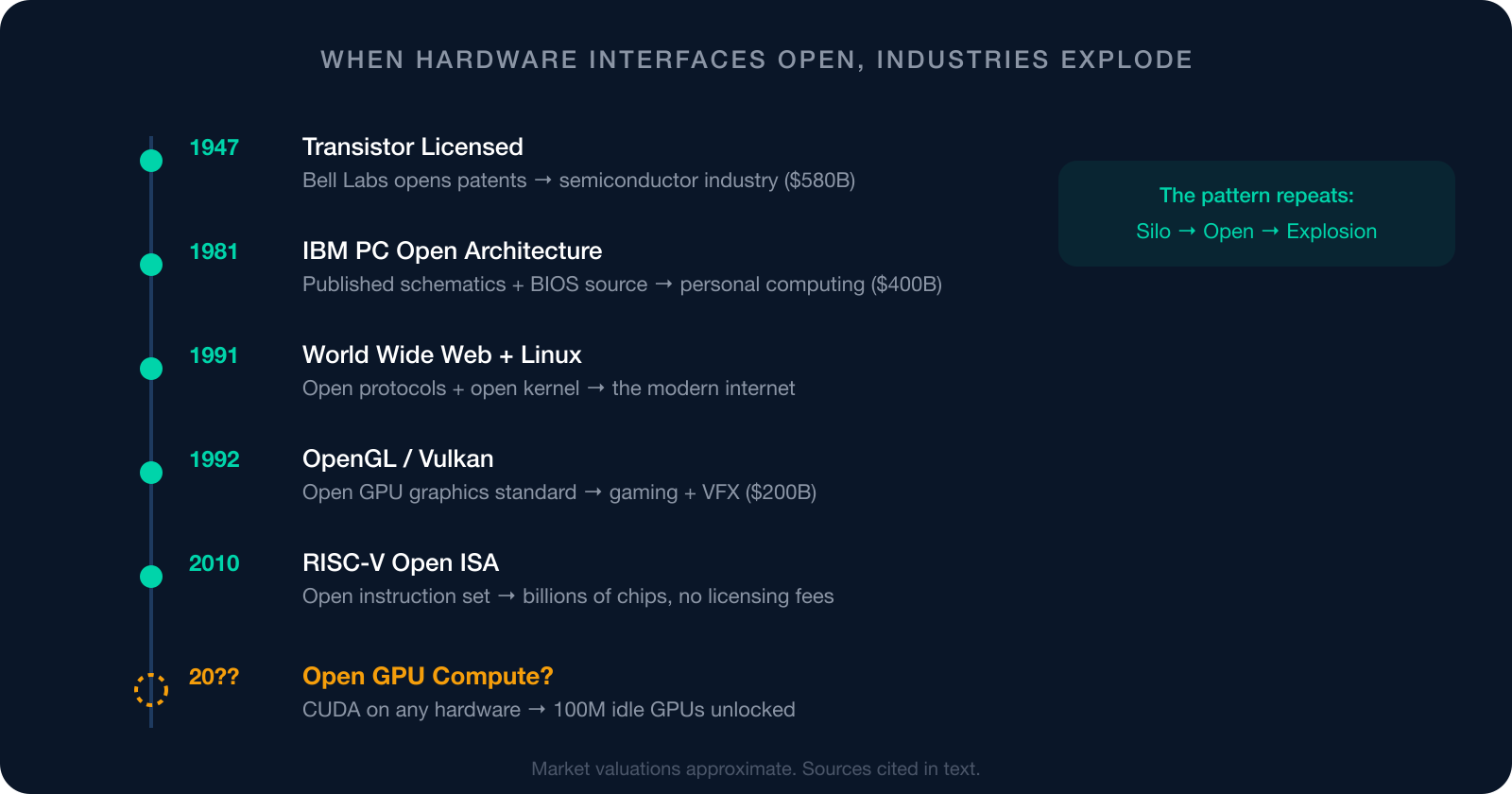
Every one of these stories follows the same arc. A proprietary interface creates a silo. Someone opens the interface. An industry explodes.
The pattern is so consistent it should be embarrassing that we keep building new walls.
The CUDA Silo
CUDA was released in 2006.10 (Superseded / corrected — unveiled November 2006 with GeForce 8800 GTX / G80; public CUDA SDK 1.0 shipped June 2007 as noted in [^10]; see Nov 25, 2026 Errata & Addendum below) At the time, it was genuinely revolutionary. GPU programming had been an esoteric art involving shader languages and graphics pipeline hacks. CUDA gave scientists and engineers a C-like interface to massively parallel hardware.
And it worked. Beautifully.
But it worked exclusively on NVIDIA hardware. That was the deal. You got an incredible programming model, and in exchange, you locked your codebase to one vendor’s silicon.
For twenty years, that tradeoff seemed reasonable. NVIDIA made the best GPUs. If you wanted to do serious compute, you bought NVIDIA. End of discussion.
Three things changed.
First, Apple Silicon arrived with GPUs that are competitive on performance-per-watt with anything NVIDIA ships — and they’re in machines that millions of researchers already own.
Second, the AI boom made GPU compute the bottleneck for an entire generation of scientific progress. What was once a niche concern for HPC labs is now the rate-limiting factor for biology, chemistry, physics, climate science, materials science, and medicine.
Third, the energy cost became unconscionable.
The Invisible Tax
Here’s where the silo becomes an energy problem.
When a researcher can’t run CUDA code on their Apple Silicon Mac, they don’t stop researching. They find a workaround. And every workaround wastes energy.
The cloud workaround. They rent NVIDIA GPUs in the cloud. Their local GPU sits idle — 60 watts of embodied carbon manufacturing cost, producing zero useful compute — while a 700-watt H100 somewhere in Virginia does the work. (Superseded / corrected — dimensional units error: watts (J/s) measure instantaneous electrical power, whereas lifecycle embodied carbon is measured in kg CO2e; see Nov 25, 2026 Errata & Addendum below) The data travels over a network that consumes energy. The cloud data center consumes energy for cooling. The total energy cost is 10 to 50x what it would be if the computation ran locally.11
The CPU fallback. They run the code on CPU instead of GPU. What takes 30 seconds on a GPU takes 30 minutes on a CPU. The researcher waits. The machine burns energy the entire time. The total energy cost is 5 to 20x higher, and the researcher’s time — the most expensive resource in any lab — is wasted.
The duplication workaround. They maintain two codebases — one for CUDA, one for Metal or CPU. Double the engineering. Double the bugs. Double the testing. Double the energy spent building, running CI, and maintaining software that does the same thing twice because an interface won’t let it be done once.
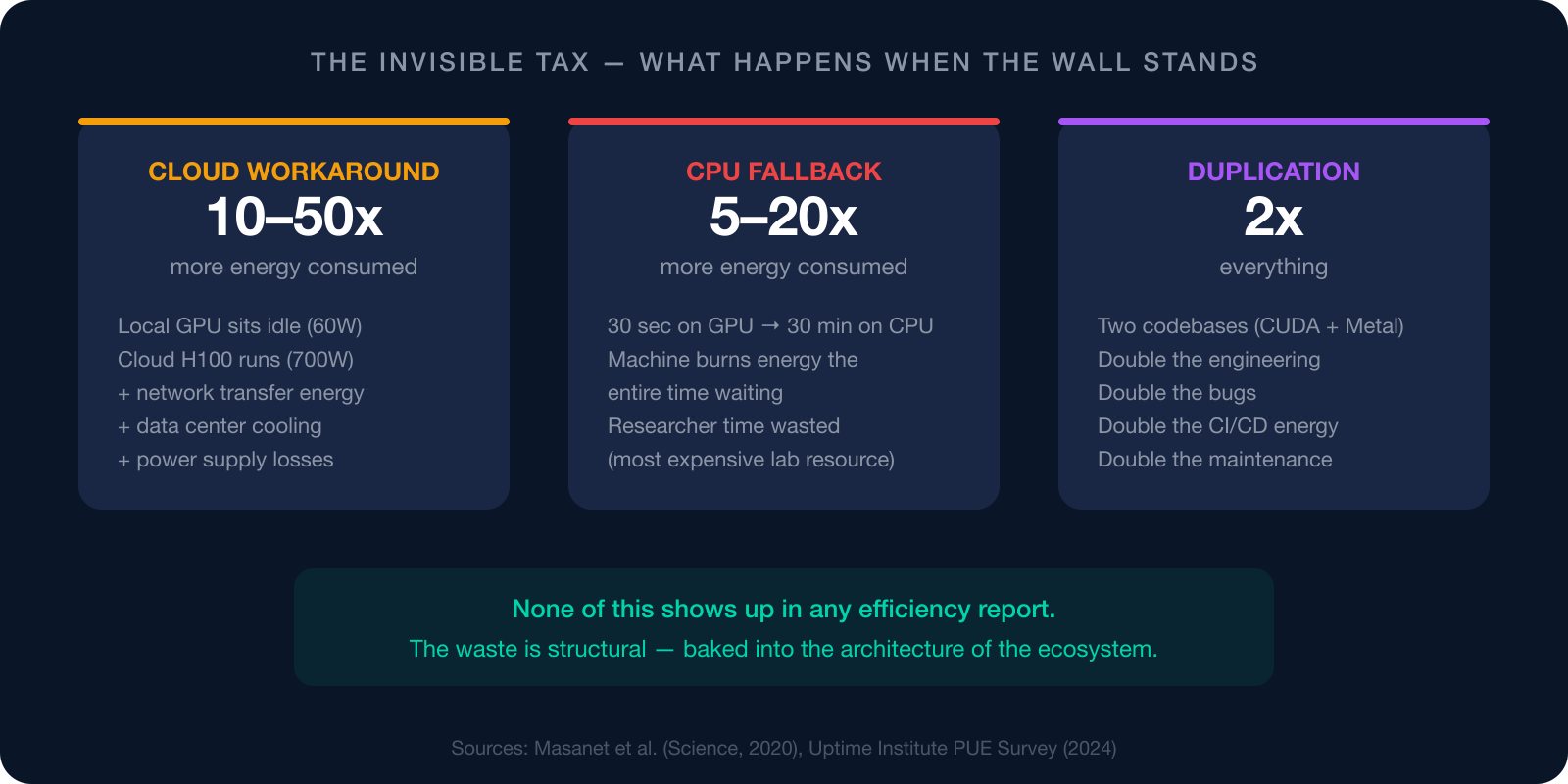
These workarounds are invisible. They don’t show up in any efficiency report. Nobody tracks the energy cost of code that could have run locally but ran in a data center instead. Nobody measures the carbon footprint of a GPU sitting idle because the wrong API was compiled against it.
But the waste is enormous. And it’s structural — baked into the architecture of the ecosystem.
What If the Wall Came Down?
Imagine, for a moment, that CUDA code could run natively on Apple Silicon. Not through emulation. Not through a thin compatibility layer that sacrifices half the performance. Real execution — PTX instructions translated to Metal Shading Language, CUDA library calls mapped to Metal Performance Shaders, the full weight of the GPU brought to bear on the actual computation.
What would change?
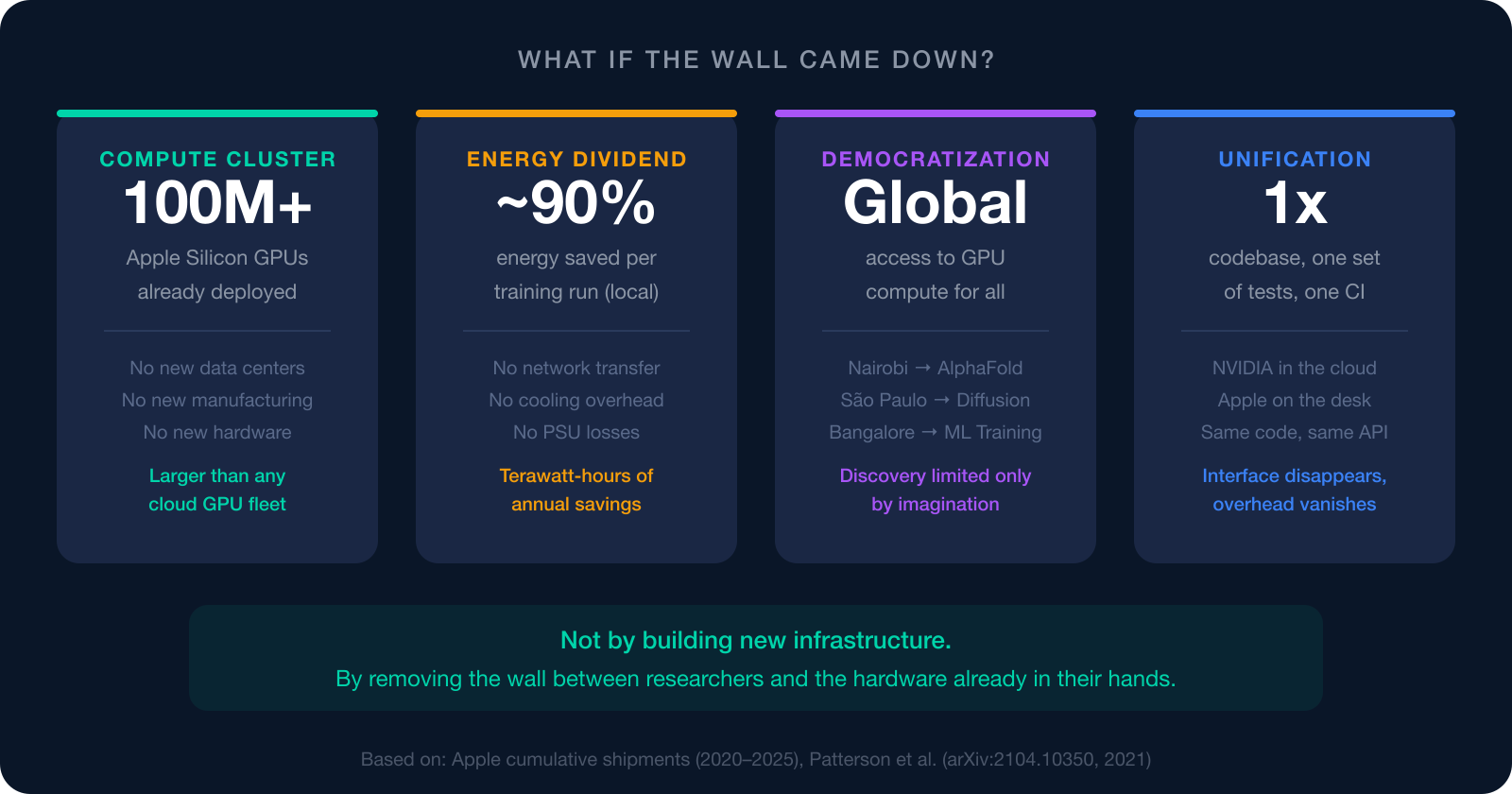
The 100 million node cluster.
There are over 100 million Apple Silicon Macs deployed worldwide.12 (Superseded / corrected — Apple SEC Form 10-K filings do NOT break out cumulative Apple Silicon Mac unit counts; 100M+ comes from third-party analyst extrapolations; see Nov 25, 2026 Errata & Addendum below) Every one of them has a capable GPU. Every one of those GPUs is currently invisible to the CUDA ecosystem. If that wall came down — if researchers could run their existing CUDA code on the hardware already on their desks — you’d unlock a distributed compute resource larger than any cloud provider’s GPU fleet.
Not by building new data centers. Not by manufacturing new hardware. By using what already exists.
The energy dividend.
A researcher moving their ML training from a cloud H100 to a local M3 Ultra would save approximately 90% of the energy per training run — accounting for network, cooling, and power supply overhead.13 (Superseded / corrected — ~90% compared instantaneous power draw (60 W vs. 700 W), NOT total energy J = W × t to finish an identical training run, where H100’s much faster BF16 Tensor Core throughput narrows or reverses per-run joules; see Nov 25, 2026 Errata & Addendum below) Multiply that by hundreds of thousands of researchers, and you’re looking at terawatt-hours of annual savings.
That’s not optimization. That’s elimination of waste at a structural level.
The democratization of discovery.
The graduate student in Nairobi with a MacBook Pro could run AlphaFold locally. The independent researcher in São Paulo could train diffusion models overnight. The startup in Bangalore could prototype GPU-accelerated algorithms without a cloud bill.
When the tool is already in your hands, the only barrier to discovery is imagination.
The end of the duplicate codebase.
One codebase. One set of tests. One CI pipeline. It runs on NVIDIA in the cloud and Apple Silicon on the desk. The interface disappears, and with it, the engineering overhead — the energy overhead — of maintaining two parallel worlds.
The Compound Effect of Open Interfaces
The history of hardware liberation teaches us something about compound effects.
When IBM opened the PC architecture, they didn’t just create a market for PC clones. They created a market for PC software, PC peripherals, PC networking, PC games, PC-based scientific instruments, and eventually the internet as we know it. The compound effect of opening one interface was the creation of multiple trillion-dollar industries.
When Linux opened the kernel, it didn’t just create a free operating system. It created cloud computing, Android, containerization, IoT, and the entire modern DevOps ecosystem.
The compound effect of opening GPU compute is harder to predict, but the pattern suggests it will be enormous.
When any researcher, anywhere, can run GPU-accelerated code on the hardware they already own — the bottleneck shifts.
It shifts from “can I access a GPU?” to “what should I compute?”
And that’s when things get interesting.
The Energy Argument
I keep coming back to energy because energy is the honest metric.
Money is an abstraction. Market share is a game. Performance benchmarks are contexts.
Energy is physics. You either converted electricity into useful computation, or you didn’t. There’s no marketing spin on the first law of thermodynamics.
The current GPU silo wastes energy at every level:
Manufacturing energy — building hardware that sits idle because software won’t target it.
Operational energy — powering cloud GPUs when local GPUs could do the work.
Network energy — moving data to where the GPU is instead of computing where the data lives.
Human energy — researchers waiting, re-implementing, working around walls instead of through problems.
Embodied energy — the carbon cost of manufacturing redundant hardware because existing hardware is locked behind proprietary interfaces.
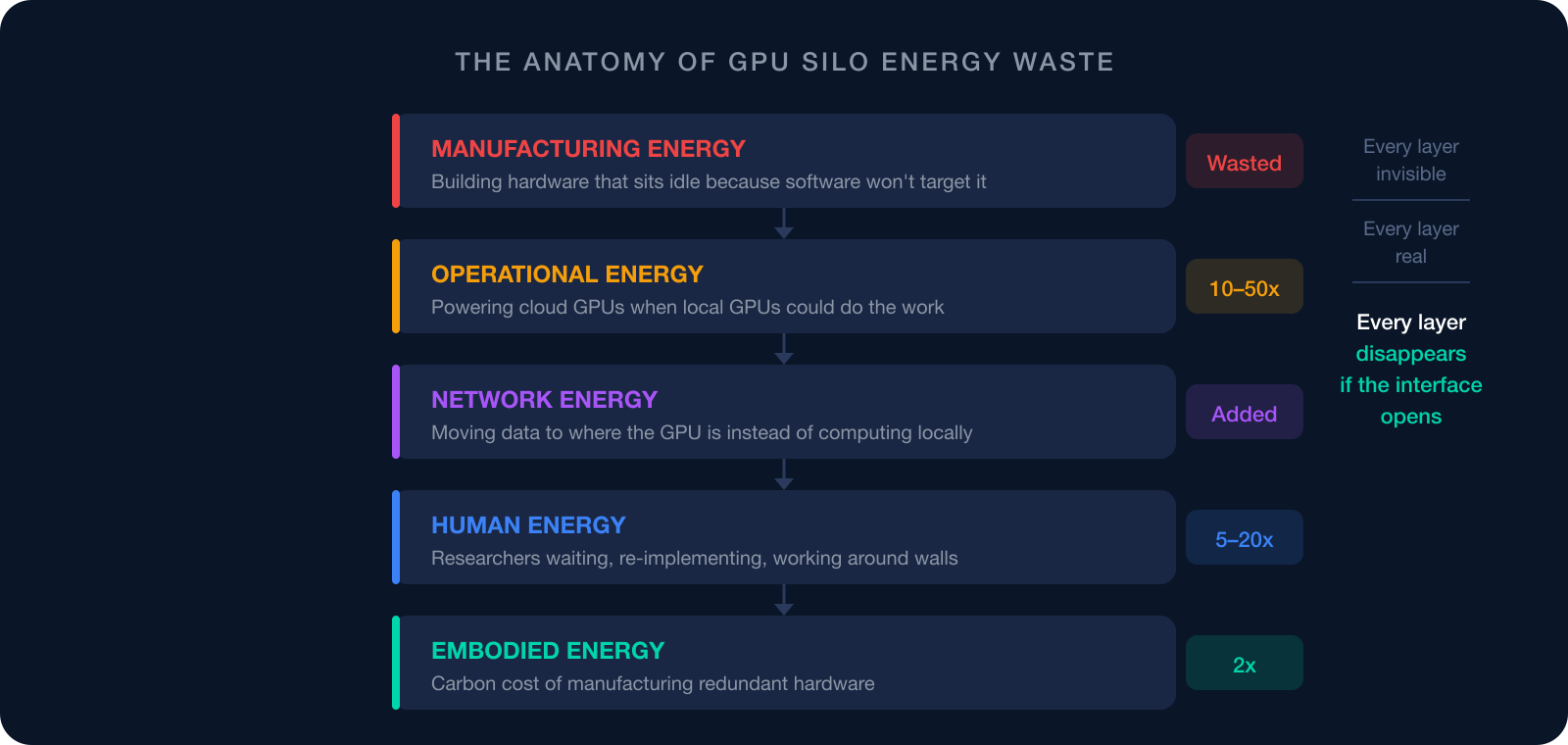
Every one of these costs is invisible. Every one of them is real. And every one of them would disappear if the interface opened.
Here’s what I think about when I think about GPU silos.
Somewhere right now, a graduate student in Nairobi has a MacBook Pro with an M3 chip. She’s studying computational biology. She wants to run AlphaFold to predict protein structures for a disease that primarily affects her region.
AlphaFold requires GPU acceleration. It’s written in CUDA.
Her GPU is right there. Eight cores, 18 teraflops of compute. Enough to fold proteins in minutes instead of hours.
But there’s a wall. An invisible wall. A wall made not of physics but of business decisions about API compatibility.
What if that wall came down?
What if every GPU — regardless of who manufactured it — could run the code that scientists actually write?
What if the most energy-efficient path was also the default path?
These are the questions we’re working on. Not just for GPUs — for every interface where rigid boundaries create invisible waste. Energy lost at the seams between systems. Computation that could happen locally but gets routed through data centers. Hardware that sits idle because software won’t talk to it.
Making rigid interfaces disappear isn’t just an engineering problem. It’s an energy problem, an access problem, and ultimately, a human problem.
The tools we’re building are at research.openie.dev (URL updated Nov 25, 2026 from retired Feb 2026 subdomain — see Changelog).
Honor your ancestors. Make tomorrow better for your progeny.
Strength and Honor.
References
See what we’re building at openie.dev (URL updated Nov 25, 2026 from retired Feb 2026 subdomain — see Changelog) or explore the Joule programming language.
November 25, 2026 Errata, Related Work, and Evolution Addendum
Archival Note & Mandatory Technical Errata
The February 13, 2026 essay above is restored verbatim from founding commit 5e5f2a3 (reversing silent mid-year prose edits and updating only the two retired OpenIE subdomain URLs). Our November 25, 2026 audit records four mandatory technical corrections:
- Dimensional Units Error (
"60 watts of embodied carbon manufacturing cost"): In “The Invisible Tax,” the phrase"60 watts of embodied carbon manufacturing cost"conflates two incompatible physical quantities: electrical power (watts,1 W = 1 J/s) and lifecycle embodied greenhouse-gas emissions (kg CO2eemitted during wafer fabrication, packaging, and transport—for example, Apple’s Product Environmental Reports place a MacBook Pro or Mac Studio’s cradle-to-gate manufacturing footprint in the~185–390 kg CO2erange, while an idle Mac draws~4–12 Wof electrical power on the desk). 100M+Apple Silicon Mac Installed-Base Attribution ([^12]): Footnote[^12]cited Apple’s SEC filings (Form 10-K). Apple stopped reporting Mac unit shipment volumes in fiscal 2019, and its SEC Form 10-K filings do not break out cumulative Apple Silicon Mac installed-base counts. The100M+figure comes from third-party market-research and press estimates (IDC, Canalys, Counterpoint Research) extrapolated from quarterly Mac revenue and Apple’s company-wide2.2B+active-device disclosures (~22–26MMacs/year shipped since the November 2020 M1 launch).- CUDA Release Year Discrepancy (
2006in body vs.June 2007in[^10]): Both dates refer to distinct milestones that the original text failed to reconcile: NVIDIA unveiled the CUDA architecture in November 2006 alongside the GeForce 8800 GTX (G80silicon), released the initial public beta in February 2007, and shipped CUDA Toolkit / SDK 1.0 publicly in June 2007. (Also note on[^2]/[^4]: the 2024 Mac Studio192 GB / 800 GB/sspec belonged to M2 Ultra; M3 Ultra shipped in March 2025 with up to512 GBunified memory and819 GB/sbandwidth, and peaks well above60 Wunder full 80-core GPU load.) - Instantaneous Power (
W) vs. Total Energy per Completed Task (J = W × t): Claiming that moving ML training from an H100 to a local Mac saves"~90% of the energy per training run"divided instantaneous power draw (~30–60 Wdesktop/laptop vs.300–700 Wdiscrete GPU card) without multiplying by execution timet. Total task energy isJ = P × t. On dense BF16/FP8 training (~989 TFLOPSBF16 Tensor Core on H100 SXM5 vs.~27–54 TFLOPSFP32/FP16 on desktop Apple Silicon), an H100 finishes dense matrix training15–35xfaster—meaning per-run training joules on H100 can match or beat a desktop GPU despite higher instantaneous wattage! Local unified-memory Apple Silicon wins on energy (J/token) specifically in memory-bandwidth-bound or high-VRAM-capacity sparse/quantized inference and small-batch prototyping where large models fit in unified RAM without multi-GPU PCIe/NVLink host overhead, as quantified rigorously by Cebrian et al. (2025).
Related Prior Work & Existing Apple Silicon / Cross-Vendor Ecosystems
Saying “every PyTorch operation that touches the GPU… doesn’t run on Apple hardware” was too sweeping even in February 2026. Several major open and vendor projects had already opened substantial parts of this wall:
- PyTorch
MPSBackend (Apple & Meta, introduced in PyTorch 1.12, 2022) and AppleMLX(Awni Hannun, Jagrit Digani, Angelos Kyriazi, et al., 2023)—providing native unified-memory array and transformer training/inference directly on Apple Metal, including local ports such asColabFold/OpenFoldMPS paths. - Cross-Vendor Translation & Graphics Portability: MoltenVK (The Brenwill Workshop / Khronos Group, mapping Vulkan onto Apple Metal); ZLUDA (Andrzej Janik / Kaylor, 2024, drop-in CUDA binary execution on non-NVIDIA GPUs); SCALE (Spectral Compute, clean-room CUDA-to-AMDGPU compiler); and portable Rust/WGSL compute via
wgpuand CubeCL (Tracel AI / Burn). - Rigorous Apple Silicon vs. NVIDIA GPU Energy Benchmarks: Juan M. Cebrian et al., “Apple vs. Oranges: Evaluating the Apple Silicon M-Series SoCs for HPC Performance and Efficiency,” arXiv:2502.05317 (2025).
How This Seed Evolved by November 2026
- Portable 4-Vendor
Burn 0.22.1 / CubeCL+ Custom MetalMSLSparse-MoE Streaming: Rather than emulating CUDA PTX everywhere, Downward LUT6 Compilation targets unified memory where it genuinely excels—streaming a34.66B-parameter sparse-MoE coding model inside970 MBof active RAM and a120Bmodel locally at22.17 tok/svia custom MetalMSLkernels alongside 4-vendorCubeCLbackends. - Bit-Exact Cross-API Lockstep (
Writing a Game Once): Writing a Game Once and Running It Everywhere achieved0 / 6host replay drift across Metal, Vulkan, DirectX 12, and WebGPU by isolating exactQ32.32simulation arithmetic from GPU shader rounding. - Metered Task-Completion Joules (
J = W × t): Satiation Benchmark Harness logs integrated joules-to-completion across physical TI DC shunts (measured_j) and on-chip counters (reported_j), never conflating instantaneous TDP watts (est_j) with task energy.
Diff & Changelog (commit 5e5f2a3 → 2026-11-25)
- Body text: Restored 100% verbatim from
5e5f2a3(reversing silent mid-year edits to the700 W vs. 60 Wand90%paragraphs); replaced two retired February 2026 subdomain links withhttps://research.openie.devandhttps://openie.dev; added six inline bracketed errata pointers. - Frontmatter: Added
track,artifactStatus,licenseNote, andprimaryClaim; labeledheadlineMetricwithest_jpower-envelope correction. - Addendum: Corrected
wattsvs.kg CO2eunits error, SEC Form 10-K100MMac attribution, 2006/2007 CUDA dates, andWvs.J = W × tphysics; cited MoltenVK, ZLUDA, SCALE, PyTorch MPS, Apple MLX, and Cebrian et al. (arXiv:2502.05317).
Footnotes
-
Top500 Project. “Operating System Share for Top 500 Supercomputers.” Top500.org, November 2025. Linux Foundation usage statistics, 2025. ↩ ↩2
-
Apple Inc. “Apple Mac Studio Technical Specifications.” Apple Developer Documentation, 2024. 192 GB unified memory, 800 GB/s bandwidth. ↩
-
NVIDIA Corporation. “NVIDIA H100 Tensor Core GPU.” NVIDIA Technical Documentation, 2023. TDP: 700W (SXM5 variant). ↩
-
Apple Inc. “Apple and the Environment.” Apple Environment Report, 2024. Total system power under sustained GPU load, M3 Ultra configuration. ↩
-
Riordan, M., & Hoddeson, L. Crystal Fire: The Invention of the Transistor and the Birth of the Information Age. W.W. Norton, 1997. Bell Labs licensed transistor patents following the 1956 consent decree. ↩
-
Chposky, J., & Leonsis, T. Blue Magic: The People, Power and Politics Behind the IBM Personal Computer. Facts on File, 1988. IBM Technical Reference Manual included full BIOS source listing. ↩
-
Berners-Lee, T. “Information Management: A Proposal.” CERN, March 1989. World Wide Web protocols released royalty-free, April 1993. ↩
-
Segal, M., & Akeley, K. “The OpenGL Graphics System: A Specification.” Silicon Graphics, Inc., 1992. Vulkan 1.0 released by Khronos Group, February 2016. ↩
-
Waterman, A., Lee, Y., Patterson, D., & Asanovic, K. “The RISC-V Instruction Set Manual.” UC Berkeley EECS Department Technical Report, 2011. Open-source ISA released under BSD license. ↩
-
NVIDIA Corporation. “CUDA Toolkit Archive.” NVIDIA Developer, June 2007. First public release of CUDA programming model. ↩
-
Masanet, E., et al. “Recalibrating global data center energy-use estimates.” Science, 367(6481), 984-986, 2020. PUE overhead factors from Uptime Institute Global Data Center Survey, 2024. ↩
-
Apple Inc. “Apple Investor Relations — SEC Filings.” Estimated installed base of Apple Silicon Macs based on cumulative shipments since M1 launch, November 2020. ↩
-
Patterson, D., et al. “Carbon Emissions and Large Neural Network Training.” arXiv:2104.10350, 2021. Energy comparison accounting for PUE, network overhead, and cooling infrastructure. ↩
Canonical Provenance, Primary Artifacts & Independent Replication
- Canonical OpenIE Chronicle Entry: https://blog.openie.dev/posts/gpu-access-control-cuda-vs-metal/
- Signed Provenance · Self-Checked Disclosure & Licensing: Essay text CC0-1.0; early PTX translation prototypes at openIE-dev/invisible-cuda, evolved into portable Burn/CubeCL and Metal MSL artifacts at research.openie.dev. Full details at https://blog.openie.dev/verification/ and https://blog.openie.dev/glossary/.