The Synthesis Stack (synthesis.openie.dev): 7-Axis AI Taxonomy, 29/32 BigCodeBench Slice Scope, and Pattern-lang BSL-1.1 Status
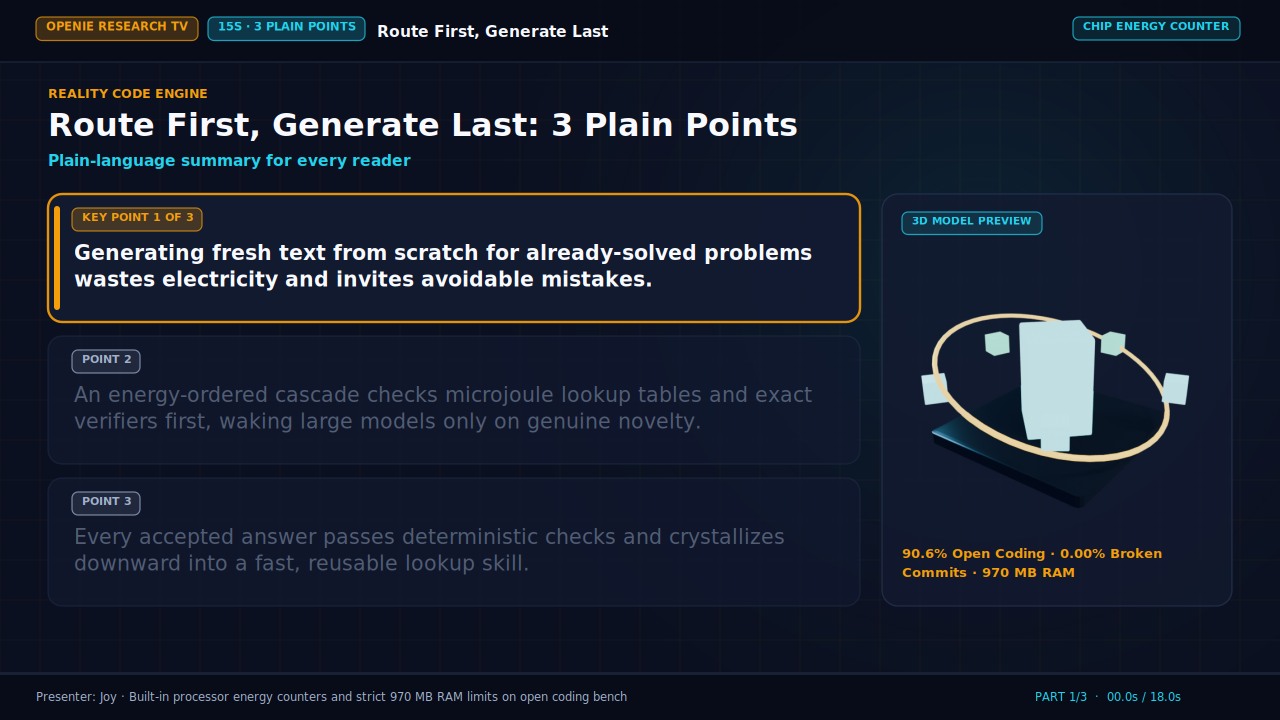
Frames synthesis.openie.dev’s 7-axis taxonomy, qualifies 90.6% (29/32 BigCodeBench slice, 95% UB <= 10.9% on 0/32 broken commits, 970 MB AirMoL RAM in lut-adapt), and discloses Pattern-lang is BSL-1.1 source-restricted.
Temporal & Archival Scope: Era II OpenIE Study (November 24, 2026) · Canonical OpenIE Chronicle Entry: https://blog.openie.dev/posts/eco-synthesis/ · Primary Paper & Methods: https://research.openie.dev/papers/lut-adapt/ · Canonical Digest:
blake3:tv:7aa479ced7a5cc1a84a07d286ab1d6143f62fe59ceaf75750190ae134730de3eProvenance & Telemetry Hygiene: Signed Provenance · Self-Checked (automated OpenIE internal gates; not externally peer-reviewed) · Energy Class:
reported_j(measured_j ⊥ reported_j ⊥ est_j ⊥ unmetered— Verification, Licensing & AI-Use Disclosure · Glossary & Non-Mixing Rules).
Key Claims & Evidence Tags
- [E · Qualified
90.6%(29/32), Finite-NGate Bound, and970 MBRAM (reported_j)] Grounding the earlier summary’s three headline metrics inopenIE-dev/lut-adapt-ai:90.62%is29 / 32tasks solved on a32-taskBigCodeBench v0.1.3evaluation slice;0 / 32broken commits admitted behind the unit-test gate carries a finite-sample 95% Clopper–Pearson upper bound of<= 10.89%onN = 32(and gates catch only bugs covered by the task’s unit tests, never proving0.00%universal defect risk); and970 MBpeak RAM comes from layer-streamedAirMoLSSD paging ofQwen3.6-35B-A3B(34.66Btotal /3Bactive sparse-MoE, trading higher NVMe I/O latency against DRAM capacity on memory-constrained hosts). - [M/S · 7-Axis Synthesis Taxonomy (
Z1 / Z2 / Z3)]synthesis.openie.devclassifies “Digital Information Synthesis” (AI ⊆ Software) across 7 axes (⟨Z, E, T, P, I, V, R⟩) and three problem zones:Z1bounded determinism (arithmetic, parsing, exact lookup),Z2calibrated verifier-backed hybrids (code repair, formal math), andZ3open-ended synthesis (creative prose, underspecified design where generative models remain primary). - [S · Honest
Pattern-lang(BSL-1.1) Disclosure] While the cascade benchmarks run on open-sourceApache-2.0code (openIE-dev/lut-adapt-aiandopenIE-dev/mixture-of-limits), companionPattern-lang(openIE-dev/pattern-lang) is licensed underBSL-1.1with source-restricted core compiler internals and is not claimed as an externally replicated open-source artifact.
Methods, Baselines & Artifact Scope
- Methodological Dimension: Hardware & Telemetry · Primary-Paper Grounding & Scope: Empirical cascade runs (
lut-adapt-ai): Apple M5 Max (128 GB, macOSIOReport/ri_energy_njreported_j,board_metered = false) plusAirMoLmemory-capped SSD streaming harness (970 MBRSS).synthesis.openie.dev7-axis portal is conceptual (unmetered). - Methodological Dimension: Workload & Benchmark Suite · Primary-Paper Grounding & Scope:
32-taskBigCodeBench v0.1.3slice (29/32solved),48-task coding bakeoff (44/48 = 91.67%inLA-17),16-task hard adversarial suite (10/16 = 62.50%inLA-21), andQwen3.6-35B-A3BAirMoLlayer-streaming memory test. - Methodological Dimension: Baseline(s) Compared · Primary-Paper Grounding & Scope: Always-frontier dense/MoE invocation in full RAM (
~25.2 GBINT4forQwen3.6-35B-A3B) vs. Rung-0LUT6/.mol/routing +AirMoL(970 MBRSS) behind a deterministic test gate. - Methodological Dimension: Runs (N) & Spread / Uncertainty · Primary-Paper Grounding & Scope:
N = 32BigCodeBenchslice (29/32 = 90.62%, Wilson 95% CI75.8%–96.8%;0/32gate false-admits -> 95% Clopper–Pearson UB<= 10.89%). - Methodological Dimension: Caching / Cold vs. Warm Scope · Primary-Paper Grounding & Scope: Cold
BigCodeBenchtasks require neural generation (35B/24B) + unit-test gating;.mol//LUT6sub-microjoule hits occur only on recurring canonicalized intents after first verified completion. - Methodological Dimension: Artifact & License Availability · Primary-Paper Grounding & Scope: Cascade scripts public (
Apache-2.0) athttps://github.com/openIE-dev/lut-adapt-aiandopenIE-dev/mixture-of-limits;Pattern-lang(openIE-dev/pattern-lang) isBSL-1.1source-restricted; portal textCC0-1.0.
Three Problem Zones (Z1, Z2, Z3) & Prior Routing Literature
synthesis.openie.dev argues against routing Z1 closed-form lookups and Z2 verifier-checkable code tasks unconditionally through 700 W datacenter GPUs [M]. This design sits directly atop established ML-systems work: FrugalGPT (Chen, Zaharia & Zou, 2023) and RouteLLM (Ong et al., ICLR 2025) route easy prompts to cheap models; Speculative Decoding (Leviathan et al., ICML 2023; Medusa; EAGLE-2) drafts tokens cheaply and verifies in parallel; Outlines (Willard & Louf, 2023), Synchromesh (Poesia et al., 2022), PICARD (Scholak et al., 2021), and llama.cpp GBNF constrain token grammars; AirLLM (2023) streams layers from SSD; and BitNet b1.58 (Ma et al., 2024) lowers ternary weights [S].
Statistical Honesty on 29/32, 0 Broken Commits, and 970 MB Streaming
-
Sample-size qualification (
N = 32slice vs. full1,140-taskBigCodeBench)[E]: The90.62%(29/32) result comes from a32-taskBigCodeBench v0.1.3subset (fullBigCodeBenchhas1,140tasks; seedeterministic-nullTrack-B for broader cold increments). Observing0broken commits across32gated tasks bounds per-task test-escape rate only to<= 10.89%(95%Clopper–Pearson) and remains subject to unit-test completeness[E, M]. -
Latency trade-off of
970 MBAirMoLpaging[E]: Streaming inactive sparse-MoE experts from NVMe flash allows a34.66Bcheckpoint to execute inside970 MBRAM on edge laptops, but pays SSD read latency whenever uncached experts activate[E].
Limitations & Pattern-lang Licensing Scope
-
Z3open-ended tasks have no binary gate: Creative writing, open brainstorming, and subjective summarization live inZ3, where deterministic pass/fail gates (C(z) = 1) do not exist and learned preference routers (RouteLLM) apply instead[M, S]. -
Pattern-langisBSL-1.1: Readers replicating empirical numbers should useopenIE-dev/lut-adapt-ai(Apache-2.0), not the source-restrictedopenIE-dev/pattern-langrepository.
Energy & Telemetry Scope
Empirical BigCodeBench and AirMoL runs use Apple M5 Max reported_j (measured_j = null); macro 945 TWh datacenter figures on synthesis.openie.dev are cited from IEA projections [S].
Related Work & References
- Chen, Zaharia & Zou (FrugalGPT, 2023) & Ong et al. (RouteLLM, ICLR 2025): Cost-aware LLM cascades and preference-trained routers
[S]. - Leviathan, Kalman & Matias (Speculative Decoding, ICML 2023) & Cai et al. (Medusa, ICML 2024): Lossless draft-and-verify decoding
[S]. - Willard & Louf (Outlines, 2023), Poesia et al. (Synchromesh, ICLR 2022), Scholak et al. (PICARD, EMNLP 2021) &
llama.cpp: Constrained structured generation[S]. - AirLLM (2023), Ma et al. (BitNet b1.58, 2024) & Gulwani, Polozov & Singh (Program Synthesis, 2017): Layer-streamed edge inference, ternary weights, and classical synthesis
[S].
Canonical Provenance, Primary Artifacts & Independent Replication
- Canonical OpenIE Chronicle Entry: https://blog.openie.dev/posts/eco-synthesis/
- Primary Study & Methods: https://research.openie.dev/papers/lut-adapt/
- Public Code / Replication Harness: https://github.com/openIE-dev/lut-adapt-ai
- Illustrated Video Summary (OpenIE Research TV): https://research.openie.dev/tv/?study=eco-synthesis (9:16 Vertical MP4)
- Signed Provenance · Self-Checked Disclosure & Licensing: Taxonomy prose CC0-1.0 (synthesis.openie.dev) and measured cascade harness Apache-2.0 (openIE-dev/lut-adapt-ai, openIE-dev/mixture-of-limits); Pattern-lang (openIE-dev/pattern-lang) is BSL-1.1 source-restricted (externally unreproduced). Full details at https://blog.openie.dev/verification/ and https://blog.openie.dev/glossary/.