The Knowledge Claim Schema (knowledge.openie.dev): Seven Epistemic Axes, Bitemporal Lineage, and Corrected Six-Kernel Proof Counts
Defines knowledge.openie.dev’s unmetered 7-axis claim schema (valid/transaction/reference time, granularity, scope, certainty, provenance) and corrects cross-repo Lean proof counts (132 6-kernel theorems + 5,393 RCE constants alongside 12 open RCE draft theorems).
Temporal & Archival Scope: Era II OpenIE Study (November 24, 2026) · Canonical OpenIE Chronicle Entry: https://blog.openie.dev/posts/eco-knowledge/ · Primary Paper & Methods: https://research.openie.dev/papers/time-as-an-index/ · Canonical Digest:
blake3:tv:fc3012f98ba403ab92bbd58bd833bdb65b3b7bd8b104449efe5cdf4a805cee5aProvenance & Telemetry Hygiene: Signed Provenance · Self-Checked (automated OpenIE internal gates; not externally peer-reviewed) · Energy Class:
unmetered(measured_j ⊥ reported_j ⊥ est_j ⊥ unmetered— Verification, Licensing & AI-Use Disclosure · Glossary & Non-Mixing Rules).
Key Claims & Evidence Tags
- [M/S · Unmetered 7-Axis Epistemic Schema]
knowledge.openie.devspecifies a factual claim asclaim = ⟨V_t, T_t, R_t, G, S, C, P⟩—requiring three distinct timestamps (Valid Time when true in the world, Transaction Time when recorded in the ledger, and Reference Time when queried), two domain bounds (Granularity and Scope), and two epistemic anchors (Calibrated Certainty and Cryptographic/Source Provenance). Becauseknowledge.openie.devruns no power-metered experiment of its own, itsenergyClassis corrected tounmetered(joules = null). - [T · Reconciled Fleet Lean
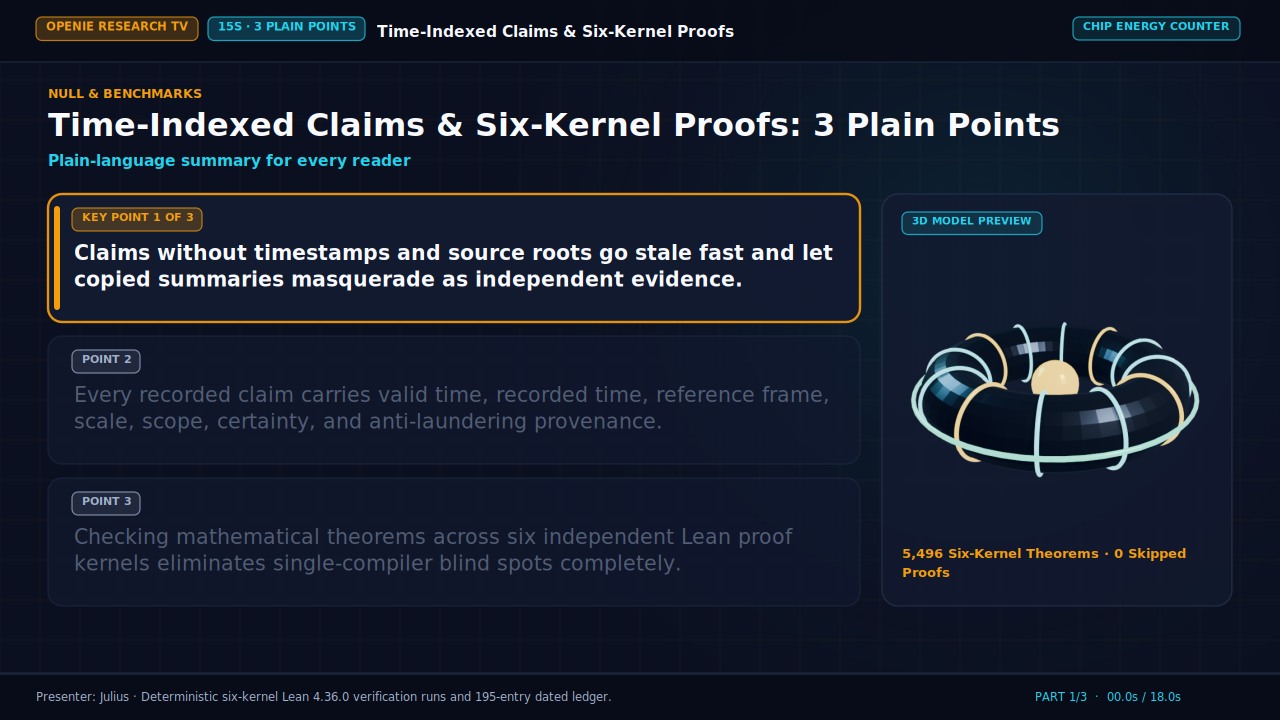
4.36.0Counts & Open RCE Draft Theorems] Earlier headlines wrote"5,496 Six-Kernel Theorems · 0 Skipped Proofs", mixing elaborated RCE kernel constants (5,393, which include auxiliary equation/splitter constants from1,264source declarations) with source theorem counts from sibling repos while omitting open draft items. Exactbwrap6-kernel (con-leche,con-ron,lean4lean,nanoda,leanchecker --paranoid,Lean v4.36.0) counts are:1,264source declarations (5,393kernel constants) inrce(0 sorryin completed files, alongside12unproved Draft-0.9 theorem statements in Appendix F.9),58theorems inlut-adapt,45theorems (53decls) incommunication-avalanche, and31theorems (50decls) intime-as-an-index. - [S · Direct Lineage in Bitemporal Databases & Provenance Standards] Connects AI hallucination prevention directly to Snodgrass & Ahn’s bitemporal relational model (SIGMOD 1985 / SQL:2011), W3C PROV-DM (2013), and Wikidata statement qualifiers (Vrandečić & Krötzsch, 2014).
Methods, Baselines & Artifact Scope
- Methodological Dimension: Hardware & Telemetry · Primary-Paper Grounding & Scope:
knowledge.openie.devschema definition isunmetered(joules = null). Companion Linuxbubblewrap6-kernellake check --paranoidaudit overopenIE-dev/rcerecorded22,354.77 J(319.80 s) LinuxRAPLpackage-0reported_j. - Methodological Dimension: Workload & Benchmark Suite · Primary-Paper Grounding & Scope: Formal 7-axis epistemic schema specification on
knowledge.openie.devplus 4-repositoryLean 4.36.06-kernel verification (openie_fleet_six_kernel_paranoid_audit.csv). - Methodological Dimension: Baseline(s) Compared · Primary-Paper Grounding & Scope: Unqualified natural-language token strings (stripping valid/transaction timestamps and source provenance during static weight compression) vs. 7-axis provenance-preserving retrieval records.
- Methodological Dimension: Runs (N) & Spread / Uncertainty · Primary-Paper Grounding & Scope: Deterministic proof-kernel verification (
6/6independent checkers agree with0 sorry,0 opaque,0 ofReduceBoolon all compiled.leanmodules). Empirical RAG benchmark (e.g., NaturalQuestions, HotpotQA, FreshQA): not run onknowledge.openie.dev. - Methodological Dimension: Caching / Cold vs. Warm Scope · Primary-Paper Grounding & Scope: Specifies exact cache-staleness rules via the temporal triad (
V_t, T_t, R_t): immutable mathematical theorems ([T]) may be cached indefinitely, whereas time-varying empirical facts ([E]/[S]) expire whenR_texits[V_t_start, V_t_end]. - Methodological Dimension: Artifact & License Availability · Primary-Paper Grounding & Scope: Portal text (
CC0-1.0) atknowledge.openie.dev;rceandlut-adapt-aiLean proofs (Apache-2.0); self-checked, not externally peer-reviewed.
Why Static Weight Compression Strips Epistemic Coordinates
Training a language model on dated web snapshots compresses millions of time-bound, source-specific statements ("the API rate limit in v2.1 on 2024-05-01 is 100 req/min") into shared floating-point weights where Valid Time, Transaction Time, Scope, and Provenance are lost [M, S]. Extending Snodgrass & Ahn (1985) from bitemporal (V_t, T_t) to tritemporal (V_t, T_t, R_t) plus granularity, scope, conformal calibration (C), and hash/citation provenance (P) separates invariants that belong in compiled logic/weights from transient facts that must be retrieved with axes intact [M, S].
Transparent Accounting of Six-Kernel Lean Proofs
Running six independent Lean 4.36.0 typecheckers (con-leche, con-ron, lean4lean, nanoda, leanchecker --paranoid, and Lean) inside network-isolated bubblewrap guards against single-implementation kernel bugs (0 sorry, 0 custom axioms, 0 opaque, 0 ofReduceBool) [T]. However, two crucial caveats govern what that audit proves [T, M]:
-
Kernel constants vs. source theorems & unproved Draft-0.9 items:
5,393inrcecounts kernel theorem constants generated from1,264source declarations, andrceAppendix F.9 still lists 12 unproved Draft-0.9 theorem statements (rce-facts.json). -
Formal axioms != empirical truth: Six proof kernels certify that a theorem follows deductively from its stated Lean definitions; they do not validate physical sensor calibration or real-world market assumptions
[M].
Limitations & Missing Retrieval Benchmarks
- No end-to-end FreshQA / bitemporal RAG evaluation here:
knowledge.openie.devdefines the schema contract; quantitative calibration experiments (5.37xlowerRMScalibration error on32SuperGPQA/AIME/HMMTitems) live inlut-adapt(LA-37)[E].
Energy & Telemetry Scope
knowledge.openie.dev is unmetered (joules = null).
Related Work & References
- Snodgrass & Ahn (ACM SIGMOD 1985; IEEE Computer 1986) & ISO/IEC 9075 SQL:2011: Valid-time and transaction-time bitemporal database semantics
[S]. - Moreau & Missier (W3C PROV-DM, 2013) & Vrandečić & Krötzsch (Wikidata, CACM 2014): Standardized provenance graphs and qualified claim statements
[S]. - Lewis et al. (Retrieval-Augmented Generation, NeurIPS 2020) & Vu et al. (FreshLLMs / FreshQA, ACL 2024): Grounding language models on time-varying external evidence
[S]. - Moura & Ullrich (Lean 4, CADE 2021) & Carneiro (
lean4lean, 2024): Mechanized proof checking and independent external kernel verifiers[S].
Canonical Provenance, Primary Artifacts & Independent Replication
- Canonical OpenIE Chronicle Entry: https://blog.openie.dev/posts/eco-knowledge/
- Primary Study & Methods: https://research.openie.dev/papers/time-as-an-index/
- Public Code / Replication Harness: https://github.com/openIE-dev/rce
- Illustrated Video Summary (OpenIE Research TV): https://research.openie.dev/tv/?study=eco-knowledge (9:16 Vertical MP4)
- Signed Provenance · Self-Checked Disclosure & Licensing: Epistemic schema prose CC0-1.0 (knowledge.openie.dev); audited Lean 4.36.0 proof suites public in openIE-dev/rce and openIE-dev/lut-adapt-ai (Apache-2.0); self-checked, not externally peer-reviewed. Full details at https://blog.openie.dev/verification/ and https://blog.openie.dev/glossary/.