The Compute Stack (compute.openie.dev): 258-Primitive Taxonomy, KV260 Whole-SOM INA260 Scope (11.43 nJ), and Toolchain Status
Maps 258 computational primitives across 33 families on compute.openie.dev, qualifying the 11.43 nJ KV260 whole-SOM INA260 reading (and inconclusive 98 pJ seed delta) from gates.md and separating Thor shunt vs Zen 5 RAPL figures.
Temporal & Archival Scope: Era II OpenIE Study (November 23, 2026) · Canonical OpenIE Chronicle Entry: https://blog.openie.dev/posts/eco-compute/ · Primary Paper & Methods: https://research.openie.dev/papers/gates/ · Canonical Digest:
blake3:tv:ad930ba0ee7548a998e3394cd5510ac8de44a6b78cc7e5dabdfa264ddfc4cd8fProvenance & Telemetry Hygiene: Signed Provenance · Self-Checked (automated OpenIE internal gates; not externally peer-reviewed) · Energy Class:
measured_j(measured_j ⊥ reported_j ⊥ est_j ⊥ unmetered— Verification, Licensing & AI-Use Disclosure · Glossary & Non-Mixing Rules).
Key Claims & Evidence Tags
- [E · Whole-SOM KV260
INA260Qualification (measured_j)] Per Critique #5, the11,428 pJ(11.43 nJ,SE = 129 pJ) figure referenced across the compute stack is not an isolated single-gate transistor reading: it is a whole-SOM module (VCC_SOM5.04 V: Cortex-A53 PS + UltraScale+ PL + DDR4 + regulators) TIINA260halt-vs-run power-slope average (+0.2857 W,SE = 0.0032 W) acrossN = 4interleaved25 sA/B/Awindows (~4 Hzsampling,~6.25 × 10^88-lane gate cycles/window at25 MHz,~1.43 nJ/lane) on AMD Kria KV260—and its companion98.0 pJ(SE = 30.8 pJ,~1.96 mA) seed-fabric delta sits near theINA2601.25 mAcurrent LSB and is inconclusive. - [E · Non-Mixing Separation of Companion Anchors] Earlier
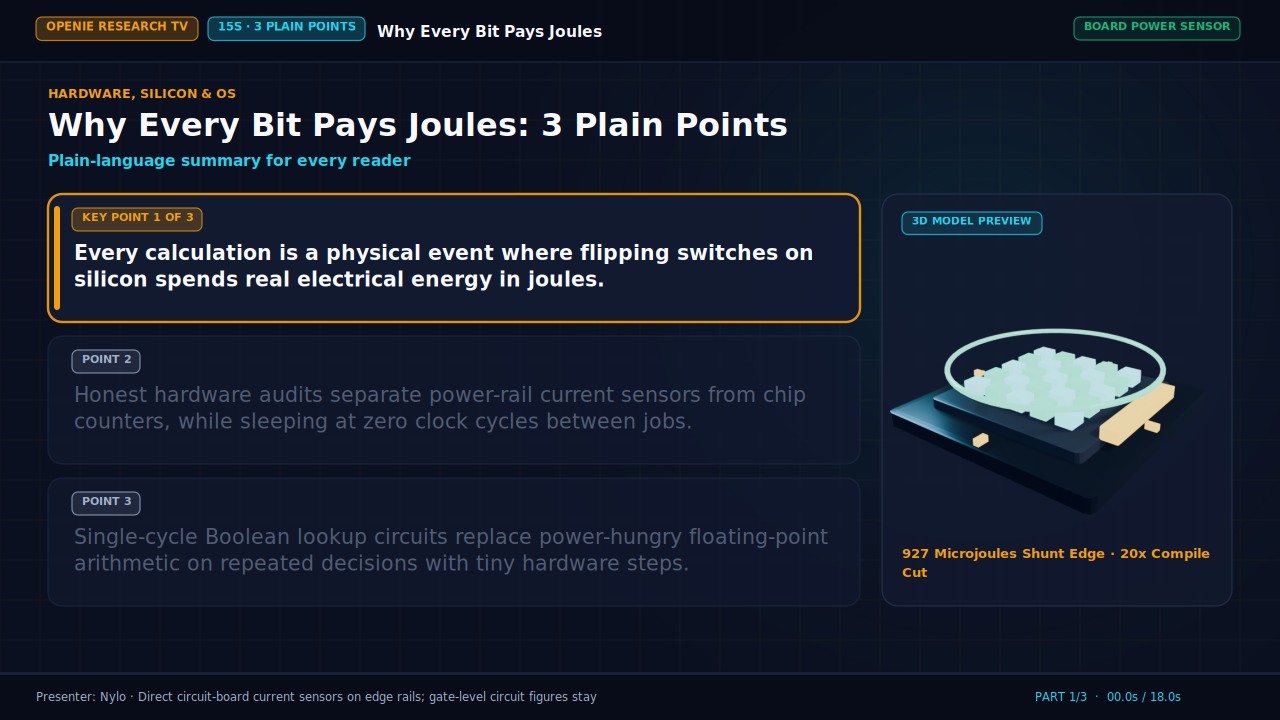
eco-computeheadlines juxtaposed927 uJ(measured_jon Jetson AGX ThorINA3221 VDD_CPU_SOC_MSSover50.13 usfor1 KiBBLAKE3+Ed25519verify inCTA-E4) with20x(20.07xLinuxRAPLcorereported_jlibrce_rt.rlibcompile cut on AMD Zen 5 inrce-compile). Both are now explicitly labeled by host and telemetry class and never combined. - [M/S · Taxonomy &
JLandauerAvailability Scope]compute.openie.devorganizes258computational primitives across33families (boolean/wire permutations, fixed-point ALU, associative search, systolic MACs) using published silicon literature (Horowitz 2014) and analytical cost bands;257of those258portal cells are analytical/literature placements rather than in-house board-shunt measurements, and thejlandauerCLI shown on the portal product page is an internal toolchain prototype, not a publicApache-2.0package.
Methods, Baselines & Artifact Scope
- Methodological Dimension: Hardware & Telemetry · Primary-Paper Grounding & Scope: Hardware anchors from companion papers: AMD Kria KV260 TI
INA260VCC_SOM(measured_j,gates.md) and NVIDIA Jetson AGX Thor TIINA3221VDD_CPU_SOC_MSS(measured_j,lut-adapt.md&communication-avalanche.md);AMD Ryzen AI Max+ 395RAPL(reported_j,rce-compile.md). Portal258-primitive table (compute.openie.dev/src/data/stack.json) is analytical/literature ([M]/[S]). - Methodological Dimension: Workload & Benchmark Suite · Primary-Paper Grounding & Scope:
258-primitive /33-family taxonomy oncompute.openie.dev; KV26025 MHz8-lane commit gate (~6.25 × 10^8cycles/window); Thorlut6-corebit-sliced/scalar evaluation and1 KiBBLAKE3+Ed25519verify. - Methodological Dimension: Baseline(s) Compared · Primary-Paper Grounding & Scope: KV260 halted vs.
25 MHzclocked SOM (A/B/A); Thorlut6-core(162.56 nJ/op) vs.INT8Micro-MLP (14,143.46 nJ/op=87.00xCpJ). - Methodological Dimension: Runs (N) & Spread / Uncertainty · Primary-Paper Grounding & Scope: KV260
INA260:N = 4interleaved25 sA/B/Apasses (11,428 pJ/cycle,SE = 129 pJ;98.0 pJ,SE = 30.8 pJinconclusive). ThorINA3221:4/4counterbalancedABBAwindows (< 0.06%GPU rail drift). - Methodological Dimension: Caching / Cold vs. Warm Scope · Primary-Paper Grounding & Scope: Stateless hardware datapaths (
0dynamic cache in KV260 LUT fabric; deterministicSRAM/BRAMpages inlut6-core). - Methodological Dimension: Artifact & License Availability · Primary-Paper Grounding & Scope: Web taxonomy public (
compute.openie.dev, proseCC0-1.0);lut6-coreandXC7A200TRTL public (Apache-2.0inopenIE-dev/lut-adapt-ai&openIE-dev/openie-research-experiments);jlandauerCLI source private.
Taxonomy vs. Physical Rail Metering on compute.openie.dev
compute.openie.dev maps 258 hardware and algorithmic primitives across 33 families—from zero-gate wire permutations (Beneš 1965; Waksman 1968) up to dense floating-point matrix units [M, S]. An outside reader must know clearly which numbers come from physical shunts vs. analytical coordinate placement [E]:
-
Physical
measured_janchors: (a) AMD Kria KV260 (gates.md):11,428 pJ/cycle(11.43 nJ,SE = 129 pJ) whole-SOMVCC_SOMINA260slope acrossN = 425 spasses at25 MHz, with98.0 pJ(SE = 30.8 pJ) seed delta inconclusive near the1.25 mAINA260LSB; (b) NVIDIA Jetson AGX Thor (lut-adapt.md,communication-avalanche.md):162.56 nJ/opbit-slicedLUT6(87.00xvs.INT8MLP) and927.30 uJ(50.13 us)1 KiBBLAKE3+Ed25519verify onINA3221 VDD_CPU_SOC_MSS[E]. -
Workstation
reported_janchors (rce-compile.md):20.07x(Zen 5) and15.44x(Core i9-13900H) LinuxRAPLcore compile reductions from factoringlibrce_rt.rlib[E].
Limitations, Sensor Resolution Floors & Toolchain Status
-
Board-level vs. isolated-transistor telemetry: Neither
VCC_SOMon KV260 norVDD_CPU_SOC_MSSon Thor isolates single combinational gates from clock trees, L2/MSS interconnects, and regulator quiescent draw; isolating sub-milliamperes on FPGA rails requires inline Kelvin shunts (INA228) onVCCINT[E]. -
Unpublished
jlandauerCLI: Thejlandauersynthesis/simulation commands illustrated oncompute.openie.dev/products/jlandauerrepresent an internal prototype; open-source hardware reproduction today uses theYosys + openXC7 + Verilatorscripts inopenIE-dev/lut-adapt-aiandopenIE-dev/openie-research-experiments[E].
Energy & Telemetry Scope
KV260 INA260 (11.43 nJ) and Thor INA3221 (162.56 nJ, 927.30 uJ) are measured_j; Zen 5 / Core i9 RAPL (20.07x, 15.44x) are reported_j; the 258-primitive catalog entries are analytical/literature classifications ([M]/[S]).
Related Work & References
- Horowitz (IEEE ISSCC, 2014): Canonical
45 nmCMOS gate, integer-add (0.1 pJ), FP-FMA (4.6 pJ), SRAM (5 pJ), and DRAM (1.3–2.6 nJ) energy hierarchy[S]. - Landauer (1961) & Bérut et al. (Nature, 2012): Physical
k_B T ln 2irreversible bit-erasure bound[S]. - Lattner et al. (MLIR, CGO 2021), Ragan-Kelley et al. (Halide, PLDI 2013), Chen et al. (TVM, OSDI 2018) & XLA: Multi-level hardware lowering and schedule-cost separation
[S]. - Beneš (1965), Waksman (JACM, 1968) & Umuroglu et al. (LogicNets, FPL 2020): Rearrangeably nonblocking wire networks and LUT-fabric datapaths
[S].
Canonical Provenance, Primary Artifacts & Independent Replication
- Canonical OpenIE Chronicle Entry: https://blog.openie.dev/posts/eco-compute/
- Primary Study & Methods: https://research.openie.dev/papers/gates/
- Public Code / Replication Harness: https://github.com/openIE-dev/lut-adapt-ai
- Illustrated Video Summary (OpenIE Research TV): https://research.openie.dev/tv/?study=eco-compute (9:16 Vertical MP4)
- Signed Provenance · Self-Checked Disclosure & Licensing: Portal taxonomy public at compute.openie.dev (prose CC0-1.0); LUT6/RTL benchmarks public in openIE-dev/lut-adapt-ai and openIE-dev/openie-research-experiments (Apache-2.0); JLandauer CLI source is private. Full details at https://blog.openie.dev/verification/ and https://blog.openie.dev/glossary/.