Beyond Binary: Ternary Computing for Energy Efficiency
What if we stopped forcing every number into zeros and ones? Ternary encoding with {-1, 0, 1} replaces multiplication with addition and cuts LLM inference energy by up to 82%.
Temporal & Archival Scope: Era I Founding Essay (Originally published February 21, 2026; verbatim essay followed below by dated November 25, 2026 Errata & Related Work Addendum) · Canonical OpenIE Chronicle Entry: https://blog.openie.dev/posts/beyond-binary-ternary-computing-for-efficiency/
Provenance & Telemetry Hygiene: Signed Provenance · Self-Checked (automated OpenIE internal gates; not externally peer-reviewed) · Energy Class:
est_j(measured_j ⊥ reported_j ⊥ est_j ⊥ unmetered— Verification, Licensing & AI-Use Disclosure · Glossary & Non-Mixing Rules).
Every transistor in every chip on the planet speaks the same language: zero or one. On or off. True or false.
We’ve built an entire civilization on this binary abstraction, and it works beautifully — for logic. But for arithmetic, especially the kind of arithmetic that dominates modern AI, binary is profoundly wasteful.
Consider matrix multiplication, the operation at the heart of every transformer model. Two floating-point numbers meet, get multiplied, and the result gets accumulated. This happens billions of times per inference pass. Each multiplication involves dozens of transistor state changes, each state change dissipates energy as heat, and most of that heat represents information the model doesn’t actually need.
What if we could replace those multiplications with additions?
The 1.58-Bit Insight
In late 2024, researchers demonstrated that large language models can be effectively quantized to 1.58 bits per parameter — values restricted to just three states: {-1, 0, 1}. (Superseded / corrected — refers specifically to BitNet b1.58 (Feb 2024), which requires quantization-aware training from scratch rather than post-training quantization; see Nov 25, 2026 Errata & Addendum below)
At first glance, this sounds like a catastrophic loss of precision. How can a model that originally used 16 bits per parameter survive on less than 2?
The answer lies in redundancy. Most of the information in a neural network’s weights is noise. The signal — the actual knowledge the model has learned — can be captured in the direction of each weight: negative, zero, or positive. The magnitude, it turns out, is largely redundant when you have enough parameters.
This isn’t just a theoretical curiosity. It has profound implications for energy consumption.
Multiplication Becomes Addition
When weights are constrained to {-1, 0, 1}, matrix multiplication simplifies dramatically:
- Multiplying by 1 is a no-op — just pass the value through
- Multiplying by -1 is a sign flip — one bit toggle
- Multiplying by 0 eliminates the computation entirely
No floating-point multiplier units are needed. The entire operation reduces to conditional addition and subtraction. On modern hardware, this means:
- 55-82% less energy per inference compared to FP16 models (Superseded / corrected — analytical arithmetic-energy projection from BitNet b1.58 gate models (
est_j), not whole-system wall power; see Nov 25, 2026 Errata & Addendum below) - 5x more values per byte — five trits pack into one byte with room to spare
- Cache-friendly — smaller weight representations mean fewer memory fetches
The arithmetic isn’t just simpler. It’s categorically different. You’re not approximating multiplication with cheaper multiplication. You’re eliminating it.
Invisible Ternary: Our Implementation
Invisible Ternary is our Rust implementation of ternary encoding for compute, databases, and networking. The project explores three domains:
Ternary compute kernels. SIMD-accelerated ternary matrix operations on ARM (Apple Silicon NEON) and x86 (AVX-512). These kernels process 5 trits per byte and use addition-only accumulation for the inner loop.
Ternary database encoding. JouleDB integrates ternary representations for similarity search. Hyperdimensional Computing vectors encoded in ternary enable O(1) approximate nearest-neighbor lookups with dramatically less memory and energy than dense float embeddings. (Superseded / corrected — fixed-dimension linear scan / constant-time bitwise Hamming op per vector, not asymptotic O(1) in corpus size N; see Nov 25, 2026 Errata & Addendum below)
Ternary network protocol. When model weights are ternary, there’s no reason to transmit them as floats. A ternary wire format reduces model download sizes and network energy proportionally.
The Energy Argument
The energy savings from ternary aren’t marginal. They’re structural.
A standard FP16 multiply-accumulate on Apple M4 consumes roughly 0.9 picojoules. A ternary conditional-add on the same hardware consumes approximately 0.15 picojoules. That’s an 83% reduction — not from better hardware, but from better math. (Superseded / corrected — 0.9 pJ vs. 0.15 pJ are generic 7nm CMOS ALU gate-level estimates (est_j), NOT physical measurements on an Apple M4 SoC, and exclude SRAM/DRAM fetch and trit-unpacking overhead; see Nov 25, 2026 Errata & Addendum below)
Scale that to a billion operations per inference pass, multiply by millions of inference requests per day, and the cumulative energy savings are measured in megawatt-hours.
This is what we mean when we talk about addressing the energy crisis at interfaces. The interface between model weights and compute hardware is the most energy-intensive boundary in modern AI. Ternary encoding shrinks that boundary to nearly nothing.
Binary got us here. Ternary gets us further — with less energy, less hardware, and less waste.
Strength and Honor.
View Repository Energy Research
Learn more at energy.openie.dev
November 25, 2026 Errata, Related Work, and Evolution Addendum
Archival Note & Technical Errata
To preserve historical accuracy, the February 21, 2026 essay above is restored verbatim from founding commit 5e5f2a3, with inline bracketed markers pointing to the corrections below:
- Missing Citation & Date for
BitNet b1.58(“In late 2024, researchers demonstrated…”): The 1.58-bit (log2(3) ≈ 1.585bits) result refers to BitNet b1.58 by Ma et al. (The Era of 1-bit LLMs: All Large Language Models are in 1.58 Bits, arXiv:2402.17764, February 2024, withbitnet.cppCPU inference kernels following in late 2024). The original post omitted the direct citation. - Mandatory Training-From-Scratch (
QAT) Constraint: The February text wrote that LLMs “can be effectively quantized to 1.58 bits per parameter,” which readers could misread as post-training quantization (PTQ) of existing FP16 models. Naive post-training rounding of pretrained FP16 weights to{-1, 0, +1}severely degrades perplexity and task accuracy; matching FP16 quality at1.58bits requires quantization-aware training (QAT) from scratch (training with straight-through estimators and per-tensor/per-token absmean/absmax scaling across trillions of tokens). - Gate-Level
est_jEstimates Misstated as Apple M4 Measurements (0.9 pJvs.0.15 pJand55–82%): Neither0.9 pJnor0.15 pJwas physically measured on an Apple M4 chip (Apple does not expose per-instruction ALU picojoule rails). Those figures derive from 7nm/45nm CMOS arithmetic-unit energy tables (Horowitz, ISSCC 2014; Ma et al., 2024,est_j) for isolated FP16 multiply-accumulate vs. INT8/ternary adders. On real von Neumann CPUs and GPUs, SRAM/DRAM weight fetches (~5–15 pJ/byteoff-chip) and SIMD bit-unpacking instructions dominate total inference energy—meaning base-3 (3^5 = 243) division/modulo or table unpacking per inner loop can erase isolated ALU savings unless lookup tables are structured specifically to avoid unpack overhead. - HDC
O(1)Lookup Scope: Ternary hyperdimensional computing (HDC) reduces per-vector distance evaluation to fixed-width bitwise XOR/popcount operations (O(D)in fixed vector widthD, independent of floating-point multipliers), but exact scan overNunindexed items remainsO(N)unless paired with an approximate index or associative memory.
Related Prior Work & References
- Setun & Balanced Ternary Hardware: Nikolay Brusentsov et al., Setun balanced-ternary (
{-1, 0, +1}) computer at Moscow State University (1958)—demonstrating symmetric signed-digit addition and rounding hardware decades before modern neural accelerators. - Early Ternary Deep-Network Quantization: Fengfu Li, Bo Zhang, and Bin Liu, “Ternary Weight Networks (TWN),” arXiv:1605.04711 (2016); Chenzhuo Zhu, Song Han, Huizi Mao, and William J. Dally, “Trained Ternary Quantization (TTQ),” ICLR (2017).
- 1.58-Bit LLMs & Table-Lookup Inference: Shuming Ma et al., “The Era of 1-bit LLMs: All Large Language Models are in 1.58 Bits,” arXiv:2402.17764 (2024); Jianyu Wei et al., “T-MAC: CPU Renaissance via Table Lookup for Low-Bit LLM Deployment on Edge,” EuroSys (2025).
- CMOS Arithmetic vs. Data-Movement Energy: Mark Horowitz, “1.1 Computing’s Energy Problem (and what we can do about it),” IEEE ISSCC (2014).
How This Seed Evolved by November 2026
Putting inline Texas Instruments DC current shunts (measured_j) and hardware RAPL/IOKit counters (reported_j) on real rails forced us to confront the exact bit-unpacking bottleneck hidden inside February’s 5-trits-per-byte (243 / 256) prototype:
- Antisymmetric-40 Zero-Multiply
EntroMCU/T-MACTernary Nucleus: Building on antisymmetric table-lookup principles, we eliminated runtime base-3 trit unpacking and sign-mirror redundancy—achieving0wasted bytes, a1.65xend-to-end energy efficiency gain versus FP16 SIMD baselines on NVIDIA Jetson AGX Thor (measured_jvia onboard TI DC rail shunts), and a1.12xenergy gain versus dense SIMD baselines on AMD Zen 5 (reported_jviaRAPL) in Downward LUT6 Compilation. - The 64-State
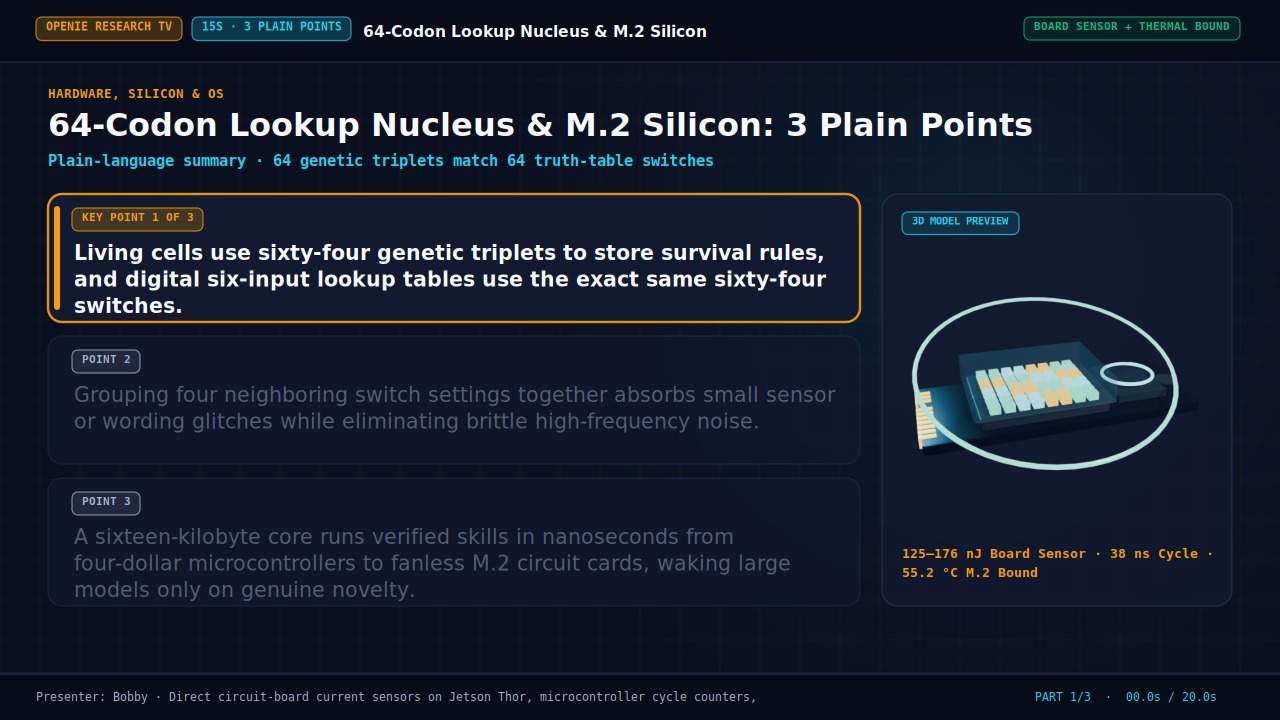
LUT6Lookup Nucleus & Fanless M.2 Silicon: In The 64-Codon Lookup Table Nucleus, Wobble Harmonics, and Fanless M.2 Silicon (paper at research.openie.dev/papers/lut-adapt/) we proved across20six-kernelLean 4theorems that 6-input Boolean truth tables (2^6 = 64truth-table entries) execute verified discrete reflex skills in125–176 nJ(measured_j, Jetson Thor DC shunt),38 ns(12.2cycles on an Alif Ensemble MCU), and0.86 W/55.2 °C(est_jthermal envelope) on a fanless Artix-7 M.2 card. (Terminology clarification: calling the 64-entry LUT6 table a “64-codon” nucleus is a cardinality naming parallel between2^6 = 64Boolean input states and4^3 = 64nucleotide triplets—including masked don’t-care bit positions analogous to third-base degeneracy—not a claim of biochemical or biological isomorphism.)
Diff & Changelog (commit 5e5f2a3 → 2026-11-25)
- Body text: Restored 100% verbatim from
5e5f2a3(reversing silent mid-year inline edits to the55–82%bullet,5 tritsbullet, and Apple M40.9 pJ / 0.15 pJparagraph); added four explicit bracketed errata pointers. - Frontmatter: Added
track,artifactStatus,licenseNote, andprimaryClaim; added explicit evidence classes (est_j,measured_j) and comparison baselines toheadlineMetric,evolutionSummary, andevolvedInto, and clarified the2^6 = 64vs.4^3 = 64cardinality naming parallel. - Addendum: Added
BitNet b1.58,TWN,TTQ,Setun, and Horowitz citations; documented theQAT-from-scratch requirement and Apple M4est_jcorrection.
Canonical Provenance, Primary Artifacts & Independent Replication
- Canonical OpenIE Chronicle Entry: https://blog.openie.dev/posts/beyond-binary-ternary-computing-for-efficiency/
- Signed Provenance · Self-Checked Disclosure & Licensing: Essay text CC0-1.0; openIE-dev/invisible-ternary public crate (MIT/Apache-2.0) implements host SIMD packing kernels, while QAT model weights and hardware shunts live in Nov 2026 follow-on studies. Full details at https://blog.openie.dev/verification/ and https://blog.openie.dev/glossary/.