AI Coding Market Arithmetic: Token-vs-Word Accounting, Annual Agent Spend Assumptions, and Mixed RCT Evidence
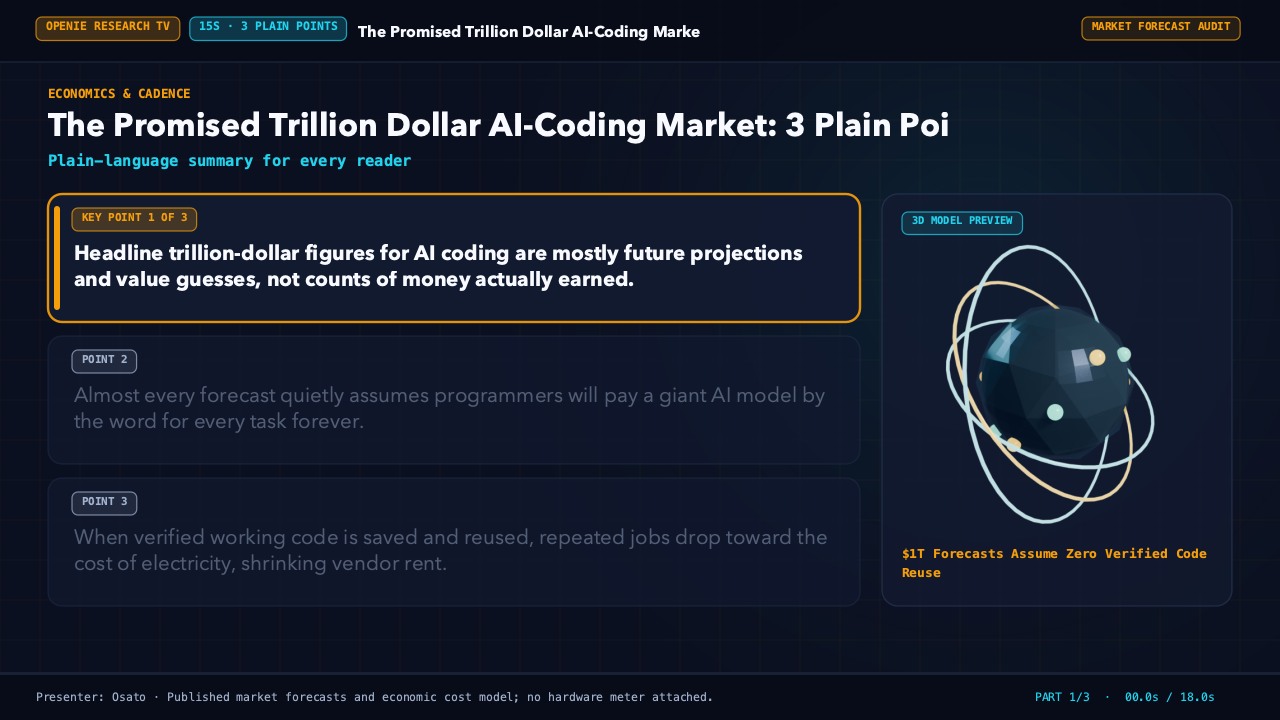
Audits enterprise AI coding TAM projections, reconciles API tokens (~0.75 words/token) and the 1,400-1,481 active-hour assumption behind ~USD 10k/yr spend, and contrasts +21%-55.8% speedups against METR -19% slowdowns.
Temporal & Archival Scope: Era II OpenIE Study (November 20, 2026) · Canonical OpenIE Chronicle Entry: https://blog.openie.dev/posts/ai-coding-market/ · Primary Paper & Methods: https://research.openie.dev/papers/ai-coding-market/ · Canonical Digest:
blake3:tv:69e7a2fe33716674a0c355af3726928fd2147ec38c6f5f2e34db059289735979Provenance & Telemetry Hygiene: Signed Provenance · Self-Checked (automated OpenIE internal gates; not externally peer-reviewed) · Energy Class:
unmetered(measured_j ⊥ reported_j ⊥ est_j ⊥ unmetered— Verification, Licensing & AI-Use Disclosure · Glossary & Non-Mixing Rules).
Key Claims & Evidence Tags
- [S/M · Exact Token-vs-Word & Annual Spend Arithmetic] Earlier blog prose blurred API tokens with English words (
1 token ≈ 0.75 words, so100,000input +10,000output tokens ≈75,000+7,500words). Under Appenzeller & Li’s (a16z, Oct 2025) frontier pricing example (100kinput tokens @USD 15/M = USD 1.50+10koutput tokens @USD 75/M = USD 0.75=USD 2.25/query), reachingUSD 9,450/developer/yr(~USD 10,000/yr) requires3 queries/hr × 7 active hr/day × 200 days/yr = 4,200 heavy queries/yr(1,400–1,481intensive active hours/yr, or multi-agent background loops burning~1,000xchat token volume per Bai, Huang & Wang 2026). - [S · Realized Spend vs. Trillion-Dollar TAMs] Contrasts top-down projections—Appenzeller & Li (a16z, 2025) (
30M developers × USD 100k = USD 3T) and McKinsey (2023) (USD 2.6T–4.4Tacross 63 GenAI use cases)—against realized benchmarks: Menlo Ventures (Dec 2025) (USD 4.0Benterprise AI coding spend out ofUSD 37BGenAI), Mordor Intelligence (2026) (USD 9.35Brising towardUSD 29.96B), Cursor (> USD 1BARR, Nov 2025), Anthropic (> USD 2.5BClaude Code ARR withinUSD 14Btotal ARR, Feb 2026), and Microsoft Form 10-Q (USD 4.1BQ3 2025 pre-tax equity-method loss from OpenAI). - [S · Mixed Productivity RCTs, Including Negative Results] Controlled trials disagree sharply by task familiarity and codebase complexity: Peng et al. (2023) found
+55.8%speed on one standalone HTTP server exercise; Paradis et al. (2024) found~21%faster task completion across96Google engineers; whereas METR / Becker, Rush, Barnes & Rein (arXiv:2507.09089, 2025) found16experienced open-source maintainers were 19% slower across246real issues in their own mature repositories—even though participants believed AI had sped them up by20%.
Methods, Baselines & Artifact Scope
- Methodological Dimension: Hardware & Telemetry · Primary-Paper Grounding & Scope: Unmetered (
joules = null,board_metered = false). Primary-source audit of SEC filings, vendor ARR announcements, VC enterprise surveys, API rate cards, and randomized controlled developer studies. - Methodological Dimension: Workload & Benchmark Suite · Primary-Paper Grounding & Scope: Published coding-agent token consumption studies (
SWE-bench Verified8-model audit in Bai, Huang & Wang 2026) and three randomized developer productivity trials (Peng et al. 2023,Paradis et al. 2024,Becker et al. 2025). - Methodological Dimension: Baseline(s) Compared · Primary-Paper Grounding & Scope: Unassisted human software engineering vs. chat/IDE autocomplete vs. autonomous multi-turn coding agents; list-price uncached API billing vs. prompt-cached and Epoch AI (
~13x/yr, range9x–900x/yr) falling per-token prices. - Methodological Dimension: Runs (N) & Spread / Uncertainty · Primary-Paper Grounding & Scope: Literature RCT sample sizes & intervals: Peng et al. (
N = 95developers,+55.8%), Paradis et al. (N = 96Google engineers,~21%speedup), METR / Becker et al. (N = 16maintainers,246real tasks,-19%slowdown); Bai et al. (8models,~1,000xtoken multiplier vs. chat,30xsame-task token spread without accuracy gain). - Methodological Dimension: Caching / Cold vs. Warm Scope · Primary-Paper Grounding & Scope: Explicitly notes that provider prompt-prefix caching (
50%–90%input discount on repeated repository context) and falling per-million-token prices (~13x/yr, Epoch AI) pull per-query cost down, while autonomous retry/test loops push token volume up. - Methodological Dimension: Artifact & License Availability · Primary-Paper Grounding & Scope: Public-domain market & literature audit (
CC0-1.0) atresearch.openie.dev/papers/ai-coding-market/; self-checked, not externally peer-reviewed.
Token-vs-Word Correction & Exact USD 10,000/Year Arithmetic
In subword BPE tokenizers (cl100k_base / o200k_base), 100,000 API tokens correspond to roughly 75,000 English words (or ~2,500–3,500 lines of source code), not 100,000 words [S]. Reproducing the exact arithmetic from Appenzeller & Li (Andreessen Horowitz, October 2025) makes every assumption transparent [S, M]:
-
Single heavy agent turn:
100,000input tokens atUSD 15.00 / 1M(USD 1.50) plus10,000output tokens atUSD 75.00 / 1M(USD 0.75) equalsUSD 2.25per query (before prompt-cache discounts)[S]. -
Annualized intensive single-seat schedule:
3 queries/hour × 7 active coding hours/day × 200 workdays/year = 4,200 queries/year(1,400intensive active hours/year) ×USD 2.25=USD 9,450/developer/year(reachingUSD 10,000/yrat~4,444queries /~1,481hours, or at far fewer human hours when multi-agent background loops issue dozens of autonomous sub-calls per ticket)[S, M].
Enterprise Spend Disclosures vs. Agentic Token Inflation
-
Surveyed spend and vendor ARR
[S]: Menlo Ventures (December 2025) estimated enterprise AI coding spend atUSD 4.0B(the largest vertical insideUSD 37Benterprise GenAI spend), alongside Mordor Intelligence (2026) (USD 9.35Bmarket size projected toUSD 29.96B), Cursor (> USD 1.0BARR, November 2025), and Anthropic (> USD 2.5Bannualized Claude Code run-rate insideUSD 14Btotal ARR, February 2026), while Microsoft’s Q3 2025 Form 10-Q disclosed aUSD 4.1Bpre-tax equity-method loss attributable to OpenAI[S]. -
Price deflation vs. volume explosion
[S]: While Epoch AI documents~13x/year(9x–900x/yracross tiers) declines in constant-capability inference prices, Bai, Huang & Wang (arXiv:2604.22750, 2026) measured8coding models onSWE-bench Verifiedand found agentic loops burn~1,000xmore tokens than single-turn chat, with up to30xtoken variance on the exact same bug without higher solve rates[S].
Mixed Developer Productivity RCTs (Including the METR -19% Slowdown)
Any honest economic assessment must report that randomized developer productivity trials do not show uniform speedups [S]:
-
Greenfield / bounded corporate tasks: Peng et al. (2023) measured a
+55.8%speedup (N = 95) on a self-contained JavaScript HTTP server task, and Paradis et al. (2024) measured~21%faster completion (N = 96Google engineers) on internal enterprise tasks[S]. -
Experienced maintainers on mature codebases (
METR 2025): Becker, Rush, Barnes & Rein (arXiv:2507.09089, 2025) randomized246real issues across16seasoned open-source maintainers working in large repositories they already knew intimately: AI-allowed tasks took 19% longer due to prompt iteration, reviewing plausible-looking errors, and context mismatch, despite developers perceiving a20%speedup[S].
Energy & Telemetry Scope
This market analysis is unmetered (joules = null, board_metered = false), tracking token counts, USD rate cards, SEC filings, and human wall-clock hours rather than hardware wattmeters.
Related Work & References
- Appenzeller & Li (a16z, Oct 2025), Menlo Ventures (Dec 2025) & McKinsey Global Institute (2023): Primary industry spend surveys, rate-card models, and TAM estimates audited in the paper
[S]. - Becker, Rush, Barnes & Rein (METR, arXiv:2507.09089, 2025), Paradis et al. (2024) & Peng et al. (2023): Randomized controlled trials of AI coding-assistant developer velocity
[S]. - Bai, Huang & Wang (arXiv:2604.22750, 2026) & Epoch AI (2025): Agentic token-burn multipliers (
~1,000xvs. chat) and historical LLM inference price-decline trends[S].
Canonical Provenance, Primary Artifacts & Independent Replication
- Canonical OpenIE Chronicle Entry: https://blog.openie.dev/posts/ai-coding-market/
- Primary Study & Methods: https://research.openie.dev/papers/ai-coding-market/
- Illustrated Video Summary (OpenIE Research TV): https://research.openie.dev/tv/?study=ai-coding-market (9:16 Vertical MP4)
- Signed Provenance · Self-Checked Disclosure & Licensing: Market synthesis and primary citation audit dedicated to the public domain (CC0-1.0); zero proprietary software dependencies; self-checked, not externally peer-reviewed. Full details at https://blog.openie.dev/verification/ and https://blog.openie.dev/glossary/.